10 Account Based Selling Tools Worth Your Stack in 2026

Most account based selling tools fail for the same boring reason. They freeze your go-to-market motion around static firmographic lists, then act surprised when buyers ignore them. If your stack still starts with “company size, industry, title,” you're not doing account-based selling, you're just mailing prettier spam to a narrower list.
The better move is behavioral. Watch who's leaning in, who's interacting with relevant people and topics, and who's showing signs of motion right now. That's the whole game in 2026, because account-based selling grew out of ABM, a model that's now mainstream in B2B, with 94% of B2B marketers using ABM and 82% of B2B companies running an active program by 2024, while 63% of companies with complete programs report at least 25% ROI and 46% report at least 50% ROI (industry roundup). The stack that wins is the one that turns those signals into a human conversation fast.
Table of Contents
1. RoverLead AI
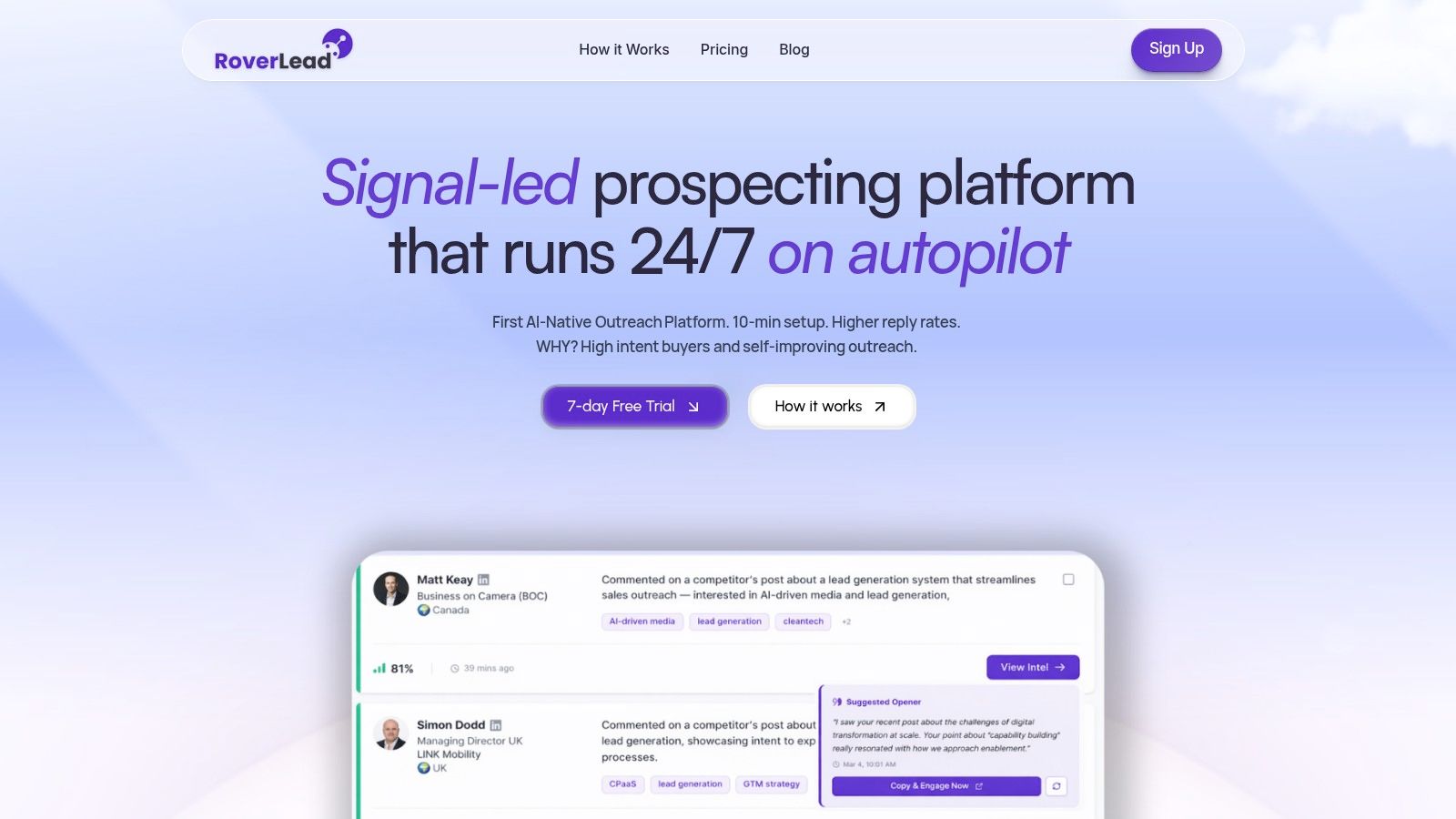
RoverLead AI is the rare tool in this category that behaves like a seller with a pulse. It watches LinkedIn engagement around creators, competitors, and topic conversations, then turns those behaviors into a daily feed of people who look in-market, instead of making you drag another stale list through Sales Nav. That matters because account-based selling works best when you engage buying committees from real signals, not paper-thin filters.
Why it earns the featured spot
Setup is quick, about 5 to 10 minutes to define your ICP, keywords, competitors, and experts, then the system starts learning from your approvals and replies. It tracks 10+ buying signals, writes contextual openers tied to the exact trigger, and runs outreach end to end without a sequence builder in the way. That's the right shape for a LinkedIn-first revenue motion, because the rep sees intent, not just a contact record.
Practical rule: if your rep has to spend half the morning researching before they can send one useful message, your tool is too static.
The pricing is straightforward too. The Starter plan is $149/month/user with 2 Signal Agents, the Growth plan is $449/month/user with up to 10 agents, and Enterprise is custom with unlimited agents, team workspaces, dedicated CSM, SLAs, and audit logs. There's also a 7-day free trial, which is a lot friendlier than the usual enterprise software hostage situation. RoverLead's direct site is RoverLead AI.
Best fit, if you want the blunt version. Use it when your team wants predictable pipeline from LinkedIn activity, wants contextual outreach that feels warm instead of canned, and wants to replace manual list pulls with a living intent stream.
2. 6sense
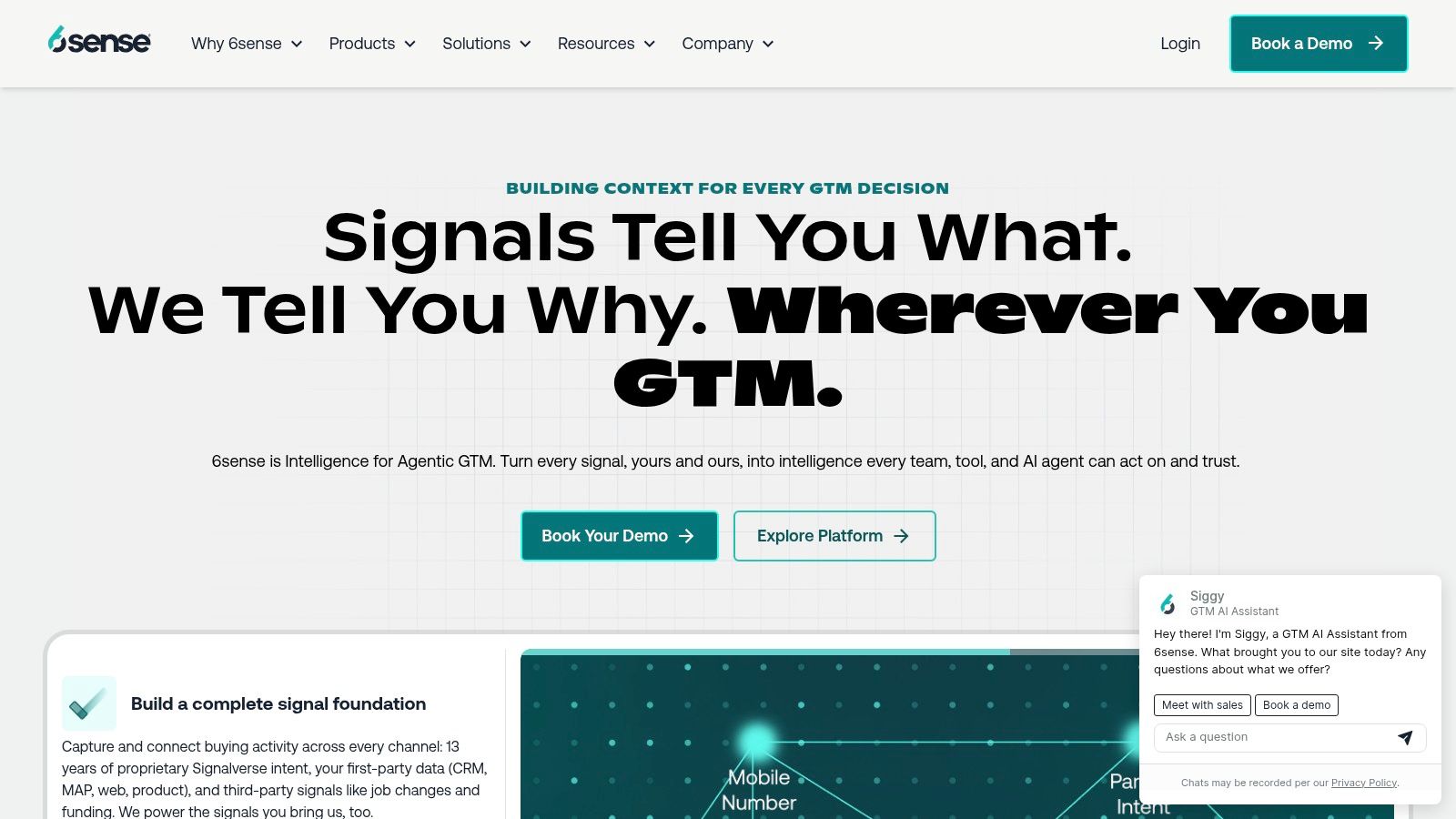
6sense is what happens when a platform decides research, prioritization, and rep guidance should all live in one place. It's built for teams that need third-party intent, web deanonymization, predictive account scoring, and sales-side recommendations that tell reps when to move and why. The category definition from Gartner is a clean fit here, since ABM platforms are supposed to handle account selection, planning, engagement, and reporting at scale, while unifying first- and third-party data and activating channels through integrations or native capabilities (Gartner ABM platforms).
Where it makes sense
Its primary appeal is timing. 6sense helps teams stage accounts by readiness, then pushes those signals into workflow through Sales Copilot, AI summaries, and recommendations. If your org has enough process maturity to act on those signals quickly, it can reduce the “who should I call today?” problem that burns seller time.
There's also a practicality angle. The market is already living in multi-platform stacks, not monoliths, with only 15.3% of organizations reportedly using a dedicated ABM platform and 56.1% combining CRM, marketing automation, and intent-data tools without a unified ABM-specific solution (state of ABM 2026). That makes 6sense less of a replacement and more of a force multiplier for an existing stack.
Intent data platform guide is worth a look if you're deciding whether you need a full suite or just the signal layer. My take, keep 6sense if your team can operationalize predictive data. Skip it if you just want prettier dashboards and no behavior change.
3. Demandbase One
Demandbase One is the classic enterprise answer when marketing wants to run coordinated advertising and sales wants the same account intelligence in a usable form. It bundles account intelligence, proprietary intent, buying-group insights, orchestration, website personalization, and a native B2B DSP, so the whole thing feels designed for teams that already believe ads, sales touches, and web experiences should reinforce each other.
Best when advertising is part of the motion
The strongest version of Demandbase is not “ABM software.” It's “coordinated account activation.” If you've got media in the plan, especially display, CTV, or LinkedIn, the native buying path is a real advantage. Demandbase One for Sales also helps reps see what's happening without forcing them to live inside the marketing console all day.
The drawback is obvious. This is a platform for teams that are already serious about ABM execution. Smaller teams often buy more than they use, then spend months pretending the empty features are “future value.” That's a costly hobby.
The good news is that the broader market still rewards this style of software because ABM itself is tied to measurable business results. One 2026 industry data set covering 1,400+ B2B teams found ABM increased tier-1 engagement by 3.4× versus non-ABM cohorts, created opportunities at 18% in tier-1 accounts versus 7% in tier-2 and 3% in tier-3, and compressed median sales cycles by 32 days (2026 ABM data set). If you're using Demandbase, that's the kind of account motion you're trying to support.
Website-wise, Demandbase is a strong fit for enterprise GTM teams with the ad layer already in place. Without that, it's a very expensive way to learn that execution still matters.
4. RollWorks
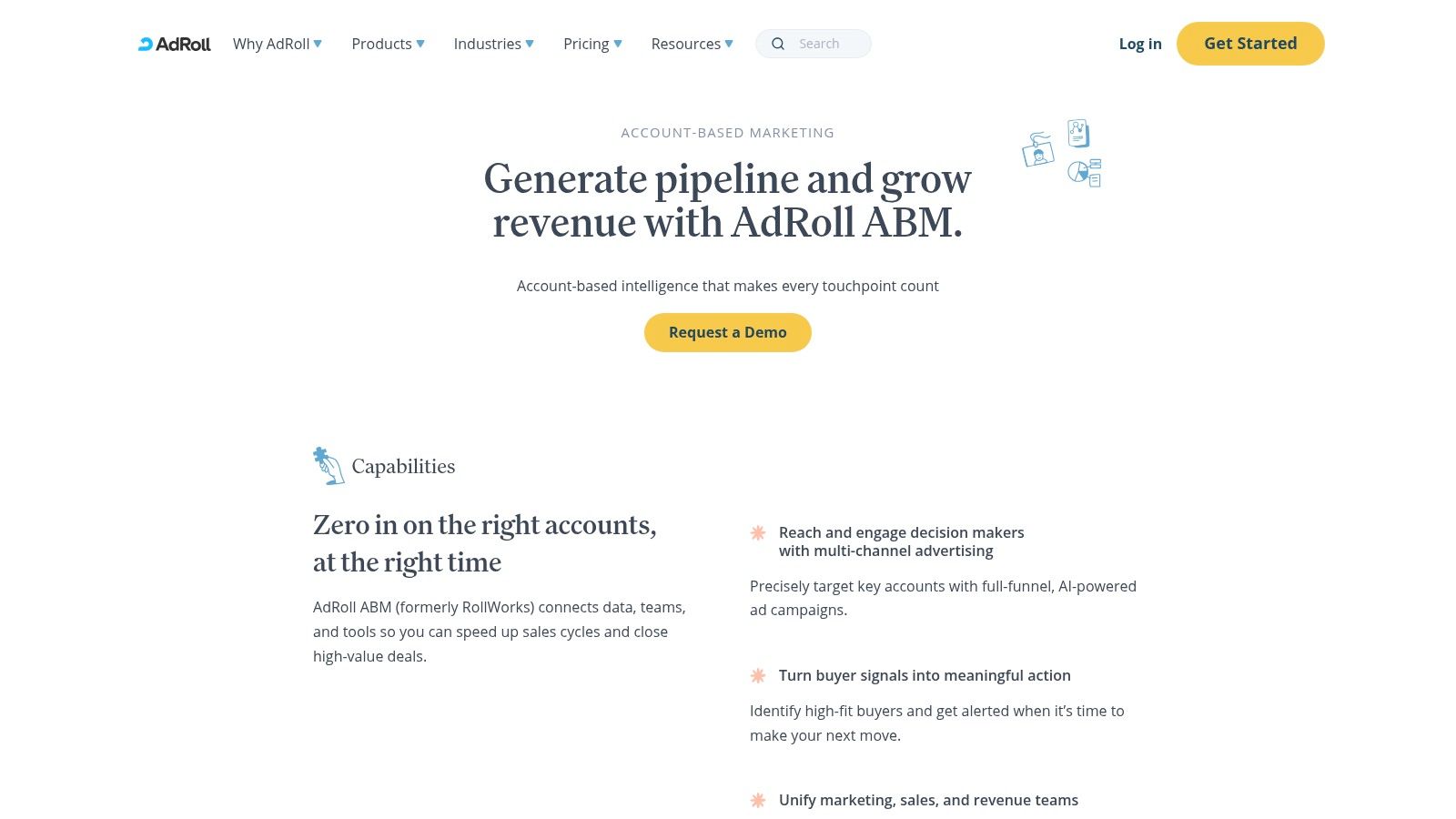
RollWorks, now branded as AdRoll ABM, is the friendlier on-ramp for teams that want account-based media without acting like they've bought an enterprise command center. The pitch is simple, run ABM advertising, give sales some account spikes, and don't require a ten-person ops team to make the thing breathe.
Why mid-market teams keep choosing it
The draw is the lower barrier. You get a free self-serve path, sales insights, and channel guidance that makes it easier to test whether ABM media moves accounts before you commit to something heavier. It also plays well with common stacks like Salesforce, HubSpot, and Marketo, which matters because many groups aren't starting from zero.
The trap with ABM media is treating awareness like intent. Ads can warm accounts, but they don't tell you who's ready to buy unless you combine them with seller signals.
That's why RollWorks works best as a paired tool, not a solo act. It gives you the media layer and account-level visibility, but you'll still want a real research or signal tool feeding reps the context they need. Its website is the place to go if you want a lower-friction ABM media stack that won't immediately terrify finance.
If your goal is to prove account-based motion without going all-in on an enterprise suite, this is the sensible compromise.
5. Terminus
Terminus earns its keep when you want advertising, website personalization, native chat, and email signature marketing living under one roof. It's a good fit for teams that understand a simple truth, accounts don't convert because of one touch, they convert because a sequence of touches feels coordinated across channels.
What it does well
The appeal is native breadth. Instead of stitching together a dozen point tools, you can keep the account experience inside one system and tie engagement back to Measurement Studio and sales workflows. That makes it easier for marketers and sellers to speak the same language when they're looking at account activity.
It's also a useful reminder that account-based selling tools shouldn't be judged only by how clever the dashboard looks. They should change what happens next. Terminus is at its best when marketing uses it to nudge the account and sales uses those nudges to accelerate the deal.
The catch is cost and coordination. Media costs are separate from software, and you need the channels working together to get real value. If the team can't align on who triggers what, the platform becomes an expensive place to host underused plays.
Terminus is worth a serious look for teams that already run multi-channel ABM and want a platform built for that rhythm rather than a bolt-on afterthought.
6. ZoomInfo SalesOS With Intent and Scoops
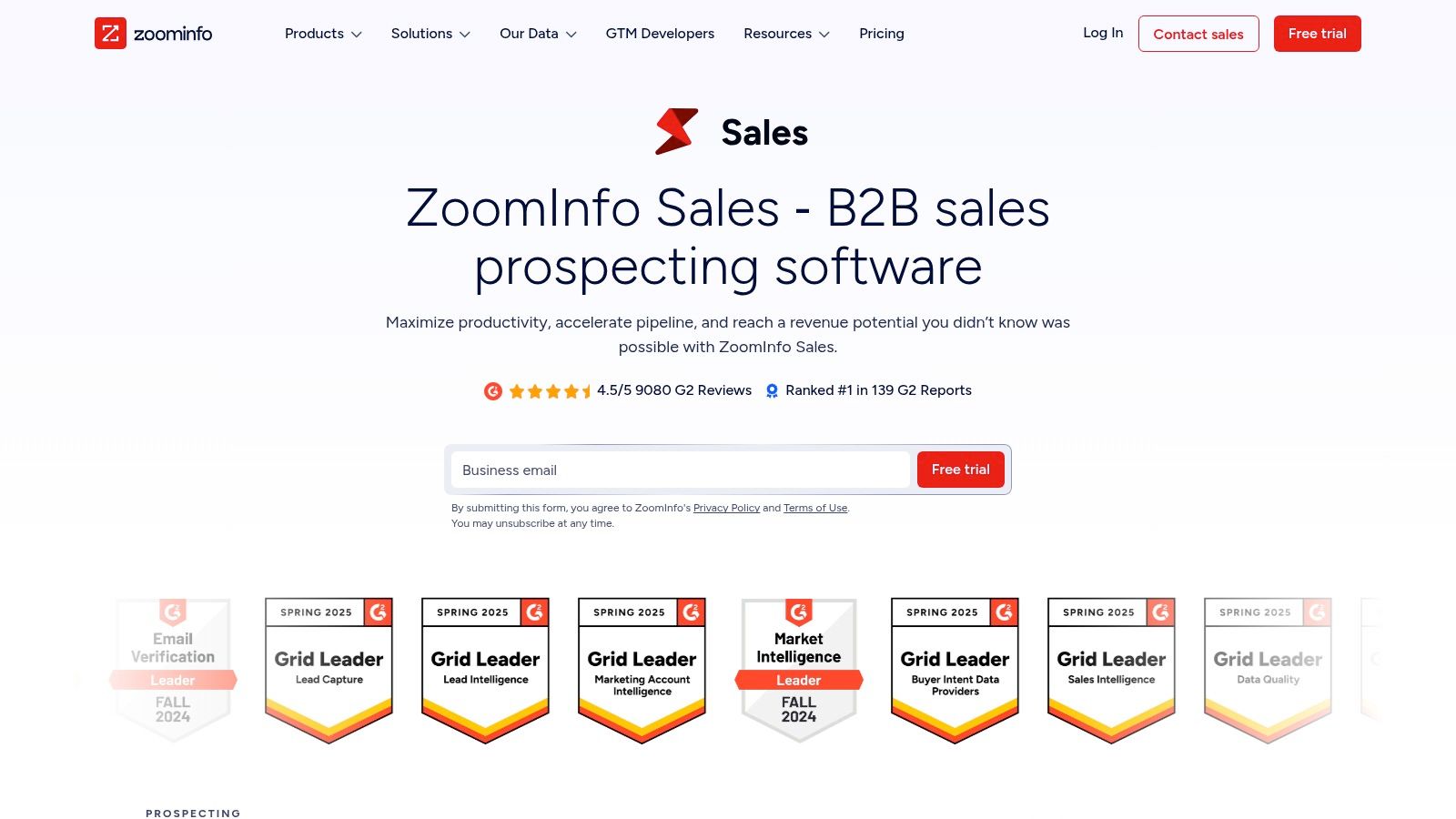
ZoomInfo SalesOS is still the blunt instrument many sellers reach for when they need contacts, org charts, and enough company data to stop guessing who owns the conversation. For account-based selling, that matters because the first problem is often not “what should I say,” it's “who the hell do I say it to?”
Why it's still in the stack
The strength is breadth and depth of B2B data, plus intent and visitor identification that help reps find contact paths and time their outreach. Scoops adds news and trigger context, which gives sellers a better shot at catching accounts when something is happening.
The downside is the classic one. ZoomInfo tells you who to call, but not always why now. That's why it pairs well with a behavioral layer, not as a standalone cure-all. If you need a deep-database backbone for research and outreach, it's hard to ignore.
For a good companion read, see sales intelligence tools if you're deciding how much of your stack should be database-heavy versus signal-heavy. ZoomInfo's own SalesOS page is still the place to evaluate it for your workflow.
My recommendation is direct. Use ZoomInfo when your team needs reliable contact coverage and account research support. Don't pretend it's an intent engine by itself.
7. Bombora Company Surge
Bombora is the cleanest answer when you want a signal layer, not another full-stack platform with too many opinions. Company Surge is designed to show which accounts are heating up on relevant topics, then let you pipe that intelligence into your CRM, ABM suite, or sales workflow.
Best as a data layer
This is not the place to go if you want orchestration. It's the place to go if you want strong topic-level intent signals that enrich what you already run. That's its strength and its limitation in the same breath.
What is intent data is a useful framing if you're sorting out whether your problem is signal quality or activation. Bombora solves the first. Your team still has to solve the second.
That's also why the product is so easy to overcredit. Good intent data doesn't close deals by magic. It just tells your reps where to look before the rest of the market catches up. If your workflow already has a CRM and an ABM stack, Bombora adds a respectable layer of motion without dragging you into a full platform migration.
Go to Bombora if you want a flexible intent layer that plugs into an existing revenue system instead of replacing it.
8. Madison Logic
Madison Logic sits in the media-heavy camp, but it's a useful one when the buying committee needs to be warmed up before sales starts pushing. Its ML Platform combines account-based audience creation, activation, and measurement, with ML Insights pulling together multi-source intent and buying-group engagement views.
Where it helps
It's especially useful for teams that treat advertising as part of revenue motion, not a brand side quest. The web analytics layer gives you on-site visibility too, which helps sellers understand whether an account is leaning in or just passing through.
That said, this is still a media-centric platform. You'll want complementary sales intelligence if you expect reps to use it day to day, because a warmed account is nice and a qualified buying committee is better.
Bottom line: media can create awareness at the account level, but sellers still need context to turn that attention into a conversation.
If your team already believes in ad-led account warming, Madison Logic belongs on the shortlist. If you're hoping it will replace seller research, it won't.
9. G2 Buyer Intent
G2 Buyer Intent is one of the most practical signals in the market because it comes from people already researching software. You're not inferring interest from random browsing, you're seeing buyer-declared activity around category research, profile visits, pricing pages, and competitor comparisons.
Why reps actually use it
That late-stage visibility is the point. When an account is actively comparing tools, a rep can follow up with a message that isn't based on hope and vibes. The integrations are broad too, so it can route alerts into Salesforce, Salesloft, Outreach, 6sense, Demandbase, RollWorks, and other common tools.
The limitation is coverage. If your buyers aren't shopping in the G2 ecosystem, the signal weakens. That makes it a sharp instrument, not a universal one.
Still, for categories with active marketplace research, it's one of the strongest intent sources you can add to a stack. G2 Buyer Intent is easy to understand, easy to operationalize, and dangerously effective when your team follows up fast.
10. UserGems
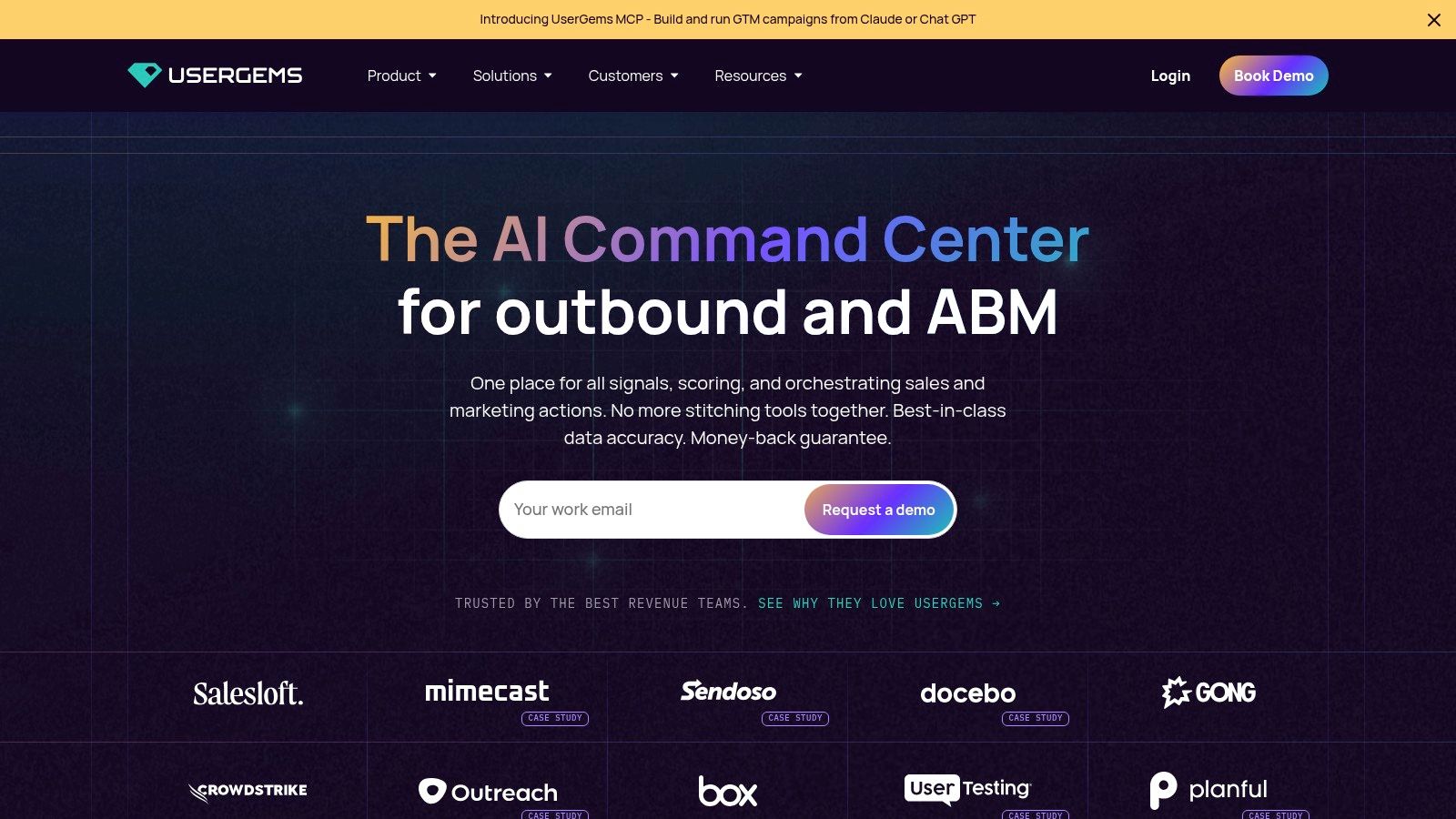
UserGems is the tool for people-level timing, which is exactly where a lot of classic ABM stacks get clumsy. It tracks things like job changes, website visits, M&A, and hiring signals, then uses unified scoring and AI agents to draft outreach or create ad audiences.
Why it's different
Champions move. Titles change. Priorities change. The account may stay the same, but the human you need to reach often doesn't. UserGems gives you a cleaner way to catch those moments and route them into CRM-first workflows.
For teams that sell into accounts where champions churn regularly, that can be the difference between a dead thread and a revived deal. For a closer look at the prospecting angle, prospect identification is the right companion topic.
UserGems is also a reminder that account-based selling tools don't all have to live at the account level. Sometimes the fastest path to pipeline is recognizing the person inside the account who just changed roles and is ready to buy again. Visit UserGems if your motion depends on those human timing signals.
Top 10 Account-Based Selling Tools Comparison
Product | Core features ✨ | Quality / Results ★ | Value & Pricing 💰 | Target audience & USP 👥 |
|---|---|---|---|---|
RoverLead AI 🏆 | Signal Agents track LinkedIn engagement, 10+ buying signals, AI openers, 5–10 min setup ✨ | ★★★★☆, reported 2–3x reply rates; 30–50% more meetings | 💰 Starter $149/mo/user (2 agents); Growth $449/mo/user; 7‑day trial; Founding perks | 👥 B2B Sales/SDRs/Founders, behavior-driven, autonomous prospecting; replaces manual Sales Nav |
6sense | Account prioritization, third‑party intent, predictive scoring, Sales Copilot ✨ | ★★★★☆, strong account-level timing & guidance | 💰 Enterprise pricing; pilot/free start to de‑risk | 👥 Mid‑market/Enterprise GTM teams, deep account intelligence & orchestration |
Demandbase One | Proprietary intent, buying‑group insights, orchestration, native DSP ✨ | ★★★★☆, cross‑channel execution & sales insights | 💰 Mid‑market → Enterprise; pricing reflects ad + platform costs | 👥 Marketing + Sales teams needing ads + sales activation, unified ad + ABM suite |
RollWorks (AdRoll ABM) | ABM advertising, account spikes, integrations, free self‑serve tier ✨ | ★★★★, accessible ABM media & basic sales insights | 💰 Freemium/self‑serve options; paid tiers for scale | 👥 Teams testing ABM media, low barrier to entry for ad-led programs |
Terminus | Ads, web personalization, native chat, Measurement Studio ✨ | ★★★★, strong multi‑channel activation & attribution | 💰 Quote-based; media costs separate | 👥 ABM teams wanting integrated channels + on‑site engagement |
ZoomInfo SalesOS | Large contact database, intent, WebSights, Scoops ✨ | ★★★★☆, broad data coverage; timely scoops for reps | 💰 Seat + credits model; often mid‑five‑figure TCVs | 👥 Sales teams needing deep contact data and enrichment at scale |
Bombora Company Surge | Topic-level surge signals from publisher cooperative ✨ | ★★★★, trusted intent signals for prioritization | 💰 Quote-based data licensing | 👥 ABM/RevOps teams that need intent layer to rank accounts |
Madison Logic (ML Platform) | ABM media, ML Insights multi-source intent, web analytics ✨ | ★★★★, practitioner‑recognized media + measurement | 💰 Quote-based; media spend additional | 👥 Media-driven ABM teams wanting measurement + activation |
G2 Buyer Intent | First‑party marketplace research signals (profile/pricing visits) ✨ | ★★★★☆, high‑intent, late‑stage buyer signals | 💰 Tiered/integrations; quote-based for volume | 👥 Reps targeting software buyers researching in G2 ecosystem |
UserGems | People-level signals (job changes, hiring, M&A), unified scoring, AI agents ✨ | ★★★★, strong champion/job‑change timing | 💰 Quote-based; value tied to segment churn/movement | 👥 Outbound/ABM teams focused on champion movement and contact timing |
Build the Stack Around Behavior, Not Buttons
The best account based selling tools don't impress you in a demo, they change what a rep does on a Tuesday morning. That's the standard. If a platform gives you another dashboard to admire while your team still guesses who to contact and when, it's decoration.
The stack usually breaks into three layers. First, the ABM platform layer, think Demandbase, 6sense, RollWorks, Terminus, or Madison Logic, where orchestration, advertising, and account-level measurement live. Second, the intent layer, where tools like Bombora, G2 Buyer Intent, and ZoomInfo help you detect motion. Third, the LinkedIn-first behavioral layer, where RoverLead AI turns active engagement into outreach that starts from real context instead of static lists.
That last layer is the part many teams miss. Behavioral intent beats firmographics because it shows you who's paying attention right now. In a market where ABM is already mainstream and mature enough for buyer scrutiny, the winners aren't the teams with the biggest stack, they're the teams that shorten the time between a real buying signal and a human conversation.
So use a blunt filter. If a tool doesn't help your reps engage a real account faster, with better context, and at the moment intent appears, it doesn't belong in the stack. Everything else is just software tourism.
If you want your stack to stop guessing and start reacting, RoverLead AI is built for that exact job. It turns LinkedIn behavior into daily high-intent leads, writes contextual openers, and helps your team act when buyers are already leaning in. Visit it if you want account-based selling tools that behave like a live revenue system instead of a static list factory.