Intent Data Platform: The 2026 Buyer's Guide

Intent Data Platform: The 2026 Buyer's Guide
An intent data platform should ingest third-party, first-party, and public signals, resolve them to accounts or contacts, score them against a baseline, and push that score into CRM or sequencing tools in near real time. The market is already at $4.75 billion in 2026 and is projected to reach $10.31 billion by 2031 at a 16.84% CAGR, so this isn't a side hobby anymore. Mordor Intelligence's intent data software market report backs that up, and so do the teams trying to turn signal into pipeline instead of collecting prettier dashboards.
Table of Contents
Why Most Intent Data Platforms Collect Dust
Many teams aren't buying an intent data platform. They're buying a dashboard that looks smart in the demo and then dies the first time an SDR has to work a live account list. That's the dirty little secret vendor slides gloss over, and it's why so many “high-intent” programs end up as expensive theater.
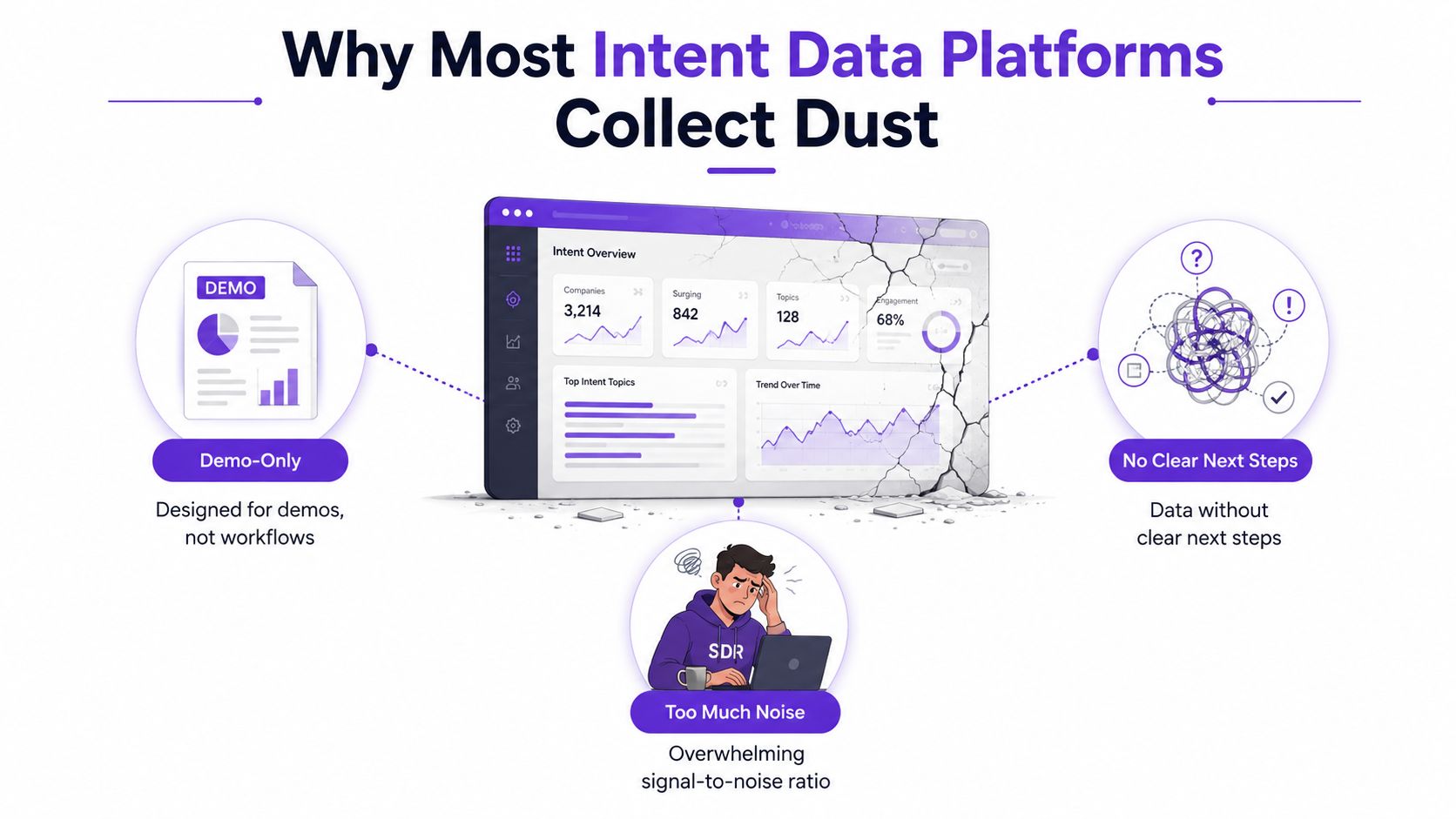
The right way to think about the category is brutally simple. A useful platform ingests third-party, first-party, and public-event signals, resolves them to the right account or contact, scores them against a baseline, activates them in CRM or sequencing tools, and keeps the whole thing governed for consent, retention, and auditability. If one of those steps breaks, the score might still look elegant, but the rep's workflow won't care.
The part buyers skip
The question isn't “how many topics do you monitor?” It's “does the platform push fresh, usable signal into the tools my team already opens?” That's where the category usually falls apart. Signal freshness and identity resolution quality set the ceiling for everything downstream, because a perfectly scored account that lands too late is just trivia with a subscription fee attached.
Practical rule: if the rep has to export, clean, and interpret the data before outreach, the platform isn't operationalized.
The market's growth shows demand, but it doesn't prove adoption is clean. A better lens is whether the signal survives contact with the daily workflow. For alignment between sales and marketing on that workflow, see this sales and marketing alignment guide, because misalignment is where most intent programs go to die.
What to demand before you sign
Buyer guides love topic lists and publisher counts. I care about three things: recency, resolution, and activation. If the vendor can't explain how quickly a topic surge becomes an assignable account, or how it moves from their system into your rep's queue, the rest is noise dressed as intelligence.
The best vendors don't just know something happened. They know who it happened to, when it happened, and what your team should do next. That's the difference between a platform and a very expensive signal museum.
The Five Layers of an Intent Data Platform
A clean mental model beats vendor jargon every time. The strongest intent data platform architecture is layered, and each layer answers a different operational question. If a vendor can't explain one of these layers without wandering into marketing fog, keep walking.
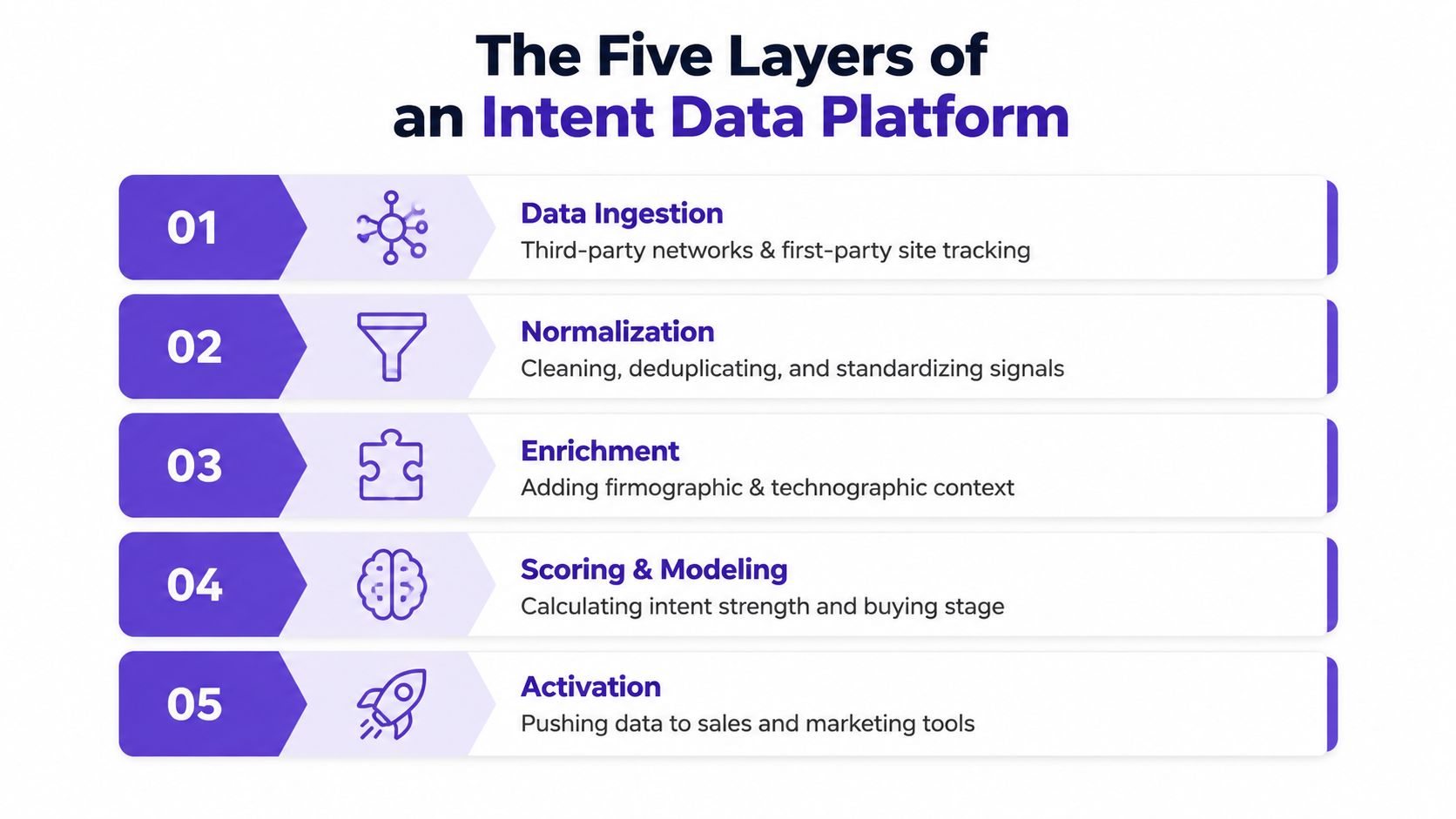
Layer 1, ingestion
The platform pulls in third-party publisher signals, first-party site activity, and public-event feeds. It sounds basic, but many systems limit themselves. A narrow feed can't see enough of the market, and a bloated feed can't separate research from random browsing.
Layer 2, normalization and identity resolution
Once the signals arrive, the platform has to clean them, deduplicate them, and map them to accounts or contacts. Intent gets real. If the system can't resolve an anonymous topic surge to the correct company fast enough, the score is technically valid and operationally useless.
If the identity graph is sloppy, every other layer inherits the mess.
Layer 3, enrichment and scoring
After resolution comes context. A good system adds firmographic and technographic detail, then scores the signal against the account baseline. That's the difference between “someone at this company read a blog post” and “this account is moving through a real buying cycle.” The exact math matters less than whether your team trusts it enough to act.
Layer 4, activation and governance
Activation is where intent becomes revenue work. The signal should land in CRM, marketing automation, or sequencing tools without someone babysitting CSV files. Governance sits underneath all of it, which means consent, retention, and auditability can't be afterthoughts if you want the platform to survive legal review. For a related view on data plumbing, this CRM data enrichment guide is worth a look.
First-Party, Third-Party, and Social Signals Compared
Vendors love to talk about “intent” as if it's one clean input. It isn't. The source changes the signal quality, the timing, and what your team can do with it. If you treat every signal like the same thing, you end up with lazy routing and bad follow-up.
Signal type | Freshness | Accuracy | Best use case |
|---|---|---|---|
First-party | Usually the freshest, because it comes from your own site and forms | High, but only for accounts already in your orbit | Prioritizing inbound, retargeting engaged accounts, and routing hot visitors |
Third-party | Broader coverage, but noisier and less immediate | Useful for account-level research, especially when layered with other data | Outbound account selection and topic-based prospecting |
Social/network | Often the most time-sensitive when it shows up in public engagement | Strong when tied to clear buying language or repeated interactions | Warm outreach, social selling, and timing-led prospecting |
First-party signals come from your own properties, so they usually reflect real interest. They're still limited to people already touching your assets, which means they are great for prioritizing inbound and terrible for discovering demand you have not seen yet. Third-party signals are broader and better for surfacing net-new accounts, but they get noisy fast. Treat them as direction, not proof.
The underused signal is social
Most articles skip social and network behavior, especially on LinkedIn. That is a mistake. Comments on creator posts, competitor follows, pricing questions, and demo chatter can tell you more about timing than another generic topic surge. Buyer conversations are already happening there, and the signal only matters if it comes from public engagement and compliant workflows, not sketchy scraping.
What I'd weight most: first-party for inbound, third-party for account discovery, social for timing.
RoverLead AI fits that conversation because it turns LinkedIn engagement into daily prospecting signals instead of treating social activity as noise. That does not make it magic, but it does make it structurally different from account-only intent suites. Use the signal that matches the motion.
For a broader definition of the category, see this overview of intent data, then stop pretending all signals are equally useful.
Delivery Mechanisms and Why Latency Changes Everything
The signal itself matters, but the delivery mechanism decides whether your team acts or misses. Polling, webhooks, and streaming are not tech jargon for procurement decks, they're the difference between useful timing and stale noise.
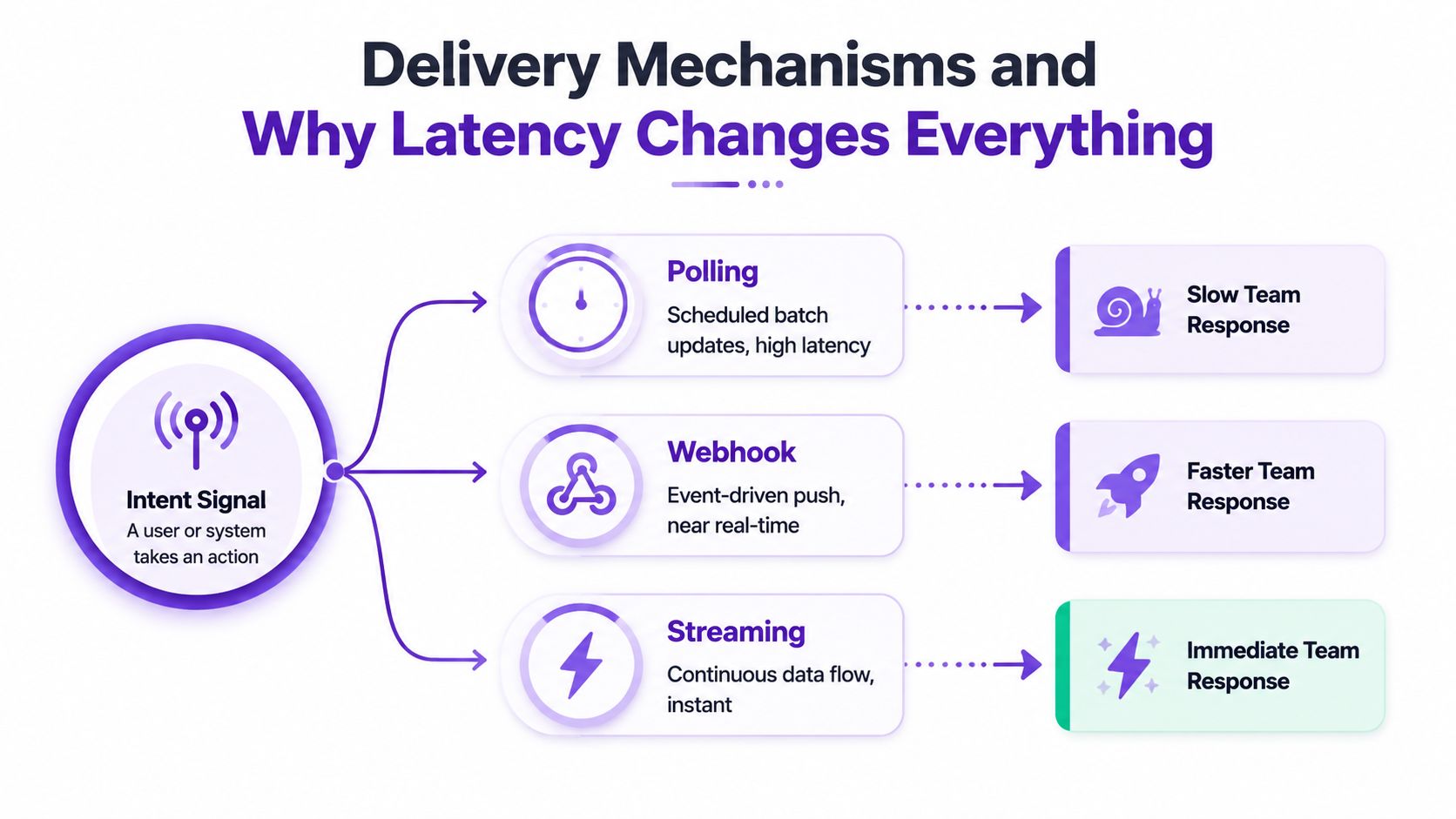
Polling is fine for bulk historical enrichment. It's the batch job, the scheduled export, the “we'll refresh this overnight” approach. That works when you're cleaning up records or building a research list, but it's lousy when an account is active right now.
Webhooks and streaming
Webhooks change the game because they fire events into Slack, CRM, or sequencing tools as soon as the platform detects something worth noticing. Streaming goes even further, feeding continuous workflows where a pricing-page surge or topic spike can trigger an automated response immediately. That's not a nice-to-have, it's the part that decides whether a rep catches the buying window or shows up after it cooled.
The practical rule is blunt. Weekly exports are research. Hours matter for outbound. Seconds matter for high-velocity inbound routing and AI-triggered workflows.
For more on the infrastructure side, this real-time data guide is the right companion piece.
How Sales and Marketing Teams Use Intent Data
A real workflow starts boring and ends with a booked meeting. First, enrichment turns a name and company into a usable record. Then prioritization ranks accounts by recency and specificity, not by some vague composite score. Then activation pushes the list into tools like Salesloft, HubSpot, or Outreach with an opener that sounds like a human wrote it after doing the work.
A Monday Morning That Works
A rep sees a signal that a target account has been engaging with pricing content and competitor comparison material. The rep does not need a thesis. They need the account name, the context, and a reason to reach out today instead of next Tuesday, after the trail goes cold.
That is where old-school account-centric suites and LinkedIn-first workflows split. Bombora, G2, and ZoomInfo-style third-party surges are built around account-level motion. That helps, but it is still broad. Social-first systems are built around public engagement, so they can surface who's commenting, who's interacting with competitors, and who's talking about demos or pricing in public, then hand the rep a tighter opener.
What Reps Need
The best workflow does not make reps think like analysts. It gives them a shortlist, a reason, and a line to send. The more your platform forces manual interpretation, the more you are paying people to do the software's job.
Concrete test: if the platform does not reduce research time, it is just another list generator.
Teams buying for social-led outbound want a feed that is already filtered to their ICP, with context attached and enough timing information to act fast. A LinkedIn-native approach can outperform a generic account score because it treats engagement as a live signal instead of a static attribute. The goal is to catch the interactions that line up with your solution, not to chase every one.
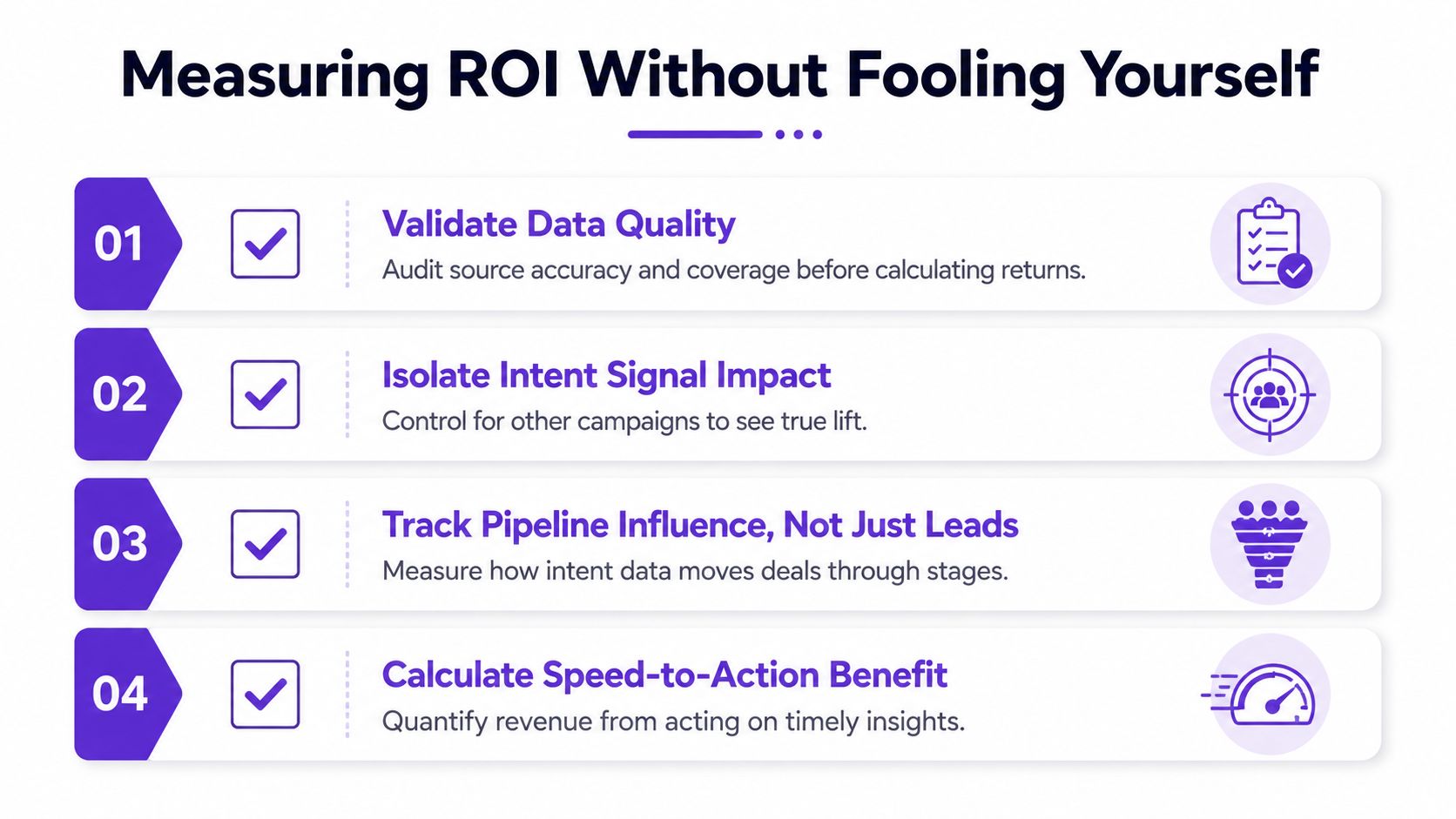
Measuring ROI Without Fooling Yourself
If you ignore data quality, your ROI math is fantasy with spreadsheets. HubSpot's 2024 State of Intent Data materials call data quality by far the most significant challenge organizations face, and that tracks with what breaks in real teams. Bad signals create bad reports, and then everyone argues about pipeline instead of fixing the inputs. HubSpot's 2024 intent data materials are a useful reminder that noise is the enemy.
The metrics that matter
Don't report “accounts scored” like that proves anything. Track signal-to-meeting conversion, lift in positive reply rate, and time-to-first-touch on high-intent accounts. Those numbers tell you whether reps are using the signal and whether the signal is good enough to change behavior.
Use those metrics with discipline. If an SDR manually researched the account and then replied, that's not intent attribution, that's good old-fashioned labor wearing a new hat.
The guardrails nobody can skip
Privacy and compliance aren't side issues in 2026. GDPR consent handling, CCPA rules, retention windows, and audit logs all sit in the path of deployment. LinkedIn-compliant workflows matter too, because public engagement is fair game, scraping isn't, and vendors who blur that line are begging you for a problem.
If the compliance story is vague, the rollout will be, too.
Vendor Checklist and a 30-Day Pilot Plan
Start with questions that expose the plumbing. Ask where the signals come from, how fresh they are, how identity resolution works, whether the platform pushes directly into your CRM and sequencing stack, how scoring is explained, and what the audit trail looks like. If social signals matter to your motion, ask how the system handles LinkedIn-compliant public engagement without turning your reps into data janitors.
A pilot that won't waste your quarter
Run a 30-day pilot with a narrow ICP and a small set of buying topics. Keep a control group of reps so you can compare activity without fooling yourself. Measure signal-to-meeting conversion, not vanity score inflation, and kill the test if the “activation” story is still a CSV export by day 21.
Start narrow: choose one ICP, one motion, and a limited topic set so the noise doesn't drown out the signal.
Layer signals: don't bet on one source if you can blend first-party, third-party, and social behavior.
Push into daily tools: the rep should see the signal where they already work, not in a separate dashboard graveyard.
Demand workflow proof: the vendor should show exactly how a signal becomes an assigned task, sequence step, or alert.
If you want a platform built around LinkedIn engagement instead of static list-building, RoverLead AI is one option to evaluate alongside the traditional suites. It turns public social activity into a daily feed with context and an opener, which makes it useful in motions where timing and relevance matter more than raw coverage.
If you're comparing vendors and want less fluff and more workflow, visit RoverLead AI and see how LinkedIn engagement can be turned into actionable intent without turning your reps into researchers. Use the pilot plan above, ask the hard questions, and make the platform prove it can earn a place in the daily workflow.