A Modern Guide to Sales and Marketing Alignment in 2026

Let’s be honest: in most companies, the relationship between sales and marketing is a polite fiction. It’s all smiles in the executive meeting, followed by grumbling by the virtual water cooler. This isn't just office drama. It’s a quiet, expensive problem that strangles growth.
We’ve all seen it. Sales, chasing a quarterly number, complains that marketing leads are junk. Marketing, proud of their new campaign, feels like they’re shouting into a black hole as their hard-won leads go untouched.
Table of Contents
Your Smarketing FAQ: The Unfiltered Answers
3. Our teams are too busy for more meetings. How does this work?
6. What's the difference between sales enablement and sales and marketing alignment?
7. How do you handle disagreements on lead quality after the SLA is in place?
8. What if our company culture is really siloed and resistant to change?
10. Our sales and marketing teams use different tools. Is that a dealbreaker?
Why Sales and Marketing Still Don't Get Along
The friction is baked into the system. It’s a predictable, frustrating cycle. Sales misses quota, marketing’s ROI looks questionable, and the finger-pointing begins. Again.

The Great Perception Gap
Here’s where it gets dangerous. There's a massive disconnect between what leadership thinks is happening and the reality on the ground.
One study found that while 82% of C-level B2B executives believe their sales and marketing teams are aligned, a staggering 65% of the actual practitioners—the people doing the work—say they’re not. It’s a critical blind spot. Leaders see harmony, while their teams are drowning in messy handoffs and mixed messages. You can dig into this and other revealing numbers in these sales and marketing alignment statistics on Sopro.io.
The truth is, when sales and marketing don't speak the same language, they can't sell the same vision. The result is a broken customer journey and a leaky revenue funnel.
This guide isn't here to rehash problems you already know you have. It’s a playbook for fixing them. We’re moving past the complaints and into concrete steps that turn that friction into a revenue engine. It’s time to get your teams working together, winning together, and actually growing the business.
What Is Sales and Marketing Alignment, Really?
Before your sales and marketing teams can ever win together, they have to stop speaking different languages. That friction you feel? It almost always starts with something as simple—and destructive—as definitions. When “a good lead” means one thing to marketing and a completely different thing to sales, you’re just running a game of broken telephone.
Sales and Marketing Alignment (often called "Smarketing") is a strategic approach that unifies the goals, processes, and technologies of your sales and marketing departments. The aim is to operate as one team with a single, shared objective: driving revenue. It's about moving from siloed functions to a fully integrated revenue engine.
Real alignment, the kind that actually grows revenue, starts by building a shared dictionary. This isn't about memorizing corporate jargon; it's about agreeing on what matters and what you call it.
Defining Your Core Terms
Let's be honest. Three little acronyms probably cause more internal arguments than anything else: ICP, MQL, and SQL. Getting these right isn't a vocabulary quiz. It's about agreeing on their practical meaning for your business.
ICP (Ideal Customer Profile): This is so much more than just a company size and industry. A real ICP comes from a joint agreement on the perfect customer—the ones who buy faster, churn less, and rave about you to their friends. Sales knows their pain points from daily calls; marketing knows how to find lookalikes with data. You need to combine that intelligence.
MQL (Marketing Qualified Lead): An MQL is not just someone who downloaded an ebook. It's a lead that marketing has vetted against jointly-defined criteria and believes is ready for a sales conversation. The key here is jointly-defined. This means they fit the ICP and have shown specific signals of buying intent.
SQL (Sales Qualified Lead): This is the official handoff. It's an MQL that the sales team has reviewed, accepted, and is now actively working. That acceptance is crucial—it creates a clean transfer of ownership and a clear line of accountability.
When both teams use these terms to mean the exact same thing, the endless debates about lead quality finally stop. A "good lead" is no longer a subjective opinion. It's a measurable attribute that everyone agreed on.
A shared vocabulary is your ultimate source of truth. It forces both teams to measure success with the same ruler, focusing everyone on revenue instead of their own siloed goals.
This shift from siloed thinking to a unified "Smarketing" approach is where the real growth happens. It's the difference between two departments working in the same building and one team driving toward the same objective.
The table below lays out just how different these two worlds really are. One is the past; the other is how you win in 2026.
Siloed vs. Aligned Teams: What's the Difference?
Attribute | Siloed Teams (The Old Way) | Aligned Teams (The Winning Way) |
|---|---|---|
Primary Goal | Separate team metrics (e.g., leads, calls) | Shared revenue targets and business growth |
Lead Definition | Subjective and inconsistent; "bad leads" | Co-created and documented (MQL/SQL criteria) |
Communication | Infrequent and reactive; often based on blame | Constant and collaborative; scheduled feedback loops |
Success Metric | Departmental KPIs (e.g., web traffic, demos booked) | Customer Lifetime Value (CLV) & conversion rates |
Culture | "Us vs. Them" mentality, finger-pointing | "We" mentality, shared ownership of failures and wins |
Technology | Disconnected tools, data silos | Integrated tech stack (CRM, Marketing Automation) |
As you can see, the differences are stark. Aligned teams don't just talk more; they operate from a completely different set of principles, all centered on a single, unified funnel.
Building Your Sales and Marketing Alignment Playbook
Now that the definitions are straight, it’s time to build the engine. A real sales and marketing alignment playbook isn't a 50-page document no one reads. It’s a simple, codified agreement on how you’ll win together.
Good intentions don't create revenue. Reliable systems do. This playbook rests on shared goals and a clear set of rules for engagement. Forget vanity metrics like social likes or raw call volume. The only numbers that actually matter are the ones tied to revenue: pipeline growth, customer acquisition cost (CAC), and lead-to-close rates. When both teams own the same number, the blame game vanishes.
Designing a Practical Service Level Agreement
Your Service Level Agreement (SLA) is the peace treaty. It’s not a weapon for pointing fingers; it’s a compass that keeps everyone pointed north. This is where you move from assumptions to concrete rules of engagement.
An effective SLA isn't about creating leverage for one team over the other. It's about building a transparent, two-way street where everyone knows exactly what’s expected of them.
A functional SLA will spell things out clearly. For example:
Marketing’s Commitment: Deliver a specific number of Marketing Qualified Leads (MQLs) each month that perfectly match the agreed-upon ICP and intent criteria.
Sales’s Commitment: Follow up on 100% of those MQLs that become Sales Qualified Leads (SQLs) within a non-negotiable timeframe, like 24 hours.
This two-way accountability is the entire point. It ensures marketing’s effort doesn’t just fall into a CRM black hole, and it guarantees sales gets the volume and quality of leads they need to hit their number. If you're struggling with this stage, our guide on how to qualify sales leads breaks down the mechanics.
The upside here isn’t marginal. When you get this right, the financial impact is massive. According to research from Influ2, highly aligned organizations can see up to 208% more revenue from marketing efforts and achieve 32% year-over-year revenue growth. That's not a small bump—it's a different trajectory altogether.
This all starts with the shared vocabulary we established earlier.
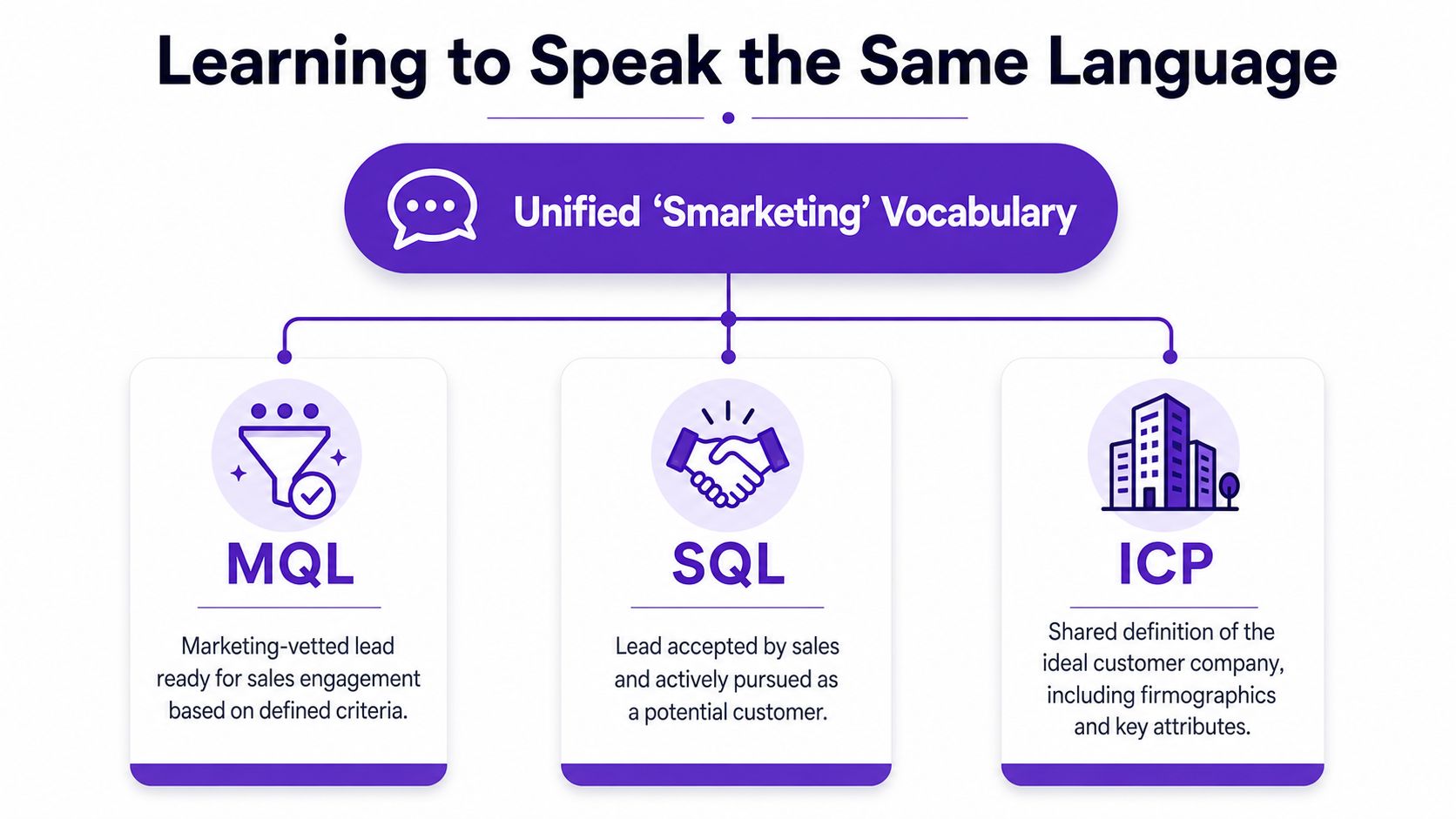
These definitions for MQLs, SQLs, and your ICP are the literal building blocks for your SLA and tech stack. Without them, you’re just guessing. With them, everyone is operating from a single source of truth.
Fixing the Lead Quality Fight with Buyer Intent
Let's get straight to it. The single biggest source of friction between sales and marketing isn't personalities or budgets. It's the handoff. Sales blames marketing for "garbage leads," and marketing fires back that sales can't close. The whole argument is a waste of time.
It’s not a lead quality problem. It's a timing problem.

The old playbook of qualifying leads based on static data—company size, industry, job title—is broken. That tells you who a prospect is, but it tells you nothing about their urgency. Buyer intent data flips this on its head. It answers the only question that actually matters to a sales team: "Why now?"
If you're new to the concept, we've broken down what intent data is and how it works in detail here.
Stop Chasing Static Data, Start Tracking Dynamic Signals
Forget the firmographics for a second. Buyer intent tracks what your prospects are doing right now. It surfaces the quiet activities that signal an active buying journey is underway.
This isn't theory. This is what it looks like in the real world:
They're searching for solutions to a problem your product was built to solve.
They're suddenly following your top three competitors on LinkedIn.
Key people from a target account are asking about pricing in online forums or communities.
These aren't "leads." They are active buying signals. When marketing starts passing these signals to sales, the entire conversation changes. It's no longer a subjective fight over quality. It becomes a data-backed discussion about relevance and timing.
Marketing’s job isn’t just to find potential buyers. It's to find them the moment they start looking. Buyer intent is the bridge that makes this possible.
Think about the difference. Imagine a BDR gets a notification: the CTO at a target account just commented on a LinkedIn post asking about a competitor's integration limits.
The old way? A cold, generic email that gets ignored.
The new way? The BDR sends a message that gets read: "Saw your comment on LinkedIn about integrations—it’s a common bottleneck. We built [Our Solution] to fix that exact problem for companies like yours. Worth a quick chat to compare notes?"
This isn't just better outreach. It's a completely different motion. It gives sales the context they’ve always wanted and proves to them that marketing is listening to the market, not just filling a spreadsheet.
How to Lead the Change to a Smarketing Culture
You’ve built the perfect playbook for sales and marketing alignment. It’s brilliant. It’s sitting in a shared drive. And nobody’s using it.
A pretty document doesn’t create change. True alignment isn’t a process you install; it’s a culture you build. This is the hard part. It’s about people, not just platforms, and getting them to actually want to work together.
This kind of shift has to come from the top. If the C-suite treats this like a side project, everyone else will, too. Executive sponsorship isn’t just about a kickoff email. It’s about sending a clear, consistent message that collaboration is a core business priority. It's about restructuring how people are rewarded.
When you reward marketing for lead volume and sales for closed deals, you’re literally paying them to argue. Shift the focus to shared revenue goals, and you start rewarding them for winning together.
The math is simple. Companies with genuinely aligned sales and marketing teams see win rates climb by 38% and customer retention jump by 36%. If you want more ammo, check out these sales and marketing statistics on Salesgenie.com.
Your Leadership Checklist for Driving Change
Getting this off the ground requires more than just a mandate. You have to get practical and build momentum from the bottom up. Start by finding and celebrating cross-functional wins, no matter how small. When a marketing-driven intent signal leads to a huge meeting for a sales rep, make sure everyone in both departments hears about it.
Here’s a quick checklist to get the ball rolling:
Form a "Smarketing" Council: Don’t just assign tasks. Create a joint task force with people from both teams who are genuinely excited about this. They’ll be your champions and your eyes and ears on the ground.
Host a Joint Kickoff: Get everyone in the same room (virtual is fine) to launch the new playbook, SLA, and shared goals. Make it feel like a real event, not just another meeting.
Publicize Early Wins: The first time a deal closes from a marketing-qualified lead, shout it from the rooftops. Post it in a shared Slack channel. Make a hero out of the people involved.
Enforce the New Rules of Engagement: Shut down the finger-pointing. Reframe conversations about "bad leads" into opportunities to refine your ideal customer profile together.
Ultimately, the processes and tech—like a powerful sales enablement platform—are just there to support the human partnerships. Your real job as a leader is to clear the path so those partnerships can actually form and thrive.
Your Smarketing FAQ: The Unfiltered Answers
You’ve read the playbook. You're sold on the idea. But now comes the real-world friction—the "what ifs" and practical roadblocks that pop up the moment you try to make sales and marketing alignment a daily reality.
Here are the most common questions we see, along with the no-fluff answers.
1. What's the actual first step we should take?
Lock your sales and marketing leaders in a room and don’t let them out until they agree on a granular Ideal Customer Profile (ICP). Seriously. If you can’t agree on precisely who you’re selling to, every other alignment effort is a waste of time. This single, often painful, exercise will expose 90% of your current misalignment. Get it done first.
2. How do you actually measure the ROI on this?
Stop tracking separate team activities and start measuring shared outcomes. The only metrics that prove this is working are the ones that tie directly to revenue. Look at these three numbers:
Sales Cycle Length: Is it getting shorter? It should be, because reps are getting better-qualified leads at the right time.
Lead-to-Close Rate: Is it going up? This tells you sales is working opportunities that are a much better fit from the start.
Customer Acquisition Cost (CAC): Is it going down? This is the ultimate proof that your entire go-to-market engine is getting more efficient.
When these numbers move, you've proven the value of alignment beyond any doubt.
3. Our teams are too busy for more meetings. How does this work?
The point isn't more meetings; it's smarter meetings. Kill the separate team huddles. Replace them with one, single 30-minute weekly “Smarketing” stand-up. Run the entire meeting off a shared dashboard. This keeps everyone focused on the same data and goals, cutting down on wasted time and miscommunication. You’ll find it actually saves time.
4. How can we use tech to help?
Technology isn't the solution, but it is the bridge. It creates the single source of truth that stops the finger-pointing. A perfect example is integrating your marketing automation platform with your CRM. When marketing can see exactly which leads converted into revenue, and sales gets the full context of a lead’s journey before the handoff, the entire "bad leads" argument evaporates. It’s all backed by data.
5. Who is supposed to own this initiative?
While this needs a clear champion at the executive level—a CRO, CMO, or the CEO—the ownership itself has to be shared. If one person "owns" it, it's destined to fail. The best structure is a “Smarketing” council. Appoint leaders from both teams who are jointly accountable for its success. You can have one person act as the project manager to keep the trains running, but accountability must be mutual. It’s the only way it sticks.
6. What's the difference between sales enablement and sales and marketing alignment?
Think of it this way: Sales and Marketing Alignment is the strategy of getting both teams to work together toward a shared revenue goal. Sales enablement is one of the key tactics to make that happen. Sales enablement focuses on providing the sales team with the resources, content, and tools they need to sell more effectively. In an aligned organization, marketing plays a huge role in creating that content (case studies, battle cards, email templates) based on shared goals and feedback from sales.
7. How do you handle disagreements on lead quality after the SLA is in place?
Disagreements are inevitable, but the SLA gives you a framework to resolve them. Instead of a "he said, she said" argument, you go back to the data. Was the lead rejected because it didn't meet the agreed-upon ICP? Or was it because the follow-up was too slow? Have a regular (quarterly, at least) SLA review meeting to analyze rejected leads. Use these outliers to refine your MQL definition, not to place blame.
8. What if our company culture is really siloed and resistant to change?
Start small and build social proof. Don't try to boil the ocean with a company-wide revolution. Find one sales rep and one marketer who are willing to pilot a small-scale alignment project. Maybe they focus on a single campaign or a specific niche vertical. Track their results obsessively. When they start producing better-than-average pipeline, publicize that success story internally. Success is contagious and is the best antidote to resistance.
9. Can small businesses or startups really do all this?
Absolutely. In fact, it's easier for them. Startups and small businesses don't have decades of entrenched silos to break down. The key is to build alignment into your company's DNA from day one. When you're a team of 10, your "Smarketing" meeting might just be everyone huddling around one table. The principles—shared goals, a common language, a feedback loop—are the same, just at a different scale.
10. Our sales and marketing teams use different tools. Is that a dealbreaker?
It's not a dealbreaker, but it is a major friction point. The goal isn't to force everyone onto one platform, but to ensure the critical data can flow between them. Your CRM (the home of sales) and your marketing automation platform must be integrated. Without a two-way sync of lead status, campaign history, and activity data, you're flying blind. This integration is non-negotiable for true sales and marketing alignment.
Ready to turn LinkedIn engagement into a steady stream of high-intent leads? RoverLead AI uses autonomous prospecting to identify prospects showing real buying signals, delivering them to your team with context and an AI-written opener. See how you can book more meetings and cut research time.