
Prospect Identification: Your Guide to Finding Better Leads

You built the list. You cleaned the copy. You hit send with the kind of optimism that only salespeople and gamblers understand. Then nothing happened. Maybe a bounce, maybe a polite brush-off, maybe silence so complete it felt personal.
It usually isn't personal. It's bad prospect identification.
Most outbound fails for one boring reason. Teams confuse a database with demand. A list of companies that look like customers is not the same thing as a list of companies actively trying to solve the problem you sell into. One is a spreadsheet. The other is pipeline.
Modern prospect identification fixes that. It shifts you from guessing who might care to spotting who's already leaning in.
Table of Contents
Stop Shouting into the Void
A lot of teams are still prospecting like it's a fax campaign with better fonts. They buy or pull a list, filter by industry and headcount, and congratulate themselves for being “targeted.” Then they wonder why outreach feels like yelling into an empty warehouse.

The problem isn't effort. The problem is timing. You're often reaching people who match your market on paper but have no reason to care today. That's not prospecting. That's administrative optimism.
Practical rule: If your list was built without any recent buying signal, you built a directory, not a pipeline.
Good prospect identification starts with a simple shift. Stop asking, “Who fits?” Start asking, “Who fits and is showing signs of movement?” That means paying attention to behavior, not just attributes. A company hiring in a relevant function, researching your category, or engaging with pricing conversations is telling you more than a firmographic filter ever will.
The teams that win don't shout louder. They listen better, then move faster.
What Prospect Identification Really Means
Old-school prospect identification is like fishing with a giant net and hoping something expensive swims into it. Modern prospect identification is using a fish finder. You still need the right lake, but now you know where the activity is.
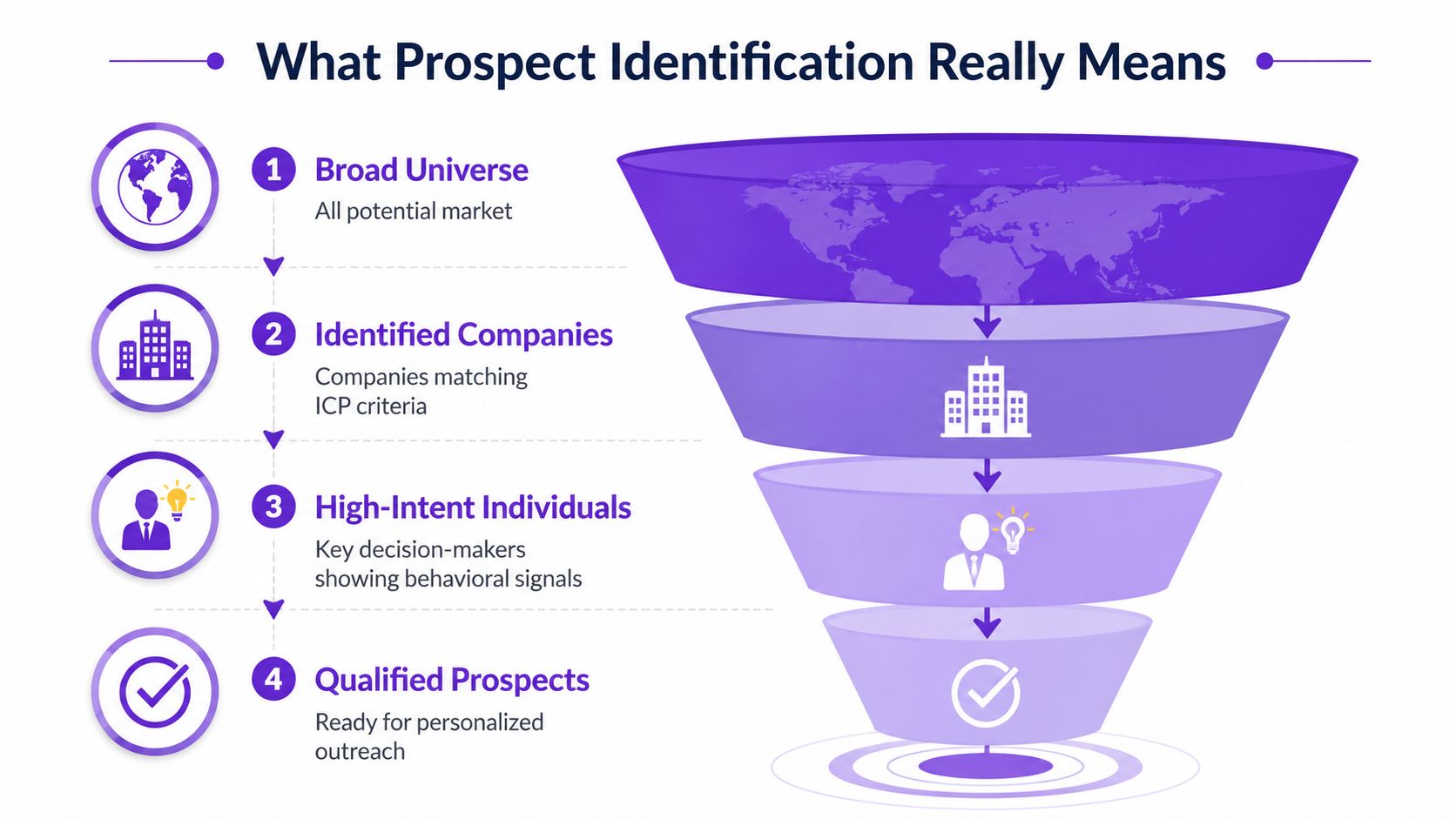
The old definition is too shallow
Prospect identification isn't just finding names, job titles, and company logos that resemble your customer base. It's the discipline of identifying accounts and people that fit your market and show evidence they may need your solution now.
That second part is where many teams fall apart. They've got the fit piece. They barely have the timing piece. That's why so much “personalized” outbound still lands like spam wearing a blazer.
One reason this matters so much is that static frameworks miss where buyers signal interest. Prospeo's analysis of prospect identification notes that 73% of B2B buyers research vendors via social interactions like comments and creator engagement before contacting sales. Most prospecting playbooks still act as if none of that exists.
The three pillars that matter
A solid system rests on three pillars:
ICP clarity: You need more than “mid-market SaaS” or “VP Sales.” Nail down pain, use case, team shape, geography, and buying context. If your ICP is mushy, your prospect identification will be mushy too. If you need to tighten this up, start with a sharper view of what ICP stands for in business.
Intent signals: These are the breadcrumbs. Website visits, pricing-page activity, content downloads, hiring activity, tech adoption, search behavior, review-site activity, social engagement, competitor interactions. Fit tells you who could buy. Intent tells you who's leaning.
Prioritization: Not every signal deserves the same reaction. A passing like on a post is not the same as repeated engagement around pricing, demos, or category pain. Good teams rank signals by strength and recency, then route outreach accordingly.
Prospect identification is not lead generation with better manners. It's selection with timing.
That's the true definition. Find the right company, the right person, and the right moment. Miss one, and the whole thing gets expensive fast.
Old School vs New School Prospecting
Traditional prospecting still has defenders. So do flip phones. Nostalgia is not a strategy.
The old model says this: find companies that look right, grab contacts, write a sequence, and let volume sort it out. The newer model says something smarter: start with fit, then wait for signs of motion, then engage with context. One approach produces noise. The other produces conversations.
Prospecting Methods Compared
Criteria | Traditional (Firmographic) | Modern (Behavioral) |
|---|---|---|
Core input | Industry, size, revenue, title | Fit plus real-time buying signals |
Data freshness | Often static and aging | Continuously updated by activity |
Prioritization | Broad list tiers | Signal-based ranking by urgency |
Outreach reason | Generic pain assumptions | Specific recent behavior or trigger |
Research method | Manual list pulls | Ongoing signal monitoring |
Best use | Broad TAM mapping | Active pipeline creation |
Main flaw | Looks relevant, feels irrelevant | Requires signal discipline |
Why the old model breaks
A major flaw is stale data. Coresignal's B2B prospecting analysis notes that 50% of B2B contact data becomes obsolete within 12 months. That means half the “perfect” records your team worked so hard to source may already be decaying while your SDRs are still writing first lines about them.
And that's just the contact problem. The bigger issue is that firmographics don't reveal urgency. A company can match your ICP perfectly and still have zero appetite, zero budget, and zero internal momentum. Another company may look slightly less perfect on paper but is hiring, researching vendors, and talking about the problem in public. Guess which one books meetings.
Use firmographics to define the field. Don't use them to decide who gets attention first.
A few old habits need to go:
Spray-first sequencing: Sending volume before validating interest burns domains, time, and morale.
Title worship: The “right” title at the wrong time still won't buy.
Static account lists: A list that doesn't change with the market gets dumber every week.
A paper map can still show you the city. It just won't tell you where traffic is.
That's the difference. Traditional prospecting helps you know where accounts exist. Modern prospect identification helps you know where demand is forming.
The Modern Prospect Identification Process
Many organizations don't need more leads. They need a cleaner system for deciding who deserves attention today.

Calibrate your ICP
Start with fit, but go beyond demographics in a hoodie. Define the conditions that make your offer relevant. What team owns the pain? What event usually creates budget? What business model gets the fastest value? Which regions matter?
A lot of teams also miss local reality. Global headcount can make an account look large while the actual in-market team you'd sell into is tiny. Build your list with operational nuance, not investor-deck vanity.
If your current process starts with list generation, tighten the mechanics of prospect list building before you add more tools.
Map your signal universe
Most generic guides get lazy here. “Use intent data” is not advice. It's a bumper sticker.
Map the places and behaviors that indicate buying motion:
First-party signals: pricing-page visits, buying-guide downloads, demo requests, trial signups
Third-party intent: category research, review-site activity, vendor comparisons
Public company signals: job postings, team expansion, tech-stack changes
Social signals: competitor post comments, creator engagement, problem-focused discussions
You're building a monitored environment, not a one-time search.
Prioritize by intent
Not all signals carry equal weight, and recency matters. A practical model uses signal scoring and decay so last week beats last quarter.
One useful benchmark comes from Prospectory's guide to buying signals and intent data, which describes a scoring model that can assign 25 points for a pricing-page visit, apply a 50% decay every 14 days, and flag accounts above a 50-point threshold for top-tier outreach. The principle is simple. Time kills intent.
Engage with context
The outreach should sound like you noticed something relevant, because you did. A generic “helping companies like yours” opener wastes the signal you worked to capture.
ZoomInfo's prospecting guidance notes that when teams act on first-party signals like a pricing-page visit or buying-guide download within 24 hours, the likelihood of securing a meeting increases dramatically. That's the operational takeaway. Fast follow-up isn't a nice-to-have. It's part of the qualification.
This process isn't glamorous. It's just more honest. You identify fit, watch for movement, rank the evidence, and reach out while the window is still open.
A Playbook for High-Intent Prospecting on LinkedIn
LinkedIn is full of buying signals. It is often used like a digital phone book.
That's the miss.
Alex stops pulling dead lists
Alex is an SDR. Old workflow: open Sales Navigator, filter by title, geography, and company size, export a list, then write messages based on what the company probably cares about. The result is familiar. Lots of effort, weak timing, thin replies.
New workflow: Alex watches for behavior first. Who commented on a competitor's post about pricing friction? Who engaged with a creator discussing tools in Alex's category? Who changed roles into a function that often owns the problem? Who shows up repeatedly, not just once?
That's the contrarian move. Don't start with people who look right. Start with people who are acting right.
A practical LinkedIn workflow
Here's a simple operating rhythm that works:
Pick your watch zones
Track competitor company pages, founder posts, category creators, and niche discussions where your buyers hang out.Filter for fit
When someone engages, check role, company type, region, and team relevance. Don't confuse internet activity with qualification.Validate persistence
One comment can be curiosity. Repeated activity across related topics is stronger. Look for recurring behavior, not random drive-bys.Reach out with context
Use the signal as the opener. Not in a creepy way. In a relevant way. “Saw your comment on X” beats “Wanted to introduce myself” every day of the week.Move fast
ScalIQ's analysis of LinkedIn intent layering says teams need to act on engagement signals within hours, and that this approach improves positive reply rates by 2–3x compared to static list-based outbound. Delay turns signal into archaeology.
Don't message because someone exists. Message because they did something that makes your outreach make sense.
A strong outbound system also needs follow-through. For high-value accounts, Mixmax's sales prospecting best practices recommend 8–12 touchpoints over a 2–3 week window across channels like email, phone, LinkedIn, voicemail, video, and text. If the account matters, act like it.
Here's a quick visual on the kind of workflow teams are moving toward:
Where tools fit
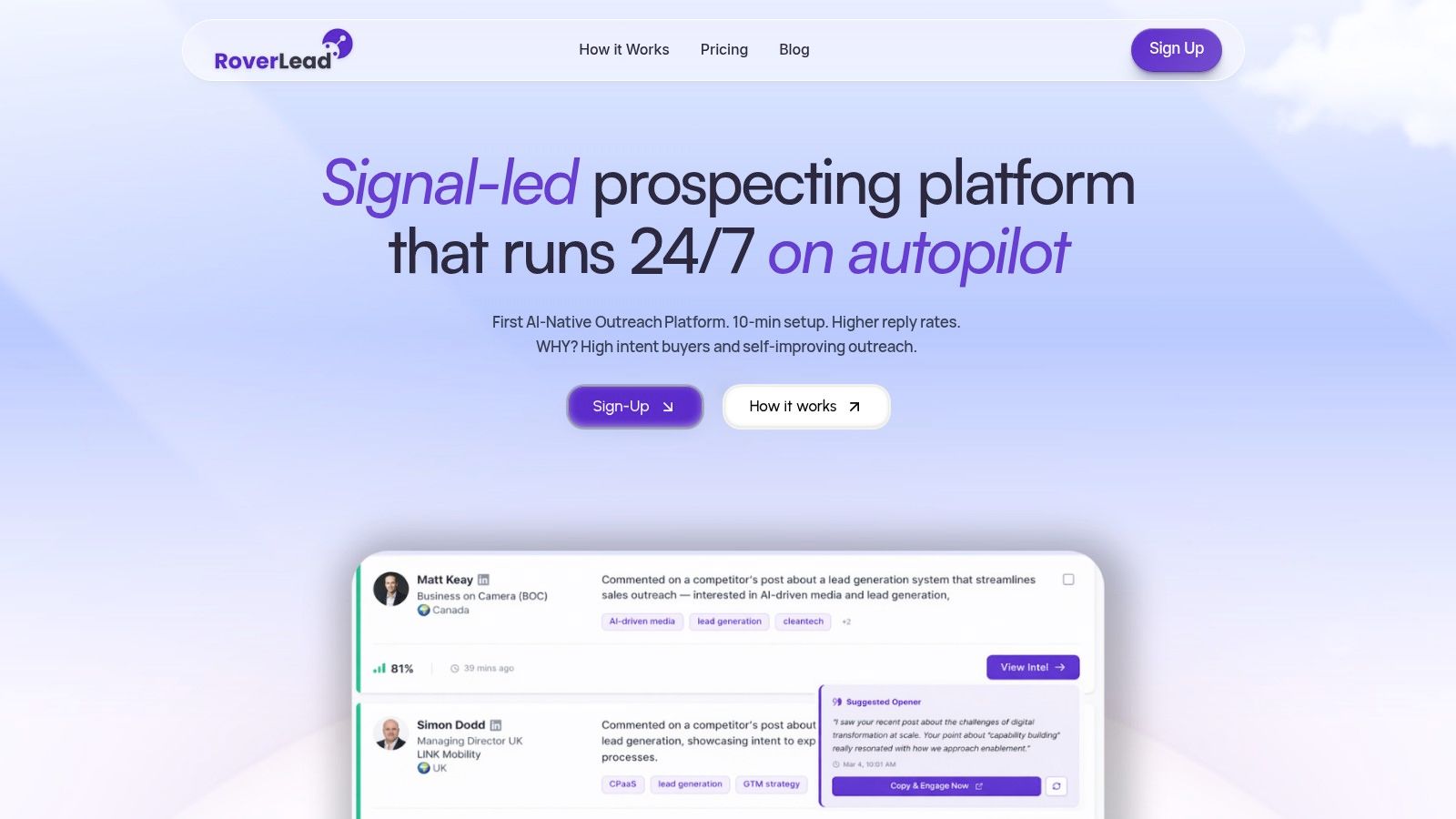
You can do this manually, but you'll spend your week tab-hopping like it's a profession. Tools help by monitoring signals at scale and preserving context. One example is LinkedIn lead generation workflows, where teams combine ICP filters with live engagement tracking instead of relying on static list pulls. RoverLead AI is one option that monitors LinkedIn engagement signals, matches them to ICP, and surfaces contextual leads for outreach.
The important part isn't the logo. It's the operating model. Watch behavior, qualify ruthlessly, respond while the signal is fresh.
Key Metrics and Pitfalls to Avoid
Monday morning. The SDR team is celebrating a spike in “intent” leads. Friday afternoon, booked meetings are flat, pipeline quality is worse, and everyone is blaming the sequence.
That is what bad measurement looks like. Activity goes up. Revenue signal goes down. If your scorecard rewards noise, your team will manufacture noise.
The dashboard that matters
Track the numbers that expose whether behavioral signals are producing real sales conversations, not just busy reps:
Positive reply rate: Do signal-based prospects reply more often than static list prospects?
Meeting booked rate: Do those replies turn into real conversations?
Lead-to-opportunity conversion rate: Are these accounts becoming qualified pipeline?
Win rate by segment: Which combinations of fit, trigger, and timing close?
Response time to signal: How long did your team wait before acting?
Keep one more rule in place. Compare these metrics by signal type, not just in aggregate. A prospect who comments on a peer discussion about your category is different from someone who taps “like” on a broad leadership post. If you blend those together, you will fool yourself.
Vanity metrics belong in a museum. Connection requests sent, profile views, and sequence volume can tell you your team is active. They cannot tell you your team is effective.
Warning lights you shouldn't ignore
False intent is the first trap. Plenty of teams buy a feed of “surging” accounts, throw them into outreach, and call it targeting. That is how you get a modern-looking version of spray and pray. If your team needs a clearer baseline on what intent data actually is and where it goes wrong, start there.
The second trap is signal decay. Behavioral intent has a shelf life. A fresh comment on a relevant LinkedIn post can justify outreach today. Two weeks later, it is stale. Two months later, it is trivia.
Watch for these mistakes:
Treating every signal the same: A casual reaction, a thoughtful comment, and a pricing question do not belong in the same bucket.
Ignoring recency: Old engagement should lose score fast, or it will poison prioritization.
Dropping the trigger in outreach: If the message does not reference the behavior, the behavior added no value.
Letting automation overrule judgment: Tools can collect signals. Reps and managers still need to decide whether the account is worth the shot.
Confusing volume with intent: High engagement on generic content often creates more false positives than buying opportunities.
One pattern matters more than the rest. High signal volume with weak conversion usually means your definition of intent is sloppy. Tighten the rules. Weight repeated, recent, category-relevant behavior more heavily. Penalize broad engagement that looks interesting but says nothing about buying motion.
Good prospect identification should make the pipeline smaller before it makes it better. If your “intent-driven” system keeps feeding reps more names without improving meetings, opportunities, and wins, the system is broken.
Prospect Identification FAQ
1. What's the difference between prospect identification and lead generation?
Lead generation creates interest at scale. Prospect identification decides who deserves attention before you spend effort.
2. Is prospect identification just list building?
No. List building gives you a pool. Prospect identification ranks that pool by fit and timing.
3. What's the best place for a small team to start?
Start with your narrowest ICP and a few obvious public signals. Don't buy a giant database and call it strategy.
4. Does LinkedIn really matter this much?
Yes. Buyers discuss problems in public long before they fill out forms.
5. How often should signals be reviewed?
Daily, if outbound matters to your number.
6. Should SDRs own this or RevOps?
Both. RevOps should define the system. SDRs should pressure-test it in the field.
7. What counts as a strong signal?
Repeated, recent behavior tied to your category or buying process.
8. How personal should outreach be?
Specific enough to prove relevance. Not so elaborate that your team can't scale it.
9. Is this compliant with privacy rules?
Use public-facing activity responsibly and keep your process transparent and sane.
10. What if I don't have expensive intent tools?
You can still watch competitor posts, creator discussions, hiring activity, and first-party engagement manually. It's slower, but it works.
If your team is tired of chasing cold lists and wants a cleaner way to spot active buyers, RoverLead AI helps turn LinkedIn engagement into daily, high-intent prospects matched to your ICP, with context for timely outreach.