Boost Sales: Lead Scoring Automation with AI

Your CRM is packed. Marketing says lead volume is up. Sales says pipeline quality is down. Both are right.
You've probably got reps chasing people who downloaded a whitepaper months ago, clicked one email by accident, or filled out a form because they wanted the template, not a sales call. That's not demand generation. That's admin work wearing a growth costume.
Lead scoring automation fixes that, if you build it around real buying behavior instead of vanity activity. Leads are often still scored from CRM fields and on-site actions alone. That's half a system. The stronger signal is often what prospects do before they ever touch your website, especially on LinkedIn, where they follow creators, comment on competitor posts, and reveal intent in public.
Table of Contents
Your Sales Team Is Drowning in 'Leads'
Let's call the problem what it is. Your team isn't short on leads. Your team is short on clarity.
Most revenue teams are activity-rich and pipeline-poor. The CRM fills up with webinar signups, ebook collectors, recycled contacts, and “interested” people who go silent the second a rep reaches out. Sales ends up sorting through a digital junk drawer while marketing celebrates MQL volume.

That's why lead scoring automation moved from nice-to-have to operating requirement. By early 2026, 79% of B2B marketing and sales teams are using or piloting AI lead scoring automation, up from 48% in 2023, according to this 2026 AI lead scoring adoption analysis. Teams aren't adopting it because it sounds clever. They're adopting it because scale without prioritization is chaos.
The real issue is wasted human effort
Your reps should spend time on people who look like buyers, not on every contact who touched a form once. Good automation filters the pile fast. It separates the genuinely interested from the casually curious, then routes the right lead to the right action.
Practical rule: If your reps still decide who's hot by scanning recent activity manually, you don't have a lead process. You have a guessing habit.
A lot of teams try to solve this by pouring more contacts into the top of funnel. Bad move. Before you add more names, fix how you prioritize the ones you already have. If your current B2B sales lead generation process keeps feeding sales unqualified volume, automation won't save you unless the scoring logic gets smarter.
Separating The Buyers From The Browsers
Lead scoring automation is just a decision engine. It tells your team who deserves attention now, who needs nurturing, and who should be left alone until they show real intent.
Picture a bouncer. A basic bouncer checks whether someone's name is on the list. A smart bouncer notices who booked the table, who knows the host, and who showed up ready to spend money. One checks static facts. The other reads context.
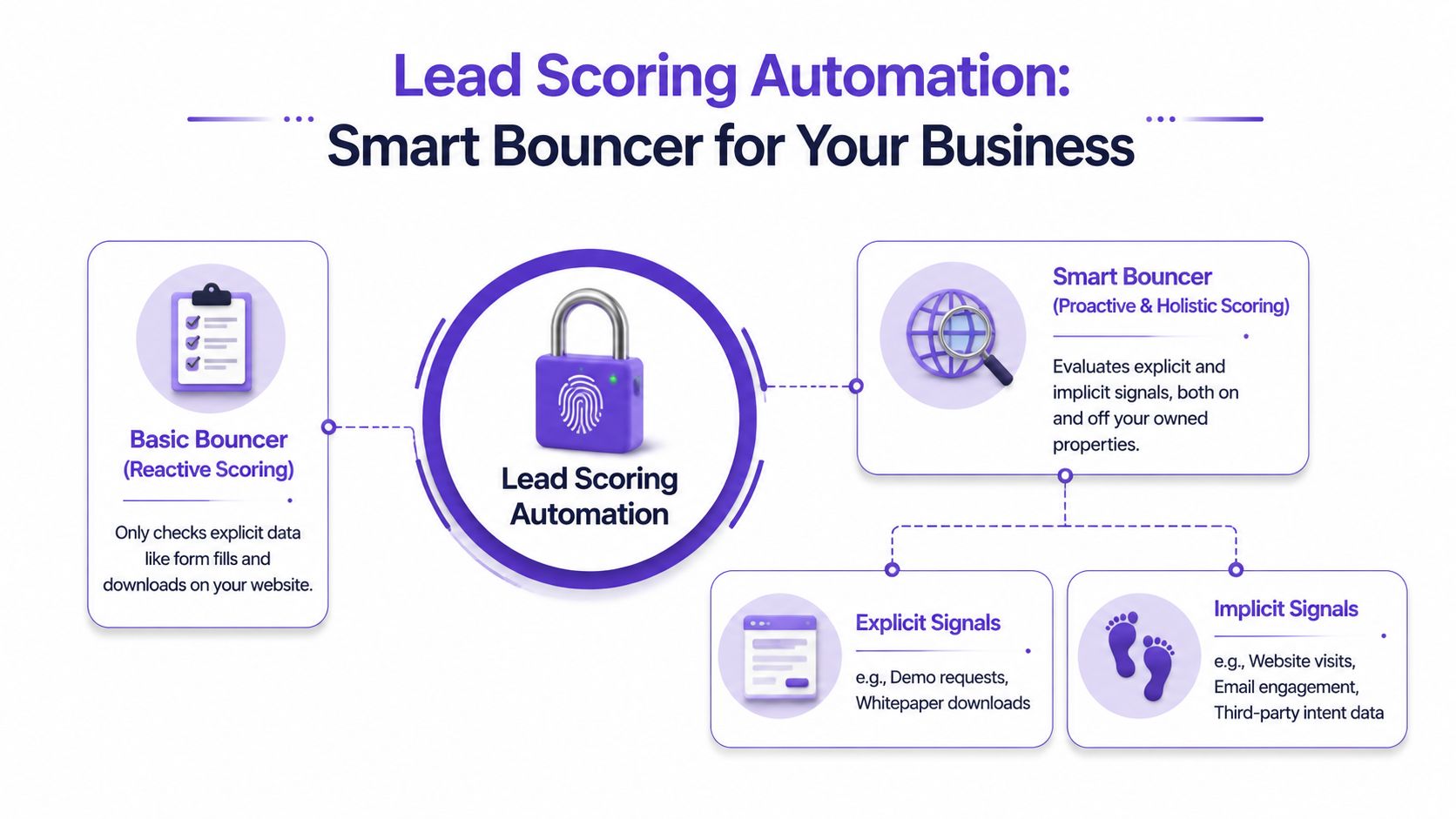
Explicit signals tell you who they are
These are the fields people fill in or the data you enrich later. Job title. Company size. Industry. Geography. Tech stack. Useful? Absolutely.
But explicit data mostly tells you whether someone fits. It doesn't tell you whether they care right now.
Implicit signals tell you what they're doing
Scoring becomes useful. Website visits, demo requests, webinar attendance, email engagement, repeat visits to high-intent pages, and third-party intent signals all inform the score. Behavior tells you timing. Timing is what sales needs.
The best systems combine both. Fit without behavior creates bloated priority lists. Behavior without fit floods reps with noise.
Mature scoring models work because they force focus. Organizations that implement mature lead-scoring models achieve 77% higher lead generation ROI, as shown in this lead scoring ROI breakdown.
Here's the blunt version. If your team only scores based on form fills and CRM profile data, you're identifying people who are easy to track, not necessarily people who are ready to buy. That's why teams chasing high-intent leads outperform teams obsessing over raw lead count.
Not All Scoring Models Are Created Equal
A scoring model can help. It can also subtly wreck your funnel if you pick the wrong one.
Some teams still run on fixed rules from years ago. Some bolt AI onto a weak dataset and wonder why the outputs feel random. Others finally realize that timing signals matter as much as fit. These are not the same system.
Comparison of Lead Scoring Models
Model | How It Works | Best For | Biggest Drawback |
|---|---|---|---|
Rule-based | Assigns fixed points to traits and actions | Teams that need transparency and quick setup | Rigid logic misses nuance and shifts in buying behavior |
Predictive or AI | Learns patterns from historical wins and losses | Teams with enough clean conversion history | Weak data produces weak scoring |
Real-time intent | Adjusts priority based on fresh behavioral and off-site signals | Teams that want faster response to buying windows | Needs stronger signal collection outside the CRM |
Rule based scoring is simple and limited
Rule-based scoring is popular because it's easy to explain. VP title gets points. Pricing page gets points. Student email gets deducted. Fine. It's visible, manageable, and fast to launch.
It's also easy to outgrow. Buyers don't follow your neat little checklist. A rigid model can't spot combinations of weak signals that together suggest real interest. It also can't adapt well when your market, messaging, or ICP changes.
AI scoring is stronger but needs real data
AI can absolutely outperform hand-built logic, but only if you feed it enough signal. Effective AI-native lead scoring automation requires a minimum training dataset of 1,000+ lead records, including at least 200 closed-won and 200 closed-lost deals, according to this guidance on lead scoring software and training data.
That requirement matters more than most vendors admit. If you're a startup or a niche B2B team without enough history, a fully predictive model can become a very polished nonsense machine.
If you don't have enough closed-won and closed-lost history, run hybrid scoring first. Don't hand your funnel to a model that learned from crumbs.
For teams cleaning up messy records before they attempt predictive scoring, better CRM data enrichment practices usually matter more than one more fancy model.
Intent scoring tells you when to act
This is the missing layer in a lot of setups. Traditional scoring is mostly reactive. It watches what happens in your forms, email platform, and website. Useful, but limited.
Intent scoring adds recency and context. It spots who is showing signs of movement now. That can include website behavior, third-party activity, or social engagement that signals active research. This enables modern sales teams to stop treating every lead like a static record and start treating them like an active buying process.
How to Build Your Lead Scoring Engine
Often, this is made too complicated. You do not need a six-month scoring initiative. You need a working model, clear thresholds, and a habit of adjusting it.

Start with fit before you obsess over activity
If you haven't defined your ICP properly, scoring is lipstick on a spreadsheet.
Use four steps:
Lock in your fit criteria
Decide who belongs in the funnel. Job title, company size, industry, and buying role matter. Keep it tight.Map buying signals that are meaningful
Not every activity deserves points. A pricing page visit is not the same as a random blog click. A demo request is not the same as an email open.Separate core signals from vanity signals
Treat weak actions carefully. If you overweight low-intent activity, your system will reward tourists.Connect the score to an action
A score without routing logic is decoration. Sales needs a trigger, not a dashboard.
Set thresholds like an adult
MQL thresholds are often set too low because of an addiction to volume. That's how junk gets handed to sales.
Best practice is to start conservatively by capturing only the top 20% of leads by score. If the average lead scores 35 points, the initial MQL threshold should be set at 70 points, according to this practical guide to lead scoring rules.
That approach works because it forces discipline. Start with a narrow gate. Watch what converts. Then adjust.
A practical model usually includes:
Fit points for role, company profile, and industry alignment
Behavior points for actions that suggest active evaluation
Intent modifiers for fresh signs that timing changed
Negative points for disqualifiers or stale activity
If your team is using AI workflows to structure logic, orchestrate signals, and route outputs, it helps to understand context engineering in practical sales systems, not just prompt writing.
Three Traps That Make Lead Scoring Useless
A bad scoring system is worse than no scoring system. At least with no scoring system, everyone knows it's messy. A broken one gives false confidence.
The model rot problem
Markets change. Messaging changes. Products change. Your scoring logic should change too.
If the model hasn't been reviewed since the last rebrand, it's probably grading the wrong behaviors. Teams love to “set it and forget it” because maintenance is boring. Revenue teams pay for that laziness later.
Score inflation turns junk into fake urgency
Old activity should not keep a lead hot forever. That's fantasy.
Automated lead scoring workflows need real-time score decay, such as reducing points after 30, 60, or 90 days of inactivity, according to this workflow design guide for automated scoring. If someone looked engaged months ago and then disappeared, their score should drop. Otherwise sales keeps calling ghosts.
A sensible setup also uses score caps. Repeated low-value actions shouldn't stack forever just because someone likes opening newsletters.
The zero score trap hides good leads
This one gets ignored all the time. Teams treat missing data like disqualification.
That's sloppy. If a lead is missing company name, industry, or another required field, don't score it at zero by default. Route it to enrichment if there's still a meaningful behavioral signal. Zero is not neutral. Zero buries leads.
Missing data is an ops problem, not a buying-intent verdict.
Good lead scoring automation doesn't just rank records. It handles uncertainty intelligently.
Beyond The CRM The Next Wave of Intent Signals
Here's the uncomfortable truth. Your CRM only knows what happened on your turf.
Prospects do a lot of buying research elsewhere. They read posts, compare vendors, ask peers for recommendations, react to industry commentary, and engage publicly before they ever fill out your form. If your scoring model ignores that behavior, you're late.
Your prospects are telling on themselves in public
LinkedIn is the obvious example. A buyer comments on a competitor's post. A founder asks their network for tool recommendations. A VP engages with content about pricing, implementation, or category pain points. Those are not casual signals.
They're often better than another whitepaper download because they happen closer to real consideration. And when AI intent scoring gets layered on top of standard behavioral scoring, the median conversion lift increases to 62%, according to this 2026 marketing automation statistics roundup.
That's the gap most scoring guides miss. They focus on records. Sales should focus on behavior in motion.
How modern teams act on off site intent
The practical move is simple. Keep CRM and website data in the model, but add a signal layer that watches buyer behavior outside owned channels. That can mean social engagement, public conversations, competitor interactions, and topic-level activity.
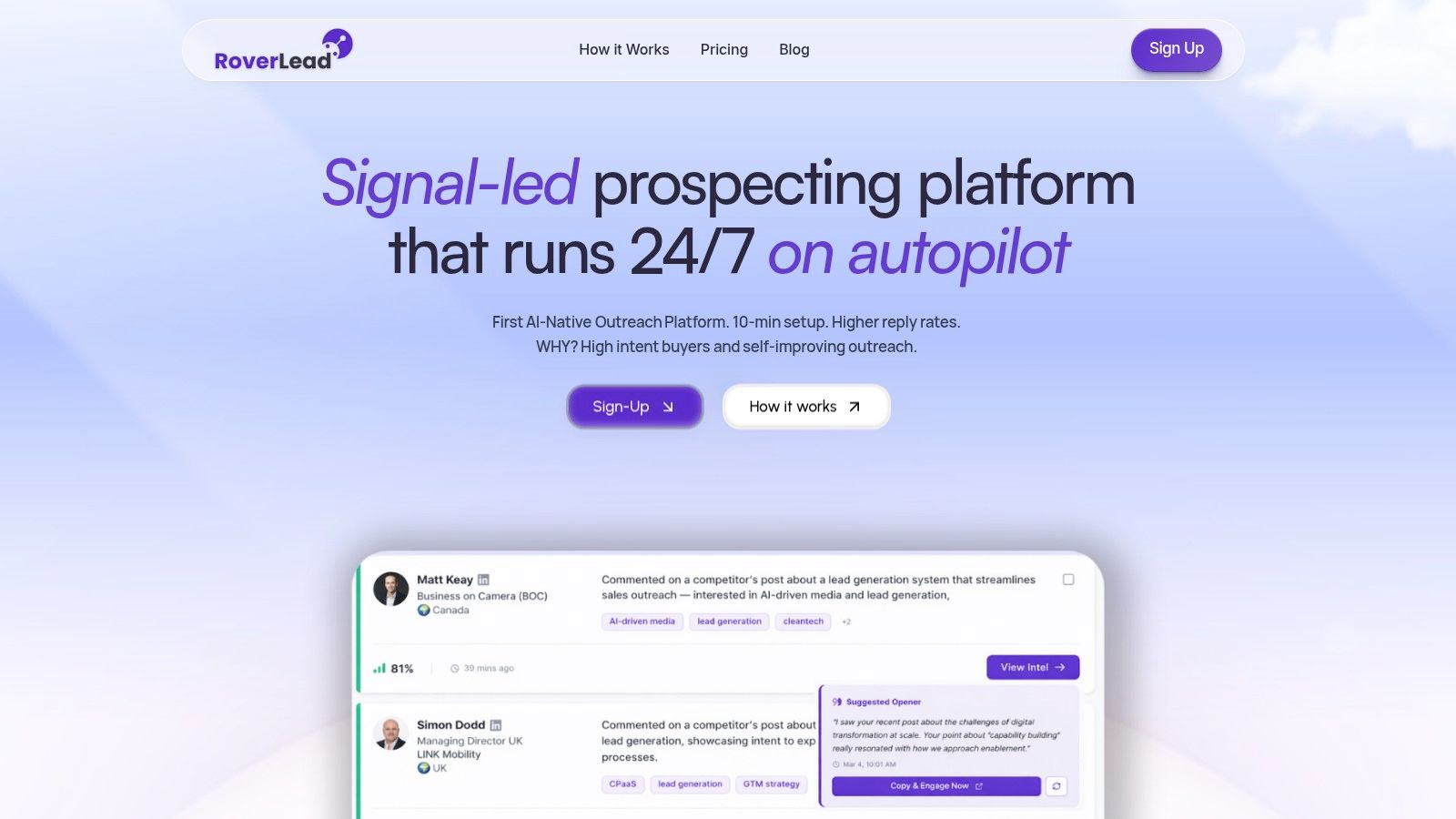
One option is RoverLead AI, which tracks LinkedIn engagement and turns those signals into ICP-matched prospecting context. It's not replacing core scoring logic. It adds the missing behavioral layer many CRM-only setups never see.
Here's a quick product view in action:
The bigger point is strategic, not tool-specific. If your lead scoring automation waits for prospects to walk onto your website before it starts paying attention, your reps are responding after the interesting part already started.
Your Lead Scoring Automation Questions Answered
The basics are easy. The annoying details are where teams get stuck. Here's the practical version.
Lead Scoring Automation FAQ
Question | Answer |
|---|---|
Should marketing and sales own lead scoring together? | Yes. Marketing can define volume and engagement inputs. Sales should validate whether high-scored leads actually become real opportunities. |
How often should we review the model? | Review it on a fixed cadence and after any major change in ICP, product focus, or go-to-market motion. If conversion quality slips, review sooner. |
Should every product line use one scoring model? | Usually no. Different products often attract different buyers and buying signals. Separate logic is cleaner than forcing one score to do everything. |
Can small teams use AI scoring right away? | Only if they have enough clean historical data. If not, start with rule-based or hybrid scoring and build toward predictive later. |
What's the best first signal to score? | Start with actions closest to buying intent, such as demo interest, pricing engagement, or repeated evaluation behavior. |
Should SDRs see the full scoring logic? | They should at least see the main reasons a lead is prioritized. Blind scores reduce trust and lead to rep workarounds. |
How do we handle upsell versus net-new scoring? | Use separate models or at minimum separate weightings. Expansion signals differ from new-logo buying signals. |
What do we do with incomplete records? | Don't bury them with a default zero. Send them to enrichment if they show meaningful activity. |
Should score alone trigger routing? | No. Pair the score with a next action, owner, and SLA. Priority without execution is just another field in the CRM. |
Is LinkedIn activity worth including? | Yes, if your buyers are active there and the signals are relevant to your ICP. Public engagement often reveals timing earlier than owned-channel behavior. |
The best scoring system is the one your team trusts enough to use. Keep it explainable. Keep it current. And stop pretending CRM history is the whole movie.
If your team wants a cleaner way to spot real buying intent before a form fill ever happens, RoverLead AI is worth a look. It helps sales teams monitor LinkedIn engagement tied to their ICP, competitors, and target topics, then surfaces context-rich leads for outreach while your existing lead scoring automation handles fit, routing, and follow-up.