Lead Generation for B2B Sales: Your 2026 Guide

Let's be honest. Traditional B2B lead generation feels a lot like shouting into the void and hoping someone, somewhere, shouts back. You build a "perfect" list, craft what you think is a killer message, hit send... and get crickets. It's the digital equivalent of dropping your business card into a canyon.
If your outreach is getting ignored, you're not alone. And it's not a problem with your hustle—it's your playbook. It's time for an upgrade.
Table of Contents
Why Your B2B Sales Outreach Is Being Ignored
The modern B2B buyer is completely immune to generic, high-volume outreach. They're drowning in automated emails and irrelevant pitches that are based on static, outdated data like company size or job titles. It's all noise, and they've gotten incredibly good at tuning it out.
The real problem? These old methods completely miss the single most important element: timing.

Success in B2B sales today isn't about shouting louder; it's about whispering the right thing at the right time. It's about cutting through the noise by focusing on genuine buying signals. It means finding prospects the moment they are actively showing interest, not months before or after.
The key is to stop interrupting strangers and start joining conversations already in progress. This requires a shift from static lists to dynamic, real-time intent.
To do this right, you have to get a feel for the nuances of buyer behavior. We break down exactly how to do that in our guide on what is intent data and how it pinpoints buyers who are ready to talk.
The rest of this guide will show you a much smarter path forward.
The Outdated Playbook vs. The Modern Approach
Let's be honest. The old B2B sales playbook is collecting dust for a reason. It’s the one that preaches manual list building, high-volume outreach with painfully low relevance, and a strange obsession with vanity metrics like open rates. It's the sales equivalent of a flip phone in a world of AI assistants.
This is the "smile and dial" approach that’s been drilled into sales reps for decades. It's a pure numbers game where success is measured by sheer activity. More calls, more emails, more noise. The problem? Buyers got really good at tuning out that noise years ago.
The Critical Shift to Intent
The modern approach to lead generation for B2B sales isn't about playing the lottery; it's about making calculated moves. Instead of blasting a list of 1,000 cold prospects, you focus on the five who just showed they’re ready to talk.
This new school of thought is built entirely on dynamic buying signals and low-volume, high-relevance engagement. It's not a "nice-to-have" anymore; it's table stakes.
Consider this: while 91% of B2B marketers claim lead generation is their top priority, a staggering 80% of the leads they generate never convert without the right nurturing. The teams that get this right—the ones who excel at targeted, intent-driven nurturing—generate 50% more sales-ready leads at a 33% lower cost. You can dig into more of these lead generation stats to see just how wide the gap has become.
The goal isn't to get more "at-bats." It's to know which pitches to swing at because you can already see the ball coming. That’s the power of intent.
This mindset flips the entire script. You stop interrupting strangers and start joining conversations already in progress. To see just how different these two worlds are, let's break them down side-by-side. If your team is still stuck in the past, you might be interested in our article on why "smile and dial" is dead.
B2B Lead Generation: Old School vs. New School
The difference between the old way and the new way isn't just a matter of tactics; it's a fundamental shift in philosophy. One is about brute force, the other is about precision and timing.
Aspect | The Old Way (Static) | The New Way (Dynamic Intent) |
|---|---|---|
Foundation | Static lists, firmographics, job titles | Real-time buying signals and behavioral data |
Targeting | Broad, based on who might be a fit someday | Narrow, based on who is a fit right now |
Outreach | High-volume, templated, and impersonal | Low-volume, hyper-contextual, and relevant |
Timing | Based on the seller’s schedule and quotas | Based on the buyer’s actions and journey |
Key Metric | Activity (dials, emails sent, open rates) | Outcomes (qualified meetings, pipeline generated) |
Core Mindset | Interruption and persuasion | Education and conversation |
Seeing them laid out like this, it's clear why the old playbook leads to burnout and diminishing returns. The new approach, centered on intent, is simply a more efficient, respectful, and ultimately more profitable way to build your pipeline in 2026.
Finding High-Intent Signals on LinkedIn
LinkedIn isn't just a digital résumé dump anymore. It’s where the world's largest B2B buying committee meets, 24/7. But most sales reps are still using it like a megaphone, shouting their pitch at anyone with the right job title. That’s a massive miss.
The real gold isn’t in the titles; it's in the comments, the questions, the conversations. When a prospect asks a question in a niche creator's comment section or complains about a problem your product solves, that's a flashing neon sign of intent. These aren't just leads. They're active buyers signaling their exact needs in real time.

Uncovering Active Buyer Intent
Manually hunting for these signals can feel like finding a needle in a digital haystack. It’s a ton of scrolling and a little bit of luck. But you can be smart about where you look.
Track Competitor Mentions: Keep an eye on the comments under your main competitors' posts. You're looking for prospects asking about pricing, complaining about a missing feature, or straight-up asking for alternatives.
Follow Industry Influencers: Identify the key creators and experts your Ideal Customer Profile (ICP) follows. Their comment sections are an absolute goldmine of pain points and buying questions.
Set Up Keyword Alerts: Use LinkedIn's search function to find posts containing keywords related to the problems you solve. Think like your customer: "sales automation challenges" or "CRM integration issues."
These manual tactics are a great start, but they won't scale. To consistently find and act on these fleeting moments, you need a more structured approach. If you want to go deeper on this, check out our guide on advanced strategies for LinkedIn lead generation.
The Critical Role of Speed and Relevance
The data on social selling is brutally clear: speed is everything. A lead is 21 times more likely to enter your sales process if you respond within five minutes versus thirty. This is where the game changes.
With 94% of B2B marketers using the platform, you aren't just competing for attention; you're competing against the clock. This is where autonomous prospecting tools become a non-negotiable, turning fleeting engagements into a curated feed of sales-ready opportunities.
By tracking who is actively interacting—commenting, asking questions, or discussing pricing—you can engage prospects at the exact moment they show intent. It's the difference between a cold call and a warm, relevant conversation.
How to Turn a LinkedIn Comment Into a Conversation
So, your prospect just dropped a comment on a LinkedIn post: "Interesting point on integration challenges." What do you do?
The rookie SDR jumps straight into their pitch. The pro starts a conversation.
This is the moment that separates a modern B2B sales playbook from the old spray-and-pray tactics. You've found the buying signal; now you have to turn it into an actual dialogue without killing the opportunity.
From Creepy to Consultative
There's a fine line between using context and just being creepy. The secret is to stop thinking, "I saw you commented..." and start thinking like a consultant. Your goal isn't to prove you've been watching them. It's to show you understand their world.
The objective isn't to get a "yes" on the first message. It's to get a reply. Frame your outreach as a genuine question based on their public activity, and you instantly shift from being a seller to a peer.
Look at the difference a small tweak makes.
Bad Opener: "I saw your comment and wanted to show you how our tool solves integration issues. Can you chat Thursday?"
Good Opener: "Noticed your point on integration challenges—we hear that a lot from leaders in your space. Is that a big priority for your team right now?"
The second one works because it opens a door to talk about their problem, not your solution. It proves you're paying attention and you're here to help, not just to sell.
This is where AI-powered tools can give your team an edge. They can analyze the original post and the prospect's comment to draft openers that are both relevant and sound human. If you want to nail this skill, we've broken down more examples of how to build engaging conversation starters that actually get a response.
How AI Automates B2B Prospecting
So, manually tracking LinkedIn comments all day to find one good lead sounds great in theory, but who actually has the time? This is where the conversation about scaling your B2B sales lead generation gets serious.
The answer isn't hiring an army of SDRs to scroll endlessly. It’s using AI to do the heavy lifting.
Modern prospecting platforms aren't just list builders. You don't just feed them a static spreadsheet and hope for the best. Instead, you teach the AI your Ideal Customer Profile (ICP) and, more importantly, the specific buying signals that matter to you. The AI then becomes your tireless digital sales rep, monitoring thousands of conversations across platforms like LinkedIn to find the handful of high-intent moments that are actually relevant.
From Manual Labor to Intelligent Automation
Let's be clear: this technology gives your sales reps superpowers, not a pink slip. Instead of spending hours drowning in manual research, they can finally focus their energy on what humans do best—building relationships and closing deals.
The impact of this shift is massive. Businesses using AI for lead generation report a 50% increase in sales-ready leads and see customer acquisition costs drop by up to 60%. It’s not just about more leads; it’s about better ones. These tools improve qualification accuracy by 40%, accelerate qualification speed by 3x, and can even boost conversion rates by 25–35%. You can discover more stats on AI's impact on B2B sales to see why this is quickly becoming a competitive necessity.
The infographic below breaks down how this process turns a simple social media interaction into a genuine sales opportunity.
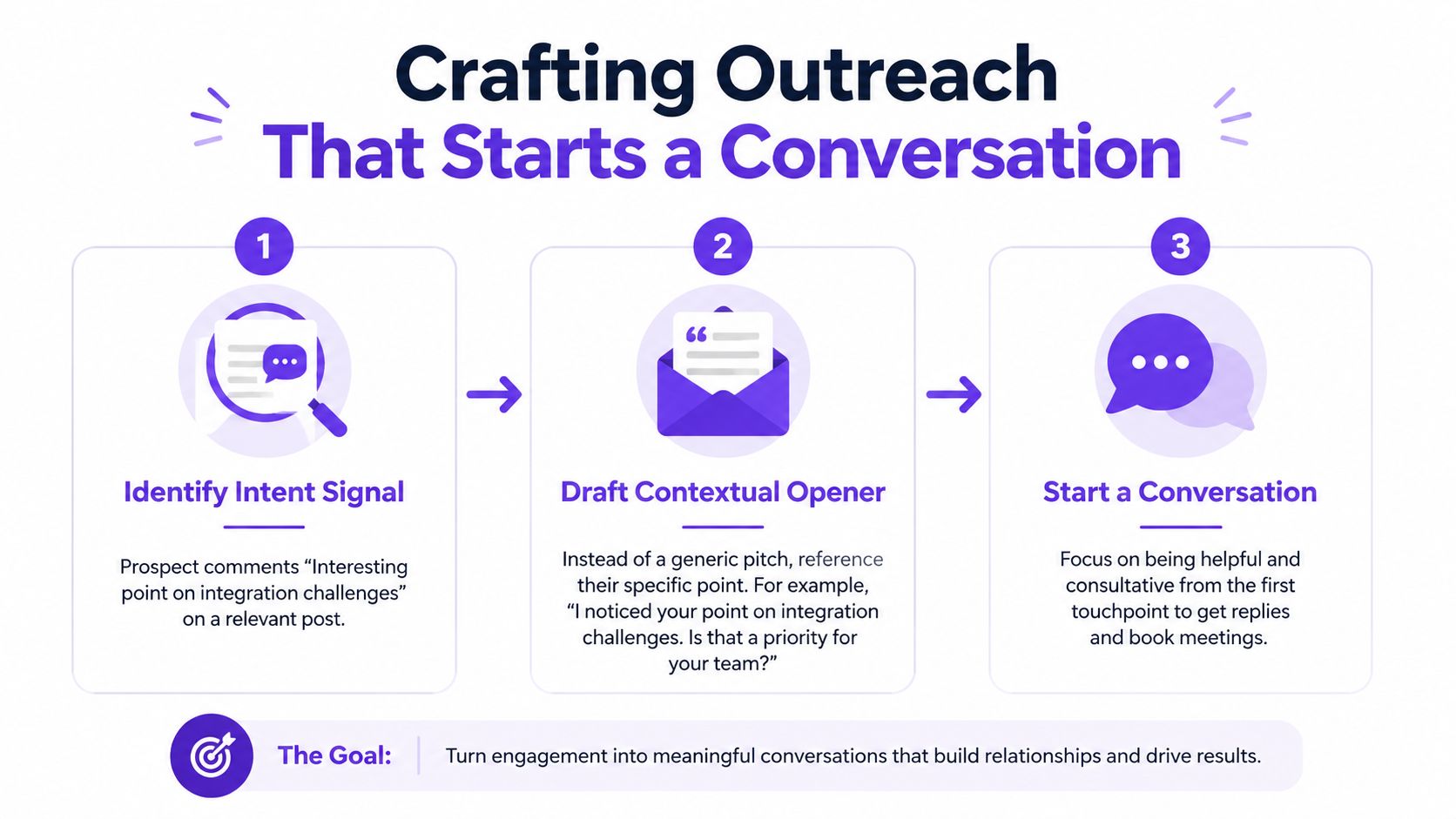
The key takeaway is that every single outreach is now rooted in perfect timing and relevance. That's why teams using this approach see such a dramatic boost in positive replies and, ultimately, more meetings booked.
Common Questions About B2B Lead Generation
Switching your team from cold outreach to an intent-based strategy always brings up a few hard questions. It's a big shift in mindset, and skepticism is healthy.
Here are the questions we hear most often from sales leaders, with the straight answers.
What is lead generation in B2B sales?
In B2B, lead generation is the process of identifying and initiating interest from potential business customers. The goal is to fill your sales pipeline with qualified prospects who have shown some level of interest in your product or service, moving them from "stranger" to "potential customer."
Why is traditional lead generation failing?
Traditional methods like buying cold lists and mass emailing are failing because B2B buyers are more informed and overwhelmed than ever. They're bombarded with generic messages and have become adept at ignoring anything that isn't highly relevant to their immediate needs. The lack of timing and personalization makes these methods ineffective.
What is intent data and why is it important?
Intent data is behavioral information that signals a buyer's active interest in making a purchase. This can include things like what they search for online, the content they engage with, or comments they leave on social media. It's crucial because it allows you to focus on buyers who are in-market right now, making your outreach far more timely and relevant.
Isn't This Just a Fancier Lead List? What’s the Real Difference?
Not even close. A regular lead list is static. It’s just a name and a title that fits your ICP, like a VP of Sales at a 500-person SaaS company. You have no idea if they’re in-market, happy with their current setup, or on vacation. Intent data shows you what that same VP is actually doing right now. Are they asking about competitor pricing on Reddit? Did they just comment on a LinkedIn post about a problem your tool solves? It’s the difference between a name in a phonebook and a hand in the air. One is a guess; the other is a signal.
Won't Using AI for Outreach Feel Impersonal and Robotic?
It's the opposite—if you use it correctly. The impersonal feeling comes from lazy, bad automation, not from the AI itself. Good AI doesn't write your outreach for you. It surfaces the most human, relevant moments for your reps to engage. It flags the context you need to start a genuine conversation. Think about it. Which is more personal? 1. A generic cold email: "Hi, we help companies like yours..." 2. A contextual message: "Saw you just commented on that post about integration costs. We actually ran into that same problem and built X to solve it..." The second one is a real conversation starter, made possible because the AI found the signal. It lets your team be more human, not less.
How do you find B2B leads on LinkedIn?
The best way is to monitor "intent signals" in comments and posts. Instead of just looking at job titles, look for prospects asking questions, complaining about problems your product solves, or engaging with content related to your industry. Following key influencers and competitors in your space will reveal comment sections rich with these opportunities.
What's the best way to approach a lead from LinkedIn?
Avoid a direct pitch. Your goal is to start a conversation. Reference the context you found—the comment or post they engaged with—and ask an open-ended question related to it. For example, "Noticed your point on X. Is that a big priority for you right now?" This shifts the interaction from a sales pitch to a peer-to-peer discussion.
How Do I Actually Measure the ROI on This?
It’s time to move past vanity metrics. Open rates and clicks don’t pay the bills. The metrics that matter are the ones that directly impact pipeline and revenue. Start tracking these: Positive Reply Rate, Conversation-to-Meeting Ratio, and Sales Cycle Length. Teams that make this shift typically see a 30-50% jump in booked meetings and a huge drop in time wasted on dead-end prospecting. That’s tangible ROI.
Can We Use This for Anything Besides Finding Leads?
Absolutely. Once you start monitoring intent signals across platforms like LinkedIn, you've essentially built a real-time market intelligence engine. Your GTM team can use these insights for competitive analysis (what are people saying about your rivals?), market research (what new pain points are emerging?), and even identifying strategic partnership opportunities. It gives you an unfiltered look into what your audience actually cares about right now.
How quickly should you respond to a B2B sales lead?
As fast as humanly (or technologically) possible. Studies show that responding within five minutes can make a lead 21 times more likely to enter your sales process compared to waiting 30 minutes. Speed is a massive competitive advantage in modern B2B sales.
Ready to stop guessing and start engaging buyers who are actively looking for a solution? RoverLead AI turns LinkedIn engagement into a daily feed of high-intent leads so your team can focus on conversations that matter. Discover how it works.