What Is Competitive Intelligence? a Guide for Sales Teams

You run a solid process. The reps know the pitch. The demos go well. Then a deal you should have won disappears, and the prospect says some version of, “We decided to go in a different direction.”
A week later, you find out the competitor had already repositioned around your weak spot, hired into that account's vertical, and seeded half LinkedIn with customer stories your rep never saw. That isn't bad luck. That's an information problem.
This is why competitive intelligence matters. Not as a boardroom hobby. Not as a quarterly slide deck nobody reads. As the game within the game for sales teams, founders, and GTM leaders who are tired of being outmaneuvered in plain sight.
Table of Contents
Why You Keep Getting Blindsided by Competitors
The usual postmortem sounds familiar. “We lost on price.” “They had a better relationship.” “The buyer went dark.” Sometimes that's true. Often it's a cleaner excuse than admitting nobody on your team saw the competitive move forming in public.
A rival changes messaging on their homepage. Their VP starts posting about a new use case. Their customers complain about onboarding friction. Their sales team begins targeting your niche on LinkedIn. Those aren't random crumbs. They're signals.
The problem is that most content about CI still treats it like an executive planning function. As this SafeGraph guide on competitive intelligence notes, existing content overwhelmingly frames CI as a strategic, long-term planning tool for executives, while missing how to operationalize it for daily sales execution and outbound prospecting.
Competitive intelligence gets expensive when it stays theoretical. The reps need it while the deal is still alive.
That gap is why sales teams keep reacting after the fact. They hear about a pricing change from a prospect. They learn about a competitor's new feature after losing two deals to it. They discover a market narrative only after it's already circulating.
If that sounds familiar, the fix usually starts with better monitoring habits and sharper workflows, not a heroic rep. A lot of teams begin by tightening their competitor monitoring tools stack so they can spot movement before it turns into pipeline damage.
The pattern behind the surprise
Three things usually cause the blindsiding:
The team tracks names, not signals. They know who the competitors are, but not what those competitors are doing this week.
The intel sits in marketing or product. Sales hears about it too late, or not at all.
Everything is treated as research. Nothing gets translated into “call this account now” or “change this talk track today.”
That last part is where most CI programs go soft. Useful competitive intelligence doesn't just explain the market. It changes what your team does before lunch.
Competitive Intelligence Is Not Corporate Spying
If the phrase still makes you picture trench coats and stolen slide decks, good news. That's not CI. That's a lawsuit.
What competitive intelligence actually is
Competitive intelligence is the practice of collecting and analyzing data on competitors to deliver insights to stakeholders, and it's broader than simple competitor analysis because it also pulls in market trends and customer research. The process follows five stages: Orientation, Data gathering, Data analysis and processing, Data reporting, and Actioning, as outlined by the Competitive Intelligence Alliance definition of CI.
In plain English, competitive intelligence means turning public and internal information into decisions your team can use.
That includes things like:
Public signals such as product pages, hiring patterns, webinars, pricing pages, customer reviews, and executive posts
Internal signals such as win-loss notes, call feedback, objection patterns, and CRM data
Decision-ready outputs such as battlecards, account alerts, competitor briefs, and outbound triggers
A good analogy is this. Market research tells you what weather patterns exist. Competitive intelligence tells your team whether to bring a coat, cancel the picnic, or launch the boat.
CI vs related disciplines
A lot of confusion comes from bundling CI together with other useful but different functions.
Discipline | Primary Goal | Key Question | Example |
|---|---|---|---|
Competitive intelligence | Help teams win against rivals | What are competitors doing, and how should we respond? | A rep gets a battlecard after a rival changes packaging and pricing |
Market research | Understand market demand and segments | What does the market want? | A team interviews buyers to learn category needs |
Sales intelligence | Find and qualify prospects | Who should we contact? | An SDR pulls contacts and account details for outreach |
Business intelligence | Track internal performance | How is our business performing? | A leader reviews pipeline conversion by segment |
There's overlap, of course. CI often uses market research, sales intelligence, and BI inputs. But the job is distinct. It exists to help the company make smarter moves against real competitors in real selling situations.
If your team is also sorting live buyer behavior, it helps to separate CI from intent data. They work well together, but they are not the same thing. Intent tells you who may be in market. CI tells you how to position against the alternatives they're considering.
Practical rule: If the output doesn't change messaging, targeting, pricing response, or rep behavior, it may be interesting. It isn't intelligence yet.
Your Competitors Are Leaving Clues Everywhere
Most competitors aren't hiding. They're publishing. Hiring. Posting. Launching. Defending themselves in comment threads. Their customers are talking too, often more candidly than the company does.
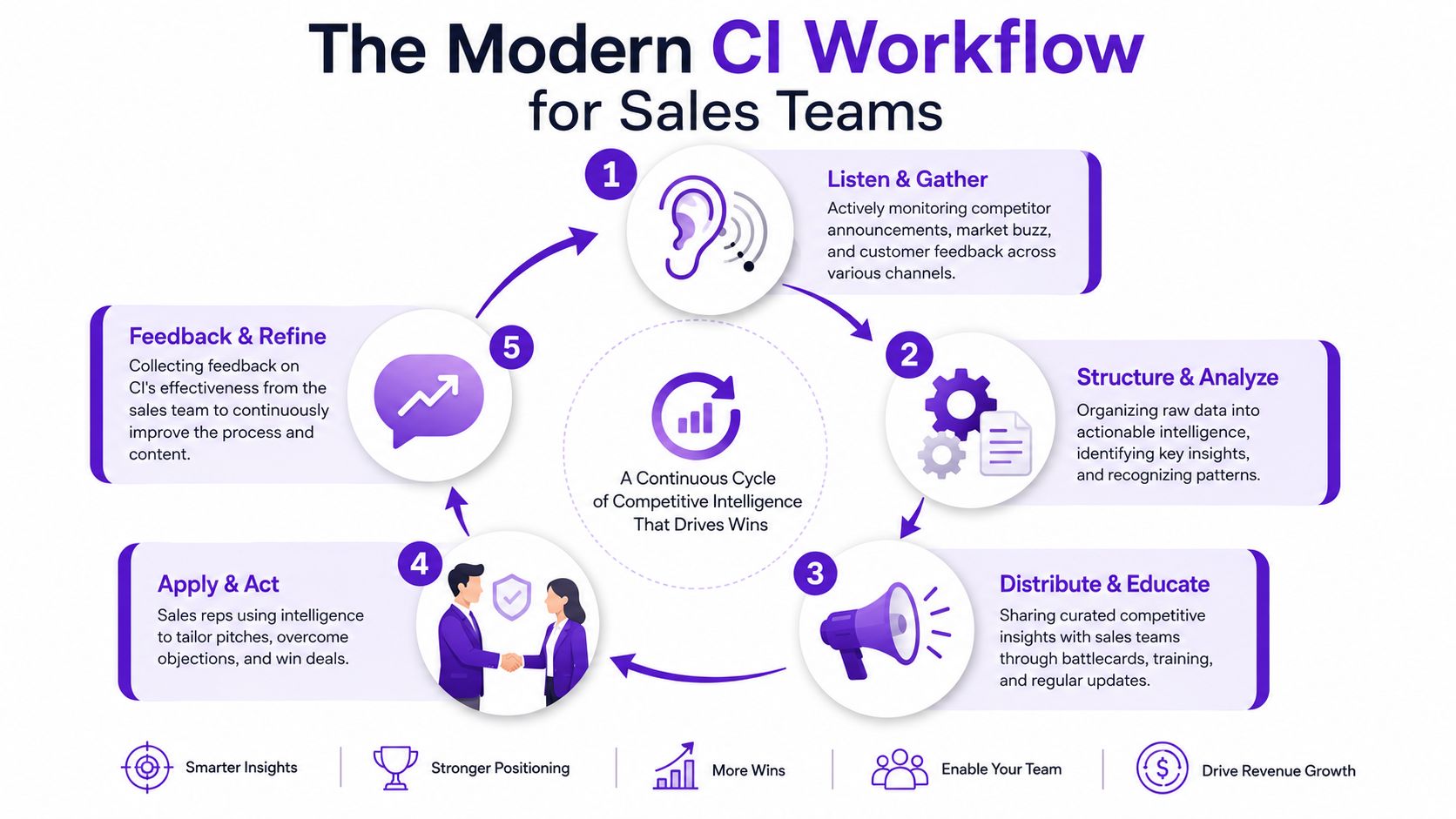
A modern CI workflow for sales looks like this:
The loop that works in the field
The cleanest model I've seen is Signal Collection → Synthesis → Insight → Human Layer → Action, with the human layer acting as the filter that keeps AI mistakes from steering strategy. It also starts with Key Intelligence Questions, so teams collect only the signals tied to actual business decisions, as explained in Contify's CI workflow write-up.
That matters because raw monitoring creates noise fast. Reps don't need every mention of a rival. They need the few signals that answer questions like:
Are they moving upmarket?
Are they pushing into our vertical?
Are customers praising a feature we still underplay?
Are buyers complaining about something we can exploit?
Here's the trap. Teams often over-collect and under-interpret. They save links, dump them into Slack, and call it a day. That's not a workflow. That's hoarding.
Where to look for live competitor signals
The most useful signals usually come from places people already scroll every day:
LinkedIn activity. New hires, promotion posts, thought leadership pivots, customer engagement, and comment threads around competitor content.
Customer review sites. Complaints reveal weak spots. Praise reveals positioning that's landing.
Websites and pricing pages. Messaging shifts often show up before launch announcements.
Job posts. Hiring tells you where they're investing.
Sales calls and lost deals. Buyers will tell you how the other vendor framed the category if you ask well.
Here's a practical walkthrough before the video.
How LinkedIn becomes an outbound trigger
At this point, CI stops being academic and starts printing meetings.
Say a competitor's Head of Partnerships starts engaging heavily with logistics content. Then several employees begin commenting on posts from logistics operators. Then a customer shares a win in that segment. That combination suggests a push into a vertical. A smart SDR doesn't admire the pattern. They build a list, adjust messaging, and get into those accounts first.
Another example. A prospect comments on a competitor post asking about implementation timelines. That's not just social chatter. It may be a buying signal with competitive context attached.
Tools can help with the listening phase. Teams often use social media listening tools to monitor these conversations, and platforms such as RoverLead AI can track LinkedIn engagement around competitors, creators, and topics so reps can work from behavior-based signals instead of static account lists.
The trick is restraint. Let software gather. Let humans judge. Then act quickly.
Putting Intelligence Into Action
Information only matters when it changes a move on the field. Otherwise, it's just trivia with a budget.
Start with tiering so you do not drown
You cannot monitor everyone at the same depth. Strong CI programs use a tiered approach: Broad Awareness, Selective Monitoring, and Close Monitoring, with close monitoring ideally focused on 5 to 10 rivals, according to AlphaSense's competitive intelligence guide.
That structure solves a very common sales problem. Teams try to track the whole market equally, then end up tracking nothing well.
A simple operating model looks like this:
Broad Awareness for the wider market. Think headline moves, category shifts, major launches.
Selective Monitoring for companies you bump into now and then.
Close Monitoring for the few rivals that regularly show up in deals, beat you on positioning, or threaten your core segment.
AlphaSense also points to SWOT/TOWS as useful analysis frameworks. They're not the end goal, but they help teams turn a threat into a response. If a competitor is strong in one area, the question becomes which internal strength lets you counter it or reposition around it.
A battlecard should answer one question fast: “What do I say when this rival comes up in a live deal?”
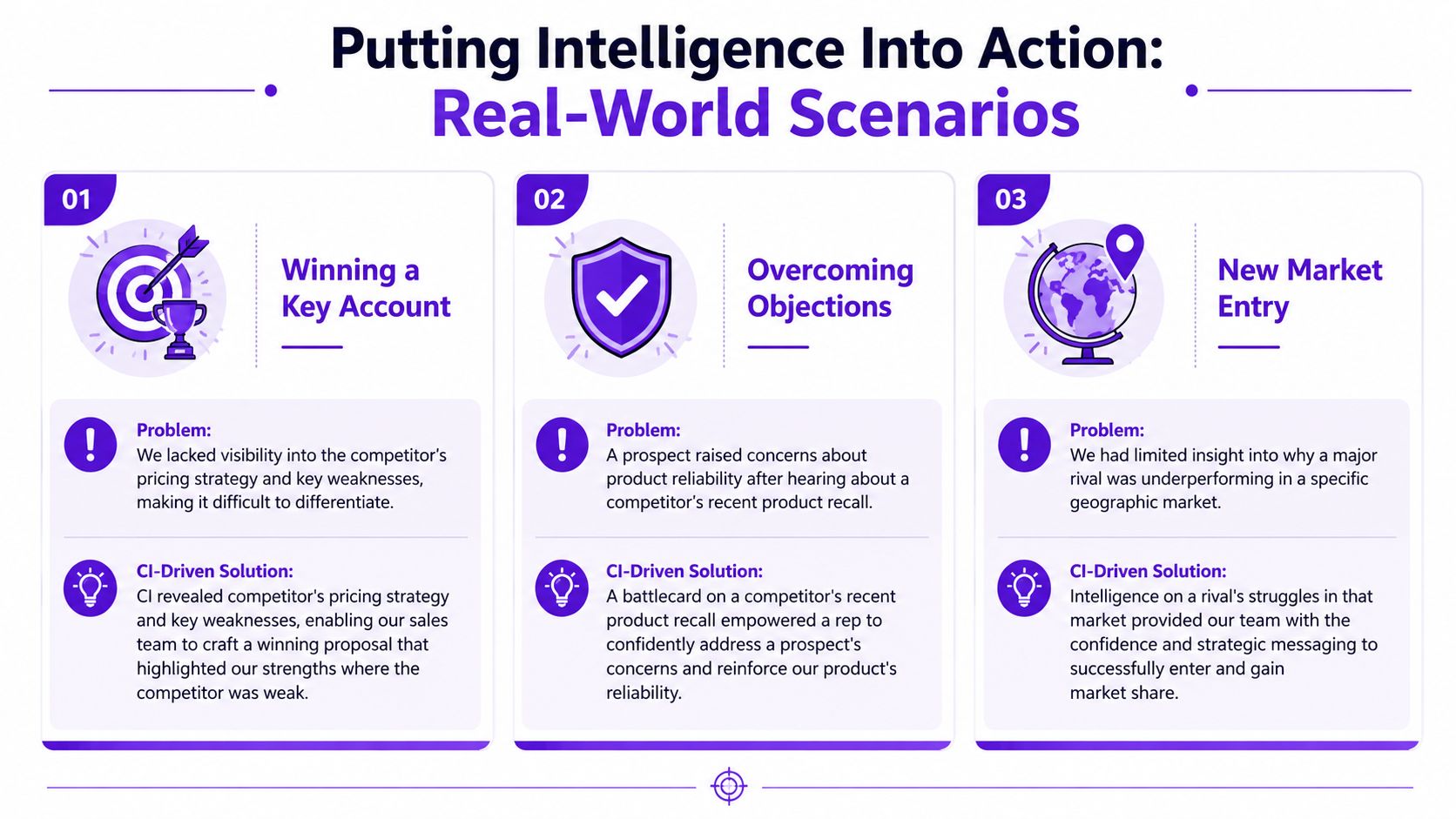
Three signal to action scenarios
Scenario one. A competitor's product lead updates LinkedIn language toward “enterprise governance” and several new hires have compliance-heavy backgrounds.
Action. Alert product marketing and enterprise sales. Refresh objection handling for governance-focused buyers before the next demo cycle.
Scenario two. A cluster of users complains online about a rival's support responsiveness.
Action. Build an outbound sequence to accounts using that competitor. Lead with service reliability and customer transition concerns, not generic “we're better” chest-thumping.
Scenario three. Your reps keep hearing the same rival in late-stage deals, but nobody can explain why they win.
Action. Pull recent call notes and lost deal feedback. Build a comparison matrix based on evidence, not vibes. Then update battlecards and call scripts so reps can answer the actual objection instead of the imaginary one.
A lot of teams support this work with sales intelligence tools, but the sales intel layer alone won't save you. You still need someone deciding which signals matter, what they mean, and what the field should do next.
The companies that get value from CI don't treat it like a library. They treat it like air traffic control.
How to Know If Your CI Program Is Working
If your CI program produces “great insights” but nobody can tie it to revenue, it won't survive budget season.
Measure outcomes not activity
Actionable CI dashboards should track ten metrics, including Revenue impact, Competitive confidence, Win-Rate, and Competitive win rate, and pair those with qualitative measures such as stakeholder confidence, according to Klue's guide to CI metrics and dashboards.
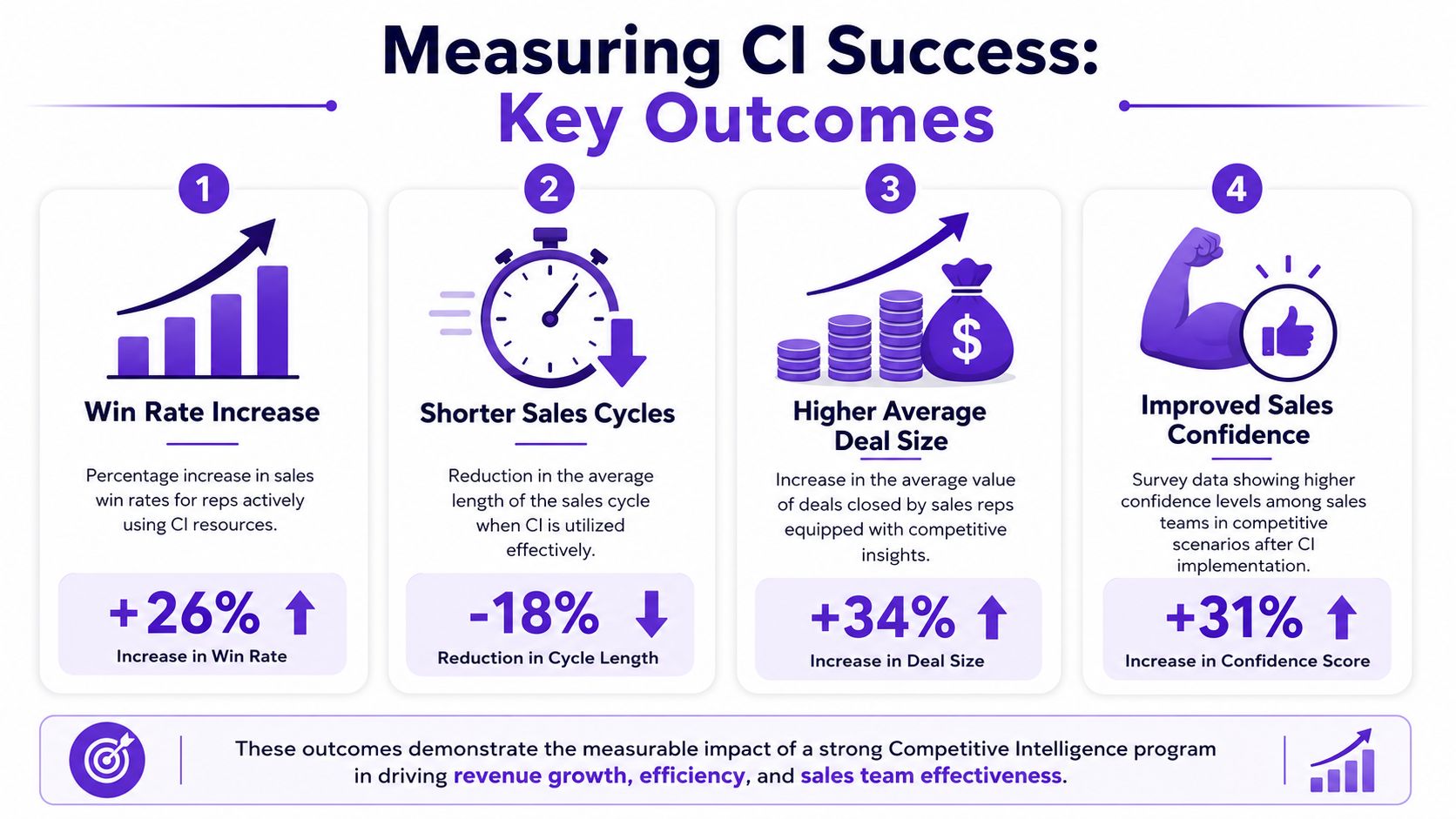
For a sales leader, the most practical scorecard usually includes:
Competitive win rate so you can tell whether the team is improving in head-to-head deals
Revenue impact so CI doesn't get reduced to content usage stats
Competitive confidence because rep behavior changes when they know how to handle a rival
Average deal length to see whether stronger positioning shortens stuck deals
Deal support requests to reveal where the field needs sharper assets
You can also calculate economic value more directly. Crayon notes that organizations can measure Competitive Revenue Won with this formula: (average deal size) × (total competitive deals) × (win rate against competition). The same source states that 91% of companies with CI programs saw quantitative benefits, 95% saw qualitative benefits, and 93% took strategic actions based on the intelligence, as described in Crayon's article on measuring CI value.
Stay useful and stay ethical
The legal line here is simple. Use public information, customer conversations, internal deal data, and ethical research methods. Don't misrepresent yourself. Don't pressure employees of a competitor for confidential material. Don't turn CI into gossip with a logo.
The best CI programs are boring in one way. Their sources are clean, documented, and repeatable.
That discipline matters because trustworthy intelligence gets used. Sketchy intelligence gets ignored, and deservedly so.
Your Competitive Intelligence Questions Answered
FAQ
1. What is competitive intelligence in simple terms?
It's the practice of collecting and analyzing information about competitors so your team can make better decisions and win more deals.
2. How is CI different from competitor analysis?
Competitor analysis is usually narrower. CI is broader, more continuous, and more action-oriented. It includes competitor moves, market context, customer feedback, and what your team should do with that information.
3. Is competitive intelligence only for big companies?
No. Big companies may formalize it more, but small teams often benefit faster because one sharp signal can change this week's outreach or positioning.
4. What should an SDR monitor first?
Start with the few competitors that come up most often in deals. Watch their LinkedIn activity, messaging changes, customer chatter, and any repeated objections tied to them.
5. How much time should a rep spend on CI? Less than one might assume. The goal isn't to become a researcher. The goal is to work from a short feed of relevant signals and use them in outreach, discovery, and objection handling.
6. What are Key Intelligence Questions?
They're the specific business questions that define what you should monitor. Without them, teams collect noise.
7. Should founders do CI themselves?
Early on, yes. Founders hear market language directly in sales calls and can often spot positioning gaps faster than anyone else.
8. What is the biggest CI mistake?
Analysis paralysis. Teams gather a pile of interesting information and never turn it into a talk track, a list, a battlecard, or an account action.
9. Can AI handle competitive intelligence on its own?
No. AI can speed up collection and synthesis, but the human layer still matters because somebody has to judge relevance and avoid bad conclusions.
10. What does a healthy CI habit look like each week?
Review the top competitor signals, update one field-facing asset if needed, and push at least one concrete action to sales. If nothing changes in the field, the loop isn't closed.
If you want CI to show up in practice, not just in slides, RoverLead AI helps teams turn LinkedIn engagement around competitors, creators, and niche topics into daily prospecting signals. It's a practical way to spot who's already leaning into the conversation, so reps can reach out with context instead of guessing.