Modern Prospect List Building: Find High-Intent Buyers

Most advice on prospect list building is stuck in 2019. It tells you to pick an industry, filter by company size, grab a title, export a list, and start sending emails like a machine with a quota and no shame.
That still produces a list. It just rarely produces timing.
The issue isn't that firmographics are useless. They're necessary. The problem is that static filters tell you who could buy, while real buying signals tell you who might buy now. If you're still building lists only from job titles and company size, you're sorting a database when you should be watching behavior. The shift from cold lists to intent-based prospecting isn't a trendy tweak. It's a practical response to how buyers research, comment, compare, and raise their hands in public long before they fill out a demo form.
Table of Contents
Why Your Prospect List Is Probably Broken
Frankly, a lot of prospect lists are cemeteries with CSV formatting.
They look tidy in the CRM, but they're stuffed with stale titles, irrelevant contacts, and people who matched a filter months ago but don't match the moment anymore. Sales teams then blame messaging, channels, or reps. Usually the bigger issue is upstream. The list was never alive to begin with.
Relying only on static criteria creates a timing problem. Nimble notes that teams relying solely on static criteria miss the "active research" window, where prospects are 30–50% more likely to engage. That's the difference between emailing someone who's vaguely in-market and reaching someone who's publicly showing interest, friction, or urgency.
Practical rule: A list built only on fit answers "could they buy?" A useful list answers "why now?"
Static list building also trains bad habits. Reps start chasing volume because relevance isn't doing any heavy lifting. They overwork dead accounts, recycle generic sequences, and wonder why replies feel allergic to their inbox.
The fix isn't to throw out firmographics. It's to stop pretending they're enough. Strong prospect list building starts with fit, then layers in observable behavior such as comments, topic engagement, competitor interactions, hiring patterns, funding news, and public buying questions. That's where timing shows up, and timing is what turns a contact into a prospect.
Beyond Job Titles Defining Your High-Intent ICP
A good ICP isn't a vague fantasy like "mid-market SaaS leaders who value efficiency." That's not an ICP. That's wishful thinking wearing a blazer.

Start with the narrow core
The foundation still matters. LeadScrape's guidance is clear that the most critical technical step is defining a narrow ICP across four dimensions, industry, company size, job title, and geography, and then mapping 2–3 contacts per account at different buying group levels. If you skip that discipline, intent signals just create a noisy pile of names.
That buying group point matters more than is commonly admitted. One-contact prospecting is lazy prospecting. Deals usually involve an economic buyer, a technical evaluator, and some internal champion who has to live with the decision after procurement disappears.
If your team needs a refresher on the basics, this guide on what ICP stands for in business is a useful starting point.
Add the signals static ICPs miss
Once the narrow core is defined, modern prospect list building gets more interesting. Add behavioral fields that help a rep understand timing and angle, not just fit.
Useful signal questions include:
Who do they engage with? Creator comments often reveal what ideas, tools, and workflows they care about right now.
What frustrations do they state publicly? Complaints about process, reporting, pricing, hiring, or tool sprawl are prospecting gold.
How do they participate? A thoughtful comment, a buying question, and a passive like are not the same thing.
What role are they playing? The loudest commenter isn't always the decision-maker, but they may be the best internal champion.
The best ICPs aren't static profiles. They're filters for relevance plus patterns for intent.
A key failing point for old-school personas is their description of the buyer as a job title. High-intent ICPs describe the buyer as a participant in a live conversation.
How to Source Prospects Who Signal Intent
The old move was simple. Open Sales Navigator, stack a few filters, export names, and feel productive. The newer move is less glamorous and far more effective. You listen first.
Static vs Intent-Based Prospecting
Attribute | Static List Building (The Old Way) | Intent-Based List Building (The New Way) |
|---|---|---|
Core input | Industry, size, role, geography | Fit plus public behavior and buying context |
Timing signal | Weak or absent | Visible through engagement and trigger events |
Research method | Database filtering | Monitoring creators, competitors, topics, and triggers |
Outreach angle | Generic role-based pain point | Specific reason tied to observed activity |
Typical list quality | Broad but cold | Smaller but warmer |
Risk | High waste on inactive or irrelevant contacts | More manual judgment required |
Best use case | TAM mapping and baseline coverage | Daily prospecting and prioritization |
If you're building from scratch, use both. Static filters define the playing field. Signals tell you where the ball is.
If you want a clearer breakdown of intent data, this overview of what intent data is gives the broader context.
Watch creator comment sections
This is one of the most underused prospecting workflows because it doesn't feel like "real list building." It is.
Find creators your ICP already pays attention to. Not celebrity fluff. Actual operators, consultants, analysts, and niche voices who post about the problem you solve. Then watch who comments consistently and substantively.
Look for people who:
Ask process questions about implementation, cost, timelines, or tooling
Share constraints like headcount, budget pressure, broken handoffs, or poor visibility
Compare options by naming competitors, approaches, or internal alternatives
A comment such as "We've been trying to fix this with spreadsheets and it's ugly" tells you more than a title ever will.
Mine competitor engagement carefully
Competitor content attracts some of the strongest buying signals in public. Not every comment is useful, but some are flashing neon.
Watch for:
Pricing curiosity. Questions about packages, contracts, onboarding, or fit.
Evaluation behavior. People asking whether the tool works for a specific team, stack, or use case.
Frustrated users. Complaints in comments are awkward for the brand and useful for you, provided you don't pounce like a raccoon in a trash can.
A compliant approach matters here. QuickColdCalls highlights the recurring question of how to build a compliant prospect list on LinkedIn without triggering bans or using black-hat scrapers, and points to a shift toward social selling through engagement-based discovery. In plain English, don't scrape recklessly. Use public engagement as a research layer, not a shortcut to spam.
Follow topic conversations, not just people
Some of the best prospects don't follow the obvious influencers and don't engage with your competitors in public. They do, however, show up around topics.
Track conversations around your problem space, common alternatives, and operational pain points. For example, if you sell recruiting software, don't just watch HR creators. Watch discussions about hiring bottlenecks, interview scheduling, and candidate drop-off.
Good sourcing isn't about finding everyone in your market. It's about catching the few people who are already leaning into the problem.
One practical setup is to combine a database for baseline coverage with an engagement-monitoring workflow. Tools like Sales Navigator still help with account identification. Lusha or Apollo can help later with contact details. Platforms like RoverLead AI monitor LinkedIn engagement around creators, competitors, keywords, and topics so reps can build lists from observed activity rather than static exports.
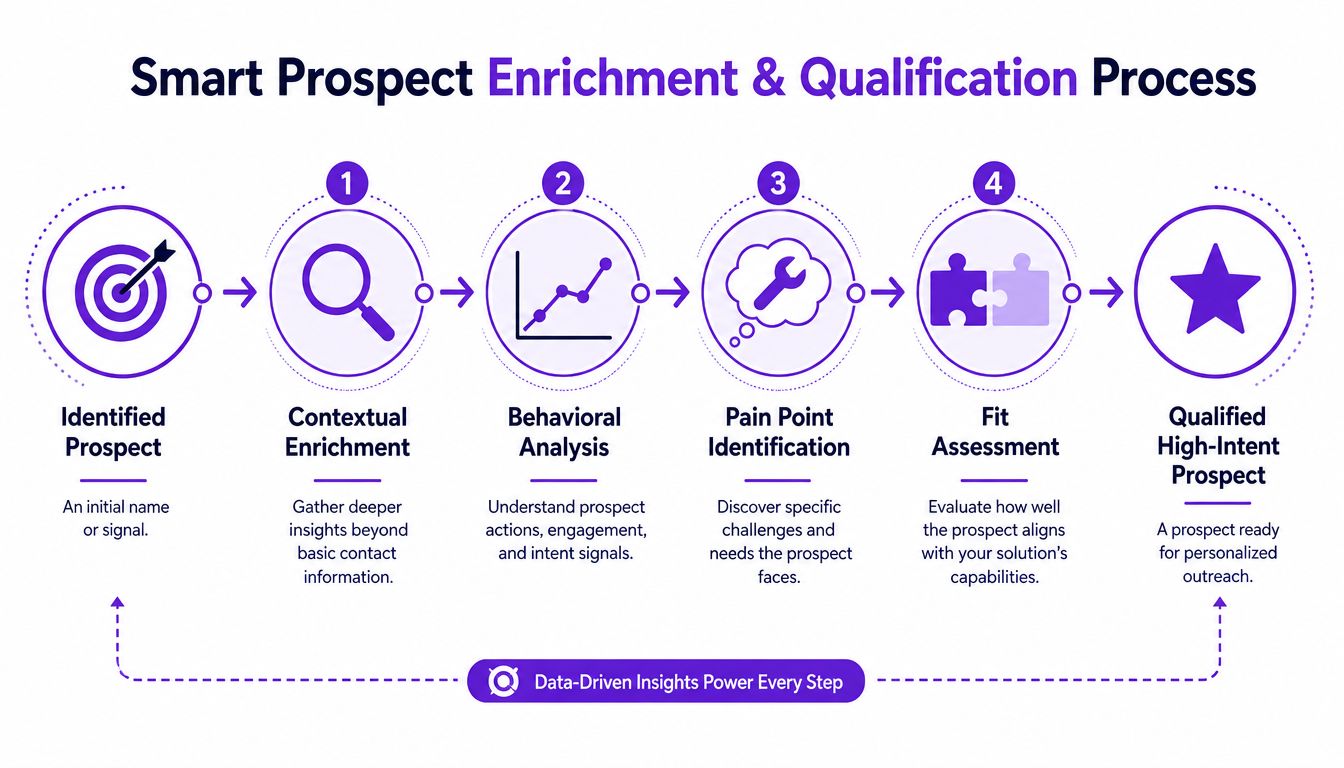
Enrichment and Qualification The Smart Way
A name plus an email address isn't enrichment. That's postage.
Context beats raw contact data
Once you've identified a prospect through a signal, add the details that make outreach timely and sane. ZoomInfo's guidance is straightforward: a high-converting prospect list should include enriched fields beyond basic contact info, including current tech stack, funding stage, hiring trends, and intent signals that indicate an active buying window.
That means the rep should know more than "VP at Company X."
A useful record includes:
Observed trigger such as a comment, share, or buying question
Company context like hiring direction, recent leadership changes, or growth signals
Environment clues including likely tech stack or operating model
Role in the deal based on seniority and what they talk about publicly
For teams cleaning and appending records, this walkthrough on CRM data enrichment is worth bookmarking.
Here's a practical visual for the workflow:
Build a mini-dossier before outreach
Keep it short. This isn't investigative journalism. It's enough context to help a rep write like a human.
A good mini-dossier usually answers:
What happened? The exact interaction or signal.
Why does it matter? The problem or priority implied by that action.
Why this person? Their likely influence in the buying group.
What should we say first? A simple observation tied to the signal.
The ordering matters. Find the signal first, enrich second, then pull contact details last. When teams reverse that order, they waste time enriching strangers who never showed intent in the first place.
Prioritizing Prospects and Crafting Your Opener
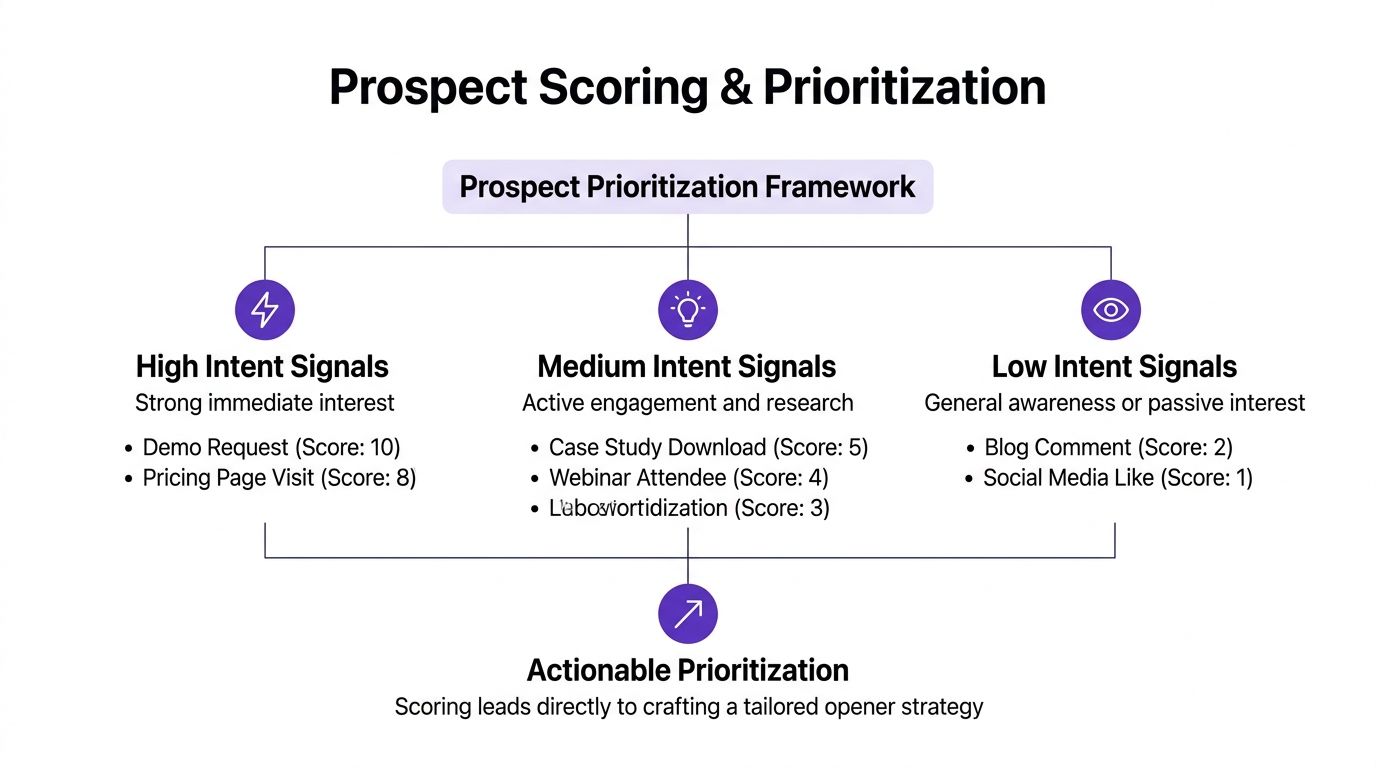
Not all signals deserve the same urgency. A like is light interest. A detailed comment about rollout friction is a conversation starter. A public pricing question is closer to a raised hand.
Score the signal, not just the account
Priority should reflect both fit and immediacy. Lusha reports that prospect lists built with intent signals and tiered by priority achieve 30–50% higher meeting rates than lists based purely on static firmographics. That's the operational case for scoring.
A simple practical model:
High priority
People discussing implementation, evaluating alternatives, asking for recommendations, or engaging repeatedly with problem-specific content.Medium priority
People commenting on adjacent topics, reacting to educational content, or appearing during a relevant company trigger such as hiring or leadership changes.Low priority
People who fit the account but show weak or ambiguous engagement.
Field note: Prioritization works best when reps can explain the score in one sentence. If the score needs a committee, it won't get used.
Write openers that sound observant, not invasive
The opener should use the signal as the reason for contact. Not as surveillance theatre.
Bad opener:
"I saw you commented on three posts, liked two others, and your team is hiring AE's, so I thought I'd reach out."
Better opener:
"Your comment about messy handoffs after demos caught my eye. That's usually a sign the issue isn't top-of-funnel volume, it's follow-up quality."
Another one:
"You mentioned evaluating options for your outbound workflow. Reaching out because that usually gets messy once lists are built on titles but not timing."
Short works. Specific works. Creepy doesn't.
If your team needs examples to adapt, this collection of cold email templates is a practical reference point.
Keeping Your Prospect List Alive and Optimized
A prospect list isn't an asset you build once. It's a system you maintain, or it turns into expensive fiction.
Treat the list like a system
Monthly hygiene is not admin busywork. This guidance on data cleansing recommends cleaning monthly rather than ad hoc because it's one of the most important and overlooked ways to prevent wasted outreach on inactive contacts. That's especially true when your list includes moving targets such as role changes, hiring shifts, and fresh engagement signals.
A healthy routine includes:
Review signal quality by checking which behaviors led to replies or meetings
Retire dead records when titles change, companies shift, or context goes stale
Tighten ICP rules when certain segments consistently underperform
Refresh buying groups so the rep isn't betting everything on one contact
One more thing. Don't measure success by how fast the list grows. Measure whether the list keeps producing relevant conversations. A smaller living list beats a giant frozen one every week.
Prospect List Building FAQ
Is prospect list building still worth doing manually?
Yes, partly. Manual review is still valuable for interpreting comments, tone, and context. Purely manual list assembly gets slow fast, so organizations use tools for discovery, enrichment, and validation while keeping human judgment for prioritization and messaging.
What's wrong with building a list only from LinkedIn Sales Navigator?
Nothing is wrong with it as a starting point. The problem starts when it becomes the whole strategy. Static filters identify possible buyers, but they don't tell you who's actively researching or frustrated right now.
How big should a prospect list be?
Big enough to support consistent outreach, small enough that every name has a reason to be there. If reps can't explain why someone is on the list, the list is already bloated.
Which signal matters more, a like or a comment?
A comment usually carries more context. A like may indicate awareness. A specific comment can reveal pain, timing, or evaluation behavior.
Should I build lists by person or by account?
Both. Start with accounts that fit your ICP, then map the actual buying group inside them. Prospecting one person per account is usually wishful thinking disguised as efficiency.
What fields should I enrich beyond email and title?
Focus on context. Tech stack, funding stage, hiring trends, and current intent clues are useful because they help a rep understand why outreach might matter now.
How often should I clean the list?
Monthly is the right default for active outbound programs. Waiting until reply rates collapse is like changing the oil after the engine starts smoking.
How do I build a compliant prospect list on LinkedIn?
Use public engagement for research and discovery, not black-hat scraping. That question comes up constantly, and the smarter direction is social selling through engagement-based discovery rather than brute-force extraction, as noted in the earlier section.
What's the difference between a marketing lead and a sales-ready prospect?
A marketing lead often shows broad interest. A sales-ready prospect shows fit plus some sign of current relevance, whether that's a trigger event, active engagement, or a clear operational problem.
When should I pull contact details?
Late in the process. First confirm fit, then validate the signal, then enrich for context, and only then find the best contact route. That sequence keeps your team from spending energy on names that were never worth pursuing.
RoverLead AI helps teams build living prospect lists from LinkedIn engagement instead of static exports. If your reps are spending too much time digging through creator comments, competitor posts, and topic feeds by hand, RoverLead AI is one option for turning those signals into daily ICP-matched prospects with context for outreach.