SDR Outbound Strategy That Actually Books Meetings

Your SDRs are busy. Their calendars are not.
They're sending emails, making calls, nudging LinkedIn requests, logging tasks, updating CRM fields, and somehow still ending the week with a pipeline that looks like a grocery receipt. Thin, forgettable, and not worth framing. That's the trap many organizations find themselves in right now. They confuse motion with progress, then wonder why reps burn out and buyers tune out.
A modern SDR outbound strategy has to do one thing well. It has to catch people when context exists. Not when a sequence says “Day 4: send follow-up.” Not when a dashboard says “activity behind goal.” When the buyer has shown a reason to care.
That shift changes everything. Who you target. When you reach out. What you say. Which channel you use first. And what you reward on the scoreboard.
Table of Contents
Why Your Outbound Feels Like Shouting into the Void
It's 4:30 p.m. Your SDR has logged a full day. Fifty emails sent. Dozens of calls made. A few LinkedIn touches. The dashboard looks busy. The pipeline does not.
That's the trap.
A lot of sales teams still reward visible effort over buyer response, then act surprised when reps burn out and meetings stay flat. More activity does not fix weak timing. It just spreads the same bad message across more channels.
Buyers are better at ignoring you than your team is at interrupting them. Generic outreach gets screened, skimmed, deleted, or forgotten. Relevance wins. Timing wins. Raw volume loses unless you enjoy paying people to be background noise.
Practical rule: If the message would make sense to a thousand strangers, it will matter to none of them.
Good outbound also works across channels with a reason, not as a random pile of tasks. Email, calls, LinkedIn comments, DMs, and follow-ups should reinforce one another around a real signal, not just fill a cadence. If email performance is already slipping, fix that first. This guide on how to avoid spam filters covers the basics your team cannot afford to ignore.
I often see these patterns:
Static list obsession means reps chase accounts because they match an old ICP doc, not because anything suggests they care right now.
Channel silos create clumsy outreach. One team sends emails, another pounds the phones, LinkedIn gets treated like a box to check, and none of it connects.
Signal blindness keeps reps working cold accounts while warmer prospects are raising their hands through hiring activity, social engagement, content views, or competitor research.
Activity theater turns management into a scoreboard for dials and send counts instead of a system for improving conversations and booked meetings.
Here's the shift I'd make. Stop asking, “How many touches did we get out today?” Start asking, “What changed at this account, and why does that make this outreach timely?”
That question produces better outbound. It also produces fewer wasted reps.
The Foundation Defining Who and When to Target
Static targeting is comfortable. It's also lazy.
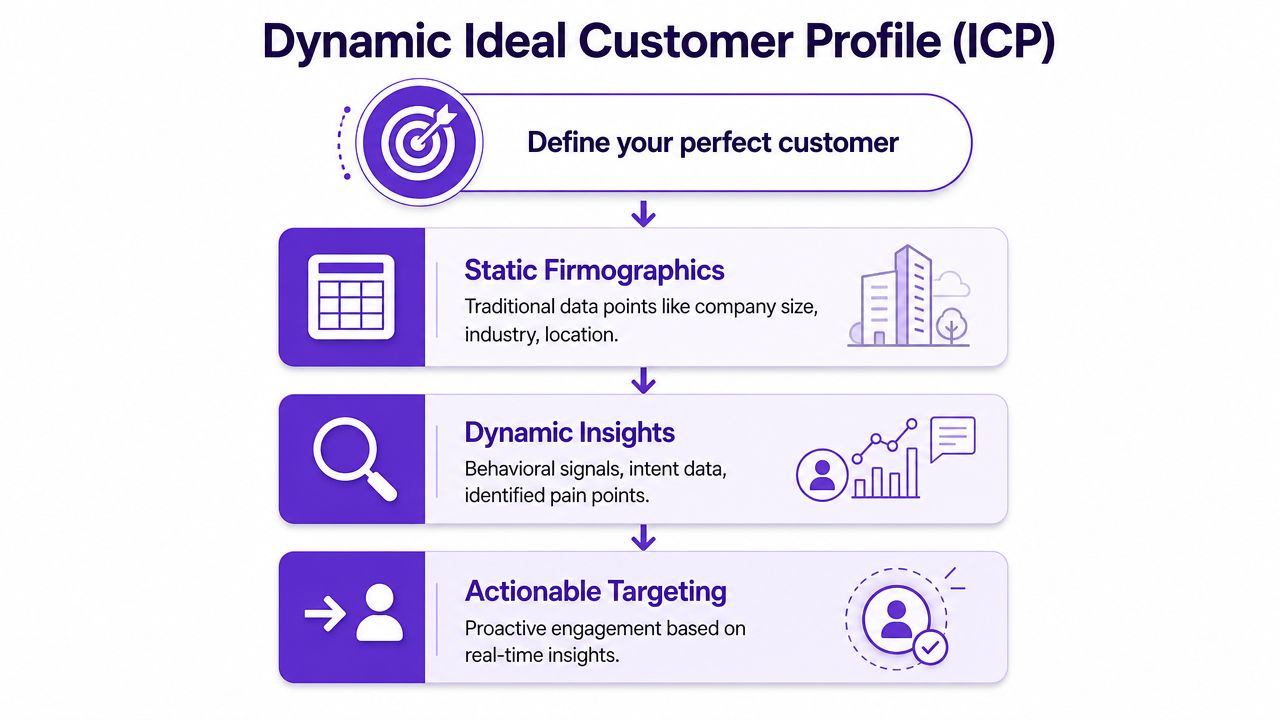
A lot of teams say they have an ICP when what they really have is a filter set. Industry, company size, region, title. Useful, sure. But that only tells you who could buy. It doesn't tell you who might buy now.
Stop treating ICP like a static spreadsheet
A real SDR outbound strategy combines firmographics with behavior. Think of it as a live ICP.
You still start with the basics. Define the segment clearly enough that messaging can stay specific. For outbound segmentation, experts recommend a minimum of 500 accounts per segment and a ceiling of 2,000 accounts so reps have enough volume without losing precision, based on SalesBread's outbound strategy guidance.
Then you layer in signals. Not vanity noise. Buyer-led clues that suggest attention, frustration, comparison shopping, or a shift inside the account.
That's why I like the idea of reviewing your ICP through the lens of real-world triggers, not just company attributes. If you need to tighten up the basics first, this explanation of what ICP means in business is a clean starting point.
What a live prospecting list actually looks like
The better teams don't just build lists. They validate them in motion.
Successful teams log first-person insights to validate lists instead of merely creating them. They track buyer-led signals such as comments on competitor content or pricing discussions, monitor 10+ buying signals, and use curated feeds to cut research time by 60% while lifting positive reply rates by 2–3x, according to Lusha's SDR outbound strategy analysis.
That changes how an SDR spends the day. Less time scraping random accounts. More time acting on timely context.
A dynamic targeting workflow usually looks like this:
Start with segment logic
Pick a narrow market with shared problems. Don't mash five personas into one sequence and call it personalization.Watch for behavior
LinkedIn is especially useful here. Job changes, comments on competitor posts, pricing chatter, and content engagement often reveal more than a database field ever will.Capture buyer language
Save the exact phrases prospects use. That gives your reps opening lines that sound observed, not manufactured.
Buyers respond when reps sound like they've noticed something real, not when they sound like they merged a first name into a template.
The old list is dead the minute you export it. A good list keeps moving.
Crafting Cadences That Don't Get Ignored
Most cadences fail because they're built around rep convenience.
“Send email on day one, call on day three, bump email on day five” is not strategy. It's calendar furniture. If there's no trigger behind the outreach, the buyer feels that instantly.
Build around a signal, not a schedule
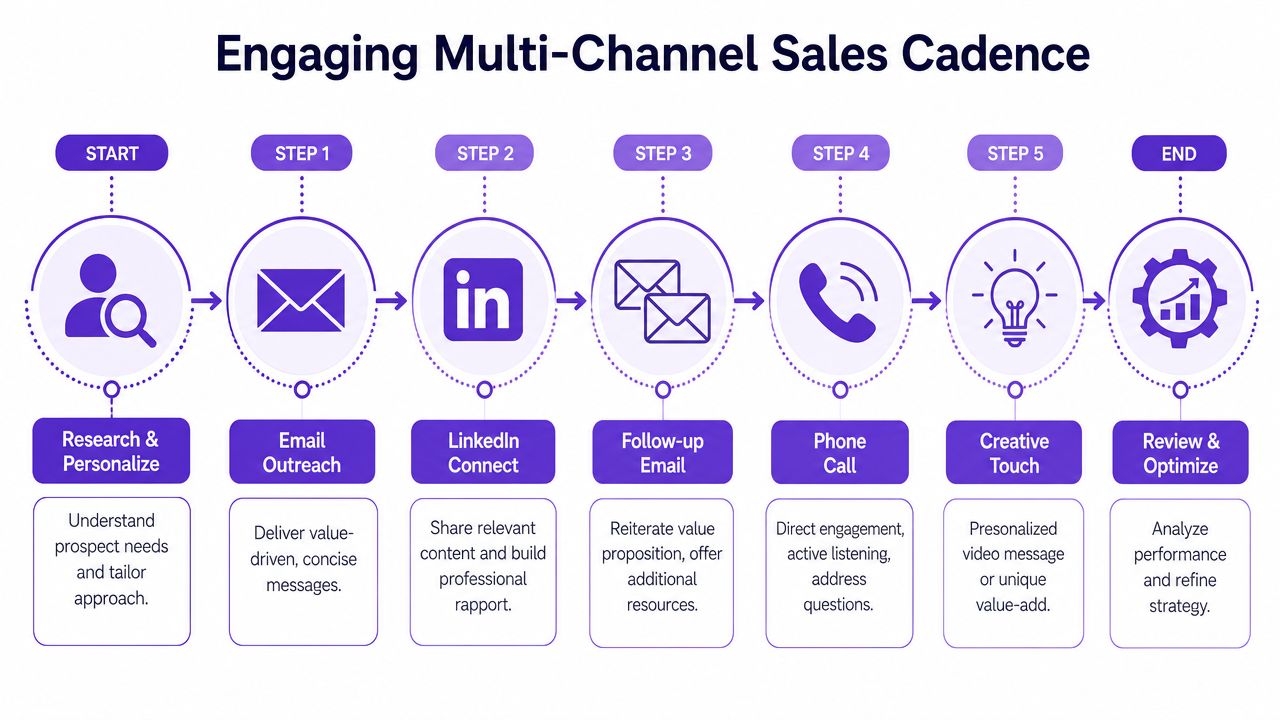
The best outbound sequences overlap channels on purpose. Email introduces context. LinkedIn adds familiarity. A call tests urgency. A comment or DM can warm the next touch. That's very different from sending disconnected messages that each pretend it's the first interaction.
LinkedIn deserves more respect than most SDR teams give it. Top-performing teams achieve a 15–25% response rate on LinkedIn outreach when messages are warm and contextual, versus the 5–10% typical for cold email connect rates. Teams also need to keep email bounce rates below 2% to protect deliverability, according to Apollo's outbound metrics guide.
If your team keeps defaulting to email-first everything, you're probably leaving easy conversations untouched. And if your messaging needs work, reviewing a few solid cold email templates can help your reps stop writing messages that sound like microwaved corporate soup.
A simple signal-based sequence might look like this in practice:
Signal appears
Prospect comments on a competitor-related post about pricing, implementation pain, or tool switching.First touch on LinkedIn
Reference the discussion directly. Don't pitch. Add a relevant thought or ask a smart question.Email follows with context
Mention the same trigger and one practical reason teams in that situation explore change.Call with continuity
Open with the observation, not your company bio. Buyers don't need a cold recital.Final touch adds value
Share a useful angle, a question, or a concise observation. Never “just checking in.”
Traditional Outbound vs. Intent-Driven Outbound
Element | Traditional Outbound (The Old Way) | Intent-Driven Outbound (The New Way) |
|---|---|---|
Targeting | Static lists pulled by title and firmographics | Live accounts filtered by fit and recent buyer behavior |
Timing | Sequence starts because the rep needs activity | Sequence starts because the buyer showed context |
Opening line | Generic intro about your company | Specific note tied to a visible trigger |
Channel use | Email-heavy, phone separate, LinkedIn optional | Channels overlap and reinforce one another |
Message goal | Push for a meeting fast | Start a relevant conversation first |
Rep behavior | Maximize volume | Prioritize judgment and timing |
Manager focus | Count sends, calls, and tasks | Inspect response quality and pipeline movement |
A cadence should feel like one conversation happening across channels, not four strangers taking turns.
Simple rebuttals that keep the conversation alive
Early objections usually mean “I'm unconvinced,” not “never contact me again.”
Try these instead:
“Not a priority.”
“Fair enough. I reached out because of the discussion around pricing and evaluation. If that's not active, I can step back. Has that conversation moved later?”“Send info.”
“Happy to. I'll keep it short. Before I do, was your interest more around replacing a current process or tightening an existing one?”“We already have a vendor.”
“Makes sense. Most teams I speak with do. I'm usually reaching out when they're comparing tradeoffs, not because they want another tool dumped on them.”
From Conversation to Calendar Booking and Beyond
A positive reply is not the trophy. It's the doorway.
Too many SDR teams celebrate the response, toss over a scheduling link, and call it done. Then the prospect ghosts, reschedules, or shows up with no real fit. That's not pipeline. That's calendar cosplay.

The reply is not the win
When someone answers, the SDR needs to do three things quickly. Clarify fit, reinforce relevance, and make booking frictionless.
That means no clunky interrogation. No mini-discovery marathon over email. Just enough qualification to confirm there's a real reason to meet.
A cleaner workflow looks like this:
Clarify the trigger
“You mentioned X. Is that something your team is actively sorting through right now?”Confirm the angle
“Got it. Sounds like the issue is less about tools and more about timing and process.”Offer a specific next step
Give actual time options or a simple scheduling path. If you need ideas, this guide on how to request an appointment covers the basics without sounding robotic.
The metrics that deserve your attention
The metric that matters most after booking is meeting quality.
Teams should aim for 20–35% of meetings converting into qualified opportunities, and highly targeted ABM outbound can reach 40% or higher, based on Outbound Republic's breakdown of outbound metrics that matter.
That benchmark forces honesty. If meetings are high but qualified opportunities are weak, your SDR outbound strategy is probably attracting curiosity instead of fit.
A healthy manager reviews:
Funnel checkpoint | What to inspect |
|---|---|
Positive reply | Was the response tied to a clear trigger or just polite curiosity? |
Qualification | Did the rep identify a real problem and a credible next step? |
Booking | Was scheduling specific and easy? |
Attended meeting | Did the SDR transfer useful context to the AE? |
Qualified opportunity | Did the meeting create pipeline, not just a calendar event? |
Manager lens: Booked meetings are output. Qualified opportunities are proof.
Good teams test messaging and cadence continuously, but they don't test blindly. They inspect where conversations stall, then adjust the opener, the channel order, or the booking language.
Scaling Your Playbook from One SDR to a Team
Your first SDR is booking meetings because they have good instincts. Your second and third SDRs will expose whether you have a strategy or a lucky outlier.

A volume playbook scales noise. An intent-driven playbook scales judgment.
That distinction matters. One rep can remember that a VP who just hired a new sales leader deserves a call today, while a dormant account with perfect firmographics can wait. A team cannot rely on memory and vibes. You need a shared standard for relevance, timing, and channel choice.
Document what top reps actually notice
Do not document a task checklist and call it a playbook. Document the decisions behind the work.
Capture things like:
which buyer signals justify outreach right now
which "good fit" accounts get skipped because there is no believable reason to contact them
which openers work for different personas and trigger types
when a rep should call first because urgency is visible
what separates real buying interest from polite engagement
That gives new SDRs something useful to copy. It also keeps the team out of the stale-list trap. Static account exports create dead activity. Signal-based targeting creates live reasons to start a conversation.
Train reps to interpret signals, not just complete steps
Managers who obsess over activity dashboards usually get exactly what they asked for. More tasks. More sends. More burnout. Not more pipeline.
Coach reps on judgment. Review whether they picked up a real trigger, connected it to a business problem, and chose the right channel. A rep who sees a prospect commenting on a peer's post, changing tools, hiring into a problem area, or engaging with category content has a reason to reach out. A rep who just plows through a list has a schedule.
That is the operating shift. Activity still matters, but relevance decides whether activity has a pulse.
A short training asset can help reinforce that mindset across the team:
Build management around repeatable judgment
If you want consistency across a team, inspect the work before the meeting gets booked.
Listen for whether reps are using current signals or recycling generic personalization. Check whether managers praise message quality and timing, not just task count. Make compensation and coaching point in the same direction. Otherwise, SDRs will chase easy activity because the system trained them to.
Tools help with speed. They do not fix bad priorities.
If your lists, coaching, and scorecards still reward maximum output over timely relevance, you will scale the same old mess with better software.
Your SDR Outbound Strategy Questions Answered
A rep burns through 100 touches, books nothing, and gets told to "pick up the pace." That is how weak outbound teams stay weak. The better question is not how much activity to force. It is whether the rep reached out when the buyer had a reason to care.
1. How many daily activities should an SDR target?
Set a range your team can sustain without turning messages into sludge. For many SDR teams, that means enough room for research, signal-checking, and thoughtful follow-up. If activity targets force reps to skip context, the target is the problem.
2. Should SDRs prioritize calls or emails?
Prioritize the channel that fits the signal. If a prospect is engaging publicly, LinkedIn or a call often beats another cold email in a crowded inbox. If there is clear context to reference, email can carry that well. Channel choice should follow timing and relevance, not habit.
3. Is email still worth using?
Yes. Email still earns its spot, but only as part of a coordinated sequence. It works best when it follows a visible trigger, reinforces a call, or adds a useful point the buyer can scan in seconds.
4. What makes a strong outbound opener?
A specific reason for the outreach. A funding event, hiring push, tech change, public comment, webinar attendance, or repeated engagement with category content all beat fake personalization pulled from a profile. Buyers respond to relevance, not flattery.
5. What should SDR compensation reward?
Reward qualified pipeline and message quality, not raw meetings. If you pay for calendar volume alone, reps will chase easy bookings, hand junk to AEs, and call it success. That is not success. That is admin work disguised as pipeline creation.
6. How do you know a list is bad?
A bad list gives reps names without a believable reason to contact them now. The account may fit your ICP on paper, but there is no timing signal, no active pain you can point to, and no recent behavior that suggests interest. That is not a prospecting list. It is a directory.
7. Should LinkedIn be part of every SDR outbound strategy?
For B2B teams, yes. It is one of the few channels where buyers show intent in public through comments, follows, job changes, and content engagement. Ignore that, and your team is choosing colder outreach on purpose.
8. When should a rep stop following up?
Stop when the rep has no new context to add. More touches without a fresh reason to reach out do not show discipline. They show that the sequence ran out of substance.
9. What is the biggest manager mistake in outbound?
Managers confuse visible effort with progress. A full dashboard feels productive, but task volume does not create demand. Better coaching starts with one question. Why this account, right now?
10. What's the simplest upgrade a team can make this quarter?
Start every sequence with an intent signal. Use recent engagement, social activity, hiring movement, or buying committee changes to decide who enters the queue first. That one shift does more for reply quality than another round of template edits. As noted earlier, RevEngine's outbound metric benchmarks support the case for stronger outbound prioritization and channel choices.
If your team is tired of grinding through stale lists and guessing who might be ready to talk, RoverLead AI is worth a look. It helps sales teams turn LinkedIn engagement into high-intent leads matched to their ICP, so reps can spend less time researching and more time starting conversations that have a reason to happen.