Thought Leadership Strategy That Actually Drives Pipeline

Most advice about thought leadership strategy starts with a publishing calendar. That's the wrong starting point. A calendar can help a team ship content, but it can't decide which buyer signal matters, who owns the program, or what happens after an ideal customer comments on a post.
The better model is an operational intent-capture system. It combines original expertise, a clear point of view, distribution on the channels where buyers make decisions, and workflows that turn engagement into sales conversations. The benchmark is not “Did we publish?” It's “Did the right people trust us, remember us, and move closer to a buying decision?”
Table of Contents
Why Most Thought Leadership Strategies Fail, and How to Fix the Design Gap
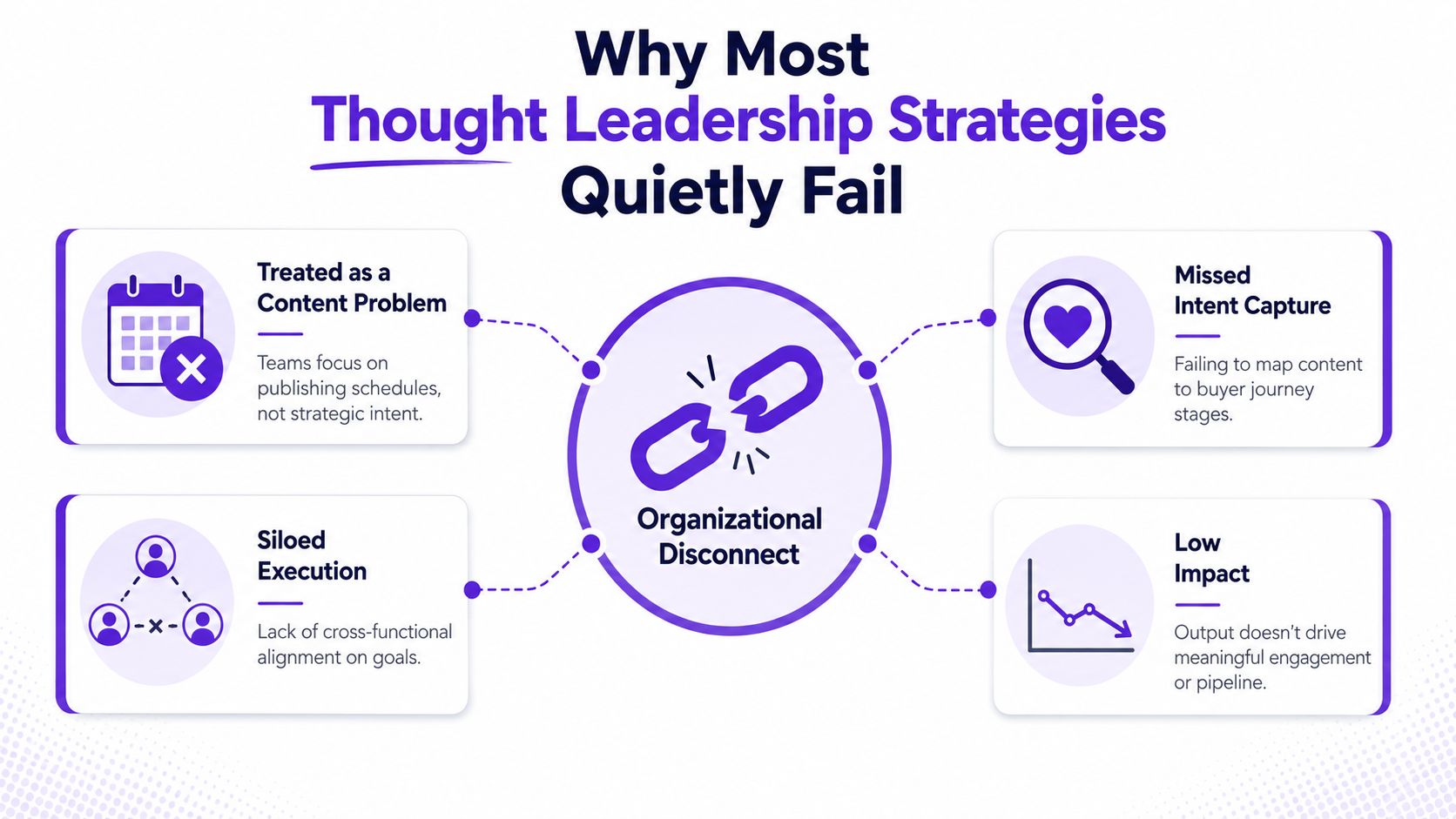
Most programs fail because teams treat thought leadership as a publishing task. Writers produce posts, executives approve opinions, and marketing reports impressions. Nobody owns the commercial system connecting those activities to buyer intent.
A typical failure looks polished from the outside. A B2B software team publishes weekly LinkedIn posts about “the future of work,” grows its follower count, and celebrates strong reach. Yet its ideal customer profile never shapes the topics, no one monitors comments for buying signals, and sales receives no prompt when a target account visits an executive's profile. The activity looks professional while commercial intent goes unworked.
The design gap appears in four places:
Unclear ownership: No single leader owns objectives, research, editorial judgment, distribution, and revenue reporting.
Weak ICP translation: “Executives in technology” does not define a useful topic. The program must identify the decision, risk, or unresolved disagreement affecting a specific buying group.
Single-channel execution: LinkedIn publishing without a workflow for comments, profile visits, direct messages, and seller follow-up leaves demand unattended.
No revenue instrumentation: Likes and impressions become the final score because engagement is not connected to account activity, meetings, opportunities, or influenced revenue.
A post that creates interest still needs an owner, a response path, and a sales context. Distribution includes that handoff.
Build the program alongside an intent-based marketing operating model. Use LinkedIn engagement to prioritize accounts, tailor follow-up, and route high-intent activity to the right seller. The recommendation is direct: stop optimizing for publishing volume. Design the operating system that captures intent and turns it into a relevant conversation.
What Thought Leadership Strategy Means
A thought leadership strategy is a repeatable operating system. It turns original expertise into a clear point of view, puts that expertise where the ICP makes decisions, and connects engagement to commercial momentum.
That separates it from content marketing and PR. Content marketing educates or attracts. PR earns third-party attention. Thought leadership requires a distinctive argument, credible evidence, a recognizable voice, and a route into business outcomes. It also belongs inside a broader B2B demand generation operating model, with ownership for distribution and intent capture.
The 2024 Edelman-LinkedIn B2B Thought Leadership Impact Report surveyed 3,484 business executives across seven countries. It found that 52% of decision-makers and 54% of C-suite executives spend an hour or more each week reading thought leadership, while 75% said a specific piece led them to research a product or service they hadn't previously considered. Treat that behavior as an intent signal, then connect it to account activity, profile visits, comments, and seller follow-up.
Three proof points worth repeating
Trust accelerates evaluation. The 2024 research reported that 73% of B2B decision-makers trust thought leadership more than marketing materials and product sheets when assessing capability. The 2024 Edelman report supports expertise-led evaluation.
Perception forms before vendor contact. A strong point of view helps buyers decide which companies deserve attention before sales engagement.
Unconsidered needs can become active research. A useful idea can create curiosity around a problem the buyer was not planning to solve.
Originality earns attention. Consistency builds recognition. Evidence gives buyers a reason to continue, creating the bridge from expertise to demand.
Three Models of Thought Leadership Compared
The right operating model depends on how quickly you need to move, how complex your ICP is, and whether buyers trust individuals or institutions more readily. These are the core tradeoffs:
Dimension | Founder-Led | Company-Led | Community-Led |
|---|---|---|---|
Ownership and accountability | Founder or executive owns the voice and final judgment | Marketing or an editorial group owns the system | A host coordinates customers, practitioners, and external contributors |
Speed of execution | Fast, because decisions stay close to one person | Moderate, with more review and governance | Slower, because participation and consensus take time |
Trust transfer to the brand | Strong personal credibility, but dependency sits with the individual | Scalable credibility when the voice is distinctive | High reciprocity and network trust, provided the community stays active |
Direct pipeline impact | Often direct when the founder is close to buyers | Broad coverage across segments and funnel stages | Strong for relationship-led opportunities, weaker without commercial follow-up |
Founder-led programs are the fastest way to establish a sharp point of view. A founder can publish a contrarian argument in the morning and respond to objections the same day. The risk is obvious: the program becomes a single-person dependency, and the brand may struggle to preserve momentum when that person is unavailable.
Company-led programs scale better across markets, products, and buyer groups. They also tend to become bland when committees remove every interesting opinion. A named editorial voice still matters, even when the company owns the underlying research and distribution.
Community-led programs earn depth through participation. Customers, operators, analysts, and partners supply real questions and language that internal teams often miss. Momentum takes longer, and the program needs a clear host who can turn conversation into a coherent thesis.
The strongest choice for most B2B teams is a hybrid. Put one or two named voices in front of the market, give them a defensible point of view, and use a community layer to provide source material, challenge assumptions, and amplify the work. Smaller companies can start founder-led. Enterprises with complex buying groups should add company governance and community inputs before scaling output.
The Repeatable Thought Leadership Framework
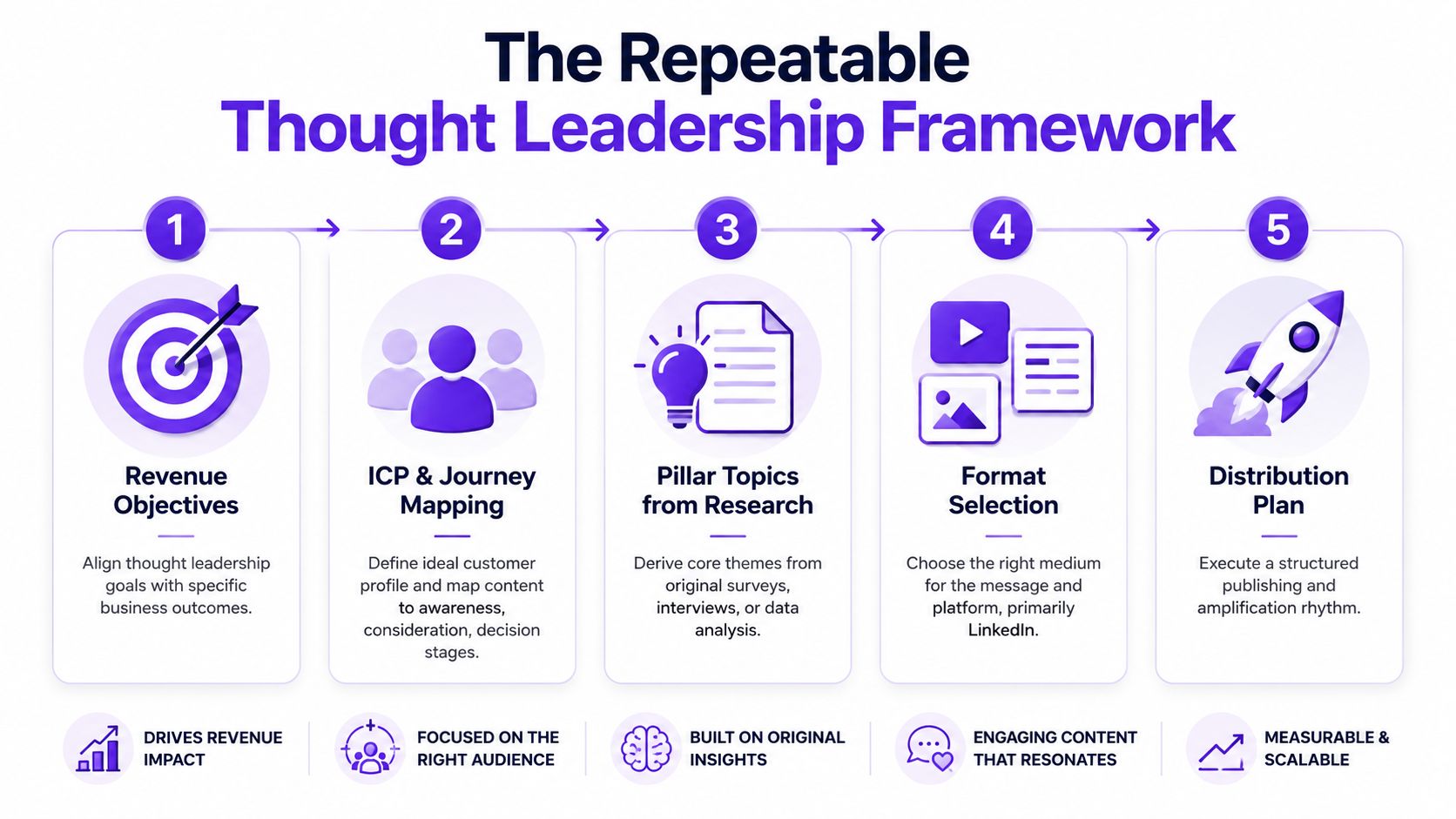
A working system has five parts. Each part needs an owner, a decision rule, and a commercial purpose.
1. Start with revenue objectives
Don't begin with “publish weekly.” Begin with the business outcome. You might want to create demand in an underdeveloped category, support a sales motion, improve executive access, or make an emerging problem urgent.
Write the objective in language sales can recognize. “Generate attention” is weak. “Create qualified conversations with operations leaders evaluating a fragmented workflow” gives the editorial team somewhere to aim.
Action for the next 30 days: Choose one revenue motion and define the account, persona, and buying behavior that would prove the program is working.
2. Map the ICP and buyer journey
Turn the ICP into tensions, not demographics. Interview sales and customer success about stalled deals, objections, internal champions, and language buyers use when describing the problem.
Map those tensions to awareness, consideration, and decision stages. Early content can challenge an assumption. Mid-funnel content can compare approaches. Late-stage content can explain implementation risks without turning into a product brochure.
Action for the next 30 days: Build a topic matrix with one buyer tension and one desired action for each journey stage.
3. Derive pillar topics from original research
Original research is the engine. It can come from customer interviews, proprietary analysis, structured surveys, win-loss conversations, or aggregated operational data. The point isn't to manufacture novelty. It's to reveal something your market can't get from a generic search.
The 2026 B2B thought leadership report from Ascend2 summarized high-performing programs around original research, influencer amplification, integrated strategy, and analytics, with 93% of respondents rating original research as effective. Research gives executives a reason to speak and buyers a reason to remember.
Action for the next 30 days: Run a small interview or data project, then extract three defensible claims that can support a pillar page and multiple LinkedIn discussions.
4. Match the format to the idea
LinkedIn posts are useful for testing hooks and exposing a point of view. Long-form articles hold the complete argument. Video shows judgment and delivery. Podcasts create room for disagreement and practitioner detail.
Don't force every insight into the same format. A controversial thesis may work as a short post first, while research deserves a substantial article, a visual summary, and an executive conversation.
A useful article structure answers the title question immediately, uses question-led subheadings, places a dated statistic early, and ends with an FAQ. OmniCite's guide to citable articles recommends this approach because tables and FAQs create extractable answer blocks for readers and answer engines.
Action for the next 30 days: Select one primary format for each pillar and create derivatives only after the core argument is strong.
5. Build distribution and ownership together
Marketing shouldn't operate this alone. The 2026 iResearch Services maturity research found that only 26% of organizations had reached strategic thought leadership maturity, while 54% split budget and strategy ownership across different functions. That split creates reactive programs.
Create a small cross-functional pod with marketing, sales, product marketing, and customer success. Marketing runs production. Sales supplies objections and follows intent. Product marketing protects differentiation. Customer success brings proof from the field.
Use this maturity ladder:
Ad hoc: Individual posts appear when someone has time.
Managed: A calendar exists, but topics and distribution remain disconnected.
Integrated: Research, content, sales follow-up, and measurement share objectives.
Scaled: Multiple voices and formats operate from a common evidence base.
Action for the next 30 days: Name one accountable owner and publish a written RACI for research, approval, distribution, response, and reporting.
Real Examples and Case Studies That Prove It Works
The strongest programs don't rely on a mysterious creative spark. They repeat a few practical patterns.
A founder-led program can turn contrarian LinkedIn essays into an executive conversation engine when the founder addresses a real market disagreement, supports the argument with evidence, and responds in the comments. A RevOps leader can turn a newsletter into a category asset by publishing original operating lessons instead of recycling software features. A community-led operator can mine practitioner conversations for recurring problems, publish the patterns, and invite the people who contributed into deeper enterprise discussions.
These are representative operating patterns, not claims about named companies or measured results. The useful question is what each team would ship, watch, and hand to sales.
Program | Cadence and Format | Distribution Channel | Pipeline Outcome |
|---|---|---|---|
Founder point of view | Regular LinkedIn essays, short follow-up posts, comment responses | Executive profile, employee amplification, sales comments | Engaged target accounts become warm conversations |
RevOps research newsletter | Original analysis, practical playbooks, long-form editions | LinkedIn, email, sales enablement | Subscribers and readers enter evaluation with stronger context |
Practitioner community | Recurring discussions, interviews, field notes, events | Community space, LinkedIn, partner networks | Contributors and observers surface as relationship-led opportunities |
The evidence supports consistency and originality, not theatrical posting volume. TopRank's 2026 B2B thought leadership survey found 97% of B2B marketers say thought leadership is critical to full-funnel success, but only 43% extend it beyond acquisition to customer retention. The gap matters because customers also need strategic education after the contract is signed.
The same research found 32% of professionals now discover thought leadership through GenAI tools. That makes answer-engine visibility part of the editorial brief. State the claim clearly, show the evidence, use descriptive headings, and make each page useful without requiring the reader to decode your positioning.
LinkedIn Distribution and Turning Engagement Into Pipeline
LinkedIn should be the operating center for most B2B thought leadership programs because it combines public expertise, professional identity, and visible conversation. But publishing there isn't a pipeline strategy. The work starts after the post appears.
Give creators and sellers different jobs
Creators need a repeatable publishing rhythm, strong opening lines, clear claims, and a reason for people to respond. Useful hooks challenge a default assumption, name a costly operational mistake, or present a finding that changes the buyer's next question. Comments should invite judgment, examples, or disagreement, not empty “thoughts?”
Sellers need a separate playbook. They should monitor who engages, inspect whether the person fits the ICP, improve their own profile so the context is obvious, and write outreach that references the buyer's behavior without sounding like surveillance. A comment from a target account is a reason to investigate, not permission to launch a generic pitch.

Use a signal-to-conversation workflow
A practical sequence looks like this:
Publish: The creator posts a clear idea tied to a pillar topic.
Observe: The team separates casual reactions from meaningful comments, profile views, and repeated interaction.
Qualify: Sales checks account fit, role relevance, current context, and CRM history.
Respond: The right person joins the conversation publicly, then moves to a relevant private exchange.
Record: The team logs the signal, message, meeting, and outcome.
LinkedIn lead generation workflows work best when content velocity and conversation velocity are connected. A strong Monday post shouldn't end as a screenshot in Slack. It should create a prioritized queue of accounts for sales to research and approach while the idea is still fresh.
The standard is not aggressive automation. It's timely relevance. Buyers can tell when a seller understood the conversation and when a tool merely found a keyword.
Measuring Whether Thought Leadership Drives Revenue
Impressions are useful for distribution diagnostics, but they aren't proof of commercial value. A revenue-minded dashboard should follow the buyer from visibility to action.
Layer | Primary KPIs | Target Threshold | Cadence |
|---|---|---|---|
Awareness | Share of voice, branded search lift, follower quality | Establish a qualified baseline | Monthly |
Engagement | Saves, substantive comments, dwell time on long-form content | Compare quality by ICP segment | Weekly |
Trust signals | Relevant DMs, inbound demo requests, unsolicited content references in calls | Track directional improvement | Monthly |
Sales receptivity | Replies to content-informed outreach, meetings progressing to opportunities | Compare against non-content outreach | Monthly |
Revenue | Sourced and influenced pipeline, closed-won activity, pipeline velocity | Tie outcomes to account history | Quarterly |
Don't invent universal benchmarks for these layers. Your first job is to establish a baseline by persona, topic, and format. Then compare content-engaged accounts with similar accounts that haven't engaged.
Last-touch attribution undercounts thought leadership because buyers may read, save, discuss, and return long before they fill out a form. A multi-touch approach captures the assist without pretending every interaction deserves equal credit. Use a documented model, then review it with sales and finance through a framework such as revenue attribution models.
A one-page dashboard is enough. Show the active pillar, target accounts engaged, meaningful conversations, meetings, opportunities, and influenced revenue. If a metric doesn't change a decision, remove it.
Frequently Asked Questions
Who should own a thought leadership program?
Marketing should run the operating cadence, but it shouldn't own the strategy in isolation. Give one person accountability and create a pod with sales, product marketing, and customer success. This week, name the owner and assign responsibility for research, executive review, distribution, follow-up, and revenue reporting. Shared input is valuable. Shared accountability is usually just a polite way to hide a gap.
How long does it take to produce measurable pipeline?
Treat thought leadership as a long-horizon program, not a one-off campaign. Content Marketing Institute guidance recommends planning for an 18- to 24-month commitment as the strategy matures. This week, define leading indicators, such as qualified engagement and content-informed meetings, so the team can learn before closed revenue arrives.
How can content become discoverable in AI answer engines?
Answer the buyer's question directly, support claims with original research, use descriptive question-style headings, and publish enough depth for a system to understand the topic without guessing. Tables, FAQs, and clear source links also create extractable answer blocks. This week, rewrite one article around the question a buyer would ask an AI tool, then add evidence and a concise answer near the top.
Does paid amplification undermine credibility?
Paid distribution doesn't undermine credibility when it amplifies useful, original work rather than disguising a product pitch as expertise. Keep the editorial standard the same, target relevant audiences, and measure qualified engagement instead of cheap reach. This week, choose one organically validated asset and promote it only to the accounts and roles it was designed to help.
Use RoverLead AI to turn the engagement those answers generate into qualified conversations.
RoverLead AI monitors LinkedIn engagement and buying signals, matches active accounts to your ICP, and gives sellers context plus an AI-written opener for timely outreach. Visit RoverLead AI to turn thought leadership attention into a practical, high-intent pipeline workflow.