Competitive Differentiation: A Playbook for B2B Sales

Only 23% of B2B technology buyers say competing solutions are meaningfully different. The other 77% see their consideration set as commodity choices, according to a Gartner B2B Buying Survey fielded from October 2023 through February 2024 across North America and EMEA, with 1,851 buyers surveyed. The benchmark is summarized in this competitive outcomes publication.
That's why capable vendors lose to cheaper rivals, why procurement turns a strategic purchase into a spreadsheet exercise, and why supposedly strong deals drift into no-decision. Competitive differentiation isn't a branding exercise. It's a sales execution problem. Your reps either make the difference visible at the moment a buyer is comparing options, or they leave price as the only obvious distinction.
Table of Contents
The Brutal Truth About Why Buyers Tune You Out
Buyers often don't experience your product as unique, even when your product team knows it is. The market may contain advanced capabilities, clever architecture, and years of engineering work. None of that matters if the buyer's working memory stores your pitch as “another platform that does roughly the same thing.”
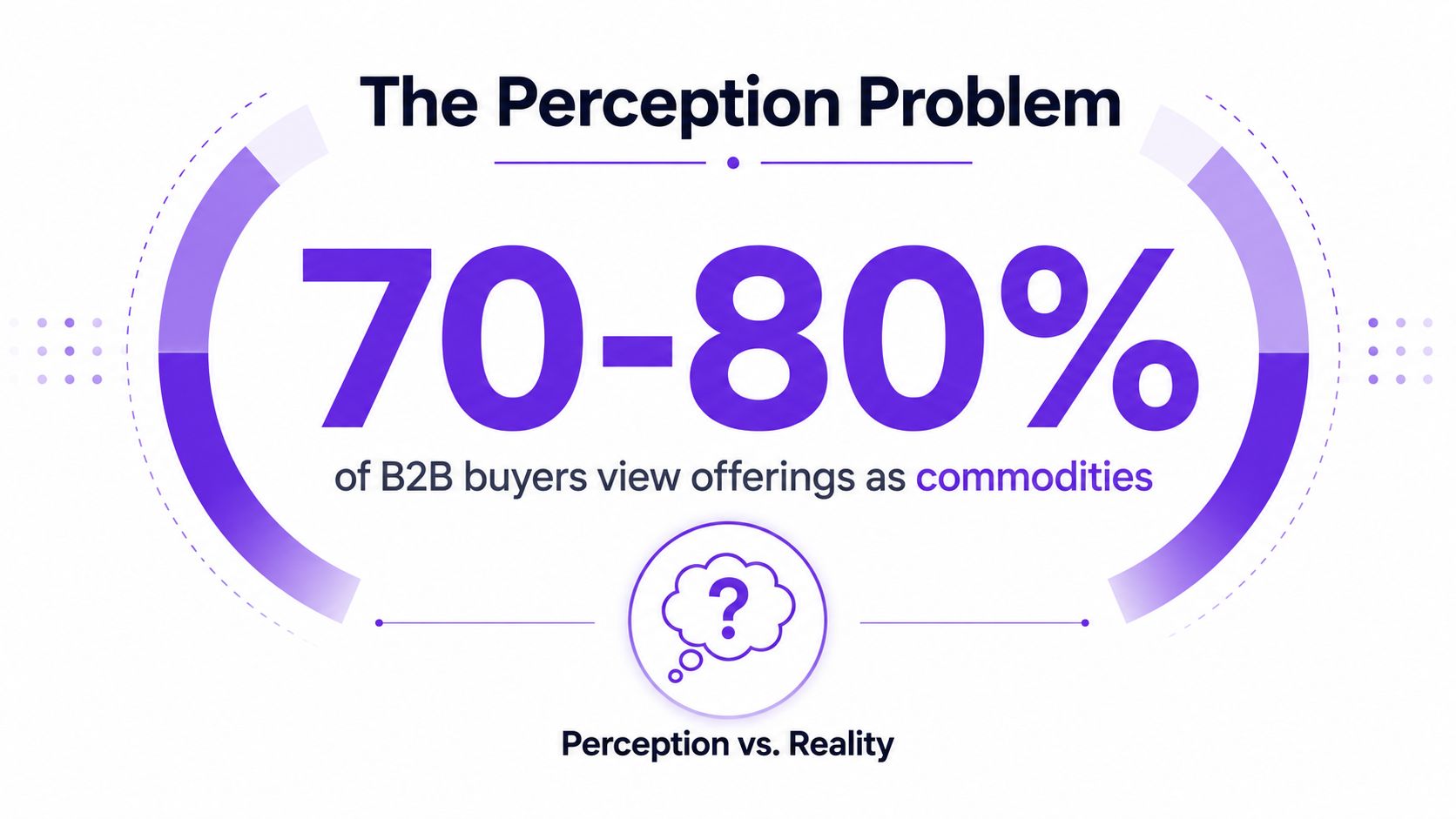
The verified benchmark is more precise than the commonly repeated 70 to 80 percent range. Only 23% of buyers perceive meaningful difference, while 77% perceive commodity choices. The same benchmark reports an average B2B competitive deal win rate of 21%, and only 41% of B2B organizations had a current, documented positioning framework reviewed within the previous 12 months. That combination points to a positioning gap, not merely a product gap.
Three forces make the problem worse:
AI-assisted sameness: More teams can produce polished copy, so polished copy no longer proves much. Generic claims about efficiency, visibility, and transformation blur together.
Fast pattern matching: Buyers often form an initial category judgment before your rep has earned the right to explain the details.
Stalled decisions: A deal can disappear without a competitor formally winning. If the buyer can't identify a compelling reason to change, “do nothing” becomes the safest choice.
Your positioning deck won't solve this by itself. Reps need a usable differentiation point in discovery, demos, security reviews, procurement calls, and follow-up messages. If you want to understand the intent signals that reveal when a buyer is actively evaluating a problem, start with what intent data means for sales teams.
Sales rule: If the buyer can summarize your value without naming a meaningful trade-off or outcome, you haven't differentiated. You've described a category.
What Competitive Differentiation Actually Means
Competitive differentiation is the process of making a product or service distinct from alternatives in a way buyers can recognize and value. The important word is “recognize.” A capability that exists only in your roadmap, product tour, or internal strategy document isn't differentiation until a buyer can connect it to a decision.
A practical model has three layers:
Owned capability: What can you reliably do better, faster, safer, or more precisely than the alternatives?
Verifiable proof: What evidence can the buyer inspect, test, or validate through customers, workflows, references, demonstrations, or commercial terms?
Accepted trade-off: What will you deliberately choose not to optimize for? A credible position usually excludes something. “We serve every company equally” sounds safe because it says nothing.
A regional freight broker illustrates the point. Its trucks may look no different from those used by national 3PLs. But it could compete around a specific operating promise, such as dispatch responsiveness for manufacturers in its service region, supported by clear escalation procedures and relevant references. The difference isn't the truck. It's the buyer-relevant experience wrapped around the truck.
A published competitive differentiation framework identifies five disciplines: identify customer wants, conduct customer research, understand strengths, gather competitive intelligence, and establish a strategic plan. Competitive intelligence gives sales teams the market context required to make those choices.

Use a simpler operating rhythm: identify, compare, choose, prove, repeat. Identify the buyer's actual pressure. Compare the alternatives the buyer will consider. Choose the position you can defend. Prove it in the buying process. Repeat it until every customer-facing team can deliver it without improvising.
Proven Frameworks to Build Your Differentiation
Revenue teams often argue about frameworks when the core issue is using the wrong lens at the wrong stage. Porter, STP, and an operational differentiation process aren't competing religions. They answer different questions.
Porter's generic strategies helps leadership decide whether the business will compete through cost leadership, broad differentiation, or a focused approach. A differentiation strategy selects attributes widely valued by buyers and aims to earn a premium. Focused differentiation applies the same logic to a narrower segment with customized attributes.
The classic STP model, segmentation, targeting, and positioning, helps a company decide which buyer groups deserve separate offers or messages. Segmentation can use geography, demographics, psychographics, or behavior, while positioning gives the chosen offer a distinctive place in the buyer's mind relative to competitors. Use this lens before asking reps to personalize outreach. Otherwise, they'll personalize adjectives instead of value.
The third lens is the daily operating layer. A five-step process built around customer wants, customer research, internal strengths, competitive intelligence, and strategic planning turns strategy into repeatable decisions. Sales and customer success need this layer because they encounter the proof, objections, trade-offs, and competitor claims that leadership rarely sees firsthand.
Framework | Best For GTM Stage | Primary Owner | Common Failure Mode |
|---|---|---|---|
Porter's generic strategies | Boardroom positioning and pricing logic | Executive team | Choosing “differentiation” without naming the attribute buyers value |
STP | Market selection and message design | Marketing and product marketing | Targeting broad segments with vague positioning |
Five-step differentiation process | Daily sales and customer success execution | Revenue leadership | Gathering insights without turning them into field behavior |
Start with your ideal customer profile, then choose the framework that matches the decision in front of you. A company can have excellent corporate strategy and still give an AE nothing useful to say on a competitive call.
The Seven Signals Buyers Actually Notice
Features are easy for vendors to count and buyers to ignore. Buyers notice signals that reduce decision risk, clarify the choice, and help them defend the purchase internally. Independent B2B buyer research found that 56% of the final supplier choice is driven by emotional factors, compared with 44% driven by rational factors. The research identifies trust, confidence, optimism, and pride as dominant emotions at the final decision stage.
Signal | Why Buyers Notice It | Where It Shows Up |
|---|---|---|
Category clarity | It helps buyers understand what you are and when to use you | First call and website visit |
Named enemy | It gives the buyer a sharper contrast than a generic competitor list | Discovery and demo |
Proof of outcome | It replaces promises with evidence relevant to the buyer's risk | Business case and reference call |
Pricing posture | It reveals what you believe your value is worth | Proposal and procurement |
Buying experience | It shows whether working with you will create friction | Evaluation and implementation planning |
Switching friction | It makes change costs visible and manageable | Competitive review and executive approval |
Trust signals | It lowers perceived career and operational risk | Security review, references, renewal |
Category clarity matters because buyers need a fast mental label. If your company sits between several categories, explain the problem you solve before listing what the software does.
A named enemy doesn't require theatrical competitor-bashing. It can be a legacy process, a costly workaround, an incumbent category, or a specific failure mode. “We replace spreadsheets” is clearer than “we enable operational excellence.”
Proof should match the decision. A logo can create interest, but a relevant workflow example, reference, or implementation artifact creates confidence. The APAC research on B2B brands found competitive differentiation was the lowest or equal-lowest scoring dimension for 92% of brands assessed, and outright lowest for 68%, while proof and trust scored much higher at 85. That research describes the problem as a Brand Relevance Gap.
Audit these signals in every active opportunity. If they don't appear in the buyer's process, your internal messaging is irrelevant.
Two Mini Case Studies From the Field
A mid-market HR analytics vendor kept losing to two cheaper incumbents. Its product had credible reporting, useful integrations, and a capable implementation team. The reps still opened with feature parity, walked through dashboards, and waited for the buyer to infer the difference.
Buyers didn't infer it. Procurement grouped the vendor with the incumbents, requested commercial concessions, and delayed the decision when the pricing gap remained. The deal wasn't lost because the product failed. It stalled because the vendor gave the buyer no memorable outcome or reason to tolerate a higher price.
The correction was straightforward: lead with a defined workforce planning problem, show the decision workflow rather than the dashboard inventory, and provide proof from a comparable operating environment. The positioning moved from “more analytics features” to a specific operating result the buyer could evaluate.
A workflow automation startup took the opposite route against an entrenched legacy RPA competitor. It named legacy RPA as the enemy, anchored every demo around time-to-first-value, and gave its champion a one-page switching-cost calculator. The calculator made migration effort, process ownership, and internal approval requirements visible instead of leaving the incumbent's familiarity unchallenged.
The startup displaced the incumbent in a six-figure deal. That outcome isn't brand magic. It came from three field choices: a clear enemy, a repeated evaluation criterion, and a practical tool that helped the champion sell the change internally.
The winning message is rarely the cleverest one. It's the one a champion can repeat accurately in a meeting you'll never attend.
Turning Differentiation Into Daily Sales Execution
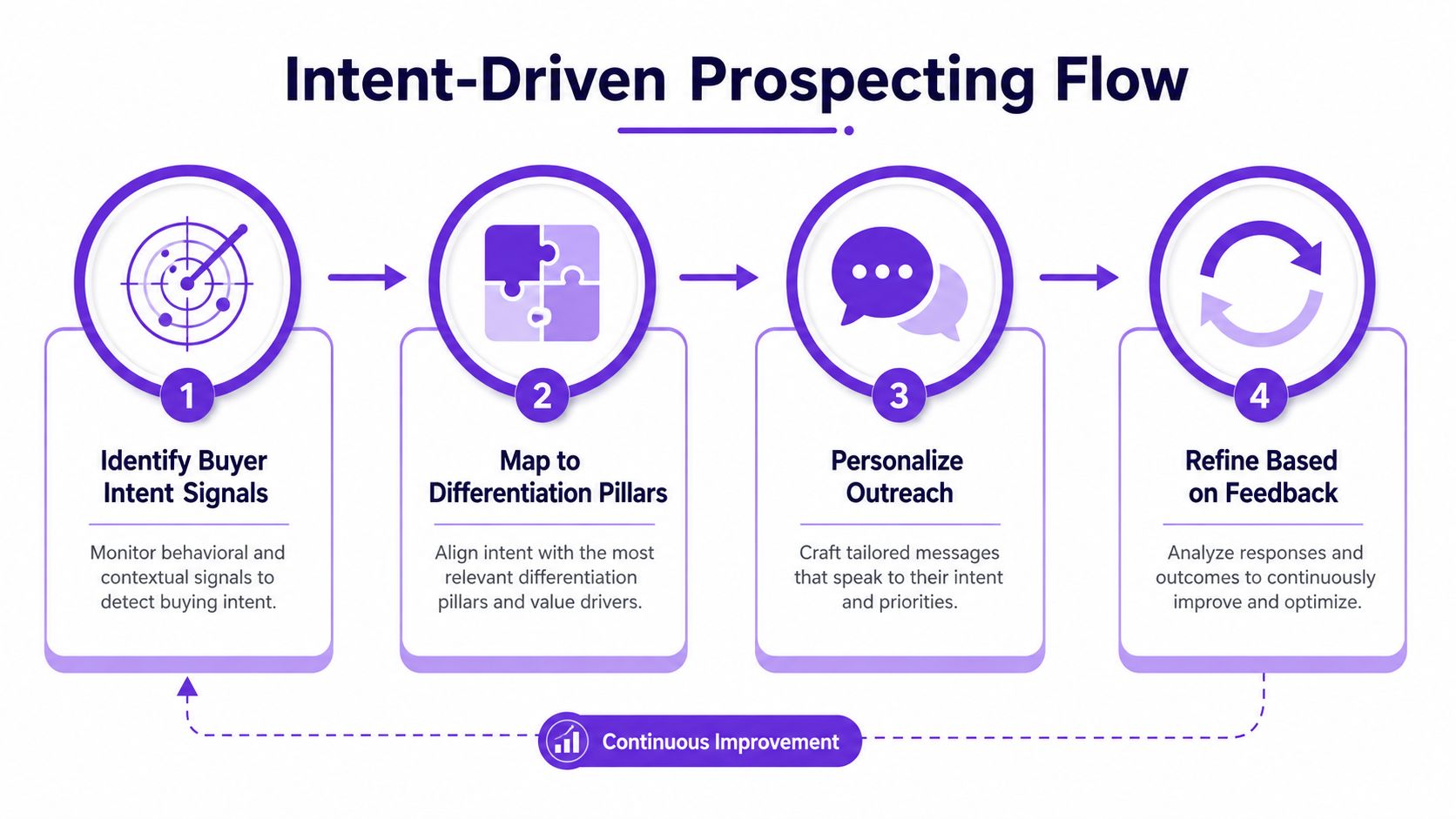
A positioning document becomes useful only when a rep sees the right account at the right moment and knows which proof to lead with. Intent-driven prospecting is the execution layer between positioning and pipeline.
SDRs should watch for behavior that changes the context of an outreach message. Hiring patterns can signal a new initiative. A technology-stack change can expose dissatisfaction or an upcoming migration. Funding events can create budget and urgency. Content consumption around a competitor, category, pricing, or implementation problem can indicate active research.
The workflow is simple, but teams usually skip the discipline:
Define three trigger events. Choose signals that match your differentiation. If your advantage is migration speed, watch for technology changes and implementation hiring, not generic industry news.
Build a signal-to-message map. For every trigger, specify the pain hypothesis, proof point, objection, and call to action.
Assign triggers to named accounts. A signal without ownership becomes an interesting notification nobody acts on.
Review signal-to-meeting conversion weekly. Keep the signals that produce useful conversations. Remove the ones that create noise.
RoverLead AI is one option for this workflow. Its Signal Agents monitor LinkedIn engagement around creators, competitors, keywords, and niche topics, then surface ICP-matched leads with context and an AI-written opener tied to the observed signal. The point isn't to send more messages. It's to give reps a reason to use the right differentiation argument now.
Use this video as a practical prompt for designing your own signal-led prospecting motion:
A 30-60-90 Plan Your Revenue Team Can Run
You don't need a reorganization to make differentiation operational. You need a short feedback loop between buyer evidence, messaging, and rep behavior.
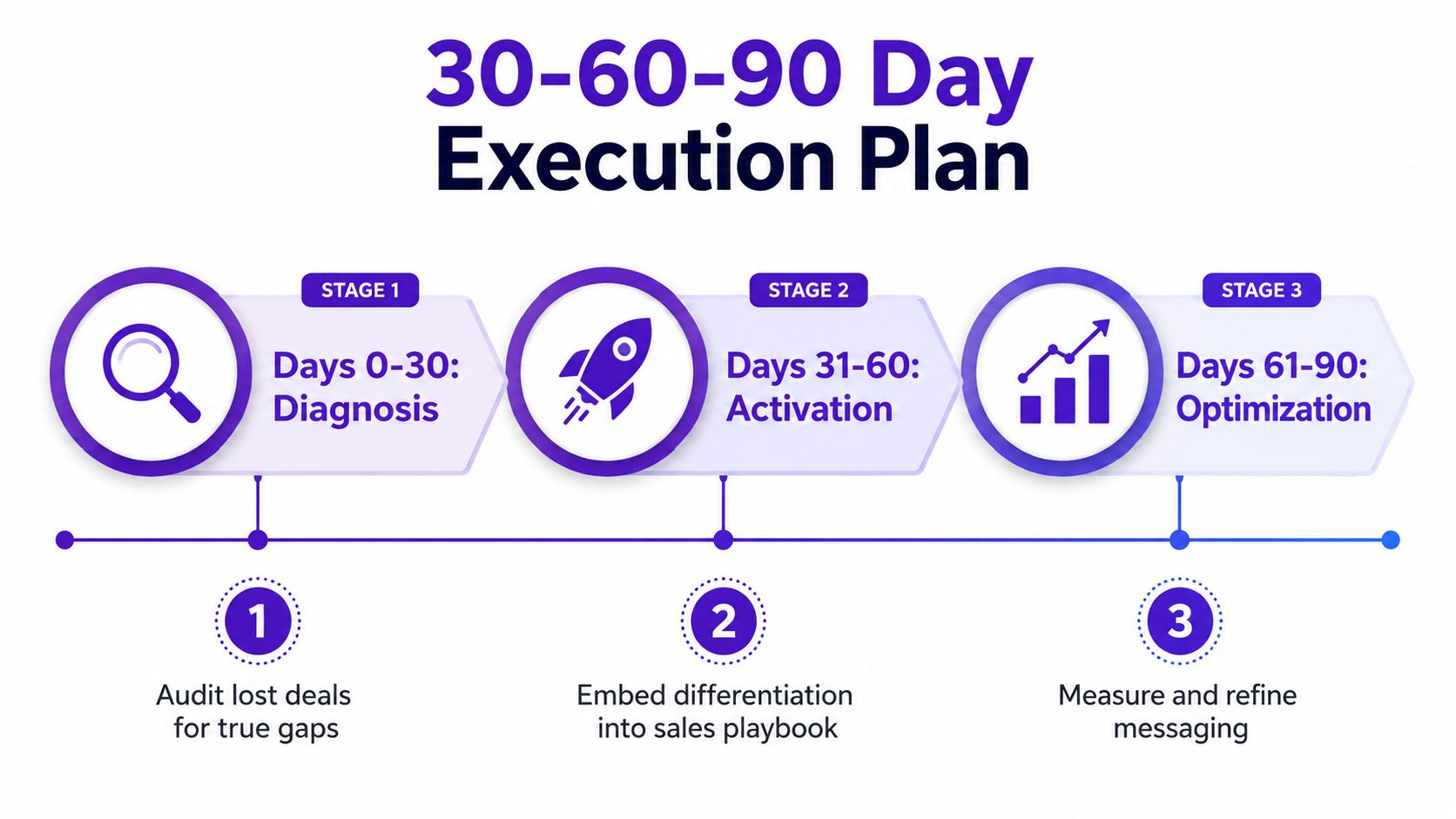
Days 0 to 30 focus on diagnosis
Audit recent lost and stalled deals. Separate product gaps from perception gaps, identify the competitor or default action that won, and record the exact point where price became the buyer's main comparison. Interview three customers about why they chose you, what almost stopped them, and which proof changed their confidence.
Write one sentence of positioning and three proof points. If reps can't say the sentence naturally, it isn't ready.
Days 31 to 60 focus on activation
Rewrite outbound sequences so each opening follows a specific intent signal. Refresh battlecards against the top two competitors, including the trade-off you accept and the proof a buyer can verify. Put category research and competitor engagement into the same workflow as account assignment, rather than leaving intent data in a separate marketing dashboard.
Days 61 to 90 focus on optimization
Track pipeline where a documented differentiation message was used. Coach discovery calls around buyer confidence, switching risk, and the operational outcome. Review which competitor losses reopened after the new message reached the account, then update the playbook based on observed buyer language.
AI is making generic content easier to produce, not automatically more persuasive. A 2026 industry analysis cited 63% of B2B marketers as worried that AI is increasing noise and reducing differentiation, while McKinsey reports leaders are 4x more likely to deploy one-to-one personalization and 2x more likely to adopt generative AI. The analysis supports a shift toward relevance and commercial accountability.
FAQ for Sales Leaders
How do we differentiate when our product is genuinely similar?
Differentiate the experience, proof, focus, or trade-off. A similar product can still serve a narrower workflow, reduce switching friction, provide faster implementation, or support a buyer segment better than a broad competitor.
What should reps say when buyers claim price is the only difference?
Ask what the buyer is including in the price comparison. Then surface implementation effort, adoption risk, time to value, support model, and the cost of staying with the current approach. Don't defend price before you've defined value.
How many proof points belong in a cold email?
Lead with one relevant proof point. A crowded email looks like a brochure, and brochures don't create urgency. Save additional evidence for the reply or discovery conversation.
Does differentiation belong in the SDR motion?
Yes. If SDRs introduce the account to your company without a clear reason to care, AEs inherit a commodity conversation. The SDR message should be narrower, signal-led, and easy for the buyer to understand.
When should we revisit positioning mid-quarter?
Revisit it when multiple deals produce the same objection, stall at the same stage, or name the same alternative. Don't wait for a quarterly planning ritual to acknowledge a field pattern.
How quickly should a win or loss insight reach the field?
Fast enough that the next relevant opportunity can use it. Turn the insight into a sentence, proof point, or objection response, then test it with reps before expanding it into a full enablement asset.
What if the prospect has already selected a rival?
Don't pretend the decision hasn't happened. Ask what the rival's selection solved, what risk remains, and whether the buyer has validated implementation and adoption assumptions. A late-stage displacement requires a sharper contrast, not a longer feature list.
Can a premium brand rely on reputation alone?
No. Reputation opens doors, but current deals still require relevant proof. Buyers need confidence that your specific solution fits their situation, not merely that your company is known.
How do we name an enemy without sounding negative?
Name the failed approach, not the individual competitor. “Manual handoffs create reconciliation delays” is more credible than attacking a rival's motives or employees.
What should sales leaders inspect in forecast calls?
Inspect the buyer's reason to change, the named alternative, the proof already verified, the accepted trade-off, and the next event that could change the decision. If the rep can only report activity and enthusiasm, the deal isn't differentiated yet.
RoverLead AI turns LinkedIn engagement around competitors, creators, keywords, and niche topics into ICP-matched prospecting signals with context and an AI-written opener. Visit RoverLead AI to connect buyer intent with the differentiation message your reps need to use today.