LinkedIn Outreach Automation: A Practical 2026 Playbook

You've loaded a clean prospect list, written a handful of “personalized” templates, and queued a healthy stream of connection requests. Then acceptance falls, replies become vague, and LinkedIn sends a warning that makes everyone suddenly interested in compliance. I've watched this happen across three startup sales teams. The problem wasn't that automation existed. The problem was automating activity without understanding who was ready, why now, and what should happen after acceptance.
LinkedIn outreach automation has matured into a workflow problem, not a button-clicking problem. The teams getting useful pipeline aren't necessarily sending more requests. They're watching signals, pacing activity, reviewing sensitive messages, and measuring whether conversations become opportunities.
Table of Contents
Why LinkedIn Outreach Has Stopped Working the Old Way
An account executive at a Series B SaaS company imports a 5,000-lead list and queues 200 connection requests a day. Six months later, acceptance has cratered from 38% to 11%, LinkedIn has issued two warnings, and the account has received a temporary restriction. The team blames the copy, rewrites the opener, and queues another batch. That's how a bad system gets a fresh coat of paint.
The old playbook assumed that enough requests would create enough conversations. It treated LinkedIn as a one-shot funnel: identify a prospect, send a connection, deliver a pitch, and move on. That model broke because the platform became less tolerant of repetitive activity, buyers saw more machine-written copy, and surface-level personalization stopped proving relevance.
Recent coverage of LinkedIn outreach automation risks and compliance highlights the practical issue operators can't ignore. LinkedIn prohibits third-party automation, connection-request ceilings are roughly 100 per week, and enforcement can involve restrictions or vendor takedowns. The exact mechanics matter less than the operating principle: an account that can't slow down or stop is already badly designed.
The three changes that matter
Platform controls tightened: Spam heuristics and throttling make sudden, repetitive activity dangerous.
Inbox sameness increased: AI can produce fluent copy, but fluent copy still looks generic when it lacks context.
Buyer patience declined: “Saw you're a VP at Company X” isn't a buying signal. Recent behavior is.
Modern outreach needs signal monitoring, post-acceptance nurture, and conservative limits. This guide rebuilds the playbook around those constraints.
What LinkedIn Outreach Automation Actually Means in 2026
LinkedIn outreach automation is the combination of three layers, not a single bot.
The first layer is workflow software. It schedules connection requests, InMail, messages, and follow-ups. That removes repetitive administration, but it doesn't decide whether a prospect deserves attention.
The second layer is signals. These are observable triggers such as a job change, funding event, relevant post engagement, hiring activity, competitor-content interaction, or a public question about a problem your company solves. Signals add the missing context: why this account, why this person, and why now.
The third layer is AI assistance. AI can draft message variations, summarize account context, score replies, and route positive intent to a human closer. It should support judgment, not impersonate it.
Think of the system as a kitchen. Automation is the kitchen, signals are the ingredients, and AI is the sous chef. The salesperson still decides what gets plated.
That distinction separates useful orchestration from spam. A workflow governed by LinkedIn's policies, conservative limits, review checkpoints, and clear stop conditions can help a team stay organized. A workflow that scrapes, blasts, and keeps sending after a reply is a liability.
For a practical framework on making scaled messages feel specific rather than mass-produced, see personalization at scale. The maturity path runs from manual execution to rule-based sequences, AI-drafted messages, and finally signal-driven workflows.
The Four Tiers of Automation From Manual to Signal Driven
Most teams can identify their current tier within a few minutes. The uncomfortable part is that many teams believe they're in tier four because they use AI, when they're running tier three against a cold list.
Tier | Setup Effort | Avg Reply Rate | Restriction Risk | Pipeline Impact |
|---|---|---|---|---|
Manual outreach | High | Quality varies by rep and context | Lower activity risk, higher execution inconsistency | Strong relevance, limited reach |
Rule-based automation | Moderate | Generic outreach converts at 18–24% | Elevated when activity and copy are repetitive | More activity, weaker downstream quality |
AI-drafted outreach | Moderate to high | Estimated at 60–75% for hyper-personalized drafts | Depends on platform behavior and review controls | Better copy, still limited by list quality |
Signal-driven automation | High initially, lower during execution | Signal-targeted campaigns convert at 55–65% | Lower when tightly governed, still subject to policy | Best alignment between timing, relevance, and follow-through |
The reply-rate figures and message-quality bands come from LinkedIn statistics for 2026. They shouldn't be treated as a promise for every campaign. They show the direction of travel: relevance changes performance more than volume does.
Where teams usually get stuck
Manual outreach often produces thoughtful messages, but reps forget follow-ups and struggle to maintain consistent research. Rule-based automation fixes the rhythm while preserving the weakest part of the process, static targeting.
AI-drafted outreach improves language. It doesn't automatically know whether a recent job change matters, whether a hiring spike is connected to your category, or whether the prospect has already been contacted by another rep.
Signal-driven automation adds that missing decision layer. It waits for a meaningful trigger, uses AI to prepare context, and lets a human review the message when the account or situation warrants it. That gap between AI copy and signal-based timing is where most of the operating advantage sits.
A Safe Workflow That Keeps Your Account Alive
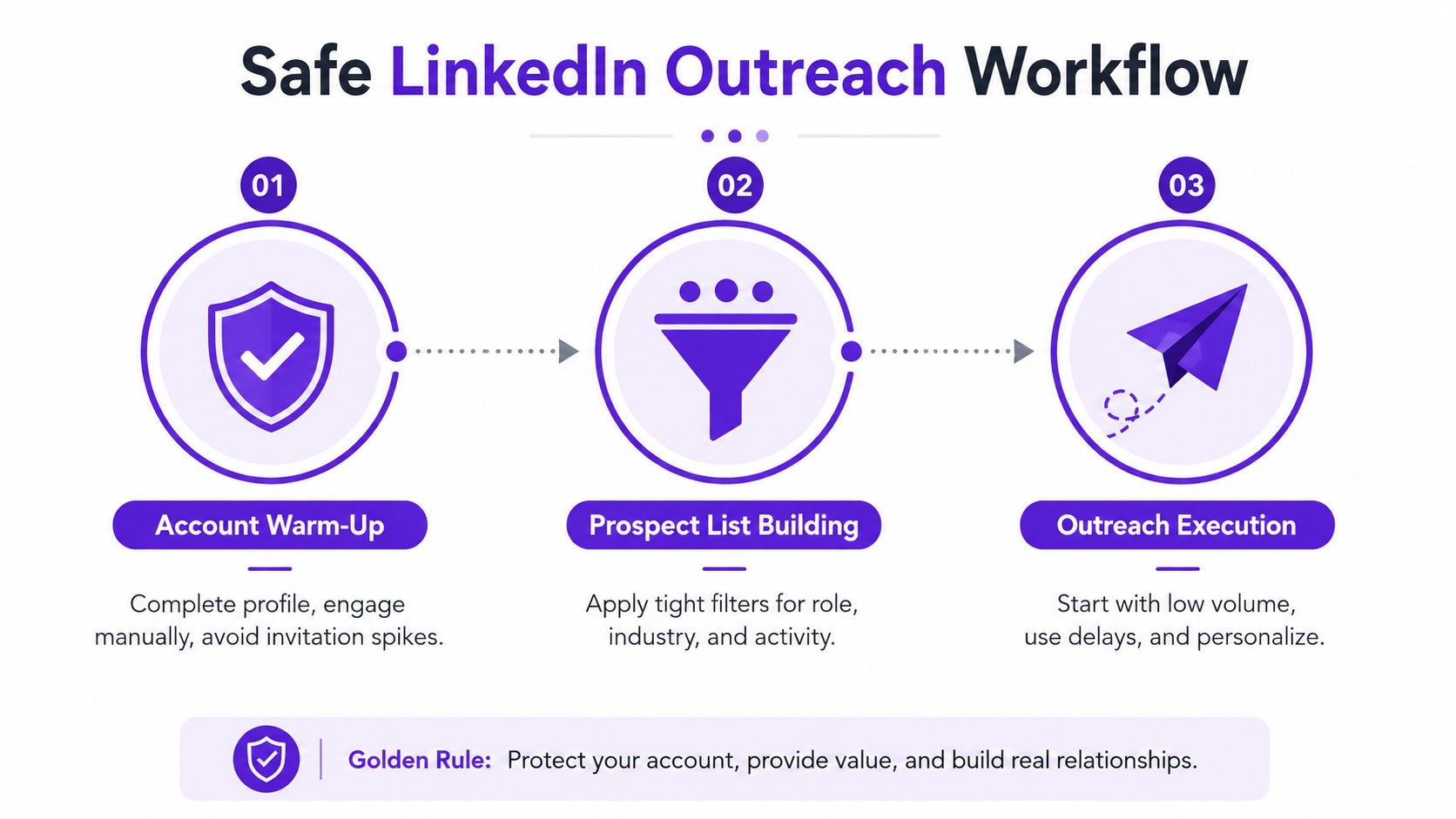
Start with a two-week warm-up. Complete the profile, make the account credible, and engage manually with relevant posts. Don't create a sudden jump from ordinary activity to aggressive invitations and messages. LinkedIn doesn't publish fixed universal daily or weekly caps, so treat independent guidance as a risk-management reference, not a guaranteed safe harbor. One 2026 automation safety guide places practical first-degree messaging around 50–80 messages per day, with weekly activity often kept around 300–400.
Build a list that deserves automation
Filter prospects by role, seniority, company fit, and a recent buying signal. Score the list before enrollment, then route accounts so two reps don't unknowingly target the same person. A small, relevant list beats an enormous spreadsheet full of stale titles.
Use this guide to avoid spam filters as an operating reference, then add your own controls:
Start with modest daily caps and stagger actions.
Send a request only when you have a real reason to connect.
Pause immediately after a warning or unusual delivery change.
Require human review for strategic accounts, sensitive sectors, and dynamic fields.
Stop after a reply, opt-out, job change, or event that makes the message irrelevant.
After acceptance, send a contextual acknowledgment rather than an immediate commercial pitch. Use a short sequence with two or three steps and a clear opt-out. Track invitations sent, accepted, delivered, and withdrawn each day. The safest workflow isn't the one that sends the most. It's the one you can inspect, slow, and stop without losing control.
KPIs That Predict Pipeline Not Vanity Replies
A reply is an intermediate event, not a revenue outcome. Measure the funnel from signal to accepted connection, positive reply, qualified conversation, booked meeting, held meeting, opportunity, and pipeline value.
The benchmark evidence shows why stage separation matters. A 2026 benchmark covering 13,218,869 connection requests and 6,730,447 outbound messages from 13,302 accounts reported 28.5% connection acceptance, 3.0% connection-note replies, and 10.4% post-connection message replies in its LinkedIn outreach analysis. The operational lesson is straightforward: post-acceptance messaging produced roughly 3.5 times the reply probability of the initial note.
Metric | Useful benchmark range | What it answers |
|---|---|---|
LinkedIn DM reply rate | 10.3% average | Is the channel producing responses? |
Cold-email reply rate | 5.1% average | How does LinkedIn compare with email? |
Overall LinkedIn reply rate | 7.2% across a dataset of 15M+ contacts | Is performance directionally healthy? |
Connection acceptance | 26% average, with a separate study at 28% | Is targeting and the connection reason credible? |
Post-connection reply rate | 10.4% | Does follow-up context work after acceptance? |
Accepted connections producing a meeting | 2.0% | Does engagement become booked pipeline? |
These figures are drawn from the 2026 LinkedIn benchmark summary and the meeting-funnel benchmark. Use them as directional comparison points, not targets to hit at any cost.
The scorecard I'd actually review
Run weekly snapshots or 30-day cohorts. Segment by seniority, account size, signal type, sequence, and rep. Compare signal-based campaigns with matched manual cohorts, then inspect opportunity creation rather than celebrating raw bookings.
Monitor opt-outs, complaints, delivery issues, and warnings as safety indicators. A reply that never becomes a meeting is curiosity. A meeting that never becomes an opportunity is activity. Pipeline per 100 targeted accounts is the final scorecard.
Why Timing and Signals Beat Templates Every Time
A perfectly written message can fail because it arrived after the buying window closed. Templates answer, “What should I say?” Signals answer, “Why this person, why now?”
Prioritize observable triggers: a leadership change, funding announcement, relevant hiring, a product launch, a new job posting, engagement with a company post, or a question in a relevant community. Combine freshness with fit. A recent trigger at an ideal account belongs in a faster path. An older trigger belongs in a slower, research-led sequence.
Intent data explained for sales teams is useful here because intent isn't a synonym for “the prospect matches our industry filter.” It's evidence that the prospect or account is doing something connected to the problem.

What signal-first execution looks like
A new VP Sales joins shortly after a funding event. The opener can acknowledge the transition and ask about the team challenge created by the company's next phase. Don't pitch the product immediately. Wait for a second trigger, such as a hiring surge or relevant post interaction, before making the commercial connection.
Another prospect comments on a post about sales forecasting. Use that public interaction as context, not proof of purchase intent. Ask a useful question, keep the message short, and stop if the response shows no interest.
Personalized messages averaged 9.36% replies, compared with 5.44% for generic messages, according to independent 2026 outreach benchmarks. The point isn't to decorate templates with names. It's to make the timing defensible.
Pitfalls Restrictions and How to Dodge the Ban Hammer
LinkedIn prohibits third-party automation, scraping, and tools that automate activity, and repeated violations can lead to temporary restrictions or permanent bans, as summarized in LinkedIn policy and enforcement coverage. Treat every tool as a risk decision, not a compliance guarantee.
Seven failure patterns
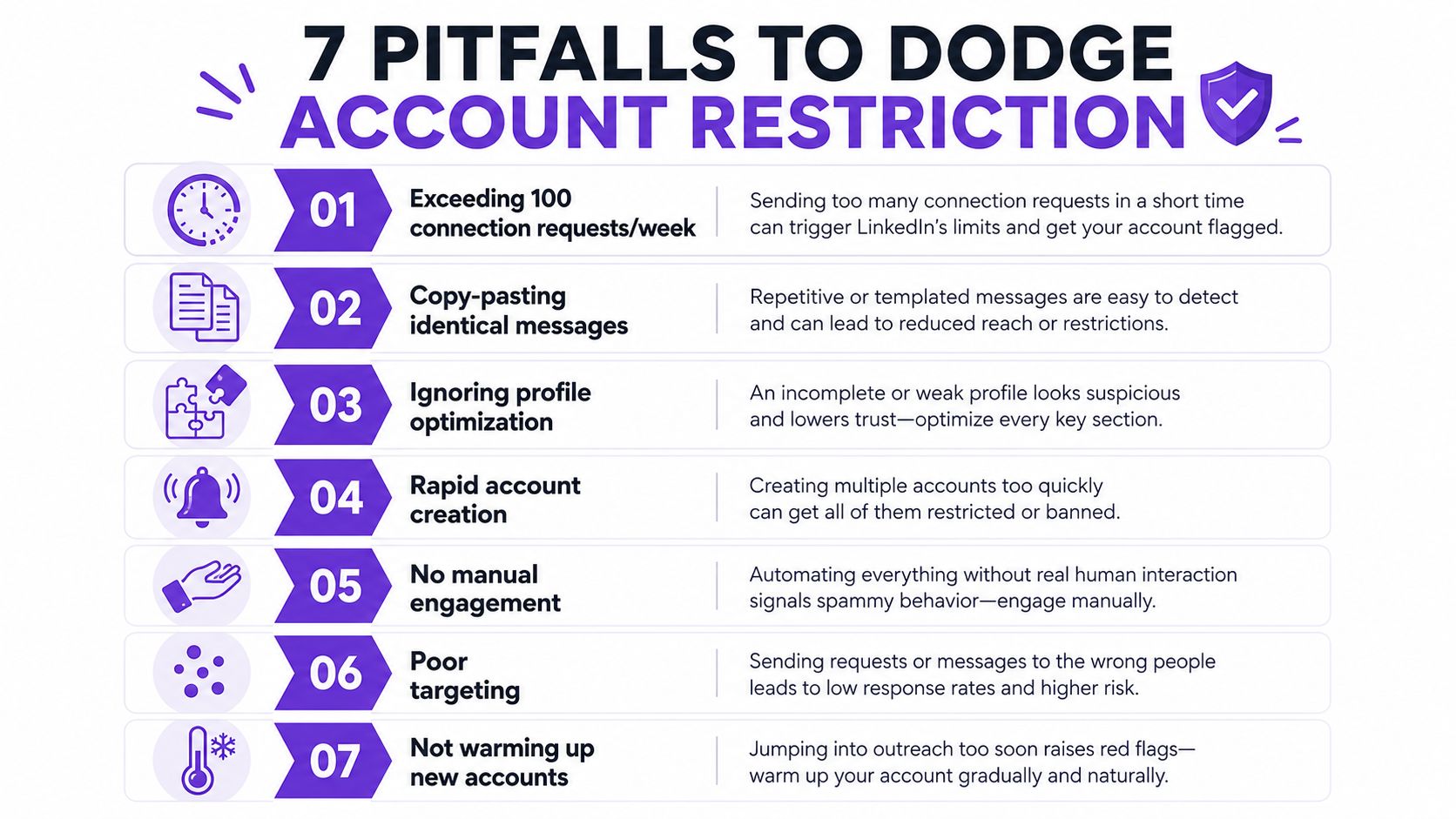
Exceeding 100 connection requests per week: Reduce invitation activity and review the account after any warning or restriction.
Copying identical messages: Replace bulk copy with reviewed variations tied to the prospect's actual context.
Scraping without rate controls: Stop extraction, remove questionable data, and use a compliant prospecting process.
Scaling an incomplete profile: Finish profile hygiene before launching any campaign.
Running multiple automations: Audit every connected workflow and disable overlapping actions.
Using a fresh profile as a launch vehicle: Warm the account through normal, manual use before any scaled activity.
Skipping warm-up activity: Build credible engagement gradually instead of switching on a sequence overnight.
I wouldn't rely on claims about “human-like” behavior, IP rotation, or copy-variation thresholds as a magic shield. Those tactics don't override LinkedIn's rules. Before launch, confirm the profile is complete, the list is narrow, ownership is clear, the sequence has stop conditions, and a human can pause every action.
Putting It Together and Where RoverLead AI Fits
A sensible rollout doesn't need a dedicated RevOps department. It needs ownership, restraint, and a clean feedback loop.
A practical 30-day rollout
Week one is foundation. Fix profile hygiene, complete the warm-up activity, and refine the ICP. Define the roles, company traits, exclusions, and problems that justify a message. Keep the process manual while you learn which signals correlate with useful conversations.
Week two adds observation. Monitor job changes, funding events, hiring activity, relevant content engagement, and competitor interactions. Build a focused list with the signal attached to every record. If the reason for contact can't fit in a sentence, the record isn't ready.
Week three introduces execution. Launch the first signal-triggered sequences with strict caps and human review checkpoints. Start after the connection is accepted, use a contextual opener, and stop on any reply or opt-out. Keep ownership visible in the CRM so no one sends a duplicate follow-up.
Week four is measurement. Review acceptance, reply, meeting, show, and opportunity conversion by signal and segment. Keep the parts that create qualified conversations. Rewrite or retire sequences that generate polite replies but no commercial movement.
Manual outreach remains viable below 200 targeted accounts per quarter with one SDR and minimal signal data, according to the operating criteria in this playbook. Once a team crosses 500 accounts, monitors 10 or more intent signals, or operates across multiple segments, an intent-driven platform becomes necessary to coordinate the work.
For teams evaluating the broader process, LinkedIn sales prospecting should be treated as an operating system, not a list export. Tools such as CRM-connected sequencers can handle workflow administration, while RoverLead AI is one option for monitoring LinkedIn engagement, matching signals to an ICP, providing contextual AI-written openers, and coordinating multi-touch outreach. Its role is execution around live intent, not permission to blast a larger cold list.
The right platform sits above static rules and generic AI drafting. It watches behavior, routes the relevant prospect, and preserves human judgment where the risk or account value is high. That's the difference between automation as a productivity shortcut and automation as a disciplined sales process.
RoverLead AI helps teams turn LinkedIn engagement into ICP-matched prospects, with signal context and AI-written openers for timely outreach and follow-up. Visit RoverLead AI to see whether its intent-first workflow fits your outbound motion.