LinkedIn Sales Prospecting Playbook for 2026

Most LinkedIn sales prospecting advice starts in the wrong place. It tells you to build a large list, personalize the first sentence, and send connection requests until the dashboard looks busy. That approach confuses activity with timing. Buyers rarely respond because a message contains their job title and company name. They respond when the message arrives in a relevant moment, with evidence that the seller understands what they're working on.
LinkedIn has become a concentrated B2B acquisition channel. Research summaries report that roughly 80% of B2B social media leads come from LinkedIn, while LinkedIn visitors convert to leads at about 2.74%, compared with 0.77% for Facebook and 0.69% for X/Twitter. The same source reports a LinkedIn lead-to-opportunity conversion rate of about 14.6%. These LinkedIn social selling benchmarks explain why prospecting teams keep returning to the platform, but they don't justify spraying generic messages.
The modern motion is signal-led. You define a focused ICP, watch for meaningful behavior, engage where the prospect is already active, and then send a short message that earns the next exchange. The clever template still has a role, but it should be the final piece of the system, not the strategy.
Table of Contents
Why Most LinkedIn Sales Prospecting Playbooks Fail
The popular playbook says volume solves pipeline. Build a massive prospect list, add a personalized opener, automate the requests, and let persistence do the rest. In practice, this produces an inbox full of messages that look customized without feeling relevant. “Saw your background in revenue operations” isn't personalization. It's a mail merge wearing a blazer.
Static list outreach fails because it ignores the prospect's current priorities. A senior buyer may fit every firmographic filter and still have no reason to speak with you today. Another person at a similar company may have just commented on a pricing discussion, mentioned a new initiative, or engaged repeatedly with a creator in your category. The second prospect has context. The first has only theoretical fit.
Practical rule: A relevant signal is more valuable than another field in your spreadsheet.
Platform constraints make volume-led systems even less attractive. LinkedIn has a hard cap of 30,000 first-degree connections, so a strategy based only on mass connecting eventually reaches a platform ceiling. LinkedIn connection limits turn “just send more requests” into a poor long-term operating model.
A better system treats LinkedIn as a live environment rather than a contact database. The useful question isn't “Who has the right title?” It's “Who has the right title and is showing evidence of a problem, priority, or curiosity that my offer addresses?” That shift is the foundation of behavioral intent data.
The practical consequence is uncomfortable but useful: fewer prospects may receive outreach, while each message carries more context. Your team measures qualified conversations, not the number of invitations sent. LinkedIn sales prospecting works when sellers arrive during a buying conversation, not when they interrupt a random Tuesday.
Defining Your ICP and Behavioral Intent Signals
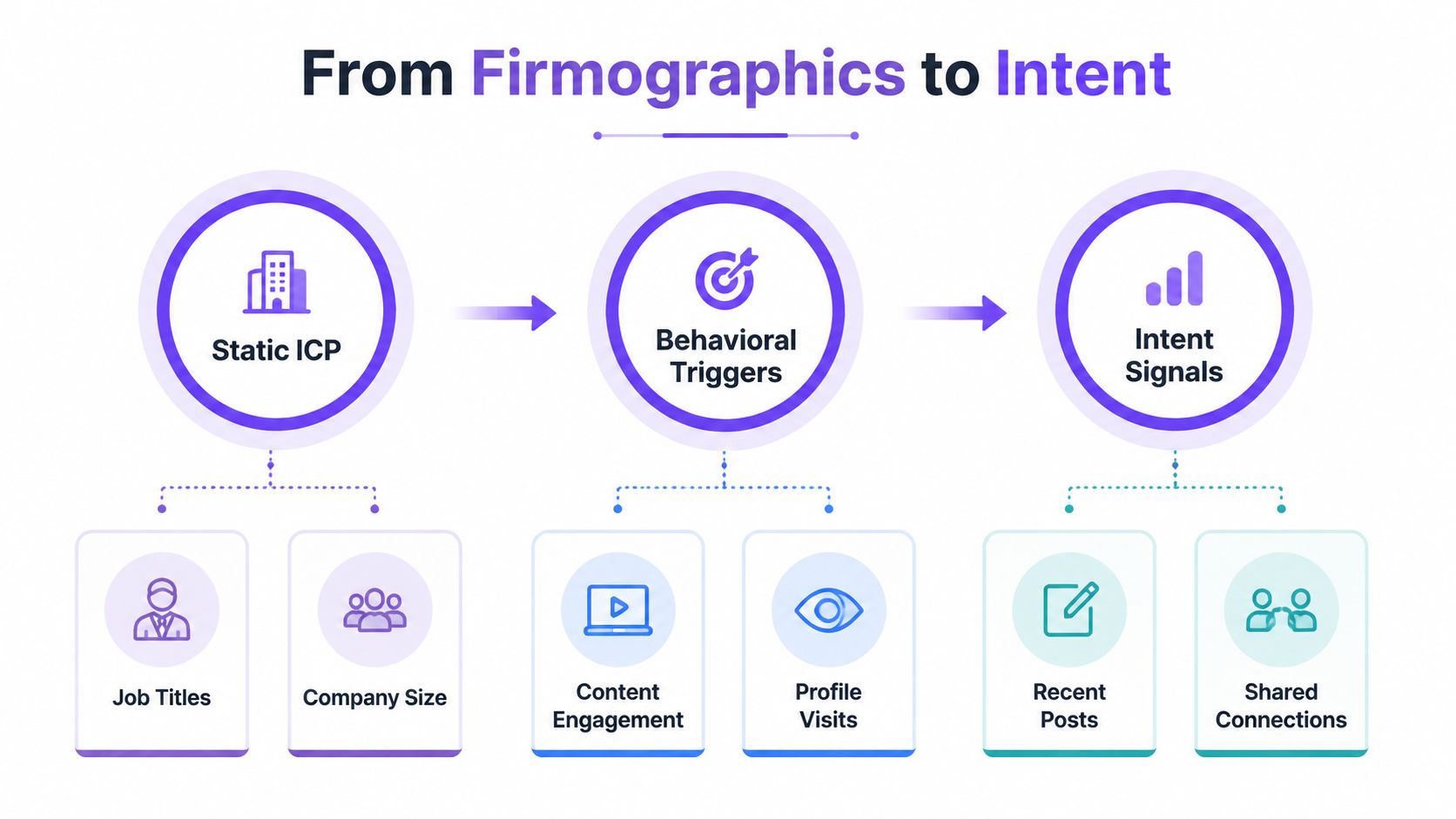
A useful ICP has two layers: who can buy and who may be preparing to buy. Firmographics, seniority, geography, technology environment, and business model establish eligibility. Behavioral signals then help rank eligible accounts by timing and relevance.
Start with a narrow account and persona definition. Record the company traits linked to a genuine use case. Then identify the roles that experience the problem, control the budget, influence evaluation, or implement the solution. A practical ideal customer profile framework should include disqualifiers as well. If every company qualifies, the ICP cannot guide prospecting.
Map observable activity to buying relevance:
Trigger events: Monitor new leadership, hiring activity, product launches, market expansion, and public initiatives that may create pressure on the target function.
Content engagement: Prioritize comments about implementation, measurement, pricing, vendors, or operational friction. A passive like provides less context than a thoughtful question.
Topic patterns: Track repeated engagement with niche creators, competitor content, events, and specialist discussions. Repetition can indicate an active learning process.
Profile context: Review recent posts, role changes, shared connections, and stated responsibilities to understand why the person belongs in the queue now.
LinkedIn's concentration makes this signal work worthwhile. It drives roughly 80% of B2B social media leads, converts visitors at about 2.74%, and records about 14.6% lead-to-opportunity conversion, according to the LinkedIn benchmark summary. These figures do not make every interaction an intent signal. They show that LinkedIn contains enough professional context to support better prioritization.
Build a living list rather than a finished export. Give each prospect a reason for inclusion, the observed signal, the activity date, and the most natural next action. Remove stale entries or downgrade them when the context disappears. The clever template still has a role, but it should complete the system rather than lead it. Your list should function as a queue of conversations, not a museum of old searches.
Static Lists Versus Signal-Based Prospecting
A large prospect list can make an outbound program look productive while giving reps little reason to contact anyone. Signal-based prospecting requires more judgment, yet it creates a timely reason for the conversation. An independent 2026 industry guide reports 10% to 20% acceptance and 3% to 8% reply rates for cold list outreach, compared with 40% to 60% acceptance and 25% to 55% reply rates for signal-based outreach. The 2026 LinkedIn outreach coverage attributes the difference to timing and context rather than message volume.
Approach | Acceptance Rate | Reply Rate | Best For |
|---|---|---|---|
Static list outreach | 10% to 20% | 3% to 8% | Broad market mapping and account discovery |
Signal-based outreach | 40% to 60% | 25% to 55% | Timely conversations with active buyers |
The table is a diagnostic, not a promise. If results resemble the first row, rewriting every opener may miss the problem. Reps may be contacting prospects before a relevant business reason exists.
Static lists still support market coverage, buying-committee mapping, and account planning when visible activity is limited. They also stop reps from pursuing only familiar or highly visible accounts. Their weakness appears when a research export becomes the daily message queue.
A signal-led workflow changes the sequence. Define the account universe with prospect list building guidance, monitor relevant behavior, classify each signal, then choose whether outreach is appropriate. The signal should influence priority, timing, channel, and the question a rep asks. A role match alone rarely provides enough context.
Keep both systems connected. Static data sets the market boundaries and preserves coverage. Behavioral data determines which accounts deserve attention now. The list identifies where to look. The signal provides a defensible reason to speak.
Crafting High-Conversion Openers and Follow-Ups
A strong opener proves that your message belongs in the prospect's inbox. It doesn't need elaborate research or a paragraph of praise. It needs one specific observation, one sensible connection to your expertise, and a low-friction question.
Use this simple sequence:
Name the signal. Refer to a recent post, comment, role change, event, competitor discussion, or topic pattern.
Connect the relevance. Explain briefly why that activity relates to the problem you solve.
Ask an easy question. Invite perspective before requesting a meeting.
For example, if a prospect comments on a discussion about inconsistent pipeline attribution, an opener could be: “Your point about attribution getting messy across channels stood out. Are you currently solving that through better reporting, or by changing the handoff between marketing and sales?” That message doesn't pretend to know the answer. It gives the prospect a reason to correct, expand, or challenge your assumption.

A recent role change calls for a different angle: “Congratulations on the new revenue operations role. Teams often revisit their reporting and process handoffs during that transition. Is improving pipeline visibility part of your initial remit?” The message works because the trigger supplies the context. It doesn't require a theatrical compliment.
Follow-ups should contribute something new. A second message can share a short checklist, clarify the question, or offer a useful observation from the prospect's industry. “Bumping this” adds nothing. A better follow-up is: “Sharing the short handoff checklist I mentioned. If this isn't on your agenda, no problem. Is there someone else who owns the process?”
For more tested prompts and natural questions, use these LinkedIn conversation starters. Keep the tone human, and don't force humor, GIFs, or voice notes into a first interaction. Pattern interrupts work only after you've established enough context for the interruption to feel personal rather than strange.
Setting Cadences and Measuring What Matters
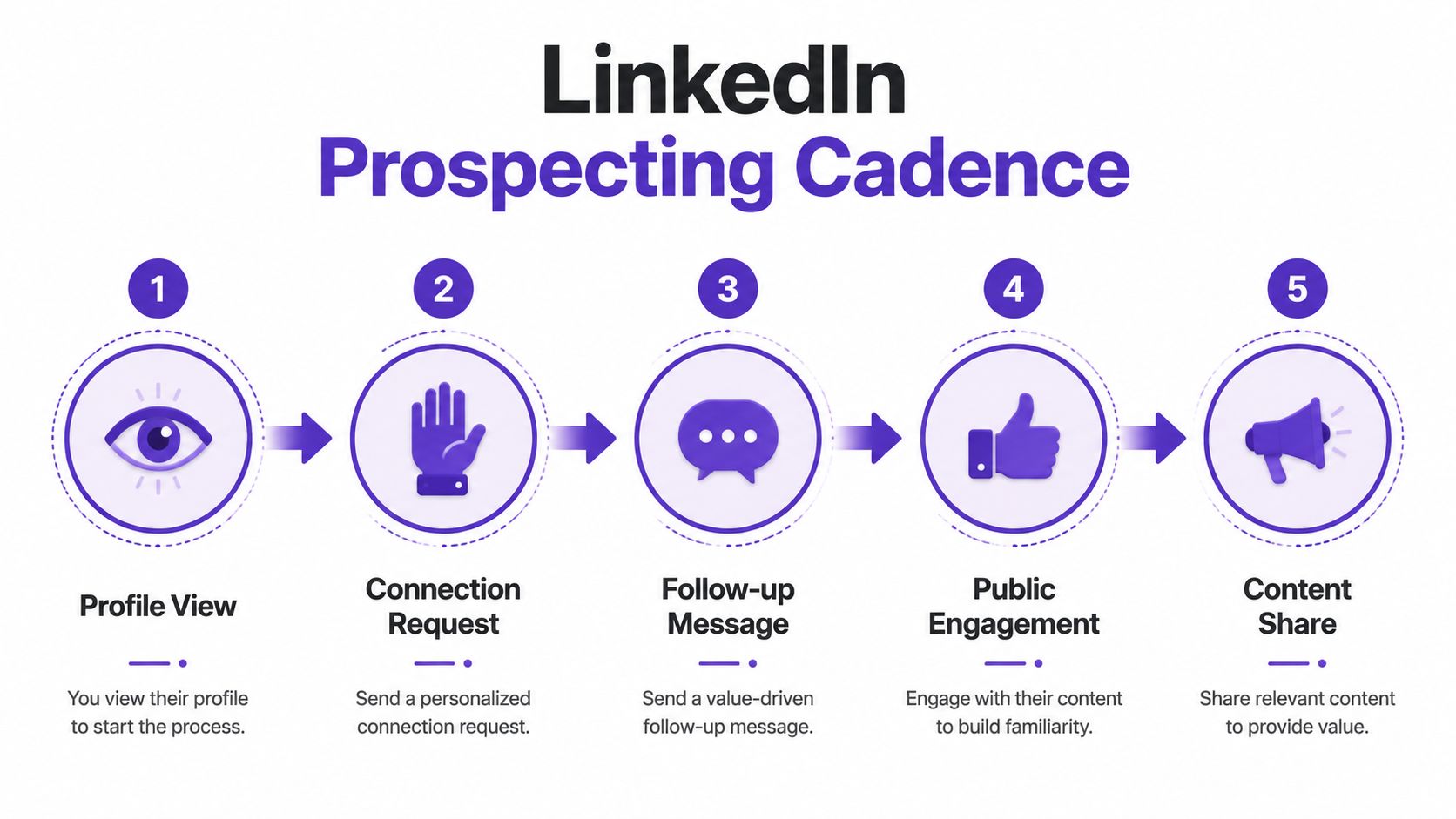
A LinkedIn cadence should build recognition without turning persistence into harassment. Combine a profile visit, connection request, relevant follow-up, public engagement, and useful content share when each action fits the prospect's behavior. The sequence should create several natural opportunities to respond, not force every lead through the same checklist.
Use three phases: prospecting, qualifying, and outreach. Set a stop rule after three to four unanswered direct messages. Continuing after that point rarely adds context, and it can make a legitimate sales motion feel intrusive. This LinkedIn prospecting outreach guide offers a useful reference for structuring the sequence, but teams should judge performance against their own audience, signals, and offer.
Measure the funnel stages that expose conversation quality:
Accepted-connection reply rate: Shows whether targeting and the initial context are strong enough to start a conversation.
Positive reply rate: Separates genuine interest from polite acknowledgements and objections.
Qualified conversation rate: Shows whether the behavioral signal attracted the right buyer.
Meeting conversion: Connects LinkedIn activity to pipeline rather than surface-level engagement.
Signal-to-reply performance: Identifies which triggers deserve more research and follow-up.
Track the trigger behind each reply. A role change, relevant post, hiring pattern, or engagement with a buying topic can reveal which signals produce useful conversations. Profile views and connection volume help diagnose reach, but they do not prove commercial progress. A smaller queue with stronger qualified replies is healthier than a crowded dashboard of unanswered requests.
This video can help teams visualize the cadence before adapting it to their own buying cycle.
LinkedIn performs better as part of a coordinated motion. One benchmark reports an average LinkedIn message response rate of 10.3%, compared with 5.1% for email, while another reports 12% to 25% reply rates for multichannel cadences combining LinkedIn and email. The channel response-rate analysis emphasizes that relevance, warming, and orchestration drive the difference. Use email to extend a qualified conversation, not to repeat the same pitch twice.
Compliant Automation and Tooling Best Practices
Manual prospecting doesn't scale cleanly. Reps lose time checking profiles, recording context, sorting signals, and deciding who deserves attention. Reckless automation creates a different problem: mass actions, generic messages, and behavior that can trigger platform restrictions or damage trust.
Automate the research burden, not the human judgment. A sensible tool should help detect relevant engagement, organize prospects against an ICP, capture the reason for priority, and suggest a contextual opener. The seller should still verify the signal, edit the message, decide whether the timing is appropriate, and handle the reply personally.
LinkedIn's 30,000 first-degree connection cap makes this distinction important. The documented connection limit reinforces why scalable prospecting shouldn't depend on accumulating connections forever. Build relationships with the people who matter, then use content and engagement to reach beyond a constantly expanding network.
Account safety beats artificial scale. A tool that sends more actions isn't useful if it produces irrelevant conversations or puts the account at risk.
Evaluate automation against practical criteria:
Signal detection: Can it identify activity around your niche, competitors, creators, and buying topics?
Context preservation: Does each lead arrive with the reason it matters, rather than just a profile URL?
Human review: Can sellers approve and edit outreach before it goes out?
CRM workflow: Can the team record replies, objections, and next steps without manual duplication?
Platform compliance: Does the system avoid encouraging mass messaging and respect LinkedIn's operating constraints?
RoverLead AI is one option built around this model. Its Signal Agents monitor LinkedIn engagement across an ICP's niche, competitors, and followed experts, then deliver a feed of high-intent leads with context and an AI-written opener. The team still owns the final judgment, while the platform reduces the repetitive work of finding who is active and why that activity matters.
Your LinkedIn Sales Prospecting Checklist and FAQ
Use this checklist before launching a campaign:
Define the ICP: Include fit, disqualifiers, and buying triggers.
Watch behavior: Prioritize meaningful comments, posts, competitor engagement, and role changes.
Warm the interaction: Engage publicly when the contribution is useful.
Write from context: Mention the observed signal and ask one easy question.
Track quality: Measure replies, qualified conversations, and meetings.
Stop intelligently: After three to four unanswered DMs, pause or change contact and channel, following the 2026 cadence guidance.
Does LinkedIn prospecting still need connection requests?
Yes, but they're one access point, not the whole strategy. Content engagement and relevant conversations often create stronger context before a request.
What should I do with low reply rates?
Audit signal quality first. If the list is static, improve timing before rewriting every template.
Should LinkedIn replace email?
No. A coordinated LinkedIn and email motion can outperform either channel alone when each touch adds context, as reported in multichannel benchmark guidance.
Is personalization enough?
No. Personalization without relevance is decoration. Start with behavior, then tailor the message.
How many follow-ups are appropriate?
Use a clear stop rule after three to four unanswered DMs. Continuing indefinitely makes the process noisy.
Are profile views a pipeline metric?
They're a diagnostic signal, not a revenue metric. Track qualified replies and meetings.
Should every prospect receive the same cadence?
No. Adjust the sequence to the signal, persona, urgency, and preferred channel.
What makes an opener credible?
A specific observation that the prospect can recognize as accurate, followed by a focused question.
Is automation automatically unsafe?
No, but mass actions and generic outreach create risk. Automate detection and organization, while keeping judgment and final messaging human.
Can a small sales team use this approach?
Yes. A focused ICP and a short daily signal review often beats an oversized list that nobody can research properly.
RoverLead AI turns LinkedIn engagement into a daily feed of ICP-matched leads, with buying-signal context and AI-written openers for timely outreach. Visit RoverLead AI to see how a signal-led prospecting workflow can replace stale list pulls with more relevant conversations.