What Is Behavioral Intent Data — And How It Transforms B2B
You've pulled a carefully filtered prospect list, written an opener that mentions the buyer's role, company, and latest initiative, and pressed send. Then the inbox does what inboxes do best: it swallows the message whole. A few people reply, most don't, and the ones who do often weren't evaluating a solution in the first place.
That's the problem with treating every qualified account as equally ready. Firmographics can tell you who might fit, but they can't tell you who spent yesterday comparing vendors, commenting on a competitor's pricing post, or researching your category with colleagues. Behavioral intent data adds timing to targeting, helping sales teams focus on buyers who are already showing signs of movement.
Table of Contents
The Cold Outreach Problem No One Talks About
Cold outreach usually fails for a simple reason. The seller starts with a list, not a buying moment.
A company may match your ideal customer profile perfectly and still have no reason to speak with you today. Its team might be focused on hiring, implementation, budgeting, or an entirely different operational problem. Your message can be personalized, grammatically flawless, and still arrive at the wrong moment.
That creates a familiar pattern. Sales teams sort prospects by industry, seniority, company size, or territory, then work through the list in order. They're guessing which accounts are ready while spending valuable selling time on people who are merely plausible fits.
Behavioral intent data changes the starting question from “Who could buy?” to “Who's showing evidence of research?”
A buyer reading competitor content, engaging with pricing discussions, or repeatedly interacting with posts about a specific problem has given you more useful context than a job title alone. That behavior doesn't guarantee a deal, but it can tell you where a relevant conversation is more likely to land.
Practical rule: A qualified account deserves attention. A qualified account displaying recent, relevant behavior deserves priority.
This isn't a replacement for good messaging or sound qualification. It's a way to stop treating cold outreach as a lottery. Sellers who use timing-based signals can spend less energy manufacturing urgency and more energy joining conversations that already have momentum.
What Behavioral Intent Data Actually Is
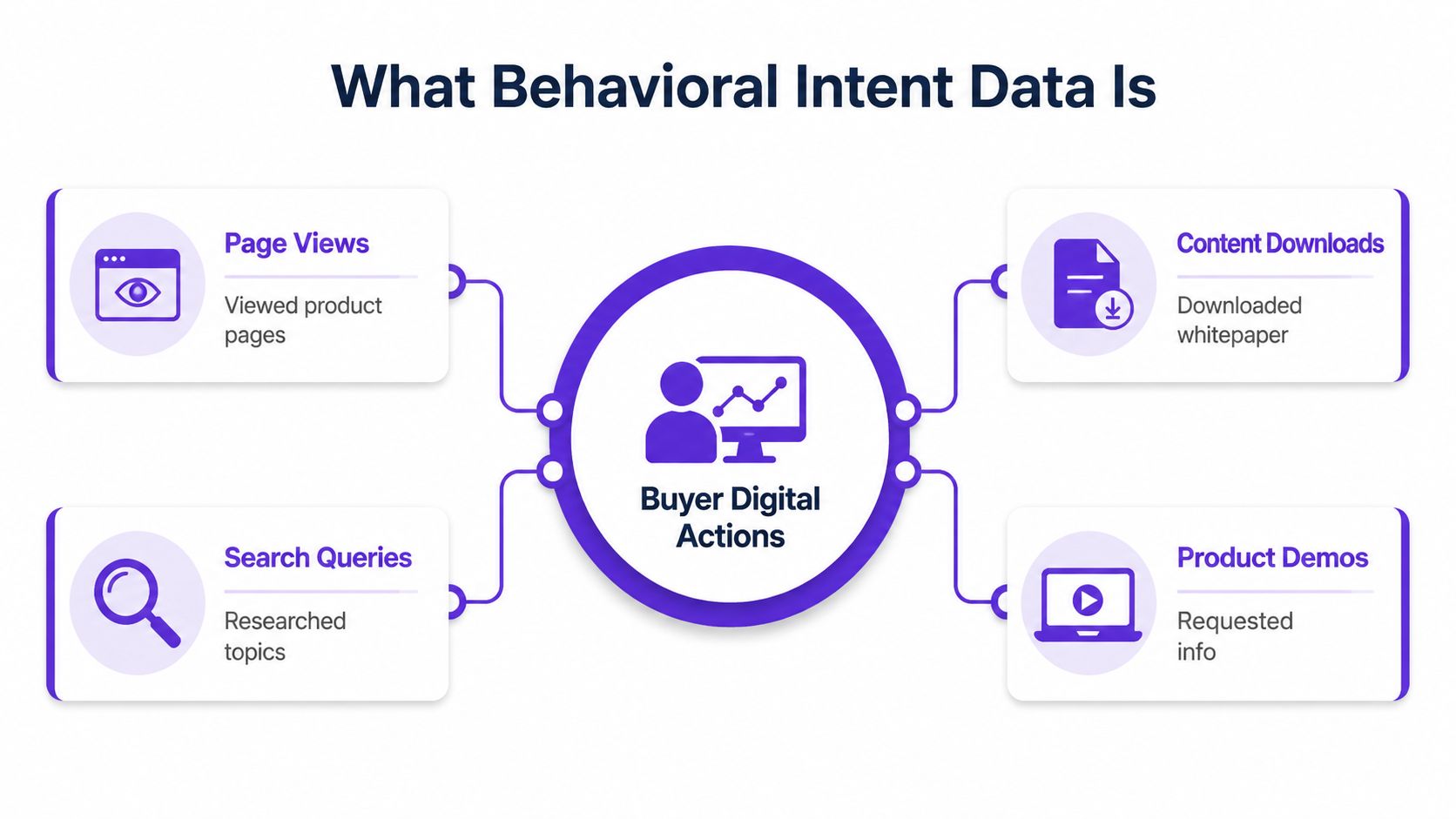
Behavioral intent data is information about what buyers do, when they do it, and how often they do it. In B2B sales, those actions can include website visits, content consumption, search activity, webinar attendance, product interactions, social engagement, and discussions around specific topics.
The important distinction is that behavioral intent tracks current research behavior, while firmographic data describes relatively stable attributes such as company size, industry, or revenue. Firmographics help answer “Who is this company?” Intent helps answer “What is this company investigating right now?” The definition of behavioral data provides useful context for understanding that difference.
The category has moved well beyond a niche analytics experiment. A 2024 industry roundup from Clearbit reported that 96% of B2B marketers had seen success using intent data, while 91% used it within account-based marketing to prioritize accounts and 60% used it for sales. The same roundup reported that 98% viewed intent data as essential for demand generation and 97% believed it provided a competitive advantage.
The reason is structural. Google research, as summarized in industry coverage of intent data statistics, found that business buyers don't contact suppliers until 57% of the purchase process is complete, and that buyers conduct an average of 12 online searches before visiting a specific brand's website. By the time a prospect fills out a form, much of the evaluation may already be underway.
The Types of Behavioral Signals That Matter
Not every click deserves a sales alert. A person can like a post while half-watching a meeting, download a report for later, or visit a pricing page because someone sent them a link. Intent comes from patterns, context, and timing, not from isolated activity.
Content consumption is usually an early signal. Repeatedly reading articles about the same operational problem suggests active research, especially when the topic aligns with your product category and the account fits your ICP. A single educational view is weak evidence. Several relevant interactions close together are more useful.
Social engagement adds the context traditional intent platforms often miss. A comment beneath a creator's post may show curiosity, but a thoughtful response to a competitor comparison or pricing discussion can reveal active evaluation. The surrounding conversation matters more than the reaction itself.
Stronger signals show decision movement
Certain actions sit closer to a buying decision:
Pricing engagement: A prospect discussing cost, packaging, or budget is likely thinking beyond general education.
Competitor mentions: Publicly comparing tools reveals that the buyer has moved from problem awareness toward vendor evaluation.
Repeated category searches: Recurring research around a solution category indicates sustained interest rather than accidental discovery.
Product interactions: Demo requests, product-page visits, and requests for more information are explicit signals, but they're often later-stage signals.
Buying committee activity: Several people from one account engaging with related topics can indicate that research is spreading beyond one individual.
Recency changes the meaning of every signal. Someone who commented on a competitor's post yesterday deserves a different approach from someone who read a category article months ago. The first prospect may welcome a relevant conversation. The second may still be gathering background, and an aggressive pitch could burn the opportunity.
Behavioral Intent vs Firmographic Targeting
Firmographic targeting remains useful. Without it, sales teams can waste time on accounts that were never a fit. The mistake is asking firmographics to do a job they can't do, which is identify immediate buying readiness.
Dimension | Firmographic Targeting | Behavioral Intent Data |
|---|---|---|
Primary question | Who fits the customer profile? | Who is researching a relevant problem now? |
Typical inputs | Industry, company size, revenue, geography | Searches, page visits, content use, social engagement, competitor activity |
Timing value | Low, because attributes change slowly | High, because signals reflect recent activity |
Best use | Define the ICP and build account lists | Prioritize accounts and choose outreach timing |
Main risk | Treating every qualified account as equally ready | Treating every interaction as purchase intent |
Sales message | Broadly relevant | Relevant to the observed topic and context |
Behavior helps sales teams choose when and why to engage, while firmographics help establish whether the account belongs on the list at all. The strongest approach uses both. A behavior signal from a poor-fit company is still a poor prospect, just as a perfect-fit company with no relevant activity may need nurturing rather than immediate outreach.
How Behavioral Signals Become Actionable Intent
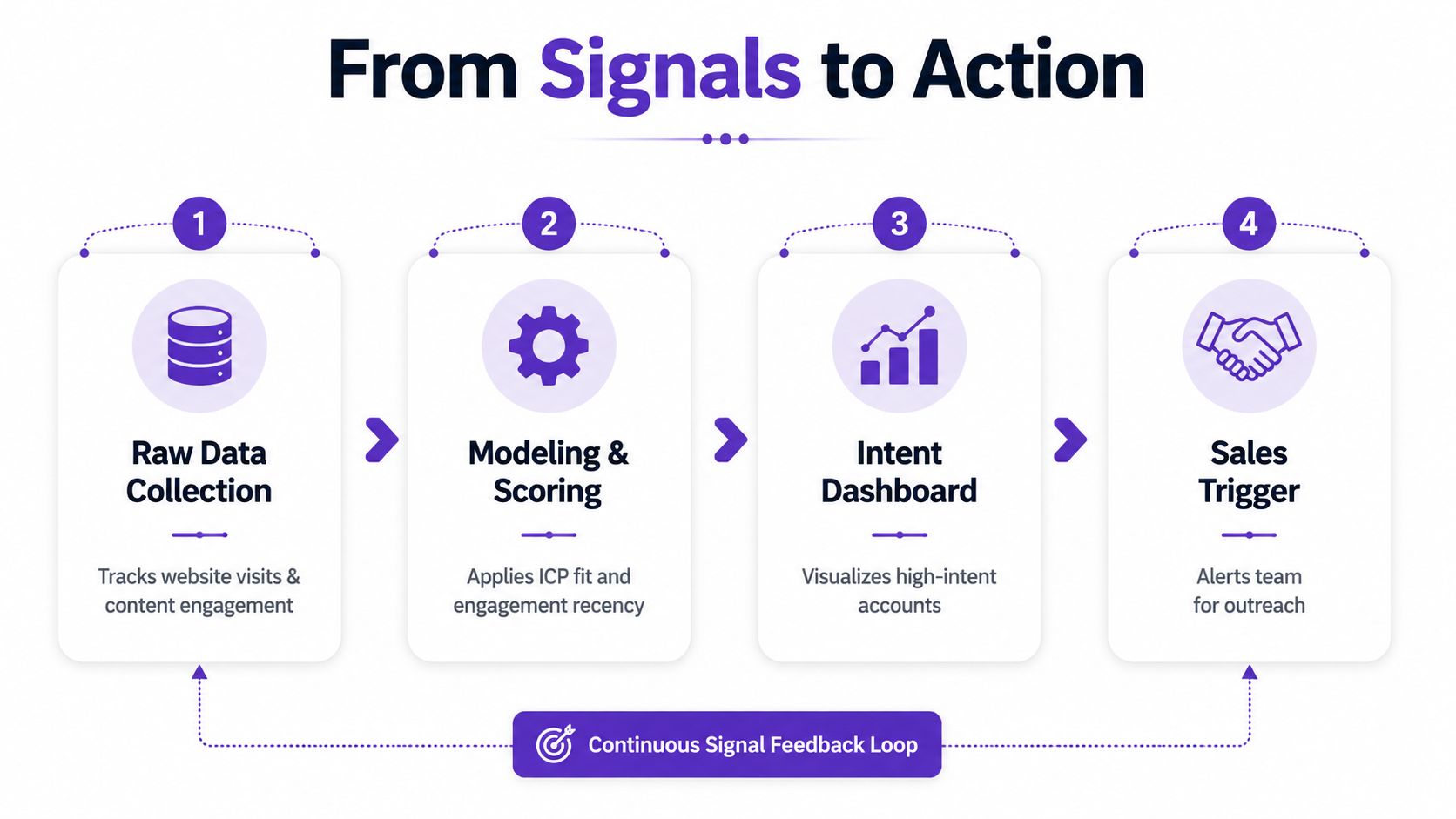
Raw activity is easy to collect. Useful intent requires a model.
Technically, behavioral intent data is a time series of observed buyer actions mapped to an account or topic and compared with a historical baseline. Systems look for meaningful changes in frequency and recency, rather than treating every event as equal. This technical explanation of intent data captures why a surge matters more than a lone click.
A pricing-page visit by itself may mean very little. Combine it with repeated engagement around the same category, competitor comparisons, and recent search activity, and the account becomes more interesting. The model should also apply fit data, because relevance depends on both behavior and the type of company showing it.
Validate before you automate
The hard question isn't “Can we collect signals?” It's “Do these signals predict useful sales conversations?”
A market analysis of buyer intent data reported that only 24% of B2B marketers reported exceptional ROI from intent data. That execution gap usually appears when teams count events without checking signal quality, account fit, baseline behavior, or buying-stage evidence.
Use the model to create a focused action queue, not a larger pile of alerts. Sellers should know what happened, how recently it happened, why it matters, and what conversation would naturally follow. The practical principles behind buying signals in sales are simple: cluster related activity, compare it with normal behavior, and give the rep enough context to act.
Real Sales Use Cases for Intent Data
Intent data earns its place in a sales stack when it changes the next action. A dashboard full of colored account scores is just office décor if reps still work their lists alphabetically.
Lead prioritization is the clearest use case. Sales leaders can rank accounts by fit plus recent activity, so reps begin with prospects showing relevant movement instead of relying on seniority or list position. That doesn't eliminate judgment. It gives judgment better inputs.

Outreach timing is the second use case. A prospect who engaged with a competitor discussion recently may be open to a comparison-oriented message. A prospect who consumed broad educational content may respond better to a useful observation or resource. The signal should shape the opening, not become an excuse for creepy surveillance language.
Personalization at scale is the third. Instead of writing “I noticed your company is growing,” a rep can reference the problem or conversation the buyer has already joined. Tools such as RoverLead AI monitor LinkedIn engagement tied to creators, competitors, keywords, and niche topics, then organize comments and content interactions into a feed with context and AI-written openers.
That approach supports intent-based marketing because sales and marketing can coordinate around what buyers are researching, rather than pushing the same message to every account.
The workflow should remain human. A useful signal gives the rep a reason to start a conversation. It doesn't write the entire conversation, qualify the account, or guarantee interest.
Limitations, Privacy, and the Execution Gap
Behavioral intent data isn't a mind reader. A comment on a viral post may reflect casual participation, while a detailed competitor comparison may come from someone doing serious evaluation. Sellers still need to verify context through public information, direct conversation, and qualification.
Signal quality improves when teams establish a baseline. Compare recent activity with normal account behavior, distinguish broad education from decision-stage research, and avoid routing every interaction to an SDR. A score without an explanation creates false confidence.
Privacy creates another boundary. Regulations such as GDPR and CCPA constrain how organizations track, store, and use behavioral information. Responsible providers should favor aggregated, anonymized, and consent-aligned sources instead of turning individual activity into a surveillance exercise.
The uncomfortable truth: Intent data can identify a promising moment, but only a salesperson can discover whether the problem, authority, budget, and urgency are real.
Execution is where many programs stall. If intent signals sit in a separate dashboard while reps continue pulling manual lists, the company hasn't operationalized intent. Put signals into the systems and routines where sellers already work, define follow-up expectations, and review false positives with the team.
The best programs treat intent as a prioritization layer, not a substitute for judgment. That keeps the technology useful without pretending that every digital breadcrumb means a buyer is ready to sign.
Operationalizing Intent Data in Your GTM Stack
Start with the ICP, not the software. Define the industries, company profiles, problems, buying roles, competitors, and topics that matter. Without those boundaries, an intent platform can surface plenty of activity that has no commercial value.
Next, choose a sales-friendly delivery format. Reps need a prioritized feed that explains the account, the observed behavior, the topic, the timing, and a sensible opening angle. A complex analyst dashboard may satisfy reporting needs, but it won't necessarily change daily prospecting.

Build the workflow around speed and accountability:
Define signal rules: Decide which combinations trigger research, nurture, or direct outreach.
Add context to CRM records: Store the topic and reason for prioritization, not just a mysterious score.
Create message paths: Match competitor engagement, category research, and pricing activity with different opening angles.
Review outcomes: Ask reps which signals produced meaningful conversations and which created noise.
Recalibrate regularly: Retire weak signals and strengthen clusters that consistently help qualification.
The intent data platform guide offers a useful reference point for evaluating workflow design. The practical standard is straightforward: intent should help a seller decide whom to contact, when to contact them, and what to say without forcing the buyer into an awkward “I saw everything you did” conversation.
Done well, behavioral intent data replaces some of the guesswork in outbound. It doesn't create demand from nothing, and it won't rescue a weak offer. It helps good sellers show up while the buyer's problem is active, with enough relevance to earn a real reply.
RoverLead AI turns LinkedIn comments, content interactions, competitor activity, and topic engagement into a daily feed of prospects matched to your ICP, complete with context and AI-written openers. Visit RoverLead AI to see how behavior-led prospecting can replace static list pulls with more timely sales conversations.