10 LinkedIn Message Templates for B2B Prospecting

The best LinkedIn message isn't the cleverest one. It's the one that arrives when a prospect has given you a relevant reason to reach out.
Teams often spend too much time polishing copy and too little time checking whether the recipient has shown any observable interest. High-performing LinkedIn outreach connects a real signal to a concise opener, a low-friction question, and evidence that the sender understands the prospect's context. A beautifully written message sent to the wrong person at the wrong time is still a beautifully written interruption.
LinkedIn message templates work best as adaptable frameworks, not scripts to paste unchanged. The ten templates below match distinct prospecting situations, including intent, pain, timing, proof, shared networks, and conversation stage. Each one includes a personalization rule, a follow-up posture, and a signal-to-message decision that fits RoverLead AI's approach to tracking engagement with creators, competitors, topics, pricing discussions, and demo conversations.
LinkedIn itself gives message performance a defined measurement framework. Its help documentation explains that InMail response rates count replies received within the first 30 days, and that recruiters sending 100 or more InMails must maintain a 13% response rate across a 14-day assessment period. LinkedIn's response-rate documentation makes the operational lesson clear: message quality needs a time window, a volume context, and a recorded outcome.
Table of Contents
1. The Intent-Based Opener
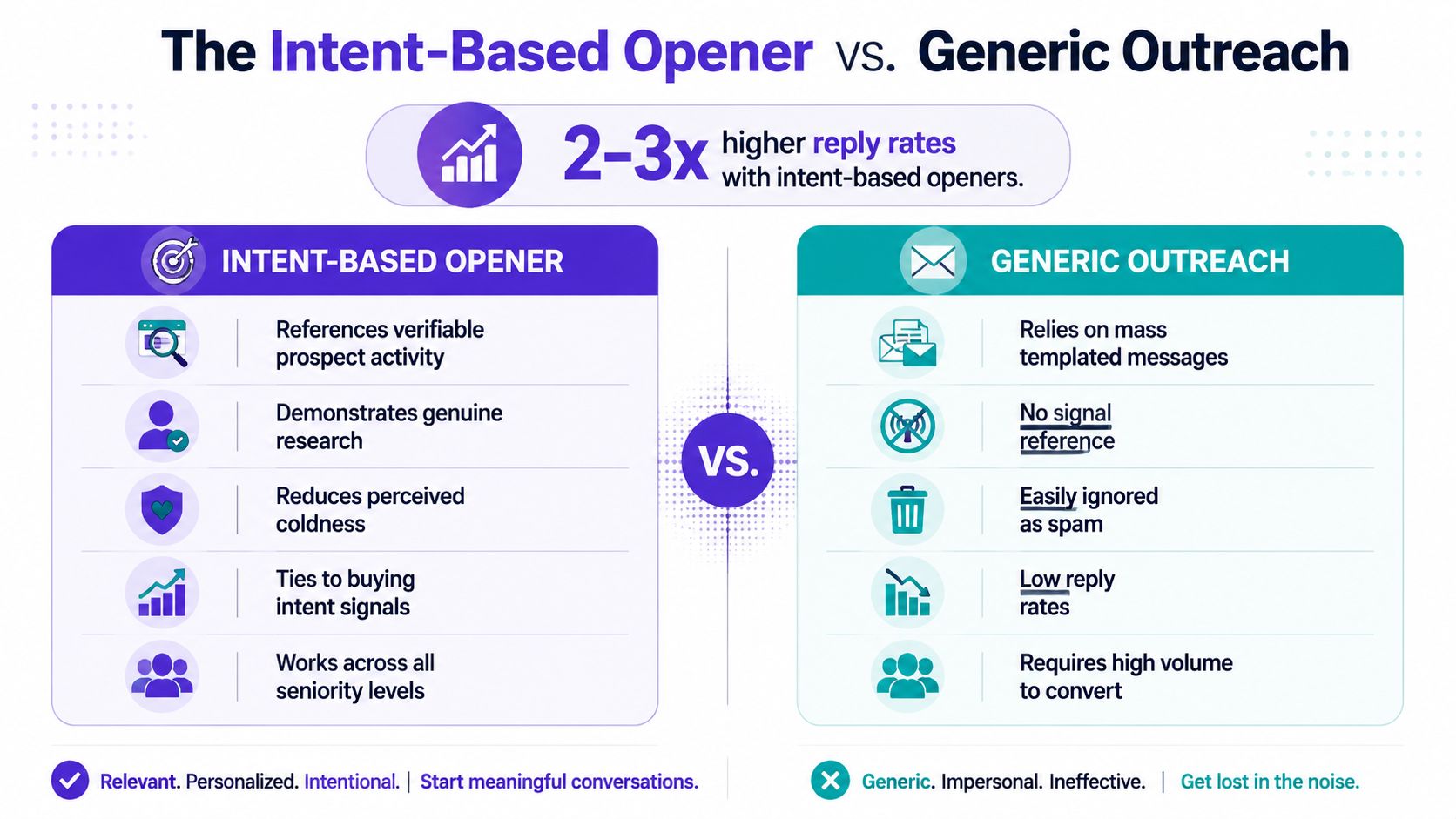
The strongest opener often starts with something the prospect did. A comment on a competitor's post, engagement with pricing content, or interaction with an industry expert gives you a reason to write that's more credible than “I came across your profile.”
Try:
“Saw your comment on [competitor's] post about [pain point]. Are you exploring similar approaches for [specific use case]?”
Or:
“I noticed you were discussing [specific topic] with [person or company]. Is that an active priority for your team?”
The signal should take one sentence, then disappear into a genuine question. Don't flatter the prospect for being “thoughtful” or “inspiring” unless you can explain why. Specificity does more work than praise.
RoverLead AI's Signal Agents are designed around this logic, identifying behaviors such as engagement with creators, competitors, and relevant topics so the sender can act on context rather than guesswork. The practical framework is also consistent with the broader principles in RoverLead's guide to buying signals in sales.
Personalization and follow-up
Send while the signal still has meaning. A recent comment about a competitor's workflow feature deserves a different message from an old like buried in a crowded feed. Test which signals produce useful conversations for your ICP, but keep the wording human.
If there's no reply, follow up with one additional insight tied to the original activity. Don't repeat the signal like a tracking pixel with feelings.
2. The Problem-First Template
Lead with the challenge your prospect may recognize, not the solution you're eager to demonstrate. A GTM marketer writing to a VP of Sales might say:
“Most VP Sales teams I speak with are balancing pipeline growth against limited team bandwidth. Is that something you're navigating right now?”
A BDR speaking with an operations manager could write:
“Revenue operations teams I speak with are dealing with toolstack bloat that makes forecasting harder. Does that resemble what you're seeing?”
The formula works because it gives the recipient something to evaluate before you mention your product. However, “teams struggle with” can become empty jargon if the problem isn't tied to the person's role, industry, or recent behavior.
Make the pain specific
Before sending, identify the top challenges your ICP discusses. Then connect the problem to the signal that made you notice the prospect. Someone engaging with content about forecasting may be worth a problem-first message about data quality. Someone commenting on a post about rep capacity may warrant a bandwidth angle.
End with a question, not a product tour invitation. If they respond, add a single sentence showing your perspective. If they don't, a later follow-up can offer a short observation about how similar teams approach the problem. The message should feel like a conversation about their operating reality, not a disguised brochure.
3. The Value-First Teaser
A value-first teaser gives the prospect a useful thought before asking for time. That insight might be a concise observation, a practical framework, or a reframed view of a problem. It should stand on its own, even if the recipient never replies.
Try:
“Quick observation. Teams in [industry] are rethinking [old approach] because [relevant reason]. I noticed you were engaged in a conversation about this and thought the angle might be useful.”
Or:
“I've been seeing revenue operations teams separate [specific process] from [related process] to make ownership clearer. Your comment on [topic] made me wonder whether that distinction is relevant on your side.”
Avoid inventing impressive performance figures to make an insight sound authoritative. If you have verified, permissioned evidence, cite it accurately. If you don't, use a well-reasoned observation and label it as such.

Keep the teaser small
The first message isn't the place for a white paper disguised as a DM. Use one or two sentences, explain why the insight relates to the prospect, and let curiosity do its job. A follow-up after 3–5 days can share an article, checklist, or relevant introduction, provided it adds something new rather than asking the same question again.
This approach works especially well for founders, consultants, and operators who can contribute a clear point of view. The trade-off is that value-first messaging demands real value. “I have some insights to share” isn't an insight. It's a trailer for one.
4. The Mutual Connection Anchor
A shared connection, community, creator, or professional interest can lower the social distance between two strangers. Start with the legitimate overlap:
“Looks like we're both connected to [mutual contact]. I've worked with them on [brief context], and your work in [area] caught my attention.”
Or:
“I noticed we're both part of [community]. I'm interested in how teams there are handling [specific challenge], and I thought it would be useful to connect.”
The mutual connection is an entry point, not the entire reason for outreach. Explain why you're contacting this person specifically. If the shared contact knows you well enough to make an introduction, ask for one instead of borrowing their name as a decorative trust badge.
Verify the bridge
Always confirm that the connection is real and that your description is accurate. Don't imply an endorsement that never happened. Keep the mention brief, then move to the relevant topic.
This template also works when the shared network is a creator or expert the prospect engages with. RoverLead AI can help surface those patterns, but the sender still needs to decide whether the overlap is meaningful. A prospect who follows the same expert may share a topic, not a buying need.
Follow up by adding context from the community or offering a relevant conversation. If the person doesn't reply, avoid escalating the social proof. A second message that says “our mutual friend thinks highly of you” usually sounds less warm, not more.

5. The Specific Use-Case Mirror
Specific examples help prospects understand how a solution might fit their environment. The useful version mirrors their role, industry, company stage, workflow, or challenge:
“We recently helped a similar [company type] team reorganize [specific process] around [approach]. The useful lesson was that [reason the approach worked]. Is that challenge relevant to your team?”
If you have permission to name a customer, do so accurately. Otherwise, anonymize the example clearly. Never manufacture a case study or attach a precise result that you can't substantiate.
Show the path, not just the outcome
A weak case-study message says, “We help teams improve pipeline.” A stronger one explains the starting condition, the intervention, and the reason it mattered. Keep the example to a few sentences and focus on the prospect's operating reality.
For teams exploring LinkedIn lead generation, RoverLead's Signal Agents can help identify prospects showing patterns similar to those associated with previous wins. That doesn't make every matching prospect a fit. It gives the seller a better starting hypothesis.
Follow up by offering to share the playbook or one implementation detail. The CTA should invite comparison, not force a demo. If the prospect's situation differs materially, say so. Credibility grows when you acknowledge where the analogy breaks.
6. The Question-Based Opener
A thoughtful question can outperform a polished pitch because it gives the prospect a clear role in the exchange. Ask:
“What's creating the biggest bottleneck in [specific process] right now?”
Or:
“I noticed you were engaged in conversations about [topic]. Is your team actively working on that, or is it more of a future-state discussion?”
The best questions are specific enough to answer and open enough to reveal context. “Are you interested in improving sales?” is technically a question, but so is “Do you like having problems?” Neither helps much.
Ask, then listen
Use “what” and “how” when you want substance. If the prospect answers, respond to what they said before introducing your solution. A question-based opener becomes manipulative when the sender treats the reply as permission to paste a pitch.
The signal-to-message decision is straightforward. If the prospect has discussed a topic publicly, ask about how it affects their team. If the signal is weak, ask a role-based question and avoid pretending you've diagnosed their situation.
A useful follow-up acknowledges their answer and asks one narrower question. The message should become more specific as the conversation develops. RoverLead's conversation-starter guidance fits this approach because the first objective is a reply with context, not an immediate calendar booking.
7. The Social Proof Multiplier
Third-party validation can reduce perceived risk, but only when it's relevant and verifiable. You might write:
“We were recently recognized by [verified authority] for [specific achievement]. I'm mentioning it because your team appears to be evaluating [relevant category]. Is that a priority at the moment?”
Or:
“A few customers in [relevant segment] use us for [specific workflow]. I noticed your engagement with [topic], so I thought the pattern might be useful context.”
The proof should occupy one sentence. The rest of the message should explain why it matters to the recipient.
Keep authority proportional
A logo list isn't a strategy. Recognition from an authority your prospect respects can help, but it won't compensate for weak relevance. Cite current claims accurately, secure permission for customer references, and don't turn a third-party mention into an exaggerated guarantee.
Social proof works best when the prospect has already shown interest in the category or problem. A signal about pricing or demos may justify a concise proof point. A casual interaction with unrelated content probably doesn't.
Follow up with a question about their evaluation criteria, not another paragraph of validation. The prospect doesn't need a museum tour of your awards cabinet. They need to know whether your experience applies to their situation.
8. The Collaborative Problem-Solving Approach
Some prospects respond better when you ask for perspective instead of presenting yourself as the answer. This is particularly useful in advisory sales, complex workflows, and markets where the buyer's internal context matters more than a standard pitch.
Try:
“I'm exploring how [role] teams are handling [specific challenge]. I noticed your engagement with [creator or topic], and I'd value your perspective on what's working.”
Or:
“I'm speaking with several [industry] teams about balancing [competing priorities]. Your work in this area stood out. How are you approaching it?”
Make the collaboration real
Don't ask for “insights” merely to create a disguised sales call. Explain what you're trying to understand and offer your own perspective in return. A genuine exchange might reveal that the prospect isn't a buyer, but it can still improve your market understanding.
The strongest personalization combines the person's observable activity with a specific question about their approach. RoverLead AI can surface the activity, while human judgment decides whether the topic is timely enough to warrant a message.
Follow up with something that reflects what they shared, such as a relevant framework or a contrasting observation. Avoid rushing from “I'd love your perspective” to “Can you meet tomorrow?” That bait-and-switch is why many people distrust research requests in sales.
9. The Friction Point Acknowledgment
Acknowledging friction shows that you understand the work behind the problem. It doesn't require a bold promise:
“I imagine coordinating [specific process] across several teams creates friction when you're trying to [desired outcome]. I noticed your team was discussing [related topic], so I wondered whether that's active right now.”
Or:
“I get the sense that managing [workflow] while scaling [business priority] is making clean execution harder. What part is causing the most drag?”
The language matters. “I imagine” and “I get the sense” leave room for correction. They're more respectful than declaring, “You have a major problem with…”
Validate without diagnosing too much
Prospects already know their pain. You don't need to describe it in theatrical detail. Name the specific friction, acknowledge the competing priority, and ask what they're seeing.
This template pairs well with signals that point to active research, such as engagement with content about a process or solution category. It's less suitable when your only evidence is a broad job title. A director of operations may care about forecasting, hiring, systems, or none of those things this quarter.
Follow up by sharing what similar teams have tried, without claiming that one approach will solve everything. The goal is to make the prospect feel understood, not cornered into admitting they need your product.
10. The Time-Sensitive Window
Urgency should come from the prospect's reality, not your sales calendar. A legitimate window might involve an upcoming industry event, a budget decision, a public product change, or an active evaluation.
Try:
“I noticed you're exploring [solution or approach]. With [specific event or deadline] approaching, is there a decision window you're working toward?”
Or:
“You've been engaging with conversations about [topic], and it looks like this may be moving from research to evaluation. Is timing becoming a factor for your team?”
The important move is to ask about timing rather than announce it. You may see a signal, but you don't know the internal deadline.
Create relevance, not pressure
Avoid artificial scarcity, vague warnings, and invented deadlines. Explain why the timing could matter to the prospect, then let them confirm whether the window is real. “We only have a few spots left” is not urgency if it has nothing to do with their business.
RoverLead AI's LinkedIn auto-message strategy describes a sequence built around a signal-led first message, one relevant question, and a final nudge. That structure is useful here because timing claims need a conversational check, not a one-way declaration.
If the prospect doesn't reply, follow up with a timing question or a useful resource related to the event or decision. If the window passes, retire the message rather than pretending the same urgency still applies.
10 LinkedIn Message Templates: Side-by-Side Comparison
Template | 🔄 Implementation Complexity | ⚡ Resource Requirements | ⭐ Expected Outcomes | 💡 Ideal Use Cases | 📊 Key Advantages |
|---|---|---|---|---|---|
The Intent-Based Opener: Capitalizing on Real Buying Signals | Medium, needs real-time signal tracking and context | Medium, intent platform + AI personalization | ⭐⭐⭐, 2–3x reply rates; warmer conversations | Intent-driven LinkedIn outreach; timely engagement across seniorities | High relevance and credibility; personalization at scale |
The Problem-First Template: Leading With Their Challenge, Not Your Solution | Medium, requires precise ICP and problem alignment | Low–Medium, research and tailored messaging | ⭐⭐, higher engagement; reduces resistance | Consultative B2B sales; discovery conversations | Positions you as an insider; creates psychological buy-in |
The Value-First Teaser: Offering Insight Before the Ask | Medium, needs genuine data/insights to share | Medium, research, data points, content prep | ⭐⭐, curiosity and follow-up; slower conversion | Thought leadership outreach; soft-engagement campaigns | Establishes credibility; differentiates from generic outreach |
The Mutual Connection Anchor: Leveraging Shared Networks and Relationships | Low, network mapping and verification | Low, LinkedIn checks and brief scripting | ⭐⭐, higher trust and response rates | SDR/BDR warm-up outreach; network-based intros | Social proof via shared connections; converts cold to warm |
The Specific Use-Case Mirror: Showing Exact Implementation in Their World | High, needs relevant case studies and careful anonymization | High, case library, permissions, legal review | ⭐⭐⭐, strong credibility; reduces implementation anxiety | Late-stage outreach; risk-averse or technical buyers | Concrete evidence and playbook; clear before/after results |
The Question-Based Opener: Triggering Curiosity With Strategic Inquiry | Low, craft thoughtful, non-obvious questions | Low, minimal tooling; thoughtful prep time | ⭐⭐, prompts responses; reveals prospect thinking | Early discovery; short outreach sequences | Invites dialogue; quickly surfaces pain and priorities |
The Social Proof Multiplier: Leveraging Third-Party Validation and Authority | Medium, requires verifiable third-party assets | Medium, analyst reports, testimonials, recognition | ⭐⭐⭐, boosts credibility and memorability | Enterprise and skeptical buyers; procurement checks | Third-party validation reduces skepticism; signals authority |
The Collaborative Problem-Solving Approach: Positioning as Partner, Not Vendor | Medium, requires authentic follow-up and relationship work | Medium, time investment and ongoing touches | ⭐⭐, builds long-term relationship capital; slower ROI | Advisory sells; long, complex buying cycles | Positions you as partner; fosters deep trust and loyalty |
The Friction Point Acknowledgment: Validating Their Pain Without Over-Promising | Low, empathic phrasing with precise context | Low, research and succinct messaging | ⭐⭐, rapport and lowered defensiveness | Early outreach; empathetic messaging to busy stakeholders | Demonstrates understanding; opens natural conversation paths |
The Time-Sensitive Window: Creating Urgency Through Relevant Context | Medium, monitor timing, events, and budget cycles accurately | Medium, signal monitoring and calendar intelligence | ⭐⭐–⭐⭐⭐, higher responses when timing is accurate | Event-driven campaigns; budget/quarter-end pushes | Creates legitimate urgency rooted in observable timing |
Turn Templates Into Conversations, Not Copy-Paste Campaigns
A template becomes useful when it helps a seller make a better decision before writing. Start with the strongest verified signal. If the prospect commented on a competitor's post, use the intent-based opener. If the signal reveals a familiar operational challenge, use the problem-first or friction acknowledgment template. If the person has already replied and shared context, move toward collaborative problem-solving or a specific use-case mirror.
Personalize the first sentence and one relevant detail. That's usually enough to make the message specific without turning every prospect into a research project. The detail might be the topic they discussed, the creator they engaged with, the workflow they described, or the reason their timing appears relevant.
Use one low-friction question or value-led CTA. “Is that active for your team?” is easier to answer than “Are you available for a 30-minute discovery call next Tuesday?” The larger ask can come after the prospect confirms relevance.
Record the signal, message angle, reply, and next outcome. LinkedIn's own measurement rules show why time windows and message volume matter, rather than treating engagement as a vague feeling. LinkedIn's business guidance also reports that the shortest InMails achieve a 22% higher response rate than average, while the longest are 11% below average. LinkedIn's InMail response guidance supports a simple editing rule: remove anything that doesn't establish context, offer value, or make the question easier to answer.
Independent benchmarks reinforce the importance of relevance, though their methodologies differ. One 2026 benchmark reports 8.62% average replies for template-based campaigns and 14–17% for more targeted messenger campaigns, while a separate study across 15M+ LinkedIn contacts reports an overall reply rate of 7.2%, with personalized connection notes at 8.2% compared with 5.3% without a note. The outreach benchmark and the independent LinkedIn study point to the same practical conclusion: copy matters, but context does more of the heavy lifting.
FAQ
How long should a LinkedIn message be?
Keep the message concise enough to scan on mobile. LinkedIn's business guidance indicates that shorter InMails outperform longer ones, so remove background and product detail that can wait for a reply.
What is the character limit for a connection request?
Connection request notes allow 300 characters on Premium, Sales Navigator, and Recruiter accounts, while free accounts allow 200 characters. The limit includes spaces and emojis, according to LinkedIn connection-note guidance.
Should I use a connection request or a direct message?
Use a connection request when the relationship is new and you have a credible reason to connect. Use a direct message when you already have access and the prospect has shown a stronger signal or entered an existing conversation.
What makes a good InMail subject line?
A good subject line sets context without sounding like an advertisement. InMail subject lines have a 200-character limit, while Recruiter message bodies have a 1,900-character limit, as outlined in LinkedIn InMail guidance for recruiters. In practice, shorter subjects are easier to understand.
How much personalization is enough?
Personalize the reason for contacting the person, then add one detail that proves the context is real. Deep personalization isn't a recital of their biography. It's a relevant connection between their activity and your question.
When should I follow up?
A value-based follow-up after 3–5 days is a practical starting point when the original message still matches the prospect's situation. If the signal changes, update the angle instead of repeating the first note.
How many follow-ups should I send?
Use judgment rather than a fixed quota. One useful follow-up and a respectful final nudge are often enough. Repeated messages with no new reason to engage turn persistence into inbox furniture.
What makes a signal high quality?
A high-quality signal is specific, recent, and connected to your ICP. Pricing discussions, demo interactions, competitor engagement, and comments about a known pain point are more actionable than a generic profile view.
How should I stay compliant?
Use truthful identity and relationship references, respect LinkedIn's limits, avoid misleading automation, and don't imply that a prospect gave consent or expressed intent when they didn't. Human review remains important for relevance and tone.
Should I measure replies or meetings?
Measure both. Replies show whether the message opened a conversation, while qualified meetings show whether the targeting, signal, message, and CTA worked together. A high reply count with poor meeting quality may indicate that the message is interesting but commercially misaligned.
When is RoverLead AI useful?
RoverLead AI is useful when sellers need to monitor buying behavior instead of relying on static lists. After defining an ICP, keywords, competitors, and experts, the platform can monitor 10+ buying signals, surface a curated feed, and generate contextual openers. Human judgment should still decide whether the signal is relevant and whether the tone sounds like something a real person would send.
The operating system is simple. Choose the template from the signal, personalize the opening and one detail, ask one easy question, follow up with a reason, and record what happened. Templates provide consistency. Context makes the conversation worth having.
RoverLead AI turns LinkedIn engagement with creators, competitors, and topics into curated, high-intent prospects with contextual openers for your ICP. Visit RoverLead AI to see how signal-led prospecting can replace manual list pulling with more timely LinkedIn conversations.