Conversation Intelligence: The 2026 Guide

It's Tuesday afternoon at a 40-person SaaS company. An SDR has just finished a promising discovery call with a VP of RevOps. The AE who should have joined was double-booked, the notes are sitting in a document nobody will open, and by Thursday no one can remember whether the buyer mentioned budget, timing, or both.
Multiply that across 15 reps and two months of pipeline. You get an ocean of conversations with very little usable signal. Managers coach from memory, onboarding drags, and “what's working” becomes whatever the most confident rep says in the forecast meeting.
The problem isn't a shortage of calls. It's the lack of a repeatable way to learn from them. Conversation intelligence closes that gap by turning calls, meetings, messages, and buyer activity into structured insight that sales teams can act on.
Table of Contents
Why Every Sales Call Still Feels Like a Black Box
A recording exists, technically. The transcript may even be searchable. But storage isn't understanding, and a folder full of calls doesn't tell a sales leader which objections are appearing across the pipeline or why one rep consistently earns better next steps.
That's where teams lose time. The manager reviews a few calls when there's a problem, the rep writes a polished CRM summary, and leadership tries to forecast from information filtered through several layers of memory and optimism. Pipeline reviews become archaeology, except the fossils are missed commitments and vague follow-up tasks.
Conversation intelligence has moved beyond a niche coaching category. One market summary estimates the global market at $1.6 billion in 2023, about $2.1 billion in 2024, and a projected $8.4 billion by 2030, implying a 26% CAGR over that period, as reported in Nimitai's 2026 B2B sales AI summary. Another market report projects the platform market from $4.54 billion in 2026 to $41.78 billion by 2035, illustrating how differently analysts define the category in Research and Markets' market report.
Practical rule: If your team can't turn a buyer's words into a coaching action, a CRM action, or a forecast decision, you don't have intelligence yet. You have an archive.
What Conversation Intelligence Actually Is
Conversation intelligence is software that records, transcribes, and analyzes business conversations, then returns structured insights to reps, managers, and revenue systems. The category covers sales calls and customer meetings, but it can also include chats, messages, and email threads. ZoomInfo's guide to conversation intelligence describes the category as a way to identify patterns, sentiment, and key moments that affect deal outcomes.
Old-school call recording stops at the file. Conversation intelligence adds interpretation. It can identify topics, objections, competitor mentions, pricing discussions, next steps, talk ratios, and coaching alerts, then write selected fields back to systems such as Salesforce or HubSpot. AssemblyAI's overview explains the distinction clearly: CI converts unstructured audio or text into usable data rather than leaving teams with a static transcript.
The pipeline from audio to action
The underlying workflow usually has four layers:
Automatic speech recognition: ASR turns audio into text.
Speaker separation: Diarization helps distinguish the rep from the buyer.
Language analysis: NLP extracts entities, topics, intent, sentiment, and commitments.
Action and workflow: Scoring, summaries, alerts, and CRM updates put the insight where people already work.
The right mental model is voice-of-customer at scale, not a fancy recorder. IBM's explanation of conversation intelligence similarly frames it as AI-powered analysis that extracts actionable insight from business conversations.
For a broader view of how conversation intelligence fits into revenue data, see this guide to what sales intelligence means in practice.
Call Recording vs Conversation Intelligence vs Signal-Based Selling
Buyers often compare products that sit at different layers of the sales stack. That creates confusion, especially when every vendor uses words such as “intelligence,” “intent,” and “AI” as though they're interchangeable.
Call recording is mainly a storage and review system. Conversation intelligence analyzes the content of the interaction. Signal-based selling starts earlier, looking for evidence that a buyer may be researching, discussing, or evaluating a problem before a meeting appears on the calendar.
Dimension | Call Recording | Conversation Intelligence | Signal-Based Selling |
|---|---|---|---|
Primary input | Calls and meeting audio | Calls, meetings, transcripts, and sometimes messages | LinkedIn activity, intent data, email replies, and social engagement |
Main job | Store interactions for review or compliance | Extract topics, objections, risks, and coaching moments | Detect buyer behavior and prioritize timely outreach |
Typical output | Audio file and transcript | Scorecards, summaries, alerts, CRM fields, and deal signals | Account or person-level triggers, routing, and outreach context |
Best use | Compliance, basic QA, and occasional review | Coaching, forecasting, qualification, and competitive intelligence | Social selling, prospect prioritization, and trigger-based prospecting |
Main weakness | Nobody has time to review everything | Poor transcripts or weak adoption can corrupt the insight | Signals can be noisy without a clear ICP and useful context |
The approaches overlap, but they aren't identical. A mature stack can use social signals to trigger outreach, conversation intelligence to analyze the resulting interaction, and both data sets to improve routing and forecasting.
That broader intent layer is covered in this guide to intent data. The useful question isn't “Which category wins?” It's “Where in the buyer journey does this system create a decision we couldn't make before?”
How Conversation Intelligence Works Under the Hood
The process begins with ingestion. Platforms capture calls and meetings through dialers, meeting bots, or communication integrations, while broader systems can pull in LinkedIn messages, email threads, CRM records, and social activity through available connections.
ASR converts speech into text, then language models look for topics, entities, sentiment, intent, objections, competitor names, pricing language, and next steps. Large language models can summarize the exchange, but the summary is only as reliable as the transcript and context supporting it.

Why transcript quality matters
Word error rate, or WER, is the first technical check. A Stanford study covering recorded calls in finance, insurance, telecom, and booking found WER as high as 23.31%, roughly five times worse than the vendor benchmark level often used to justify deployment, according to Granola's discussion of missed speech in AI meeting recorders.
That matters when the system needs to distinguish a competitor's name from a product name, or “next quarter” from “not this quarter.” Test your own noisy VoIP calls, accents, speaker overlap, and industry vocabulary. Clean demo audio is a charming liar.
The final layer enriches conversation data with CRM and intent context, then pushes structured outputs into Salesforce, HubSpot, dashboards, or workflows. This is why the same intent-mining logic can support LinkedIn prospecting. A public post about a pricing problem and a buyer's objection on a call become comparable signals instead of isolated anecdotes.
Teams evaluating the wider category can also compare the role of AI sales tools in the broader revenue stack.
Real Benefits for B2B Sales Teams in 2026
A manager opens a flagged call before the deal review, finds a missed objection, and coaches the rep on the next conversation. That is where conversation intelligence earns its keep. The tool supports behavior change when managers use evidence, reps trust the data, and revenue operations connects insights to an existing workflow.
Adoption has reached mainstream B2B operations. A 2026 industry summary reports that 51% of B2B sales organizations with 10 or more reps use conversation intelligence, and those organizations report 18% higher average win rates, according to Stealth Agents' AI sales tools adoption summary. The same source reports that AI call coaching can shorten new-rep ramp time by 32% when paired with manager coaching.
Those figures provide direction, not a preset outcome. Managers still need to review flagged moments, reps need to change their behavior, and the same intent-mining logic can extend into LinkedIn and social-selling workflows. A buyer's public post about a pricing problem can sit beside a call objection as a usable signal, rather than remaining an isolated anecdote.
Benefit Category | Realistic Lift When Adopted | Adoption Threshold | Marketing Claim to Question |
|---|---|---|---|
Coaching and ramp | Faster feedback and more consistent practice | Managers review flagged moments regularly | “The AI coaches reps automatically” |
Win rates and deal quality | Better visibility into objections, commitments, and risk | Calls are captured and referenced in deal reviews | “Every team immediately closes more” |
LinkedIn and social selling | More relevant timing and messaging | Signals are matched to a defined ICP | “Any engagement means buying intent” |
Revenue operations | Cleaner feedback for forecasting, product, and competitive analysis | Insights flow into CRM and operating rhythms | “The platform becomes a source of truth by itself” |
The market data also shows the adoption gap. One 2026 summary cites 380% ROI over 24 months with an 18-month payback, while companies that miss recording, peer-review, and coaching thresholds may see only 0.8x to 1.4x ROI, as detailed in Research and Markets' category analysis.
CI value depends entirely on how the team uses the tool, not on the purchase itself.
A Practical Rollout Plan for SDRs, Leaders, and Founders
Treat the rollout as a coaching-system change, not an app installation. The teams that get stuck usually connect the tool, announce it, and wait for productivity to emerge like a houseplant.
Phase one, days 1 to 14
Define the ICP and the conversations you want to understand. Confirm recording consent and data-handling requirements in every region before anyone captures calls. Choose two integration anchors, such as a dialer plus CRM, or LinkedIn Sales Navigator plus CRM.
Ask:
Can we explain which conversations are in scope?
Does every region have a documented consent workflow?
Where will the insight appear for reps and managers?
Phase two, days 15 to 45
Enable automatic capture for all relevant calls and meetings. Push only useful tags into the CRM, then run three coaching sessions each week using flagged moments instead of full-call marathons.
Build a simple rep scorecard around talk-to-listen ratio, objection handling, next-step clarity, and qualified meetings booked. If your ASR benchmark shows WER below 10% on key call types, investigate before expanding. That threshold is a rollout checkpoint, not a universal industry standard.
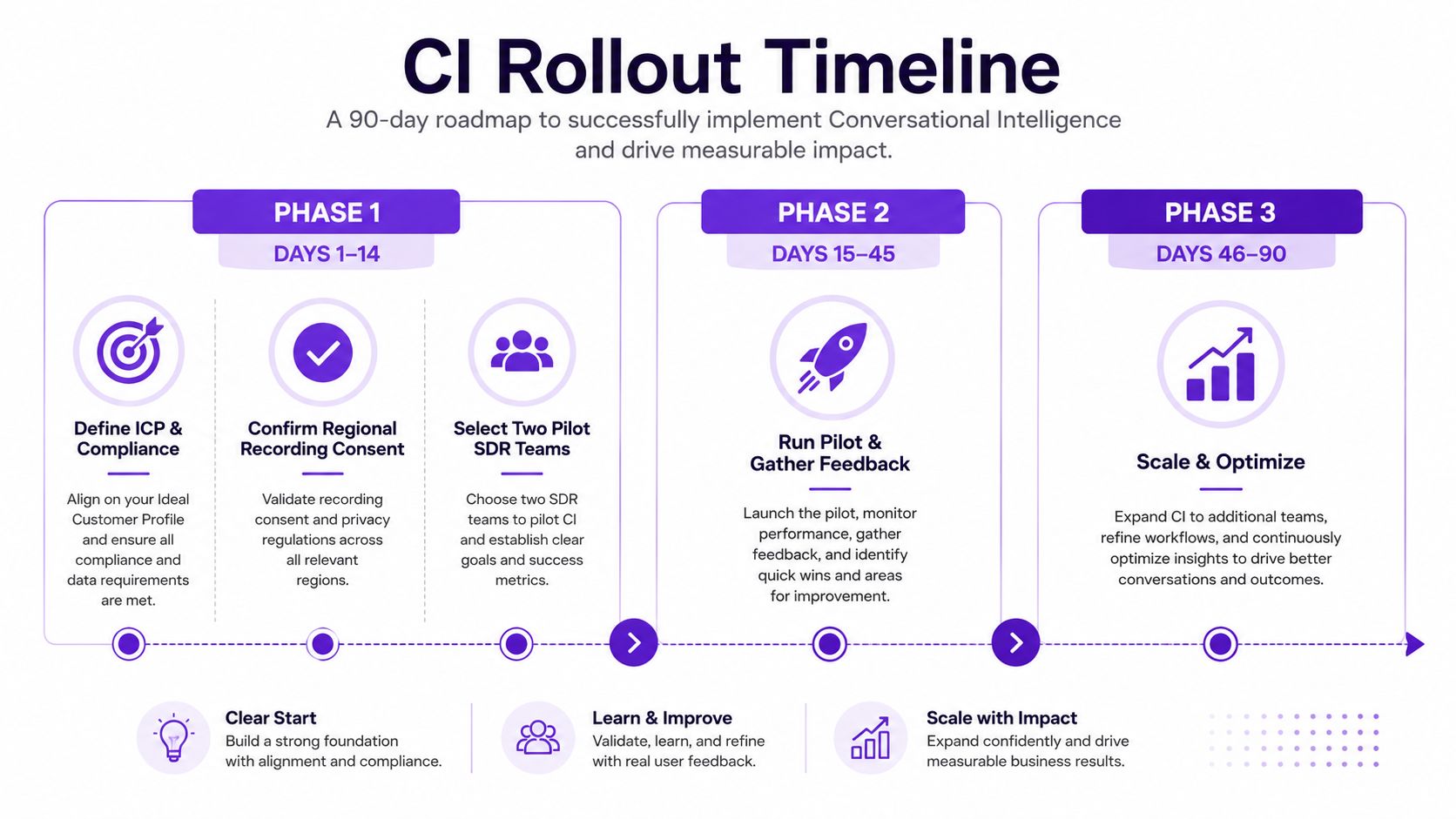
Phase three, days 46 to 90
Add LinkedIn and email signal mining once the call workflow works. Tie usage to manager OKRs, not punitive surveillance. Check whether reps open their dashboards weekly and whether deal reviews name tagged moments instead of relying on “the buyer seemed interested.”
A practical sales enablement platform should reinforce this loop, not create another place where useful information goes to nap.
Common Pitfalls and Best Practices You Should Not Skip
Five failure modes appear again and again.
Ignoring WER: Run a sanity check on a five-call sample that includes noise, accents, overlap, and your industry terms. If the transcript gets competitor names or pricing language wrong, fix the data layer before trusting the scorecard.
Skipping consent: Give reps a clear consent script and document regional rules. A clever analysis workflow is worthless if customers weren't properly informed about recording or processing.
Treating CI as transcription: A transcript is an input, not an outcome. Pair AI flags with a manager rubric that turns “pricing objection” into a specific coaching conversation.
Over-automating alerts: Too many notifications train reps to ignore all notifications. Start with a small set of high-value moments, then remove alerts that don't change a decision.
Buying without a champion: Assign an executive sponsor, a sales operations owner, and a frontline manager who will use the system in public. Adoption dashboards should track weekly rep login frequency and whether managers reference the data.

The best first use case is usually the one a manager can demonstrate in a team meeting, not the one with the longest feature list.
Review transcripts monthly against the language your ICP uses. Keep one measurable outcome in view, such as clearer next steps, more consistent qualification, or better forecast discipline. Then expand only after the first team has a working coaching loop.
Examples, Scenarios, and Frequently Asked Questions
An SDR can use a LinkedIn trigger, such as a relevant post or a discussion about a problem, to prioritize an InMail instead of treating every profile as equally cold. A sales leader can review talk-to-listen patterns and objection handling with a stuck mid-market rep, using specific moments rather than personality judgments.
A founder has a different job. Deal-risk signals can help decide whether a stalled opportunity deserves another executive touch or should leave the forecast. In each case, the system matters because it connects evidence to a decision.
Questions buyers usually ask
How long until ROI appears? It depends on capture, manager participation, and workflow integration. A pilot should define the expected behavior and outcome before anyone calls it a success.
What does it cost per rep? Pricing varies by vendor, channels, processing volume, integrations, and governance requirements. Ask what is included in the base plan and what creates usage-based charges.
Does it replace sales managers? No. It reduces manual searching and gives managers better evidence, but coaching still requires judgment, context, and trust.
How does it handle multilingual calls? Never assume support on a feature page equals reliable analysis for your team. Test the languages, accents, terminology, and audio conditions you use.
What stays in the CRM? Decide whether the CRM receives summaries, tags, next steps, scores, or links back to the full record. Keep sensitive data governed and make retention rules explicit.
Can it analyze LinkedIn conversations? It can support broader signal workflows when the platform has appropriate integrations and permissions. Public engagement and private messages shouldn't be treated as interchangeable data.
Is sentiment reliable enough for coaching? Sentiment can provide context, but it shouldn't become a verdict on a rep or buyer. Pair it with observable behaviors and manager review.
Should every call be recorded? Capture policies depend on consent, jurisdiction, customer expectations, and your use case. Compliance belongs in the rollout plan, not in the post-launch cleanup queue.
What's the best first KPI? Choose one behavior or outcome your team can influence, then measure it consistently. A sprawling dashboard usually hides weak adoption.
What's the differentiator? The coaching loop. CI is only as good as the coaching loop it feeds.
RoverLead AI turns LinkedIn engagement into daily, high-intent leads matched to your ICP, using Signal Agents to find relevant behavior and provide context for timely outreach. Visit RoverLead AI to connect social-selling signals with a more practical conversation intelligence workflow.