How to Define Your ICP That Actually Closes Deals

Your sales team has a beautifully formatted target-account list, a carefully written sequence, and a calendar full of discovery calls. The problem is that too many prospects never had the budget, urgency, authority, or operational fit to buy. The reps aren't failing at outreach. The account selection is doing the damage before outreach begins.
That's why learning how to define your ICP matters. A useful Ideal Customer Profile isn't a description of everyone who could theoretically use your product. It's a working filter built from actual wins, losses, buying conditions, and live intent signals, including what prospects say and engage with on LinkedIn.
Table of Contents
Building Your ICP From Closed Deals and Validating With Intent Signals
Diagnosing Common ICP Failures Before They Cost You Pipeline
The $80K Mistake That Started With a Bad ICP
The warning arrived in a forecast meeting. A rep had burned through $80K in pipeline spend pursuing a broad SaaS segment, and the opportunities looked healthy in the CRM. Meetings had happened. Proposals had gone out. Forecast categories had been updated with impressive confidence.
Then sales ops compared the account list with a year of closed-won data. Three industries were converting at 5x the rate of the broader segment, yet outbound was still treating every SaaS company as equally attractive. The team had optimized email copy for an account-selection problem.
The consequences showed up everywhere:
Higher acquisition costs: Reps and marketers spent time on accounts that weren't likely to buy.
Lower win rates: Discovery calls started without a clear business problem or buying path.
Distorted forecasts: Pipeline volume looked acceptable while fit and conversion quality deteriorated.
Slower learning: Every poor-fit deal created more noise in the data used for future targeting.
The uncomfortable diagnosis: Better cold email copy won't rescue a list filled with companies that lack pain, authority, or buying readiness.
The fix wasn't another sequence. It was a rebuild from observed winners before the next quarter began. That meant examining industry, size, revenue contribution, technology, buying behavior, and post-sale outcomes, then using those patterns to decide which accounts deserved attention.
A benchmark cited in 2024 reported that 65% of high-growth B2B companies, defined as firms growing revenue by more than 40% year over year, had a documented ICP, compared with 14% of no-growth firms. The benchmark is summarized in B2B buyer persona and ICP benchmarks for 2024. The exact mechanism varies by company, but the operating lesson is straightforward: precise targeting gives every downstream activity cleaner inputs.
What an ICP Really Is and How It Differs From a Persona
An Ideal Customer Profile describes the company most likely to buy, close efficiently, adopt successfully, retain, and expand. It combines firmographic characteristics, such as industry, company size, revenue, and geography, with behavioral, technographic, and organizational signals. Salesforce describes an ICP as a detailed description of the buyer most likely to become a paying customer, including behavioral, firmographic, and environmental characteristics in its guide to ideal customer profiles.
A buyer persona describes the human inside that company. It covers the person's role, priorities, motivations, objections, influence, and preferred evidence. The ICP selects the account. The persona shapes the conversation.
Confusing the two creates a familiar mess. Marketing writes sharper messages for a RevOps leader, but sales still targets companies with no RevOps function. The copy improves while the pipeline remains weak. Before refining a persona, confirm that the account belongs in the target universe.
ICP vs. Persona at a Glance
Dimension | ICP | Persona |
|---|---|---|
Primary question | Which companies should we target? | Which people should we engage? |
Unit of analysis | Account | Individual stakeholder |
Typical inputs | Industry, size, revenue, stack, readiness, intent | Role, goals, objections, influence, language |
Practical output | Ranked account list and qualification rules | Messaging, content, discovery approach |
Relationship | One ICP can include several personas | Each persona should sit inside a qualified ICP |
A useful explanation of behavioral data helps clarify why account selection can't stop at static attributes. A company may match your industry and size criteria, but its people's behavior can reveal whether the problem is active, funded, and being discussed.
The rule I use is simple: personas can be multiple per ICP, but every persona must live inside one ICP. If a contact looks perfect but the account has the wrong economics, stack, or readiness, the contact isn't a qualified opportunity. They're just an interesting person at the wrong company.
The Five Layers Every Strong ICP Needs
Firmographics are the entry point, not the finished profile. A strong ICP combines company fit with evidence that the organization can use, approve, and prioritize your solution.
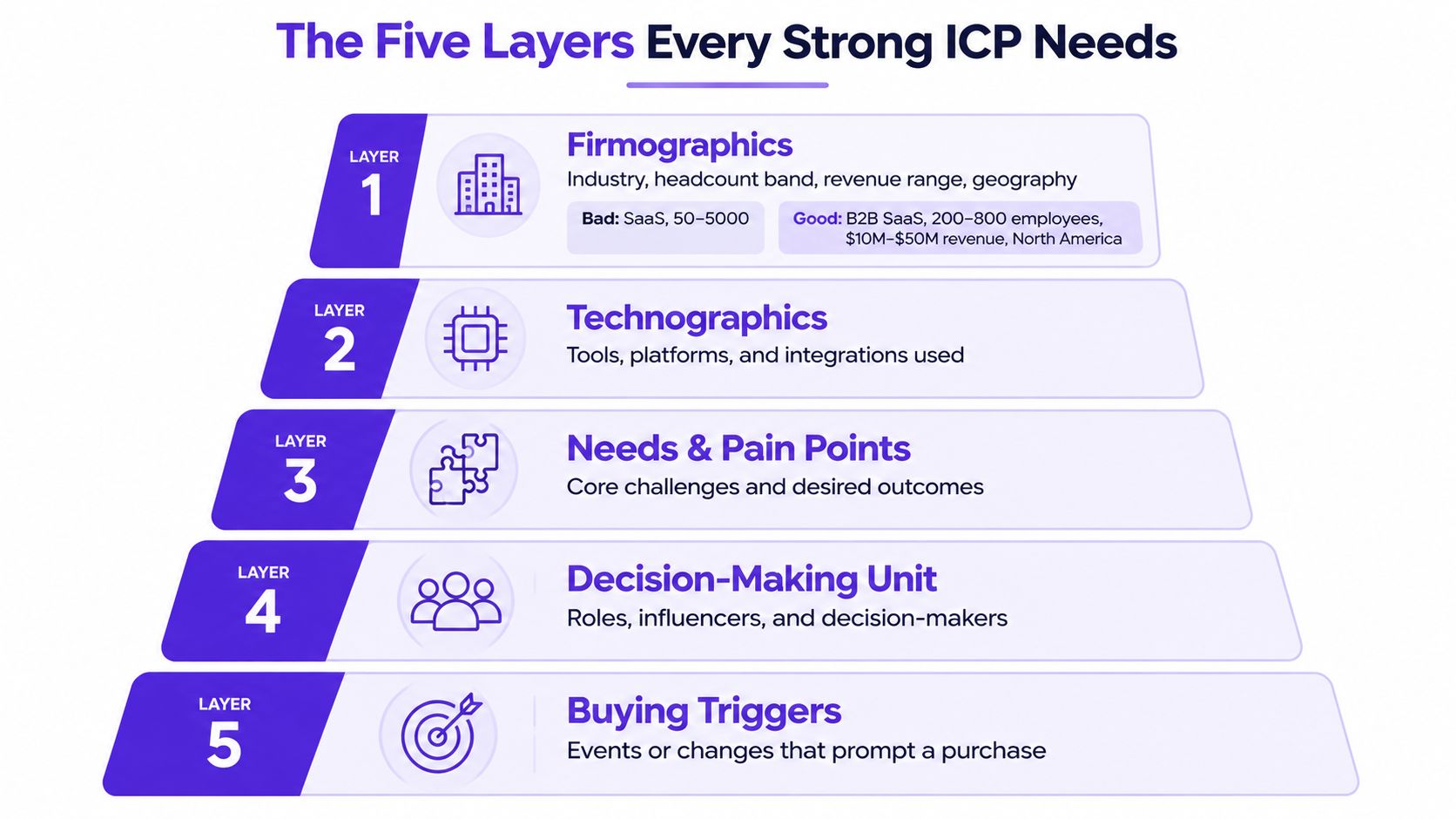
1. Firmographics
Start with industry, headcount band, revenue range, and geography. “SaaS, 50–5000” is too loose to guide a rep. A more useful profile might be “B2B SaaS, 200–800 employees, $20M–$100M ARR, North America.”
The visual example uses $10M–$50M revenue, which is also valid if it reflects your actual winners. The point isn't to copy a range. It's to create boundaries that distinguish a high-fit account from a merely possible one.
2. Technographics
Document the technology that supports a successful implementation, plus tools that indicate maturity or create friction. A CRM, sales-engagement platform, analytics stack, or integration environment can reveal whether the account has the resources to adopt.
A bad technographic layer says, “Uses modern tools.” A good one names the required systems, compatible integrations, and disqualifying conditions, such as a fully embedded competitor when displacement isn't part of your motion.
3. Needs and pain points
Name the operational problem buyers pay to solve. “Wants growth” isn't a pain point. “Sales leaders can't identify which LinkedIn conversations indicate active buying interest” is specific enough to shape qualification and messaging.
Also define urgency. A company can have the problem without having a reason to act this quarter.
4. Decision-making unit
Map the roles required for approval, implementation, security, finance, and daily use. A profile that names only a job title is incomplete. Deals often stall because the user, economic buyer, champion, and approver aren't the same person.
5. Buying triggers and negative fit
Triggers include leadership hires, expansion announcements, technology changes, funding events, or public discussions about pricing and process. Negative indicators matter just as much. Add industries, stages, geographies, implementation conditions, and behavioral patterns that historically produce poor retention or repeated no-decisions.
Practical rule: A criterion belongs in the ICP only when it helps predict buying, adoption, retention, or expansion.
Matching Your ICP to Your Real Growth Motion
The same account can be attractive for acquisition and poor for retention. Treating every growth motion as if it has the same definition of “ideal” creates a profile that's technically rounded but operationally useless.
Consider a 600-person mid-market logistics firm. For a first contract, you might care most about segment fit, relevant technology, and evidence of an active operational problem. For expansion into another business unit, product usage, seat density, and the presence of a related team may matter more. For retention, implementation quality, support load, renewal timing, and adoption patterns become central.
ICP Criteria Weighting by Growth Motion
Criterion | Acquisition Weight | Expansion Weight | Retention Weight |
|---|---|---|---|
Firmographic fit | High | Medium | Low to medium |
Technographic compatibility | High | Medium | Medium |
Product usage and seat density | Low | High | High |
Buying and expansion triggers | High | High | Medium |
Implementation and support fit | Medium | High | High |
Negative indicators | High | High | High |
The table uses qualitative weights because your data should determine the final score. Pick the two or three criteria that deserve 60–70% of the weighting for your dominant motion, then let the remaining criteria qualify, disqualify, or prioritize accounts.
If net-new acquisition drives the quarter, don't let retention signals drown out market reach. If expansion is the growth engine, don't keep ranking accounts solely by their original firmographic fit. Your account-based prospecting approach should reflect the motion your team can execute.
The practical test is whether a rep knows why an account is prioritized today. If the answer changes by motion, create separate scores or tiers instead of forcing one universal ICP to do three jobs.
Building Your ICP From Closed Deals and Validating With Intent Signals
A company can match your firmographics, sign a contract, and still become a poor customer. Rebuild the profile from accounts that bought, stayed, expanded, and created manageable post-sale work. Your CRM is usually the best starting point.
Start with the evidence
Export the last 18–24 months of closed-won and closed-lost deals. Normalize fields before searching for patterns. Inconsistent industry labels and missing revenue values can make random noise look like a segment.
Capture:
Account attributes: Company size, industry, revenue, geography, and relevant team headcount.
Technology context: CRM, sales tools, integrations, and competitor products.
Commercial data: Deal size, sales-cycle length, and time to close.
Buying context: Trigger event, first meaningful signal, decision-maker title, and buying committee.
Outcome data: Revenue contribution, retention, expansion, implementation complexity, and loss reason.
Rank accounts by revenue contribution and post-sale value, not deal count alone. Score each account against the five layers, then compare strong customers with closed-lost and stalled deals. The useful pattern is the small group of attributes that recurs among customers who produce value without creating disproportionate delivery work.
A practical methodology in why your ICP may be wrong recommends exporting deal records, identifying clusters across strong accounts, and cross-referencing losses to separate genuine fit from superficial similarity.
Turn the profile into a living filter
Firmographic fit shows who could buy. Intent signals show who may be evaluating the problem now. Review what intent data means alongside account attributes, especially on LinkedIn, where public discussion can reveal urgency before a form fill or sales conversation.
Track people and accounts that:
Comment on competitor comparison posts.
Engage with content about pricing, implementation, or vendor selection.
Discuss operational pain in public threads.
Share changes involving hiring, layoffs, tools, or go-to-market structure.
Appear in second-degree connection graphs around recent buyers.
Build a saved search for commenters on competitor comparison posts. Create engagement-based audiences for relevant content. Route high-intent commenters to an SDR with account context and a specific outreach reason, rather than placing them in a generic sequence.
LinkedIn is a high-signal B2B attention channel. A 2026 benchmark reported a median B2B company-page 5.10% engagement rate in Q1 2026, with the top quartile at 8.61% and the top decile above 21.63%, according to the LinkedIn benchmark report. It also reported that personal profiles can receive about 8x more engagement than company pages, supporting social selling around people who generate visible discussion.
RoverLead AI lets teams define an ICP, competitors, keywords, and niche experts, then track LinkedIn engagement signals and review outreach context through a curated feed.
If the static ICP and intent-signal ICP disagree, treat the intent version as the stronger hypothesis until deal data proves otherwise.
Diagnosing Common ICP Failures Before They Cost You Pipeline
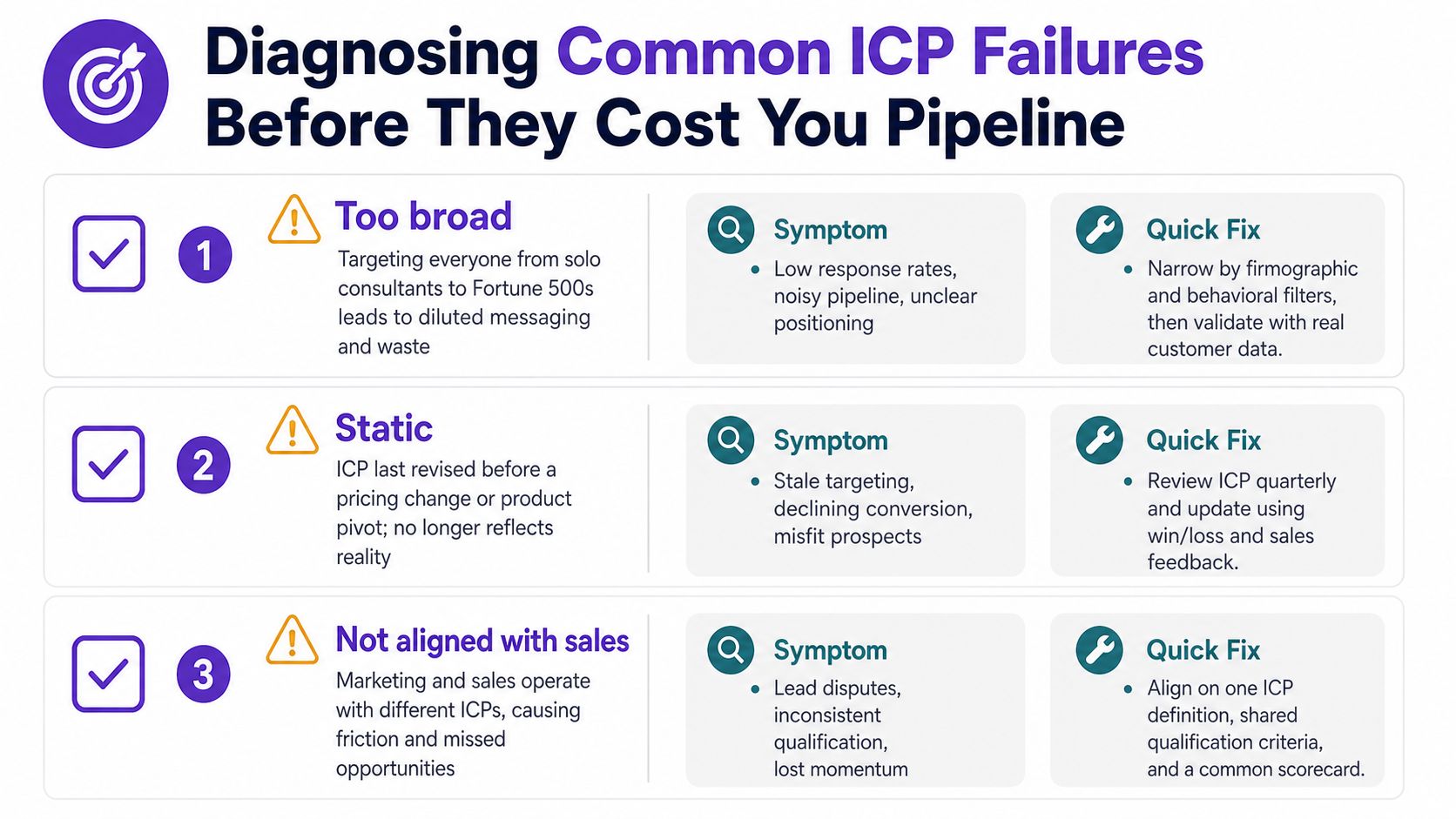
Most broken ICPs fail in predictable ways. They either include almost everyone, preserve assumptions long after the business changes, or omit the accounts you should actively reject.
Too broad is easy to spot. “B2B SaaS” might include a solo consultancy, a young startup, and an enterprise software company with entirely different budgets and buying processes. The symptom is diluted messaging and reps debating whether every account is “close enough.”
Static profiles survive product changes, pricing changes, new markets, and shifts from sales-led growth to product-led motions. The profile may have been accurate once, but it no longer describes the accounts your current offer serves well.
Missing negative criteria creates the most expensive debates. If your ICP says who fits but not who should be excluded, reps keep pursuing companies that historically churn, stall, or require disproportionate support.
Run a quick audit using last quarter's closed-lost deals:
Tag every loss against the current ICP.
Separate no-decision and competitor losses from clear poor-fit losses.
Check how many accounts still counted as fit.
Investigate if more than 20% of those fit accounts ended in no decision or competitor loss.
That 20% diagnostic threshold comes from the operating rule in this playbook, not a universal law. Use it as a warning signal, then inspect the reasons rather than blindly changing the model.
The fixes are practical. Narrow the primary segment when the profile is sprawling. Schedule a 90-day refresh when the market or product has changed. Write explicit disqualifiers into the definition so reps don't negotiate with the ICP in the middle of a deal. Tools such as predictive lead scoring can help operationalize those criteria, but they won't compensate for unclear rules.
Keeping Your ICP Alive With a 90-Day Refresh Cycle
An ICP isn't a slide deck you approve and forget. It should behave like an operating model, with owners, evidence, and a defined review rhythm. Gartner's B2B buyer persona research emphasizes using target-account profiles to tailor segmentation, demand generation, and account growth. That work becomes useful only when teams revisit the profile as buying behavior changes.

Use three checkpoints:
Day 30
Review win and loss data for tier-fit drift. Check whether Tier 1 accounts are still producing stronger opportunity-to-close rates, shorter or more predictable sales cycles, and healthier pipeline coverage than lower tiers.
Refresh the account scorecard and record rep feedback. Don't change criteria because one deal surprised you. Look for repeated evidence across outcomes.
Day 60
Stress-test negative criteria against new pipeline. Ask whether disqualified accounts are poor fits or whether the team has begun excluding a viable segment because of outdated assumptions.
Update disqualification triggers, loss reasons, and any conditions tied to implementation or support.
Day 90
Reconcile the ICP with LinkedIn engagement from your highest-converting accounts. Compare which topics, competitors, pricing discussions, and creators generated meaningful activity before successful opportunities.
Refresh intent-signal thresholds, rep feedback notes, tier definitions, and routing rules. A criteria shift that changes the primary segment, pricing motion, or sales capacity should receive leadership sign-off. An ops-level update is usually enough for field normalization, scoring weights, or a clarified trigger that doesn't alter strategy.
Track opportunity-to-close rate by ICP tier, sales-cycle length variance, and pipeline coverage ratio against refreshed tier definitions. The right change is the one these measures support, not the one that sounds clever in a planning meeting.
Skip the cycle and even a strong ICP becomes a stale list within two quarters. Set the recurring review now, assign an owner, and bring the next closed-won, closed-lost, and LinkedIn signal review into the calendar.
RoverLead AI helps turn your ICP from a static account description into a living prospecting filter by monitoring LinkedIn comments, content interactions, competitor discussions, and other buying signals. Define your target market and intent inputs, then visit RoverLead AI to see how the platform can surface relevant accounts with context for timely outreach.