10 Social Selling Tools for Smarter B2B Growth

More contacts, more scheduled posts, and more automated messages don't automatically create better social selling. They often create a fuller activity dashboard and a emptier pipeline. The useful question is simpler: which tool helps a seller recognize real buying intent, respond with context, and measure whether that conversation improves pipeline quality?
Social selling tools generally fall into five practical categories: intent-first prospecting, list-based prospecting, employee advocacy, personal-brand publishing, and measurement-led social operations. The distinction matters. A static account list tells you who might fit your ICP. An intent signal tells you who may be paying attention now. Content amplification can extend reach, but reach isn't the same thing as a qualified conversation.
This comparison separates those jobs instead of pretending one platform does everything well. You'll find a quick comparison marker for the later table, detailed reviews of ten tools, pricing and implementation trade-offs, workflow guidance, links to related resources, and a ten-question FAQ. The central rule is straightforward: use social activity as evidence, not as proof of pipeline.
Table of Contents
1. RoverLead AI
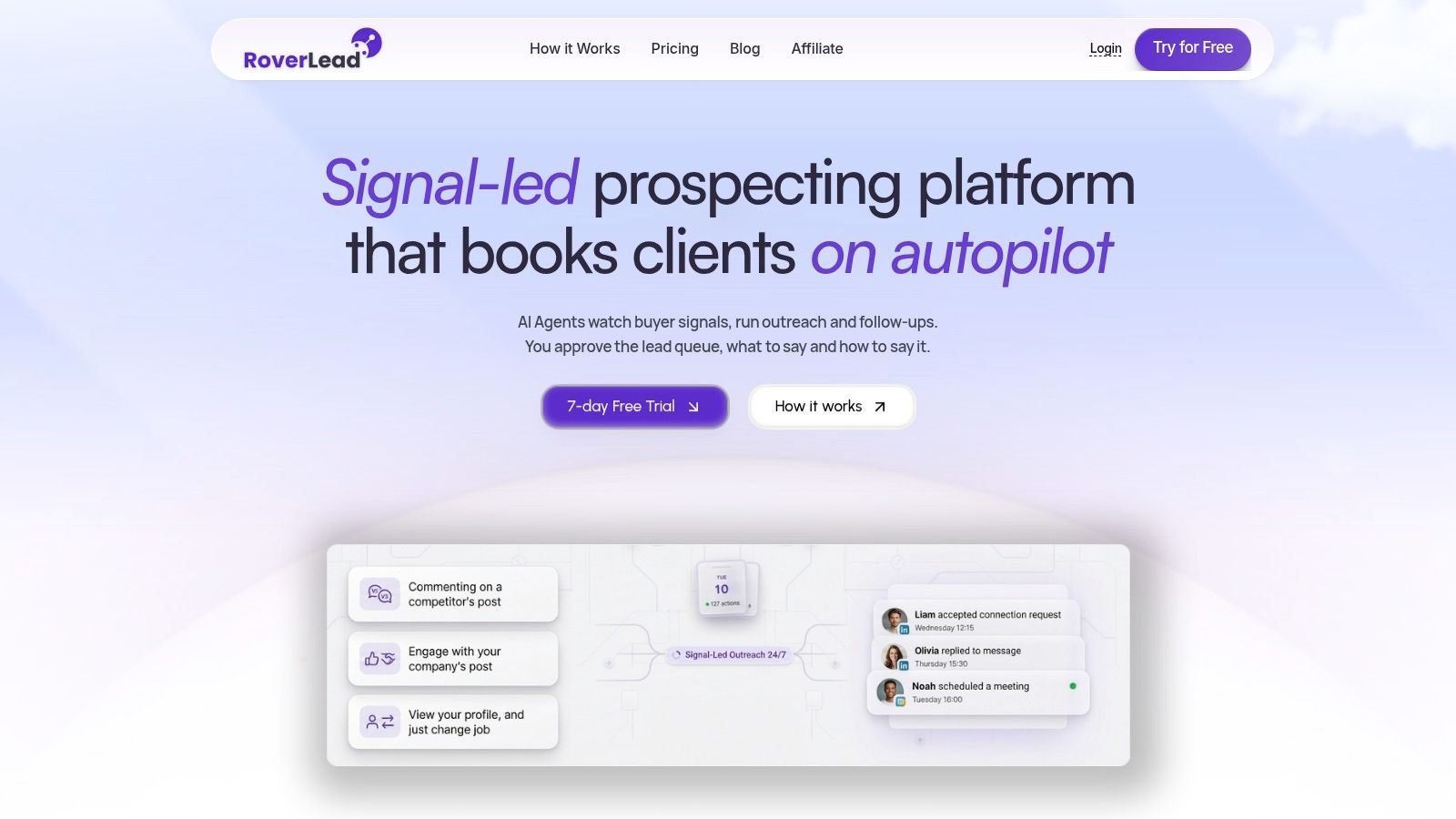
RoverLead AI focuses on active buying intent, not another static contact list. Its Signal Agents monitor LinkedIn activity across your niche, competitors, and relevant creators, then surface people engaging with posts, commenting on pricing or demo discussions, or interacting with competitor content. The practical shift is from “who fits our firmographics?” to “who is showing relevant behavior now?”
Setup requires your ICP, keywords, competitors, and niche experts. The platform then learns from approvals and replies. It monitors 10+ buying signals, delivers a daily feed with context, and drafts an opener linked to the interaction that triggered the lead. Reps still make the call, but they review a focused queue instead of browsing LinkedIn without a clear priority.
Practical rule: A signal earns attention only when the rep can see why it matters and respond while the context is fresh.
RoverLead reports 2–5x positive replies, 30–50% more meetings, and up to 60% less research time in its product materials. Treat those figures as internal customer benchmarks, not a forecast. Validate them against your own qualified-reply and meeting data, with results depending on ICP quality, message relevance, and follow-up discipline.
Pricing is transparent. Starter costs $149 per user per month with two Signal Agents. Growth costs $449 per user per month with up to ten agents. Enterprise pricing is custom and adds unlimited agents, workspaces, routing, audit logs, a dedicated customer success manager, service-level agreements, and quarterly reviews. A 7-day free trial lets a small team test signal quality before committing.
The trade-off is platform dependence. RoverLead is most useful when buyers actively use LinkedIn, and the system may need a short learning period while it refines your ICP and signal patterns. Per-user pricing also matters as headcount grows. For context on adjacent B2B sales intelligence tools, compare discovery, enrichment, and workflow coverage before adding another platform.
Best for: B2B sales leaders, SDR and BDR teams, founders, growth marketers, and agencies that prioritize timing and relevance over contact volume.
2. LinkedIn Sales Navigator
LinkedIn Sales Navigator remains the baseline prospecting layer for B2B teams selling on LinkedIn. It provides advanced lead and account search, saved lists, alerts, buyer-intent indicators, InMail, and CRM-connected workflows that vary by plan. Its biggest advantage is native access to the professional network where sellers already research accounts and contacts.
The strongest use case is controlled account coverage. An account executive can save a target company, follow relevant stakeholders, watch for job changes or engagement, and coordinate with colleagues through shared-connection features such as TeamLink. That structure suits account-based selling, territory planning, and sales managers who need visibility into who owns which relationship.
The limitation is equally important. Sales Navigator is excellent at helping sellers search and monitor known criteria, but prospect discovery is still largely seller-driven. Reps must define searches, inspect profiles, interpret alerts, and decide which activity deserves action. It can show useful signals without automatically turning them into a prioritized, contextual daily queue.
LinkedIn's Social Selling Index gives users a separate way to assess activity across four areas: professional brand, finding the right people, engaging with insights, and building relationships. LinkedIn says SSI uses a 1 to 100 scale and updates daily, according to its Social Selling Index explanation. Treat the score as an activity diagnostic, not a revenue metric.
Sales Navigator is often the right foundation, especially for teams that need account control. It may need a signal-led layer when reps spend too much time pulling lists and too little time responding to active conversations. The practical difference between the two approaches is covered in this guide to social selling on LinkedIn.
Best for: Account-based teams that need native LinkedIn search, relationship mapping, and structured account monitoring.
Visit LinkedIn Sales Navigator
3. Sprout Social Employee Advocacy
Sprout Social's Employee Advocacy add-on is designed for organizations that want sellers and employees to share approved content without creating a separate publishing process. Marketing can curate material, suggest copy, manage approvals, and report on reach and engagement from an advocacy hub connected to Sprout's wider social inbox, scheduling, and analytics environment.
That integration is the main reason to choose it. A social team already using Sprout can add advocacy without forcing employees into an unfamiliar tool. Governance also matters for larger organizations. Marketing can define what gets shared, while employees retain some control over which content fits their audience and personal voice.
The downside is cost and scope. Advocacy is an add-on, so the total investment rises beyond the core platform. It also isn't an intent-discovery system. It can help a seller distribute a useful post, but it won't necessarily identify the person who just commented on a competitor's pricing thread or determine whether that interaction signals an active project.
Where Sprout Social earns its keep
Sprout is strongest when the bottleneck is distribution with guardrails. It can turn a content library into a usable seller workflow, especially when brand safety, approvals, and reporting sit with a central marketing team. It's less compelling if the sales problem is poor targeting or weak follow-up context.
The operating requirement is ongoing curation. A stale advocacy feed becomes another internal newsletter that employees politely ignore. Marketing needs to supply timely content, give sellers room to personalize, and connect engagement reporting to downstream CRM activity rather than celebrating impressions alone.
Best for: Established social teams that already use Sprout and need governed employee advocacy.
Visit Sprout Social Employee Advocacy
4. Hootsuite Parliament
Hootsuite Parliament, formerly Amplify, gives marketing a central library for content that sellers, executives, and employees can share through their personal profiles. It fits naturally into Hootsuite's broader publishing, engagement, and listening environment, making it a sensible extension for teams already managing social activity there.
The product is practical for distributed teams. Mobile workflows, templates, and suggested content reduce the friction between “marketing published something” and “a seller shared it.” Program analytics help administrators understand participation and reach, while governance controls support brand consistency across teams and regions.
That convenience doesn't remove the human part. Sellers still need to choose content that makes sense for their audience and add a personal point of view where appropriate. If everyone posts identical copy at the same time, the program may look organized internally and robotic externally. Social selling works better when the platform handles distribution mechanics while the rep handles relevance.
The Hootsuite trade-off
Parliament is a reach and governance tool, not a replacement for prospect research. Pricing is quote-based, and the total cost can climb with seats and modules. The best results also require active marketing ownership. Someone must curate the library, retire outdated assets, provide useful prompts, and review whether shared content creates conversations with target accounts.
Choose it when Hootsuite is already part of the operating system and advocacy is the missing layer. Don't buy it expecting content distribution alone to solve a targeting problem.
Best for: Hootsuite customers that need controlled employee sharing at organizational scale.
5. EveryoneSocial
EveryoneSocial focuses on making employee-led sharing easy for sellers, executives, partners, and customers. Its curated feeds let users find approved content quickly, while leaderboards, gamification, prompts, and recognition help marketing sustain participation after the launch excitement fades.
The seller experience is the product's strongest argument. Reps don't need to hunt through a shared drive, copy a link, or wonder whether an asset is approved. A smoother workflow makes it easier to share useful material during the normal sales day, when the alternative is usually “I'll do it later,” followed by never.
EveryoneSocial is also attractive for larger user populations because it's often sold through flat-rate or unlimited-user structures, though buyers should confirm the commercial model for their specific agreement. Its reporting covers reach, clicks, and adoption, but revenue attribution usually requires disciplined CRM mapping and UTM practices.
Adoption isn't attribution
A high-participation program can still produce weak pipeline. Leaderboards may encourage activity, but they can also reward easy sharing rather than meaningful engagement with the right buyers. Marketing and sales operations should connect shared content to target accounts, conversations, opportunities, and revenue stages.
An operator needs restraint. Use EveryoneSocial to expand trusted voices, not to turn sellers into human scheduling slots. The distinction between activity and commercial impact is explored further in these social media engagement tools.
Best for: Organizations that want low-friction advocacy and strong adoption across a broad employee base.
6. Oktopost
Oktopost is a B2B-focused social management suite that combines publishing, listening, employee advocacy, and sales-team workflows. Its appeal is strongest for marketing operations teams that need to connect social activity to pipeline through marketing automation and CRM integrations rather than stopping at reach and engagement.
The platform supports advocacy and social publishing while providing governance around UTMs and integrations with systems such as HubSpot and Salesforce. That makes it suitable for account-based programs where the team wants to understand whether a social interaction influenced a known account, contact, or opportunity.
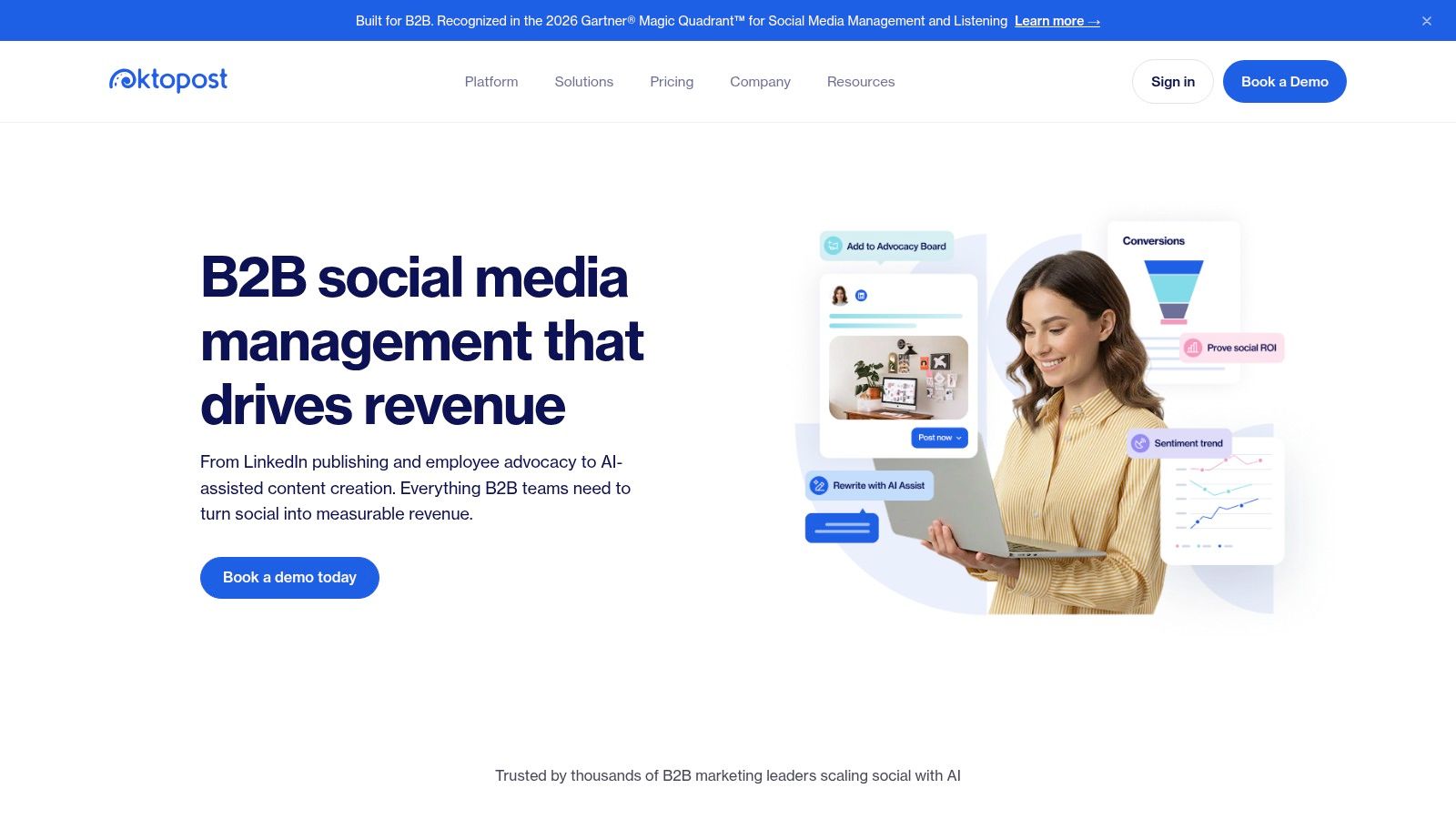
Oktopost's strength is also its implementation demand. Revenue attribution doesn't appear by magic because a dashboard has a pipeline tab. Marketing operations needs consistent campaign naming, UTM rules, CRM field hygiene, and agreement on how social touchpoints should be interpreted. Without that foundation, the platform may produce precise-looking reports built on incomplete journeys.
When Oktopost makes sense
Choose Oktopost when the team has enough operational maturity to maintain attribution. It's less suitable for a small group that wants a fast way to publish posts or find prospects. Pricing and packaging require a sales conversation, so buyers should evaluate the implementation effort alongside the license.
The useful question isn't “can it report clicks?” It's “can our team reliably connect a social interaction to the buying stages we already trust?”
Best for: B2B marketing and revenue teams that need governed social operations and CRM-linked attribution.
7. Seismic LiveSocial
Seismic LiveSocial serves enterprise teams that want sellers to share approved content while staying connected to enablement and compliance workflows. It curates content streams, provides messaging guidance, measures personal reach and engagement, and links social activity with Seismic's wider enablement environment.
This matters in regulated sectors, where a seller's improvised post can create more work than a missed impression. LiveSocial gives administrators stronger control over approved messaging and content governance, while mobile apps help sellers participate away from a desktop workflow.
The platform is not aimed at a founder who wants to draft a few LinkedIn posts before lunch. Its enterprise buying motion, implementation needs, and broader enablement connection can be excessive for a small team. It also belongs primarily in the governance and distribution category. Sellers still need a separate prospecting workflow if the goal is to identify active buying behavior.
Governance before growth
LiveSocial is valuable when legal, compliance, marketing, and sales enablement must agree on how employees represent the company. It can create a repeatable path from approved asset to personal share, but adoption still depends on useful content and coaching. No platform can make irrelevant material interesting through administrative force.
Best for: Regulated or enterprise organizations that need social advocacy tied closely to enablement and compliance.
8. GaggleAMP
GaggleAMP organizes employee advocacy through “Gaggles,” which can group programs, audiences, or activities for different teams. Its task-based prompts and suggested copy make participation straightforward for sellers who don't want to write every post from scratch.
The interface leans into guided action. A marketing team can provide content, recommended language, and engagement tasks, while leaderboards and gamification create a visible participation loop. Slack and Teams workflows can bring prompts into tools employees already use, reducing the chance that advocacy becomes a forgotten destination.
GaggleAMP often uses company-size or program-level pricing rather than strict per-seat pricing in many deals, which can be useful for organizations with broad participation. Buyers should verify the current commercial structure. The platform also offers reach and ROI reporting, including EEMV calculators, but those outputs shouldn't be confused with sourced revenue unless UTMs and CRM stages are configured carefully.
The management cost is real
Advocacy programs need an owner. Someone must create fresh Gaggles, remove outdated messages, coach contributors, and inspect whether activity reaches the intended accounts. Without that maintenance, gamification can produce a burst of sharing followed by quiet dashboards.
Best for: Teams that want guided advocacy, program-level organization, and seller-friendly onboarding.
9. Sociabble
Sociabble combines employee advocacy with gamification, micro-learning, mobile workflows, and detailed analytics. It's designed for global enterprises that need a structured way to activate distributed employees while supporting multiple languages, governance requirements, and local participation.
The platform's value goes beyond a content feed. Challenges, recognition, and learning components can help organizations teach employees how to participate rather than just asking them to repost corporate material. Detailed reporting gives program owners a view of advocacy KPIs, participation, and content performance, while mobile apps support employees who aren't working from a desktop.
That depth comes with change-management work. A global program needs local champions, clear editorial rules, training, and a content operation that respects regional differences. Quote-based pricing and implementation costs also make Sociabble more appropriate for organizations with a defined advocacy program than for a small sales team testing social selling for the first time.
Where Sociabble fits
Sociabble is primarily a reach, enablement, and governance platform. It can help a company coordinate many voices, but it won't by itself tell a seller which prospect is actively evaluating a solution. Pair it with an intent-first prospecting workflow when the commercial priority is timely one-to-one outreach.
Best for: Large, distributed organizations that need multilingual advocacy, engagement mechanics, and enterprise services.
Visit Sociabble
10. Taplio
Taplio is a LinkedIn-first tool for sellers, founders, and creators who build pipeline through personal content, comments, and direct engagement. It supports AI-assisted post ideation, writing, scheduling, analytics, content curation, and outreach assistance through lead lists and reply workflows that vary by plan.
Its appeal is speed. An individual seller can turn a rough idea into a draft, schedule consistent posts, save useful content, and manage engagement without assembling an enterprise stack. That makes Taplio a good fit for personal-brand-led selling, especially when the founder or rep is already active on LinkedIn and wants a repeatable publishing habit.

The boundary is important. Taplio amplifies a seller's voice and helps manage activity, but publishing more frequently doesn't prove that the audience contains active buyers. Its LinkedIn-only focus may also leave teams needing Sales Navigator, CRM workflows, or a broader advocacy system. Heavier automation can create compliance risk if users treat LinkedIn like an email blast engine.
Use Taplio for consistency, not volume
The strongest workflow is simple: publish a useful point of view, engage thoughtfully with relevant conversations, then move qualified interactions into a human follow-up. Pairing that habit with intent signals can help reps distinguish a post that earned likes from a conversation that deserves prospecting attention. For content-led pipeline, this thought leadership strategy provides useful context.
Best for: Founders and individual sellers who need fast LinkedIn content and engagement workflows.
Top 10 Social Selling Tools Comparison
Product | Core features | UX & outcomes (★) | Price & value (💰) | Target audience (👥) | Unique selling points (✨) |
|---|---|---|---|---|---|
RoverLead AI 🏆 | Autonomous Signal Agents; intent feed; AI-written openers; monitors 10+ buying signals | ★★★★★, 2–5× replies, 30–50% more meetings, ~60% less research | 💰 Starter $149/mo, Growth $449/mo, Enterprise custom; 7‑day trial; founding perks | 👥 SDRs/BDRs, sales leaders, founders, GTM teams, agencies | ✨ Behavior-first intent from comments/engagement; contextual outreach; LinkedIn-compliant |
LinkedIn Sales Navigator | Advanced lead/account search; saved alerts; InMail; CRM sync; TeamLink | ★★★★, reliable job/change & engagement signals | 💰 Plan-dependent; higher cost for team features | 👥 B2B sellers, ABM & account teams, account execs | ✨ Native LinkedIn data & warm-intro network (TeamLink) |
Sprout Social – Employee Advocacy | Advocacy hub; governance & approvals; reporting; integrates with Sprout suite | ★★★☆, enterprise governance; consolidated workflows | 💰 Add-on pricing; best value when on Sprout platform | 👥 Marketing ops, social teams, mid-large orgs | ✨ Integrated publishing + advocacy with approval flows |
Hootsuite – Parliament (Advocacy) | Central content library; mobile workflows; program analytics; part of Social OS | ★★★☆, familiar UI for Hootsuite users | 💰 Quote-based advocacy add-on; seat/module costs can rise | 👥 Teams using Hootsuite, social managers | ✨ Program-level control and brand safety at scale |
EveryoneSocial | Curated feeds; share workflows; leaderboards & gamification; deep reporting | ★★★★, low friction, strong adoption & analytics | 💰 Often flat-rate / unlimited-user models, cost-effective for large teams | 👥 Enterprise advocacy, sales enablement, large user bases | ✨ Simple UX, gamification, attractive unlimited-user pricing |
Oktopost | Employee advocacy + B2B analytics; MAP/CRM integrations; publishing & listening | ★★★★, strong pipeline attribution for ABM workflows | 💰 Quote-based; ROI best with marketing ops integration | 👥 B2B marketers, revenue ops, ABM teams | ✨ Revenue attribution with MAP/CRM & UTM governance |
Seismic LiveSocial | Curated content streams; engagement analytics; enablement integration; mobile apps | ★★★★, compliance-friendly, enablement linkage | 💰 Enterprise pricing and implementation | 👥 Regulated enterprises, enablement & compliance teams | ✨ Strong governance + tight tie to enablement content |
GaggleAMP | Centralized content; suggested copy; gamification; Slack/Teams workflows | ★★★☆, easy adoption; strong CS/onboarding | 💰 Program-level or company-size pricing; transparent models | 👥 Programs needing simple adoption, mid-large orgs | ✨ “Gaggles” & task-based prompts; program-level pricing options |
Sociabble | Advocacy feeds; gamification & micro-learning; detailed analytics; mobile & multi-language | ★★★★, strong engagement mechanics for global teams | 💰 Quote-based; implementation and change management costs | 👥 Global enterprises, distributed teams | ✨ Multi-language support, micro-learning, granular KPIs |
Taplio | AI post ideation & writing; scheduling; analytics; outreach/reply assist | ★★★☆, great for consistent personal branding & creators | 💰 Lower entry price; credit-based outreach features | 👥 Founders, creators, individual sellers | ✨ AI-assisted LinkedIn content & Chrome extension for curation |
Choose the Signal, Reach, or Measurement Layer You Need
The right social selling tool depends on the bottleneck, not the loudest feature list. If your team struggles to know who is in-market and when to engage, start with intent-first prospecting. RoverLead AI is designed for that job, while LinkedIn Sales Navigator provides the native search, account coverage, and relationship infrastructure that many teams still need.
Choose list-based prospecting when controlled coverage matters more than live behavioral discovery. Sales Navigator works well for territory planning, named-account programs, saved searches, job-change alerts, and shared relationships. It gives managers a repeatable way to define the market, but reps still need to interpret signals and do the research.
Advocacy tools solve a different problem. Sprout Social Employee Advocacy, Hootsuite Parliament, EveryoneSocial, Oktopost, Seismic LiveSocial, GaggleAMP, and Sociabble help distribute content, govern messaging, encourage participation, or connect activity to reporting. They're useful when marketing has strong content but sellers aren't sharing it consistently. They won't compensate for weak targeting, irrelevant content, or outreach that arrives without context.
Measurement-led platforms deserve separate scrutiny. Oktopost and similar systems can help connect social activity to CRM and marketing automation data, but attribution depends on implementation quality. A report can show clicks and influenced accounts while still failing to answer whether social activity caused a qualified conversation. The measurement gap is real: 96% of social-first brands rate social commerce as a high or very high priority, while only 39% report high ROI, according to the survey summary cited by MagicPost's social selling tools analysis. That mismatch is a warning against buying engagement dashboards without defining commercial outcomes.
A practical buying review should cover:
Signal quality: Can the tool show the behavior behind a lead, or does it mainly surface firmographics and activity totals?
Workflow ownership: Who reviews alerts, approves content, maintains prompts, and follows up with prospects?
Commercial model: Is pricing per user, per program, quote-based, or tied to broader platform modules?
Compliance: Can your team control automation, approvals, audit trails, and platform-safe behavior?
Data connection: Will CRM, marketing automation, and UTM conventions support the attribution you expect?
Maintenance burden: How much time will marketing and sales operations spend keeping signals, content, and routing useful?
Don't use reach as a substitute for pipeline. LinkedIn research cited by Demand Gen Report found that 72% of B2B buyers use social media to research solutions, which makes visibility valuable, but research behavior alone doesn't identify a qualified opportunity. Track the ladder from relevant signal to accepted conversation, meeting, opportunity, and revenue influence.
The final decision can be disciplined and small. Define the primary bottleneck, shortlist one category, run a focused workflow with clear ownership, and compare qualified conversations rather than likes, impressions, or follower growth. If intent is the missing layer, test an intent-first prospecting tool. If distribution is the issue, fix advocacy. If leadership can't trust the numbers, repair the measurement system before adding another dashboard.
Social Selling Tools FAQ
What are social selling tools?
Social selling tools help sales teams find prospects, understand social behavior, publish useful content, manage relationships, or measure commercial impact. They range from LinkedIn prospecting platforms to employee advocacy suites and personal-brand tools. The useful distinction is whether a product discovers intent, amplifies reach, or measures activity.
How is social selling different from social media marketing?
Social media marketing usually focuses on audience growth, brand visibility, content distribution, and demand creation. Social selling is more person-led and relationship-oriented. Sellers use profiles, comments, content interactions, mutual connections, and direct conversations to build relevance with specific prospects and accounts.
Should a small B2B team start with Sales Navigator?
Sales Navigator is a sensible starting point when the team needs account lists, advanced search, job-change alerts, and native LinkedIn workflows. It may be enough for controlled prospecting. If reps spend too much time manually researching activity, add an intent-first layer rather than expecting more saved searches to solve the problem.
Is employee advocacy the same as prospecting?
No. Employee advocacy helps employees share approved content and expand distribution. Prospecting identifies people or accounts that may be relevant buyers and supports direct engagement. Advocacy can create useful visibility, but it doesn't automatically tell a rep who deserves a personalized conversation.
Which social selling tool is best for active buying intent?
Choose a tool that surfaces behavior with context, not just a contact record or engagement count. RoverLead AI is designed to monitor LinkedIn signals across niches, competitors, creators, and relevant discussions, then deliver a prioritized feed with contextual openers. Results still depend on buyer activity, ICP definition, and rep follow-up.
Can AI-generated openers replace human outreach?
They shouldn't. An AI-written opener can reduce blank-page friction and reference the post or interaction that created the signal, but the rep must check accuracy, tone, and relevance. The best use of AI is preparation and prioritization, not pretending a machine understands a buyer better than the buyer does.
What should teams measure first?
Start with qualified conversations, accepted meetings, opportunity creation, and progression from social-sourced or social-influenced activity. Keep reach, clicks, replies, and engagement as diagnostic metrics. A large activity number is useful only when it helps explain why the right buyers moved forward.
How do teams separate correlation from causation?
Use consistent source definitions and compare the full journey from signal to conversation to opportunity. Record which activity preceded the interaction, whether the account was already active elsewhere, and whether the opportunity would likely have existed without the social touch. Avoid claiming that every engagement caused revenue.
How much content should sellers share?
There isn't a universal volume target that guarantees pipeline. Sellers should share content they can explain, personalize, and connect to buyer problems. A smaller stream of relevant posts and thoughtful comments is usually more useful than a crowded feed of identical corporate links.
Can social selling work outside LinkedIn?
Yes, but the workflow must follow buyer behavior on the relevant platform. LinkedIn is particularly useful for B2B professional networks, while other communities may matter for specific industries and audiences. The tool should follow where meaningful conversations happen, not force every market into the same channel.
Visit RoverLead AI to turn LinkedIn engagement into a daily feed of high-intent prospects matched to your ICP, with context and AI-written openers for timely outreach. If your team is tired of static list pulls and wants to test whether live buying signals improve qualified conversations, start with RoverLead AI.