10 Social Media Engagement Tools for B2B in 2026

Your social feed is full. Your calendar is empty. You're doing everything you're “supposed” to do on LinkedIn, posting, replying, and watching impressions inch up, but the pipeline still looks like it took a day off. The problem usually isn't effort, it's the tool stack. Many teams buy social media engagement tools that help them manage noise, then wonder why none of that noise turns into meetings. The smarter move is to split the category in two, tools for managing existing conversations, and tools for finding new ones with intent.
For B2B founders and sales leaders, that distinction matters. LinkedIn is where the buyers are, but only some tools help you catch them while they're paying attention. Others keep the inbox clean, which is nice, if your business goal is a tidy inbox. If your goal is pipeline, you want systems that surface signals, not just schedules and replies. Use the right platform, and social stops being a content chore and starts acting like a prospecting channel.
Table of Contents
1. RoverLead AI
RoverLead AI belongs in the conversation if your team wants LinkedIn to act like a live buying signal stream, not a content graveyard. It tracks public engagement around creators, competitors, and niche conversations, then turns that activity into a daily feed of prospects that match your ICP. That matters because outreach tied to real behavior beats outreach tied to a stale list every time.
The setup is simple enough for a busy team. Define your ICP, keywords, competitors, and experts, then let the autonomous Signal Agents do the work. The platform detects 10+ buying signals, including comments, content interactions, and pricing or demo interest, then drafts a contextual opener so reps are not staring at a blank screen. If you want a practical starting point, see this guide on social selling on LinkedIn.
Practical rule: if your SDRs spend more time researching than replying, your process is backward.
RoverLead also fits teams that care about reply quality, not vanity activity. The site highlights customer-reported 2–5x higher positive reply rates, 30–50% more meetings booked, and up to 60% less research time. It is LinkedIn-compliant, and it replaces manual Sales Navigator list pulls with live intent data, which is what outbound teams need.
Pricing is straightforward. There is a **7-day f...
1. RoverLead AI
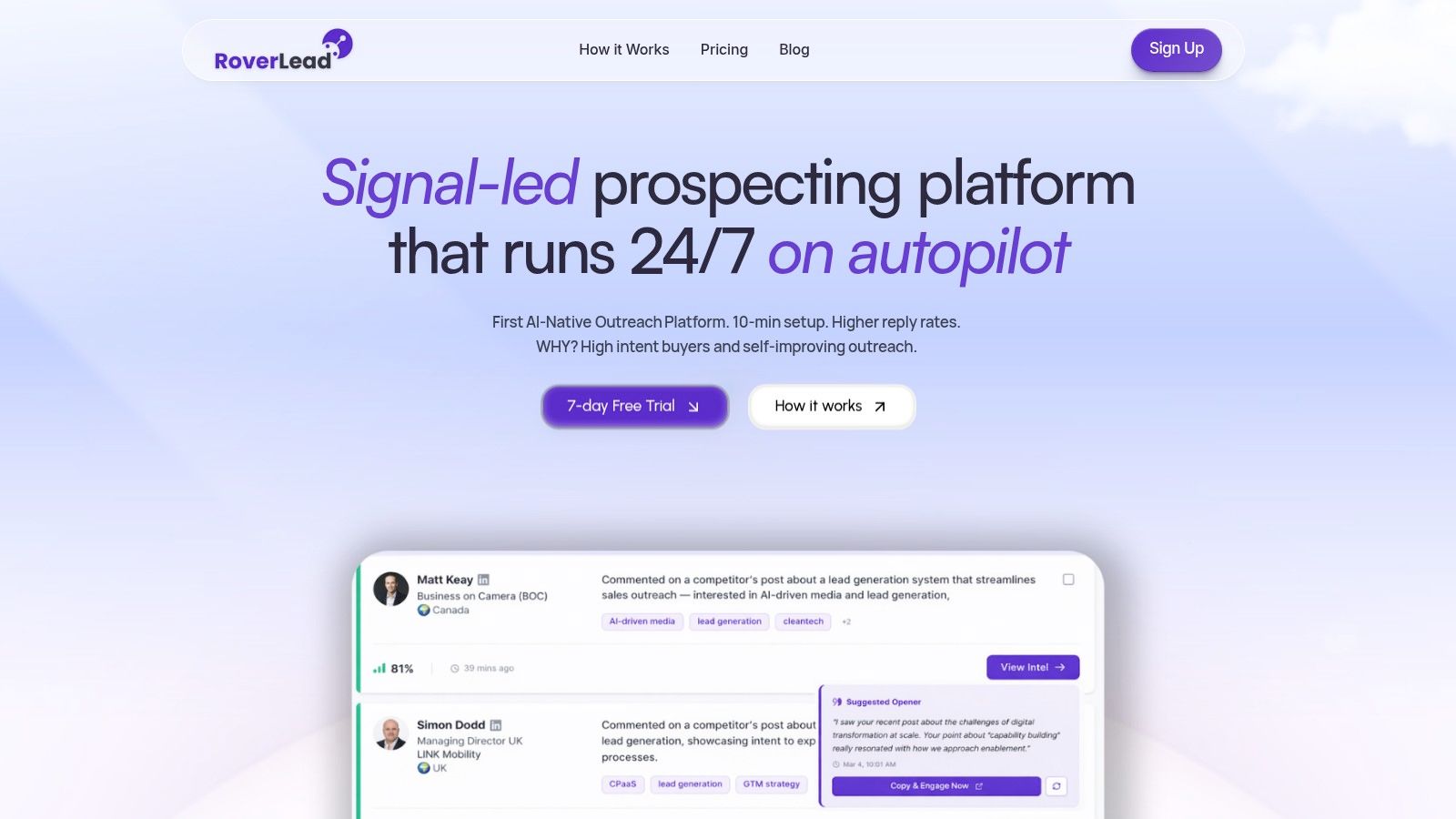
RoverLead AI is the one to look at if you want LinkedIn to behave less like a content feed and more like a live buying signal map. Instead of handing reps a static list and telling them to “personalize harder,” it watches public engagement around creators, competitors, and niche conversations, then turns that activity into a daily feed of high-intent prospects matched to your ICP. That's the whole game, timing outreach to real behavior, not to a spreadsheet you pulled last Tuesday.
The setup is fast. Define your ICP, keywords, competitors, and experts, and the platform does the rest with autonomous Signal Agents. It detects 10+ buying signals, including comments, content interactions, and pricing or demo interest, then writes a contextual opener so your reps aren't starting from scratch. The result is simple, fewer blind shots and more conversations that already have a reason to exist.
Practical rule: if your SDRs spend more time researching than replying, your process is backward.
RoverLead is also the cleanest fit for teams that care about reply quality, not just activity volume. The site highlights customer-reported 2–5x higher positive reply rates, 30–50% more meetings booked, and up to 60% less research time. It's LinkedIn-compliant, and the platform is built to replace manual Sales Navigator list pulls with living intent data, which is exactly what most outbound teams need.
Pricing is straightforward. There's a 7-day free trial, the Starter plan is $149/month/user with 2 Signal Agents, the Growth plan is $449/month/user with up to 10 Signal Agents, and Enterprise is custom with unlimited agents, workspaces, routing, audit logs, and a dedicated CSM. The site also points to founding-plan perks like priority support, roadmap co-shaping, and a locked lifetime rate.
Website: RoverLead AI
Best for: B2B sales leaders, SDRs, founders, GTM marketers, and agencies that want pipeline from LinkedIn engagement.
Skip it if: your buyers don't show up on LinkedIn or your team wants a pure publishing suite.
2. Sprout Social
Sprout Social is the classic answer when your team needs one place to triage social engagement without turning every comment into a Slack scavenger hunt. The Smart Inbox centralizes messages and comments across networks, then layers on filters, tags, routing, and saved replies. For teams that need approvals, collaboration, and a paper trail, it's one of the least messy ways to keep social from becoming a shared panic attack.
The platform makes the most sense when multiple people touch the same account. Assignments, collision detection, and reporting by profile, tag, and campaign give managers enough control to keep responses consistent. If you're running a marketing team with customer care overlap, that governance matters more than flashy AI features.
Strong inbox software keeps your team fast. Weak inbox software just makes the chaos more organized.
The tradeoff is obvious, it's built for operational control, not intent discovery. That's fine if your job is to manage existing conversations across channels. It's not the same thing as finding buyers who are already leaning in on LinkedIn, and no amount of dashboard polish changes that.
For teams researching how social selling fits into broader engagement workflows, the internal breakdown on social selling on LinkedIn is worth pairing with a real engagement stack. Sprout Social is a strong management suite. It's just not a prospecting engine.
Website: Sprout Social
3. Hootsuite
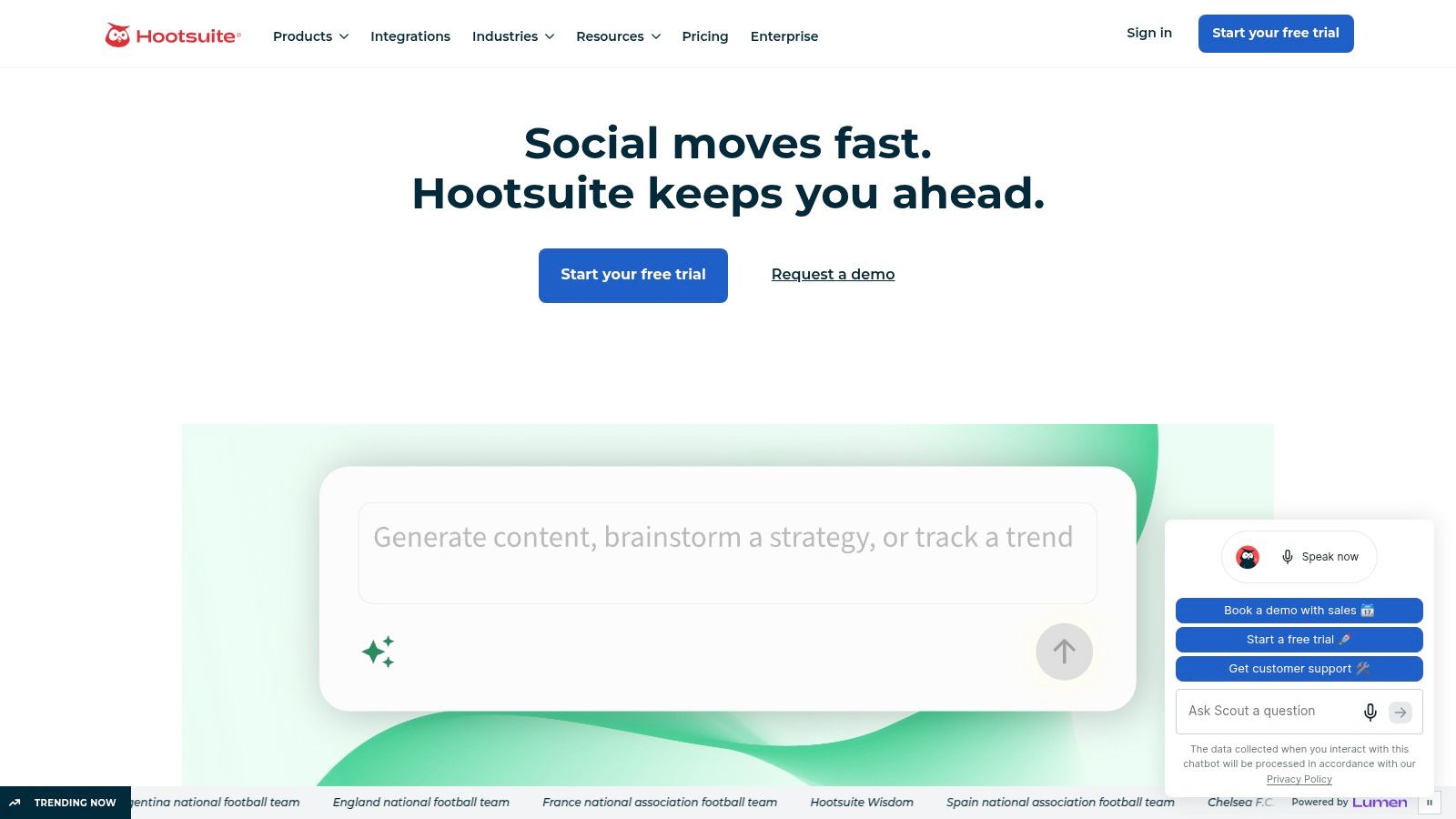
Hootsuite is still the utility player for teams that want broad channel coverage without stitching together five different tools. Its Social Media Inbox handles messages, case tracking, and a Zendesk link, while the publishing side covers Facebook, Instagram, X, WhatsApp, TikTok, LinkedIn, and Threads. That's a lot of surface area, which is exactly why some teams keep it around.
The engagement angle is practical rather than magical. You get AI captioning, best-time-to-post suggestions, approvals, competitor monitoring, and custom reports. If your social team is juggling marketing plus customer care, the appeal is obvious, one interface, one reporting layer, fewer login tab gymnastics.
The downside is also obvious. Hootsuite scales with plan level and connected accounts, so it can get pricey fast, and some inbox features sit behind higher tiers. For a founder or sales leader, the key question is simple. Are you buying a broad command center, or are you buying meetings? If it's the second one, Hootsuite helps with management, but it won't do the signal hunting for you.
For teams thinking about reputation, messaging, and public response as one system, the internal guide on online reputation management strategies pairs well with this category. Hootsuite is strong when the job is breadth. It's less interesting when the job is precision.
Website: Hootsuite
4. Agorapulse
Agorapulse is the no-drama choice for teams that want speed in the inbox and don't need a PhD in social operations. The Unified Inbox groups messages and comments across brands or profiles, then lets you set moderation rules, assignments, and saved replies. It's tidy, practical, and built for people who'd rather answer than admire dashboards.
That makes it a good fit for agencies and B2B teams that need moderation without friction. The publishing calendar and reporting are there, but the product's real value is getting your team to zero unread without making them wrestle the interface. In social ops, that kind of simplicity is underrated.
A small warning. Agorapulse is excellent at response management, but it's still a management tool. If your outbound team wants to discover in-market buyers on LinkedIn, this isn't the platform that will surface those opportunities for you. It keeps the conversation moving once it exists.
Website: Agorapulse
5. Zoho Social
Zoho Social is the budget-friendly option that doesn't act embarrassed about being budget-friendly. It gives you a unified inbox, AI posting aids, and strong CRM integration, which is exactly why it works for SMB teams already living in the Zoho world. If you want social engagement tied to lead handling without paying enterprise-suite money, this one deserves a look.
The best part is the workflow bridge. Comments and interactions can move toward CRM activity, so social doesn't stay trapped in a separate lane. For smaller teams, that can be the difference between “we saw it” and “we followed up.” And in sales, follow-up wins more arguments than ambition does.
The limitation is governance, not utility. Zoho Social is useful, but it doesn't bring the heavyweight controls or deep enterprise layer some larger teams need. That's fine. They don't need a battleship, they need a serviceable boat that reaches the lead before the lead disappears.
Website: Zoho Social
6. HubSpot Marketing Hub Social tools
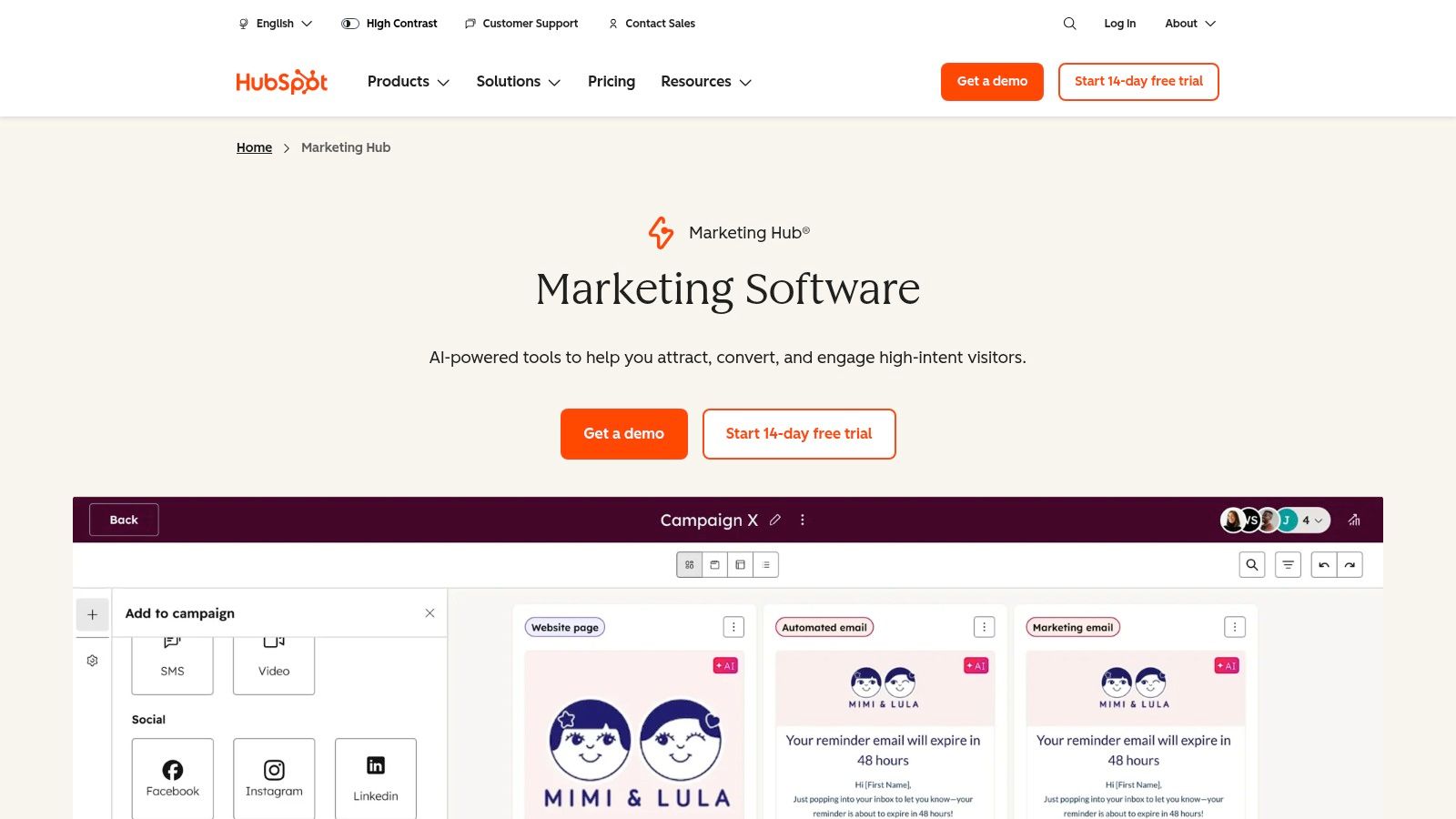
HubSpot's social tools make the most sense when your team wants social activity tied directly to CRM records and revenue reporting. You can publish to LinkedIn, Facebook, Instagram, TikTok, Reddit, and X, monitor brand mentions and sentiment, and connect social interactions back to campaigns and contact data. For B2B operators, that's the core promise, fewer disconnected reports and more line of sight from post to pipeline.
The publishing workflow is solid. HubSpot lets you draft once and customize per network, which helps when your team runs the same message across multiple channels without sounding like a copy-paste machine. The limitation is that the deeper social features still aren't as rich as dedicated suites, and some capabilities depend on your Marketing Hub plan.
If your real problem is attribution, HubSpot helps. If your real problem is prospecting, it helps less. That's a useful distinction, because a lot of teams buy CRM-connected social tools and then still don't know who to contact tomorrow. For a broader view of what good engagement infrastructure should do, the internal piece on what a customer engagement platform is is the right companion read.
Website: HubSpot Marketing Hub
7. Sprinklr Social
Sprinklr Social is built for large organizations that need governance without chaos. It covers publishing, engagement, listening, paid social, and analytics across 30+ channels, which is the kind of breadth enterprise teams buy when they've outgrown improv. The platform's central value is coordination, one system for multiple brands, functions, and regions.
The engagement side leans hard into routing and AI-assisted triage. That matters when marketing and customer care both touch the same public channels, because the risk isn't just slow replies, it's inconsistent replies. Sprinklr handles scale well, but scale comes with baggage. Longer deployments and premium pricing are part of the deal.
If you're running a lean sales team, this is almost certainly more machine than you need. If you're running a global brand with compliance requirements and multiple stakeholder groups, it's the kind of platform that prevents social from turning into a governance mess. Buy it for control, not for clever prospecting.
Website: Sprinklr Social
8. Khoros
Khoros makes sense when marketing and care can't afford to work in separate universes. The platform combines social marketing and customer care, with Iris AI, routing, moderation, APIs, and shared analytics. That unified context is the value, because customer-facing teams don't care which department owns the reply if nobody answers.
For large teams, shared workflows are the selling point. Khoros is useful when multiple functions need to see the same conversation history and move messages without duplicate effort. It's a heavier lift than SMB tools, though, and the quote-only pricing tells you everything you need to know about the buying motion.
This is enterprise software with enterprise friction. If your team needs a central engagement layer and has the budget and patience to implement it, Khoros belongs on the shortlist. If your sales motion lives on LinkedIn and depends on finding intent quickly, you're shopping in the wrong aisle.
Website: Khoros
9. Emplifi Social Marketing and Care
Emplifi is what happens when social marketing, analytics, and customer care all get pushed into one environment. It covers major channels including LinkedIn, Facebook, Instagram, X, WhatsApp, TikTok, and Google Business, and it ties marketing, commerce, and care data into unified analytics. That combination matters when leadership wants a single view of how social activity affects the customer journey.
The platform is strongest when service and marketing can't keep their data separate anymore. AI-powered care tools help with triage and response, and the broader package is aimed at teams that need a shared operating layer. That makes it useful for enterprise organizations, but less friendly for smaller teams that just want cleaner LinkedIn prospecting.
If you're buying for a sales team, be honest about the job. Emplifi is a good engagement and care stack. It is not a shortcut to qualified pipeline on its own.
Website: Emplifi Social Marketing and Care
10. Brandwatch Social Media Management formerly Falconio
Brandwatch Social Media Management is the pick for teams that want listening and engagement under one roof. The suite includes Engage, Publish, Measure, Benchmark, Influence, and Listen, which gives it depth that pure inbox tools usually can't match. For teams managing reputation, trends, and high-volume responses, that blend is useful.
The Engage inbox handles social messages and comments with assignments and workflows, while the listening side gives context before your team responds. That's the advantage. You're not just replying, you're replying with a clue about what people are saying elsewhere.

Brandwatch earns its keep when listening and management have to live together. It's less attractive if you only need LinkedIn-specific prospecting, because strong listening is still not the same thing as signal-driven outbound. For a deeper angle on monitoring conversations as part of the stack, see the internal guide on social media listening tools.
Website: Brandwatch Social Media Management
Top 10 Social Media Engagement Tools Comparison
Product | Core features | UX & ROI ★ | Value & Pricing 💰 | Best for & Unique Selling Point 👥 ✨ |
|---|---|---|---|---|
RoverLead AI 🏆 | Signal Agents monitor LinkedIn engagement, 10+ buying signals, AI-written openers, 5–10 min setup | ★★★★☆, 2–5x positive replies; 30–50% more meetings; ~60% less research time | 💰 Starter $149/mo/user; Growth $449/mo/user; Enterprise custom; 7‑day trial | 👥 B2B SDRs, founders, GTM teams, ✨Behavioral intent feed vs static lists |
Sprout Social | Unified Smart Inbox, routing, tagging, analytics for LinkedIn + channels | ★★★★☆, reliable team workflows & reporting | 💰 Per-seat pricing; mid→enterprise cost | 👥 Social teams & mid-size firms, ✨Robust inbox + team collaboration |
Hootsuite | Inbox, scheduling, AI captions, multi‑channel publishing & reporting | ★★★☆☆, broad tools; inbox features vary by tier | 💰 Tiered pricing by plan & accounts; higher tiers add features | 👥 Marketing & care teams, ✨Wide channel support (Threads, messaging apps) |
Agorapulse | Unified Inbox, moderation rules, assignments, publishing calendar | ★★★★☆, fast moderation; easy team workflows | 💰 Per-user pricing; competitive for small teams | 👥 Agencies & B2B teams, ✨Speed to zero inbox; simple reporting |
Zoho Social | Scheduling, unified engagement, AI post suggestions, Zoho CRM sync | ★★★☆☆, strong value; fewer enterprise controls | 💰 Free tier + low-cost plans; good SMB value | 👥 SMBs & Zoho users, ✨CRM integration at lower cost |
HubSpot Marketing Hub (Social) | Publish & monitor social, ties interactions to CRM & campaigns | ★★★☆☆, social→pipeline visibility; features depend on Marketing Hub tier | 💰 Included in Marketing Hub plans; varies by tier | 👥 B2B teams needing CRM-linked social, ✨Native revenue attribution |
Sprinklr Social | Enterprise CXM: engagement, listening, governance, AI triage | ★★★★☆, enterprise scale & compliance; high ROI for complex orgs | 💰 Premium/quote-only; longer deployments | 👥 Global brands & regulated industries, ✨Comprehensive CXM & compliance |
Khoros | Unified marketing + care with Iris AI, routing, APIs | ★★★★☆, strong routing/moderation for large teams | 💰 Quote-only; enterprise pricing | 👥 Large teams needing shared engagement stack, ✨Integrated care + marketing |
Emplifi Social Marketing & Care | Centralized care, analytics, AI-powered triage across channels | ★★★★☆, unified analytics across marketing/commerce/care | 💰 Enterprise packaging; custom pricing | 👥 Brands needing combined care & marketing, ✨AI care + commerce linkage |
Brandwatch (Falcon.io) | Engage inbox, publish, measure, listening, influencer tools | ★★★★☆, powerful listening + high-volume inbox | 💰 Custom pricing; module-based | 👥 Teams needing deep listening + SMM, ✨Strong listening + measurement |
Stop Managing Noise, Start Engaging Signals
The right social media engagement tools aren't the ones with the longest feature pages. They're the ones that match the job you need done. If your team needs to manage inbound conversations at scale, a traditional suite like Sprout Social, Hootsuite, Agorapulse, HubSpot, Sprinklr, Khoros, Emplifi, or Brandwatch makes sense. They organize replies, govern workflows, and keep public channels from turning into a trash fire.
But if your team's real problem is outbound pipeline, use a different standard. You don't need another polished inbox. You need a system that finds buyers while they're active, public, and relevant. That's where a signal-first platform wins, because it turns engagement into timing, and timing into meetings.
LinkedIn is crowded enough already. The winners won't be the teams posting the most, they'll be the teams that know who's leaning in, why they're leaning in, and what to say next. That's the part most social tools still miss, and it's exactly why a signal-led approach beats a management-first one for B2B prospecting.
RoverLead AI turns LinkedIn engagement into daily, high-intent leads matched to your ICP, so your team can sell into real buying signals instead of cold lists. If you're tired of managing noise and want a cleaner path to qualified meetings, take a look at RoverLead AI and see how signal-led prospecting changes the job.