Sales Engineer Responsibility: The Practical Playbook

You can spot the problem before the buyer says it out loud. The deck is polished, the AE is optimistic, the prospect smiles through the demo, and then the deal wanders into legal, security, and “we'll circle back next week” territory. That's usually the moment someone realizes the team had pipeline, but not a technical win strategy.
A modern sales engineer responsibility isn't to entertain the room with a slick product tour. It's to reduce deal risk, translate customer requirements into something real, and make sure the buyer can say yes without crossing their fingers. That's why the role sits at the center of complex B2B buying, where technical validation matters as much as commercial fit, and why the U.S. Bureau of Labor Statistics pegs the role at a median annual wage of $121,520 in May 2024, with 5% projected employment growth from 2024 to 2034 and about 5,000 openings per year on average BLS sales engineer outlook.
If you're a seller, leader, or founder who keeps asking why “great demos” don't close, the answer is usually hidden in the handoffs. The SE is expected to carry discovery, demos, proof-of-concept work, RFPs, security questions, and post-sale technical continuity. Miss that chain, and the deal doesn't usually explode. It just dies in a spreadsheet.
Table of Contents
The Moment the Deal Slips
A good SE spots the wobble before anyone says the deal is in trouble. The prospect likes the use case, the AE thinks the commercial shape is there, and then one engineer on the buyer side asks a question nobody prepared for. The room changes fast. Conversation turns from value to verification, and the team starts defending the solution against doubt instead of moving the deal forward.
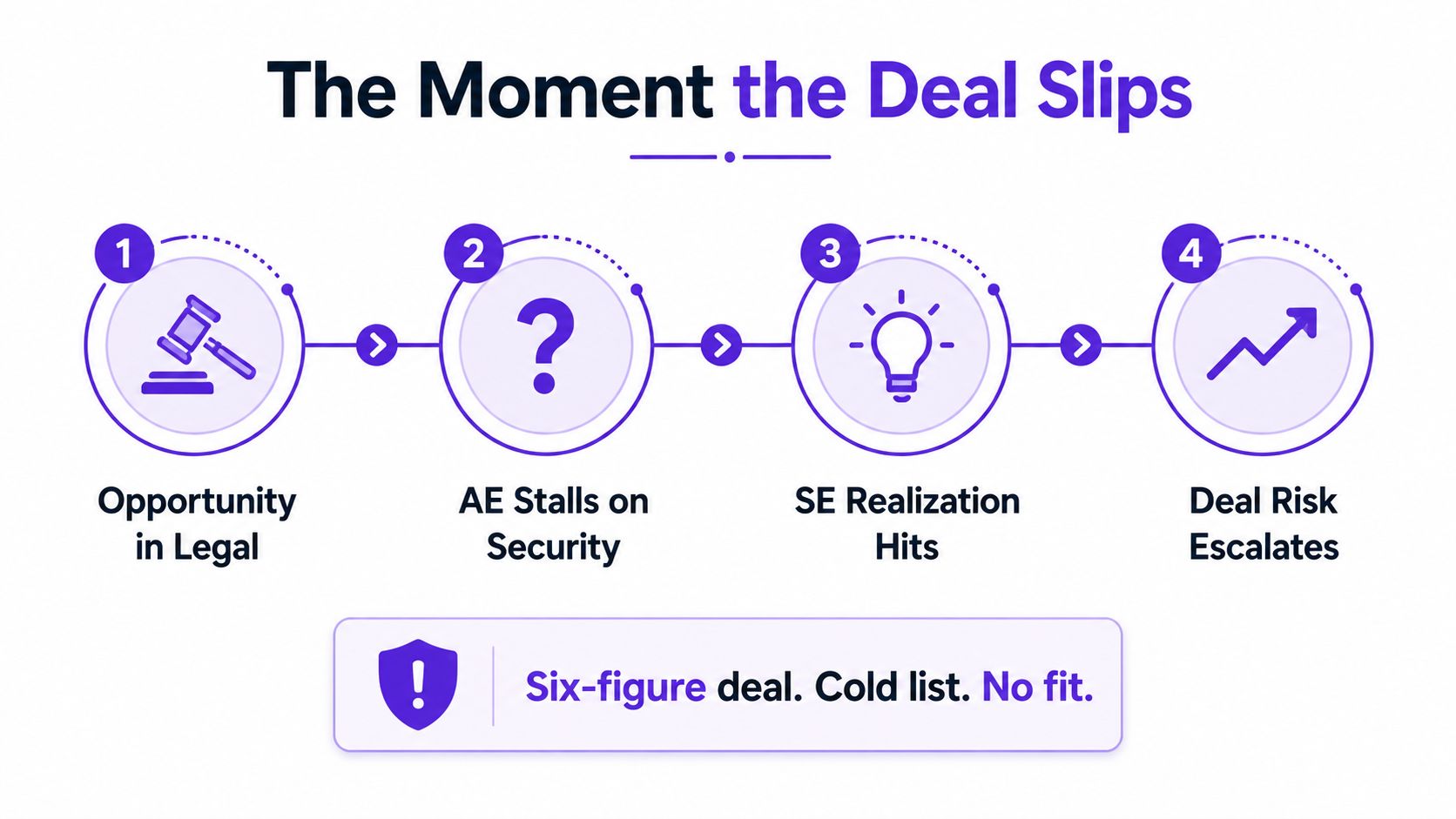
Practical rule: if the buyer asks for technical proof and your team only has enthusiasm, the clock is already running.
That is where sales engineer responsibility becomes visible. Sales engineers are expected to explain complex products, run demonstrations, handle technical questions, and align solutions to customer requirements, which is why the role matters inside enterprise buying cycles BLS sales engineer outlook. The job is not decorative. It sits between the buyer's technical anxiety and the vendor's revenue target.
The strongest SEs own that bridge from the first discovery call through the handoff after signature. Industry descriptions place them in pre-sale demos, technical qualification, proof-of-concept support, and post-sale support, because buyers do not just want to hear what the product does, they want to know whether it fits their stack, survives security review, and works in their environment Salesforce sales engineer role. That is also why intent-driven prospecting matters before the SE ever joins the call. A tool like RoverLead AI sales enablement content helps cold outreach surface better-fit, pre-qualified opportunities, so the SE spends time on deals that have a real chance of closing. That sounds less glamorous than a big closing call, and it should. Glamour does not unblock procurement.
A lot of teams still treat the SE like a late-stage accessory. That is a mistake. When technical credibility enters the deal too late, buyer risk rises and the close gets dragged into the mud. The SE who spots the wobble early does not just save the demo, they save the deal.
What a Sales Engineer Does
A sales engineer is the person who keeps a deal from drifting into fantasy. On paper, the role sits between sales and technology. In practice, it sits between buyer uncertainty and a vendor's promise. The best SEs do not perform a polished routine and hope for applause. They keep the conversation honest, technical, and tied to what the customer can run.
The day-to-day mechanics
The work usually starts with technical discovery. That means learning the buyer's current stack, workflow, constraints, and definition of success before anyone starts improvising with product talk. A strong SE turns those details into system requirements, checks whether the use case fits, and calls out a mismatch early, before the team burns time on a deal that was never sound.
The demo gets the attention, because everyone likes a good screen share. The job is less flashy. A demo should answer specific buyer questions, show how the product behaves in the buyer's environment, and reduce the risk that is sitting in the room but no one wants to name. Good SEs also handle troubleshooting, customer training, and post-sale technical support, because buyer confidence does not stop when the demo ends.
A weak team treats the SE like a polished presenter who appears late and disappears after the slide deck. That version wastes technical talent. The better version uses the SE as a risk reducer from the start, which is where tighter qualification and stronger pre-work matter. Intent-driven prospecting helps here, because sales enablement content and pre-qualified outreach can surface opportunities that deserve SE time instead of random curiosity calls. Cold outreach gets warmer when the buyer already has a real problem, a fit signal, and some reason to keep talking.
The compensation story reflects that weight. Industry summaries cited by analysts and review data point to a median total pay of $153,000 and a top-end pay potential of $198,000 per year for sales engineers Consensus sales engineer article. That range is not for someone who just clicks through slides. It reflects a role that has to translate, validate, and keep revenue from running into technical walls.
A good SE doesn't “present.” They translate, test, and remove excuses.
The practical split is simple. An account executive sells the business outcome. A sales engineer proves the business outcome can survive contact with the customer's environment. That is why the role matters so much in enterprise deals, and why the calmest person in the room is often the one protecting the close.
The SE Responsibilities Mapped to the Deal Cycle
Enterprise deals rarely break in one loud collapse. They fray in small gaps, the unanswered technical question, the unclear integration assumption, the security review nobody prepared for. A sales engineer owns the work of closing those gaps before they become deal damage.

Where the work sits
The first meeting is not a feature parade. It is a test of whether the buyer's environment, priorities, and constraints make the conversation worth continuing. During qualification, the SE turns customer requirements into system specifications and decides whether the opportunity deserves more technical attention.
The demo stage is where the product gets interpreted, not just shown. The SE owns the technical narrative, so the buyer can connect a feature set to a real outcome instead of nodding politely and forgetting half of it by lunch.
Technical validation is where the pressure climbs. Engineers show up, architecture questions get sharper, and the SE has to prove fit while preparing proposals or RFP and RFI responses. If the architecture story is shaky at that point, the deal is already limping.
Security review is the quiet deal killer. Teams that wait until this stage to discuss integrations, controls, and non-functional requirements have usually burned too much momentum already. Good SE work gets those questions on the table early, because late surprises are expensive and usually avoidable.
That is also why strong teams treat SE responsibility as part of sales process optimization. sales process optimization only works when the handoffs are disciplined and the technical questions are surfaced before someone starts improvising under pressure.
Procurement and signature may look commercial, but the technical thread still matters. If the proof was thin, procurement slows down while someone asks for one more review. Then kickoff arrives, and the SE's job shifts into post-sale continuity, making sure implementation does not inherit a promise that was never fully real.
The best mental model is simple. The SE owns the technical trust layer of the deal. Build that layer early, and the deal has a much better chance of surviving contact with reality.
How SE Responsibility Splits From the AE and SDR
If your team ever debates whether an AE can “just run the technical part,” the honest answer is that they can maybe fake it once. Maybe. The role split exists because each revenue function solves a different problem, and the confusion starts when people pretend those problems are the same.
Responsibility | SDR | AE | SE | CSM |
|---|---|---|---|---|
Prospecting and outbound targeting | Owns outreach and list building | Supports account strategy | Rarely owns | No |
Discovery of business pain | Schedules and qualifies at a basic level | Owns business discovery | Owns technical discovery | Uses downstream context |
Demo delivery | No | Sometimes light support | Owns technical demo | No |
Solution architecture | No | Frames business fit | Owns technical fit | Informs post-sale adoption |
Security and integration questions | No | Escalates | Owns answer coordination | Helps after signature |
Post-sale technical handoff | No | Supports transition | Shares technical context | Owns adoption and account health |
Technical objection handling | No | Commercial objection handling | Owns technical objection handling | Escalates if needed |
Renewal and expansion support | No | Commercial support | Advises where needed | Owns customer lifecycle |
The cleanest difference is between business qualification and technical qualification. SDRs and AEs can identify interest and urgency, but SEs validate whether the solution is viable in the customer's environment. That means dealing with integrations, performance, scale, security, and implementation risk, not just enthusiasm.
A lot of deals get muddy because nobody defines who runs which call. The AE should lead the commercial motion. The SE should lead the technical proof. The CSM should own the post-sale lifecycle. When those lanes blur, buyers get mixed signals and sellers step on each other's toes. For a useful lens on the outbound side of that machine, the SDR outbound strategy piece helps clarify what should be happening before the SE ever enters the room.
The most effective teams write this down in a RACI and stick to it. That sounds boring because it is boring, and boring is good when the alternative is a stalled quarter. The SE isn't there to replace the AE, and the AE isn't there to impersonate the SE. Each role protects a different part of the buying decision.
How Intent Signals Reshape the SE Pipeline
A bad calendar slot tells on the pipeline fast. If an SE spends the week rescuing cold prospects with no real buying signal, the calls drag, urgency stays soft, and the demo turns into a polite tour of features nobody asked for. A signal-driven pipeline starts differently. The buyer shows up with context, and that changes the whole technical conversation.

Why the warm opportunity matters
Intent data matters because it stops upstream teams from tossing the SE a stack of guesses. When buyers have already been reading, comparing, and revisiting topics in the product category, the first technical call does not have to start at square one. That is a better use of the SE's time, and usually everyone else's too.
If you want the mechanics behind that signal layer, what is intent data is a useful place to start before asking an SE to rescue another random demo.
The practical payoff is simple. Better intent upstream means the SE spends less time proving basic relevance and more time on architecture fit, proof-of-concept scope, and whether the customer's environment can support the solution. That is the job, even if a few job descriptions still dress it up like stage performance.
Industry guidance describes SEs as owning demos, troubleshooting, customer training, and post-sales technical support, and that role gets a lot more effective when the buyer is already leaning in rather than being dragged along Indeed sales engineer description. The point is not to create more meetings. The point is to make the meetings worth having.
A cold list motion makes the SE rebuild context before any technical proof begins. A signal-driven motion gives the SE a buyer who already understands the category, so the conversation can get to fit, constraints, and stakeholder alignment much faster. That changes the tone of the room and the quality of the questions.
That shift also changes buyer behavior. The meeting feels less like a first date and more like a working session. SEs usually do better there, because they can pressure-test assumptions instead of performing for an audience that has not decided why it is there.
RoverLead and similar intent-driven prospecting tools help route cold outreach toward prospects who are already showing buying signals, which means the SE gets pulled into pre-qualified opportunities instead of paper-thin ones. That is where the pipeline starts to behave like a pipeline, not a conference call generator.
The lesson is straightforward. The SE's output depends on the quality of the opportunities on the calendar. Better intent upstream means less wasted technical effort downstream, and fewer meetings that end with everyone saying, “Interesting,” while nobody means it.
Skills and KPIs That Matter
A good sales engineer gets judged on more than how clean a demo looks. In practice, the role is closer to a risk reducer than a stage performer. You are helping the buyer decide whether the product fits the stack, the team, and the politics inside the account, which means technical skill and commercial judgment have to show up together.
The skills that separate useful from merely busy
The strongest SEs do a few things well, and they do them without turning every conversation into theater. They can map architecture, spot implementation risk early, and explain trade-offs in plain language so the buyer can make a decision without needing a translator.
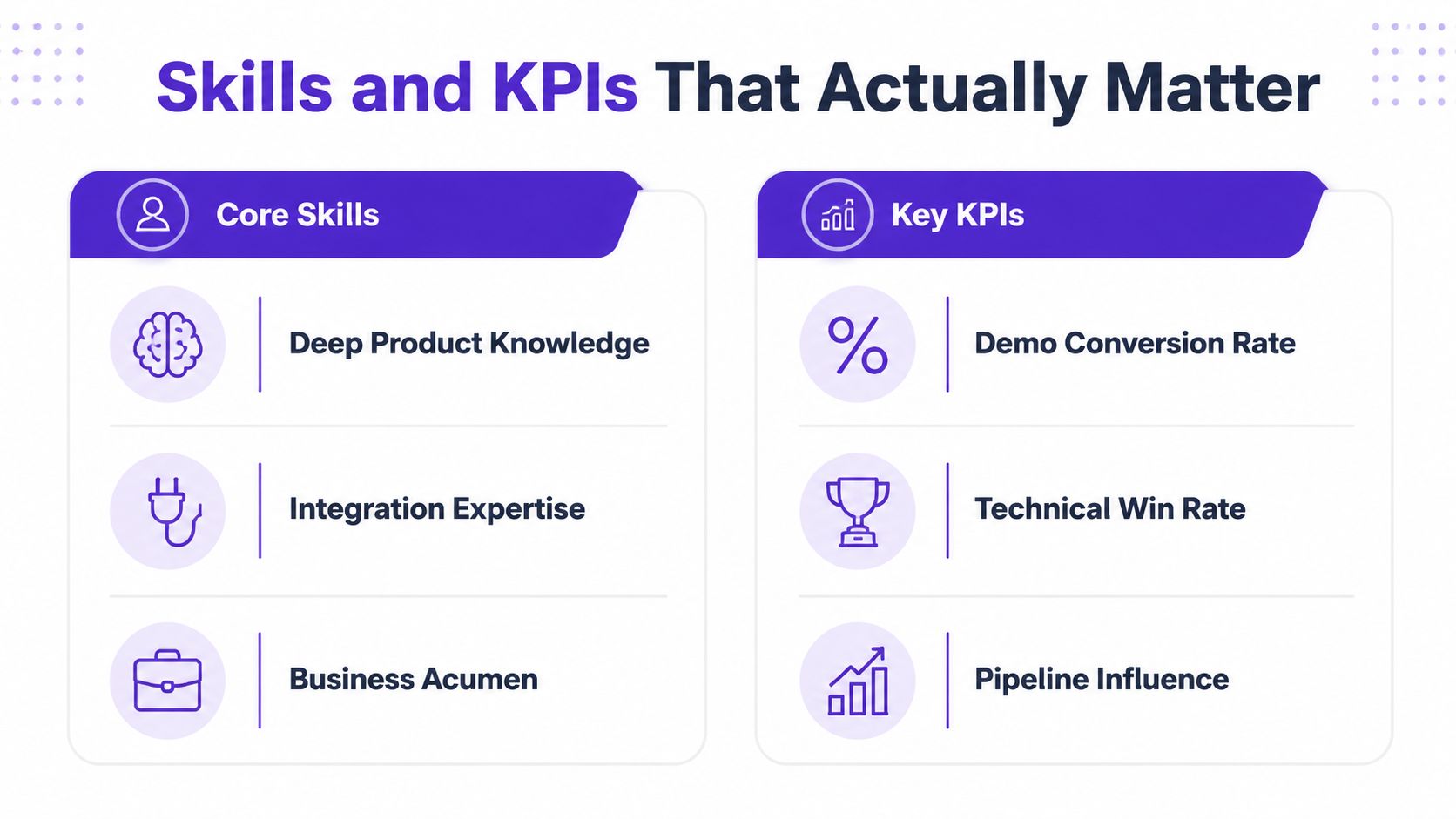
The hard skills worth caring about are straightforward:
Deep product knowledge: not just feature recall, but knowing where the product fits, where it breaks, and where it needs guardrails.
Integration expertise: because most real deals live or die on how well the solution fits the customer's stack.
Business acumen: so technical explanations land in the language of risk, value, and priority.
The softer side matters just as much, even if it is harder to put on a slide. SEs need to run discovery with technical stakeholders, handle competing opinions in the room, and write follow-ups that still make sense after three internal forwards and one skeptical manager. If the buyer reads the recap and knows what happens next, the SE did the job properly.
Useful filter: if a skill does not help the buyer decide, it is probably not a core SE skill.
The KPIs should follow the same logic. Demo conversion rate can tell you something, but only if the demos are qualified. Technical win rate is a cleaner read on whether the SE is helping deals move. Pipeline influence matters when the SE is part of the buying path. POC success matters more than polished slides, because buyers are looking for proof, not a performance review.
Vanity metrics are easy to spot. Number of demos delivered, number of calls attended, number of deck views. Those numbers prove the SE stayed busy. They do not prove the SE reduced risk or helped the deal advance. Good leaders measure what buyers felt and what changed in the deal, not just what the calendar logged.
Sample Job Description, Interview Questions, and Onboarding Checklist
A lot of hiring docs for SEs read like they were copied from a vending machine. This version is tighter, more honest, and closer to the work the role requires.
Sample job description
We're looking for a customer-facing technical individual contributor who partners with sales to qualify, shape, and win opportunities by translating customer needs into viable solutions. The role owns technical discovery, solution validation, product demonstrations, proof-of-concept execution, and technical objection handling. You'll work closely with AEs, product, engineering, and customer success to ensure buyers understand how the solution fits their environment and what success looks like.
That language lines up with DevOpsSchool's definition of the role and its focus on owning the technical win strategy and driving technical discovery and solution qualification DevOpsSchool sales engineer blueprint.
Five interview questions that actually test the role
Technical win strategy walkthrough: Walk me through how you'd win a deal where the buyer has three competing technical concerns.
Live discovery role-play: Ask me questions to qualify a customer with vague pain and a messy current-state architecture.
POC critique: Review a failed proof of concept and tell me where the technical scoping went wrong.
Security objection handling: Explain how you'd respond when security asks for proof the product can't currently provide.
Handoff simulation: Show me what you'd pass to implementation so the post-sale team doesn't have to relearn the deal.
30-60-90 onboarding checklist
First 30 days: Learn the product thoroughly, shadow discovery and demo calls, and document the common technical objections.
By 60 days: Own smaller demos, help scope at least one proof of concept, and draft your own technical follow-up notes.
By 90 days: Run discovery with minimal support, lead technical validation on active deals, and hand off clean implementation context after signature.
The best onboarding plans don't treat the SE like a presenter learning lines. They treat the SE like a risk analyst learning how the company sells.
Common Misconceptions and What Great Looks Like
Three myths stick around on SE teams because they sound tidy to people who have never had to save a deal from technical drift.
The first myth is the easiest to spot. Buyers do not need a slide performer. They need someone who can answer technical questions live, pressure-test fit in the moment, and turn uncertainty into a path the buyer can trust. A polished deck helps, but it does not carry the weight of real technical scrutiny.
The second myth is that the SE only backs up the AE. That framing misses the point. AEs own the business motion, while SEs own the technical proof, and when those jobs blur together, the deal gets fuzzy fast. Strong teams keep that split clean, because the commercial conversation and the technical validation need different hands on the wheel.
The third myth falls apart the moment the contract is signed. The role extends well beyond pre-sale, because troubleshooting, customer training, and post-sales support are part of the job too, and Salesforce's framing makes that cross-functional scope explicit Salesforce sales engineer role. Good SEs set implementation up to succeed instead of handing over a technical mess and calling it done.
Great SEs act as risk reducers. They make the purchase feel safe by surfacing constraints early, showing where the product fits, and giving the buyer enough technical confidence to move forward without second-guessing the decision.
Intent changes the math here. A warm pipeline means the SE spends less time rescuing bad meetings and more time validating serious ones. With intent-driven prospecting, tools like RoverLead AI turn cold outreach into pre-qualified, SE-ready opportunities, so the technical conversation starts with context instead of guesswork. That saves everyone time and makes the deal easier to close.