How to Qualify B2B Leads That Actually Close

Jordan's week looked productive on Monday morning. He'd found a “perfect-fit” account in a webinar list: 2,400 employees, Series C funding, and a marketing director title. The account matched the target profile on paper, so Jordan booked the discovery call, followed up three times, and pulled in an account executive for a presentation.
By Friday, the answer was less flattering. The prospect's budget was frozen until Q3, and the marketing director wasn't part of the buying group. The AE had blocked valuable calendar time, the marketer had scrapped a custom deck, and Jordan was left wondering whether qualification meant anything beyond checking boxes in a CRM.
The frustrating part was that another lead had looked weaker. The company didn't match the preferred employee range, and the contact had a less senior title. But several people from the account had engaged with comparison content, the contact replied quickly, and the team had a live operational problem. That opportunity moved from first conversation to signed deal inside nine days.
The difference wasn't luck. One account had fit without buying evidence. The other showed a pattern of fit, urgency, and group-level activity. If you're rebuilding your process, the practical question isn't how to collect more leads. It's how to qualify B2B leads in a way an SDR can defend on a Monday morning. A useful ideal customer profile helps, but it's only the starting line.
Table of Contents
The Lead That Wasted Everyone's Week
Jordan's mistake wasn't unusual. The webinar list had created a neat illusion of progress. Someone had attended, the account looked substantial, and the contact had a plausible job title. Those details made the lead easy to explain in a pipeline meeting, but they didn't answer the questions that matter.
Was the company solving the problem now? Did the contact have access to the people who would approve a purchase? Had anyone else at the account shown interest? Was there a project, deadline, or internal trigger that made a conversation timely?
Jordan had none of that information. Instead, the team treated company size and title as a proxy for readiness. The account executive discovered the budget problem only after investing in a second call. The marketer learned that the prospect wasn't evaluating vendors at all. Everyone had mistaken an attractive profile for an active opportunity.
Practical rule: A lead can be an excellent ICP match and still be a poor sales priority today.
The second account gave the team better evidence. A technical evaluator and an operations manager had both returned to product pages. The contact replied with a specific description of the workflow they wanted to replace, then named the colleague who would need to approve the change. The company wasn't perfect by the old checklist, but its behavior revealed a live buying process.
That distinction protects more than sales capacity. It protects morale. Reps don't burn out only from rejection. They burn out from spending days on opportunities that should never have reached their calendars.
A defensible qualification process combines fit, behavior, timing, and buying-group coverage. It won't predict every close, but it will make weak assumptions visible before they become a week-long project.
What Lead Qualification Really Means Today
Lead qualification is the process of estimating whether a prospect deserves sales attention before the team commits significant time. It isn't filtering form fills or assigning points to a job title. The useful output is a decision: route, nurture, disqualify, or investigate further.
The old approach leaned heavily on firmographics. Industry, headcount, geography, revenue, and seniority determined whether a contact looked suitable. Those details still matter because they describe potential fit, but they say little about whether a buying process exists today.
Modern qualification adds live evidence. A B2B intent data workflow can help identify research activity, return visits, competitor comparisons, and other signals that reveal timing. The strongest process treats those signals as evidence to examine, not as an automatic invitation to pitch.
The vocabulary your team needs
Fit asks whether the account resembles the customers your business serves well. Intent asks whether the account is showing signs of an active problem or evaluation.
Account refers to the company and its broader activity. Contact refers to one person. That difference matters because one enthusiastic contact may lack influence, while several modestly senior contacts may collectively reveal a serious buying group.
Inferred data is an educated conclusion from behavior or external information. Confirmed data comes directly from a conversation, reply, or verified business record. A pricing-page visit is inferred intent. “We're replacing our current process this quarter” is confirmed timing and need.
B2B qualification also differs from a simple consumer purchase. Deals often involve multiple stakeholders, technical review, procurement, legal approval, and future expansion considerations. The person who downloads a guide may be a useful champion, but they may not control the budget or the decision criteria.
BANT remains a practical baseline. The framework covers Budget, Authority, Need, and Timeline, and it was originally developed by IBM, according to this BANT qualification guide. Use it as a conversation structure, not an interrogation script.
Firmographic, Behavioral, and Intent Signals Compared
No signal layer does the whole job. Firmographic data tells you whether an account could be a fit. Behavioral data shows whether people are engaging with your offer. Intent data helps estimate whether an external trigger or active research pattern is creating urgency.
Consider a Series B fintech searching for SOC 2 vendors. Its funding stage, sector, technology environment, and hiring activity may indicate a plausible fit. Searches for compliance tools, competitor comparisons, and repeated visits to implementation pages add timing. A single webinar registration, by itself, adds much less.
Signal Layer | What It Reveals | What It Misses | Best Use |
|---|---|---|---|
Firmographic | Industry, revenue band, headcount, geography, funding stage, hiring velocity, and technology environment | Whether the account has an active project or budget | Establish the ICP fit gate |
Behavioral | Product-page revisits, pricing-page activity, demo attendance, downloads, webinar engagement, and email replies | Research happening away from your properties and the reason behind the activity | Measure engagement depth and recency |
Intent | Third-party research spikes, competitor comparisons, category interest, hiring for relevant roles, and regulatory triggers | Whether the account can buy from you or whether the researcher has influence | Prioritize timing after fit is established |
Firmographic signals are strong at answering “could this work?” They're weak at answering “why now?” Behavioral signals provide useful first-party context, but they can produce false positives from students, competitors, or casual researchers. Intent signals can reveal urgency, yet a highly active account outside your serviceable market still deserves caution.
The practical solution is stacking. A high-fit account with little activity should enter nurture, not receive senior-rep attention. A low-fit account with intense research may feel urgent, but it should usually be deprioritized until the fit problem is resolved.
The same principle applies to behavioral data. Score recency, frequency, and depth rather than treating every click as equal. A repeat comparison-page visit from a relevant account tells you more than a passive blog read.
The Layered Scorecard That Replaces Gut Feelings
A scorecard should make judgment more consistent without pretending that a spreadsheet can understand a deal better than a human. A practical four-layer model separates ICP fit, engagement depth, intent strength, and buying readiness, with weights of 30%, 25%, 25%, and 20% respectively. The weighting creates a defensible starting point, not a universal law.
Layer | Weight | Example Signals | Points | Routing |
|---|---|---|---|---|
ICP fit | 30% | Industry, headcount, revenue, technology stack, geography | Up to 30 | Fail the gate if the account is materially outside the ICP |
Engagement depth | 25% | Repeat page visits, asset downloads, pricing activity, event attendance | Up to 25 | Increase priority when activity is recent and repeated |
Intent strength | 25% | Research surges, competitor comparisons, hiring, regulatory triggers | Up to 25 | Validate an existing account rather than sourcing blindly |
Buying readiness | 20% | Reply sentiment, demo request, stated timing, stakeholder involvement | Up to 20 | Route when a live project and buying path are visible |
How the rules work in practice
The ICP layer checks whether the account belongs in the market you can serve. Engagement rewards meaningful activity, but it should distinguish a pricing visit from a generic article read. Intent captures external research, including Bombinga-style topic surges and competitor comparisons. Readiness reflects direct evidence, such as a demo request, a positive reply, a stated project window, or an identified approval process.
Use negative scoring where it protects rep time. Student domains, free-mail signups, irrelevant job functions, competitor activity, and obvious recruiting research can subtract points. The purpose isn't to punish curiosity. It's to stop weak context from inflating a queue.
Stale activity needs decay. Apply score reductions after 30, 60, and 90 days so an old download doesn't compete with a current evaluation. The AI-powered lead scoring layer can assist with pattern recognition, but sales operations still owns the definitions and reviews the outcomes.
Route the result operationally. A-tier accounts go to senior reps within minutes. B-tier accounts enter active nurture. C-tier accounts receive lower-intensity newsletter or education tracks. D-tier accounts are recycled, disqualified, or moved into a different campaign when the original context was wrong.
Questions and LinkedIn Messages That Sound Human
Qualification fails when discovery sounds like a form being read aloud. Start with the buyer's situation, then earn the right to ask about the decision.
Use questions that invite detail:
Current workflow: “Can you walk me through how your team handles this today, in your own words?”
Business impact: “What does that process cost you in time, missed opportunities, risk, or rework?”
Buying group: “Who else needs to be comfortable with a change before this can move forward?”
A MEDDIC-aligned follow-up can surface decision criteria without turning the call into an exam: “If this becomes a priority, what will the team use to compare options, who owns the approval process, and what has to happen internally before procurement can act?”
On LinkedIn, lead with the trigger, not flattery. Keep the connection request under 250 characters:
“Saw your team is hiring for revenue operations and noticed your posts on pipeline quality. I work on practical qualification systems for B2B teams. Open to connecting?”
After acceptance:
“Thanks for connecting. The hiring signal and your focus on pipeline quality suggest this may be an active project. I can send a short scorecard template, or we can spend 15 minutes reviewing where leads are leaking. Which is more useful?”
The difference between weak and useful outreach is easy to see:
Bad: “Your company is doing amazing work. I'd love to show you our powerful platform.”
Better: “You're hiring for RevOps while discussing lead quality. How are you currently deciding which accounts deserve an SDR response?”
The better message may produce fewer instant replies, but it gives the recipient something real to answer.
Automating Qualification Without Losing the Context
A small sales team can run a useful qualification loop without building a science project. Start with an intent platform such as Bombinga, or a comparable system, watching keyword sets, competitor terms, and topic clusters. Push qualified accounts into the CRM or a controlled spreadsheet, then use Make or Zapier to enrich the company record and calculate the four-layer score.
A second automation can tag the tier, alert the assigned rep in Slack within five minutes, attach the three strongest signals, and create a draft LinkedIn message with the trigger already included. The rep shouldn't have to open six tabs to understand why an account appeared.
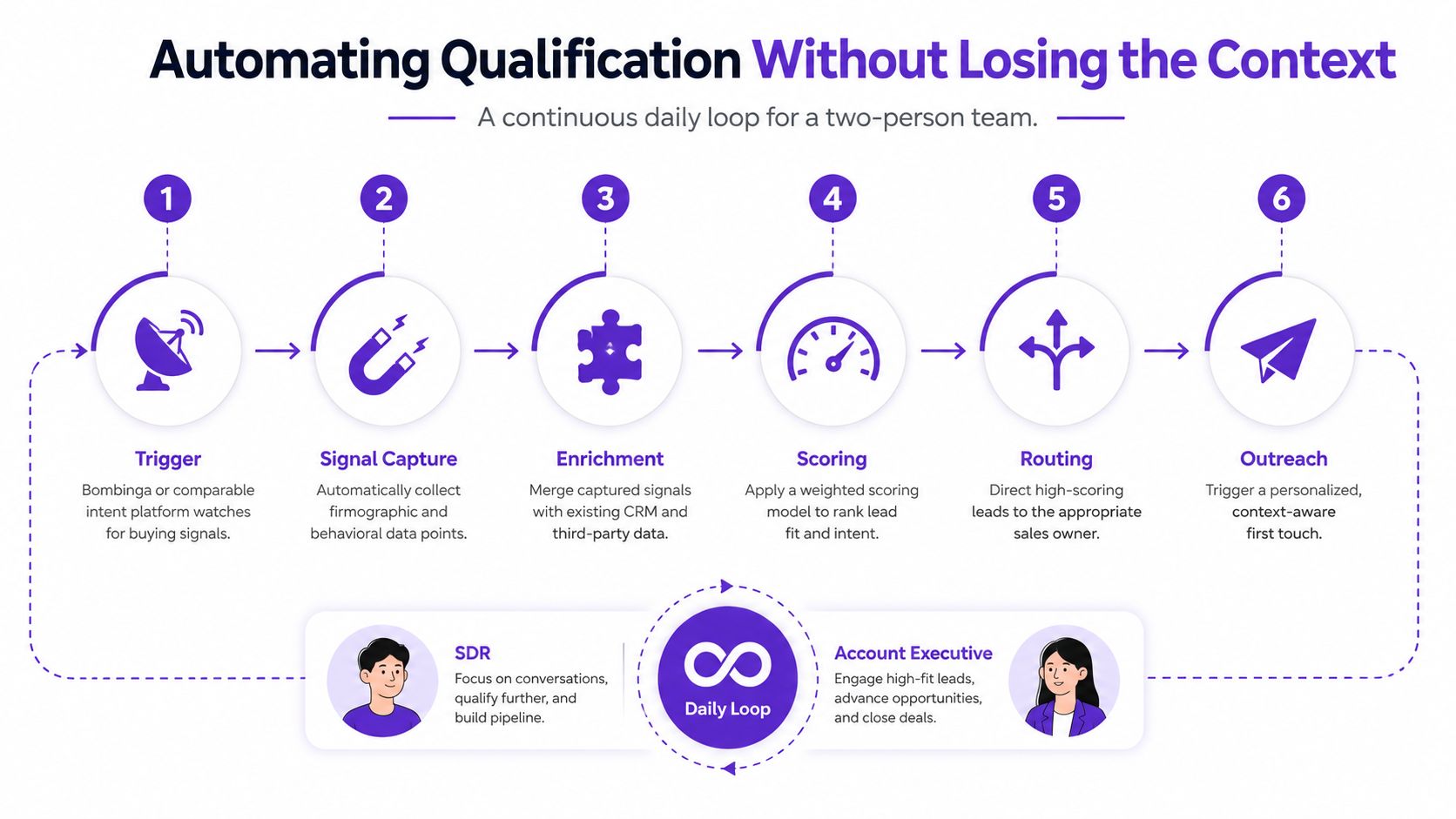
Automation should handle capture, enrichment, scoring, routing, and preparation. It shouldn't handle the first human reply, the qualification call, or objection handling. Those moments depend on context, tone, and details that a workflow can't safely infer.
A two-person team can keep the daily rhythm simple:
Review the overnight surge list at 9 a.m.
Work A-tier accounts first.
Log the disposition reason, not just the stage change.
Review outcomes every Friday and adjust the scoring weights when the evidence supports a change.
A tool such as RoverLead AI can surface LinkedIn engagement matched to an ICP and provide context for why a prospect appeared. That makes it one possible input to the workflow, alongside CRM activity and other intent sources.
The process works when automation shortens research without hiding the evidence. A score without its underlying signals is just another unexplained number.
Buying Groups, Signal Stacking, and the KPIs That Matter
The single-contact MQL is one of the most persistent traps in B2B sales operations. A contact can be active, responsive, and interested while still lacking the authority or internal access needed to move a purchase forward.
Qualify the account-level buying group instead. Map the economic buyer, champion, technical evaluator, end user, and blocker. Then stack activity across those roles. Several lower-authority contacts engaging with the same topic can create stronger evidence than one highly active contact who's operating alone.
The qualification conversation should answer three practical questions: who is involved, what does each person care about, and where can the process stall? That map helps the AE choose the next action, whether it's a technical session, business case, executive introduction, or procurement review.
KPI | What It Measures | Target Benchmark | Coaching Trigger |
|---|---|---|---|
Account-to-opportunity conversion | Whether qualified accounts progress into real opportunities | Establish a baseline from your own CRM | Strong fit but weak opportunity creation means intent or readiness rules need review |
Multi-threaded account rate | Whether more than one relevant stakeholder is engaged | Define by segment and sales motion | Single-threaded opportunities expose contact-level qualification |
Time-to-qualified | How quickly the team confirms fit and buying evidence | Set an SLA appropriate to your motion | Delays suggest routing or enrichment friction |
Pipeline produced per signal stack | Whether stacked signals create useful pipeline | Compare signal combinations over time | High activity with low pipeline indicates false positives |
Disqualified-but-rescued rate | Whether recycled leads later become viable | Track by campaign and reason | High rescue rates may indicate overly strict early filters |
Don't use invented universal targets for these KPIs. Your baseline depends on deal complexity, market, channel, and sales capacity. What matters is connecting each metric to a workflow output and reviewing whether the scorecard improves decisions rather than merely increasing activity.
The broader benchmark makes the need for discipline clear. One B2B lead quality benchmark reports that 13% of MQLs convert to SQLs, while 44% of MQLs are rejected by sales as unqualified or outside the ICP. The same source describes a funnel where 31% of leads become MQLs, followed by 13% of MQLs becoming SQLs, which is why qualification should be treated as staged filtering rather than a single checkbox.
RoverLead AI helps sales teams turn LinkedIn engagement into a daily queue of prospects matched to their ICP, with the behavior and context behind each signal. Visit RoverLead AI to see how a signal-led workflow can help your team spend less time on static lists and more time on accounts showing buying evidence.