How to Define Ideal Customer Profile That Actually Converts

Most advice on how to define an ideal customer profile starts with industry, employee count, and annual revenue. That's backwards. Those fields tell you which companies look familiar, not which accounts will buy, retain, expand, and generate efficient revenue.
A useful ICP is a living, scored, intent-aware operating system. It connects account fit to observed customer outcomes, then tells sales and marketing what to do next. If your profile lives in a slide deck and never changes a rep's call list, qualification decision, or message, it isn't strategy. It's office décor with a logo on it.
Table of Contents
Why Most Ideal Customer Profiles Quietly Fail
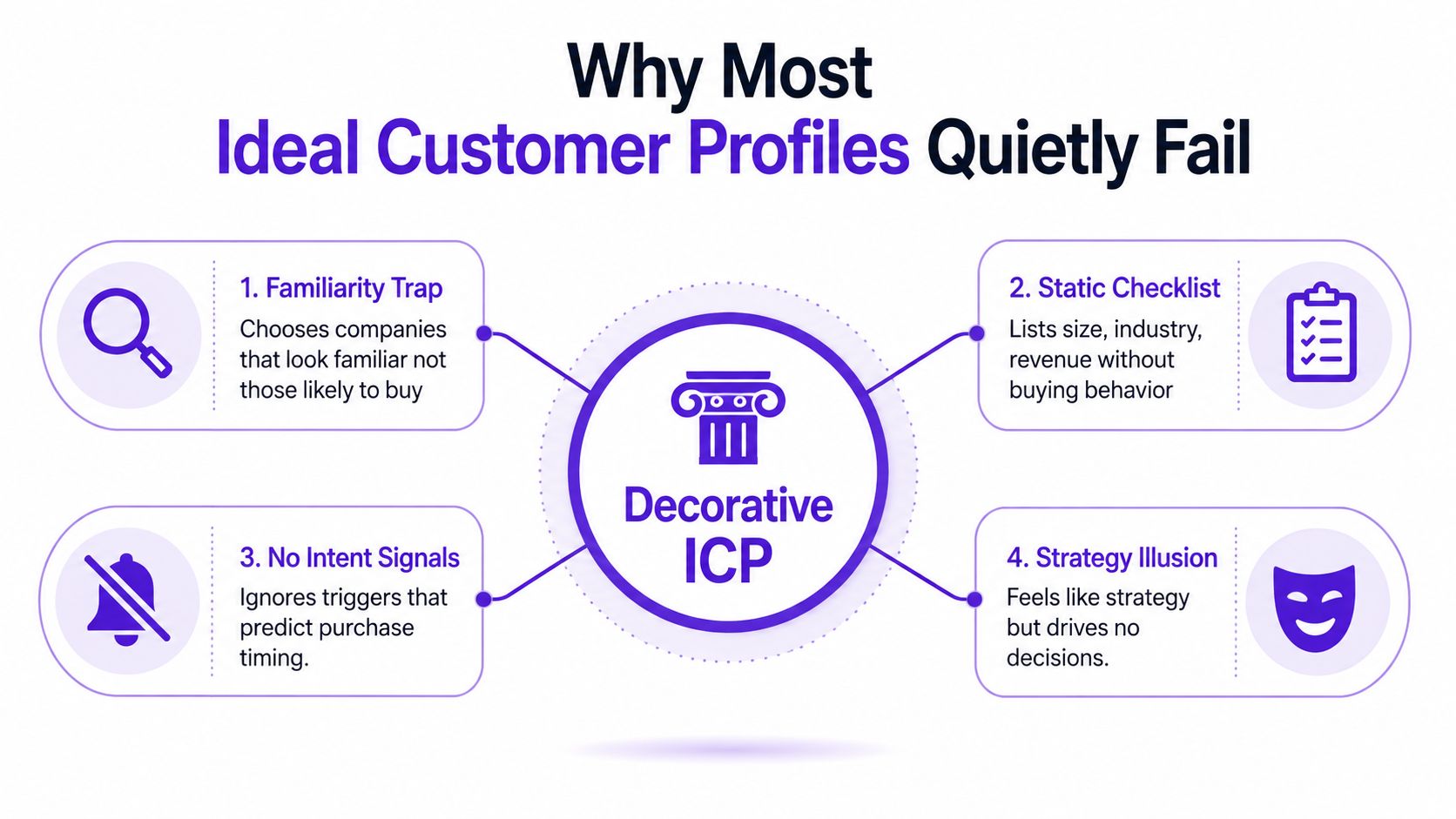
Most ICPs aren't technically wrong. They're decorative. A team lists company size, industry, geography, and revenue, then calls the document finished. That checklist describes a recognizable account, but it doesn't answer the questions that protect revenue: Will this company buy? Can it implement? Will it stay? Is there a reason to act now?
A widely cited SiriusDecisions benchmark, reported in ZoomInfo's analysis of ideal customer profiles, found that 65% of high-growth companies, defined there as companies with 40% or more year-over-year revenue growth, had a documented ICP, compared with 14% of no-growth firms. The point isn't that a document magically creates growth. The point is that serious commercial teams use an ICP as an operating discipline, not as a description of their favorite logos.
The checklist problem
A static profile usually fails in four ways:
Familiarity trap: It selects companies that resemble existing customers, even when those accounts lack a live problem.
Checklist blindness: It records firmographics but ignores technology, usage, buying triggers, and implementation reality.
Intent vacuum: It treats a perfect-fit account with no current urgency like an active opportunity.
Strategy illusion: It gives marketing a target audience while giving sales no decision rule.
The better approach starts with retained customers and works backward. Compare deal performance, sales-cycle length, product adoption, objections, support themes, expansion, and churn. Then separate fit from intent. A smaller account with a painful, urgent problem may deserve a conversation before a larger account that's merely a theoretical match.
Practical rule: If your ICP doesn't help a rep decide whom to contact, why now, what to say, and when to walk away, rewrite it.
Dimension | Decorative ICP | Operating ICP |
|---|---|---|
Account definition | Industry, size, revenue | Firmographic, technographic, and behavioral fit |
Buying readiness | Assumed from company attributes | Measured through current intent signals |
Customer quality | Initial purchase | Retention, expansion, usage, and commercial value |
Sales use | Static list filter | Tier, action, message, and disqualification rule |
Governance | Updated when someone remembers | Reviewed against wins, losses, churn, and expansion |
Behavior matters because a company's actions often reveal more than its profile fields. Teams that want to understand that layer should use this practical guide to behavioral data. Your ICP should remain a falsifiable hypothesis. If matching accounts stall, supposedly poor-fit accounts outperform, or customers churn after fitting the model, the model is failing.
Building an ICP From Real Customer Evidence
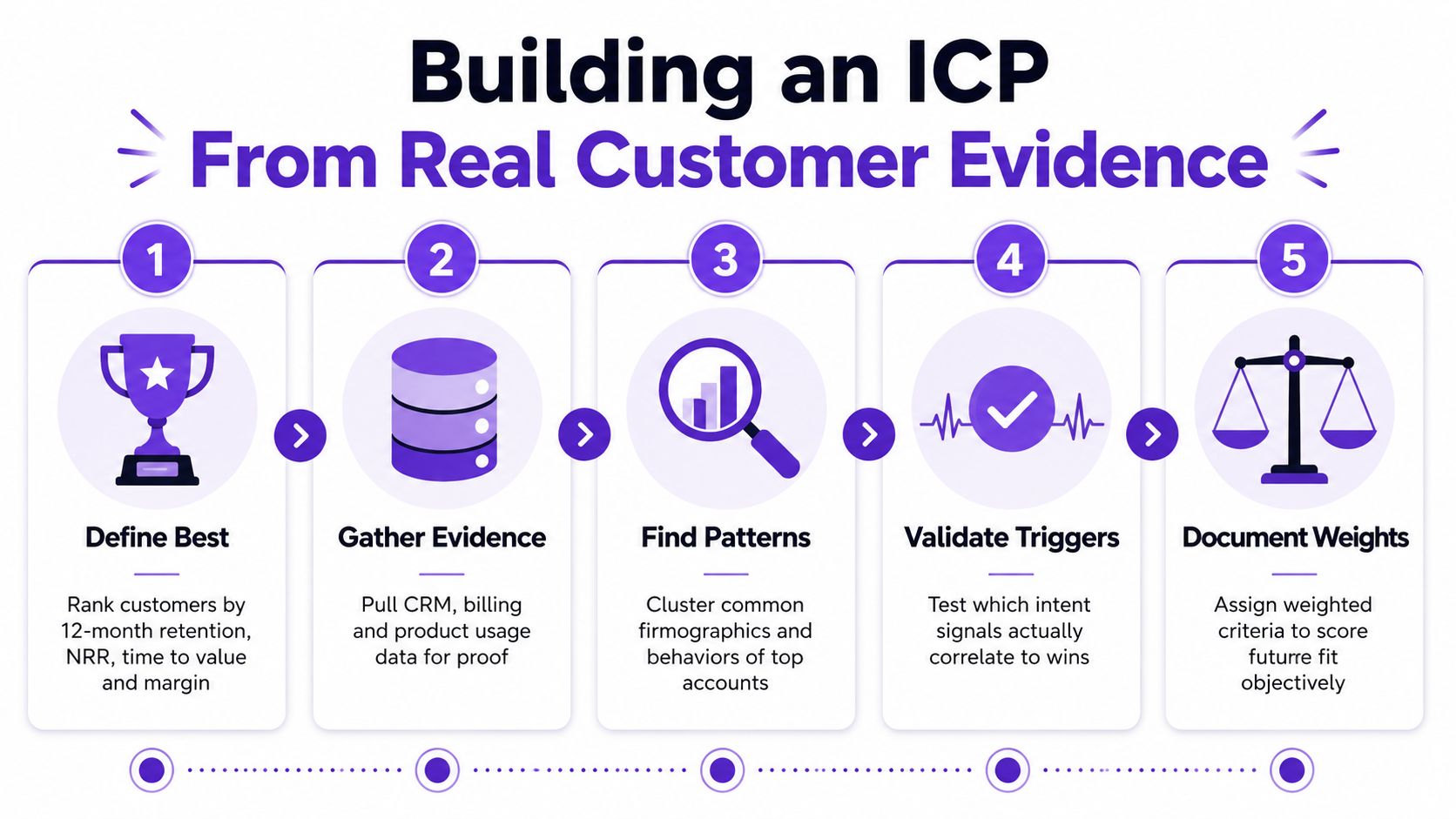
Start with customers who can prove they're good for the business. “Best customer” shouldn't mean the logo your founder likes showing investors. It should mean an account with strong retention, fast time to value, healthy expansion potential, sensible support demands, and attractive sales efficiency.
The historical logic behind customer modeling supports this approach. Persona research is commonly traced to Alan Cooper's 1985 interviews with prospective users, including the first commonly cited persona, “Kathy.” Modern ICP work applies the same behavior-first logic to company-level data, combining firmographics, technographics, and engagement signals. Salesforce's ICP overview also frames the profile around outcomes such as lifetime value, churn, sales-cycle length, and net revenue retention.
Start with winners, then study the failures
Review your last 20 closed-won accounts, as recommended in this practical B2B ICP methodology. Record:
Industry, company size, geography, revenue band, and business model
Technology stack, integrations, and organizational structure
Original trigger, buying committee, objections, and sales-cycle length
Time to value, adoption pattern, support burden, retention, and expansion
Then run the same review across your last 20 closed-lost accounts. The lost set exposes exclusion criteria. Perhaps the product technically fits, but implementation requires a team the account doesn't have. Perhaps the buyer likes the solution but can't secure internal sponsorship. Those facts belong in the model.
A useful starting score can weight company fit at 40%, need or problem fit at 25%, timing and intent at 20%, and relationship or access strength at 15%. Treat those weights as a hypothesis, not sacred math. Recalibrate them against actual wins, losses, retention, and expansion.
A worked account example
Consider a 300-person software company using HubSpot, hiring for revenue operations, repeatedly visiting a pricing page, and engaging with an executive's relevant LinkedIn post. Its firmographic and technographic fit looks promising. Its behavior suggests research. Neither proves urgency.
The rep should translate those observations into an operating decision:
Tier: High-fit account under active review.
Priority: Immediate research, not automatic opportunity creation.
Next action: Identify the revenue operations leader and connect the hiring pattern to a likely initiative.
Reason: Multiple relevant signals exist, but the message must test the problem rather than assume it.
Document the evidence in your CRM. Enrichment helps only when it improves qualification, routing, or message quality, so connect the process to CRM data enrichment rather than collecting fields for their own sake.
Step | Required evidence | Output |
|---|---|---|
Define best | Retention, net revenue retention, time to value, margin, expansion | Clear winner criteria |
Gather evidence | CRM, billing, product usage, interviews | Account-level evidence set |
Find patterns | Common firmographics, technologies, triggers, objections | Candidate ICP attributes |
Validate triggers | Wins, losses, replies, meetings, cycle time | Proven and rejected signals |
Document weights | Predictive value of each criterion | One-page scored ICP |
A finished profile should help a rep act on Monday morning. If it only helps a marketer describe an audience, you stopped too early.
ICP vs Buyer Persona and Where Each One Breaks
An ICP qualifies the account. A buyer persona qualifies the people inside that account. Confusing those layers creates outreach that is either relevant to nobody or relevant to the wrong business.
The ICP asks whether an organization has the conditions to gain value and remain commercially viable for you. It considers industry, size, geography, business model, technology, operational complexity, and behavior. The persona asks who experiences the problem, who sponsors change, who controls the budget, who uses the solution, and who can block the deal.
Dimension | Ideal Customer Profile | Buyer Persona |
|---|---|---|
Unit of analysis | Company or account | Individual stakeholder |
Core question | Is this account a profitable, retainable fit? | What does this person need to act? |
Typical attributes | Industry, size, tech stack, geography, behavior | Role, pains, goals, triggers, objections, language |
Buying role | Account-level qualification | Economic buyer, champion, user, blocker, procurement |
Failure when used alone | Targets logos without relevance | Creates interest in accounts that won't succeed |
The two predictable mistakes
A company-level profile without human context produces “Hello, {{company}}” outreach in a nicer shirt. The account may fit, but the message lands with someone who doesn't own the problem, doesn't control the decision, or has no reason to change.
A detailed persona without account fit creates the opposite mess. A rep can have a lively conversation with a thoughtful operations manager at a company that is too small, too complex, poorly supported, or economically unattractive to serve. Personal relevance can't rescue bad account economics.
Build the layers together. An ICP might identify 200 to 500 employee software firms with a scaling sales team. Inside those accounts, the VP of Revenue Operations may champion the issue, the CRO may own the business case, and a RevOps manager may validate implementation. Each person needs a distinct job-to-be-done, trigger, objection, and proof point.
A fit account without an urgent persona is a nurture account. An engaged persona inside a bad-fit account is not a victory.
Map the buying committee instead of pretending one person is “the customer.” If the account fits but nobody has urgency, don't manufacture pain. If a persona engages but the company fails the account threshold, nurture or disqualify politely.
Scoring Fit and Intent Like an Operating System
Gut feel is useful for forming a hypothesis. It's terrible as a routing system. A scored ICP should treat fit and intent as separate inputs, then combine them into a priority that determines the next sales action.
Use a 100-point model with explicit weights. One workable structure is:
Industry: 15 points
Company size: 10 points
Technology stack: 10 points
Use-case fit: 15 points
Budget signal: 10 points
Recent funding: 5 points
Pricing-page visits: 10 points
Demo request: 15 points
LinkedIn engagement: 5 points
Relevant job postings: 5 points
This is not a universal truth. It's a transparent starting model that forces your team to explain why an account ranks highly. Score fit attributes separately from intent attributes. Strong fit without intent means “watch.” Strong intent without fit may mean “churn risk,” not “hot lead.”
Turn scores into sales behavior
Create A, B, C, and D tiers, then attach each tier to a real pipeline play. Don't let the score become another dashboard ornament.
Quadrant | Profile | Action | SLA |
|---|---|---|---|
High fit, high intent | Target account showing relevant activity | Personalized outreach, multithread, live call | Same business day |
High fit, low intent | Strong account with no active buying evidence | Nurture with trigger-based content | Review on signal change |
Low fit, high intent | Interested account unlikely to retain or succeed | Disqualify politely or provide a referral path | Prompt response, no pursuit |
Low fit, low intent | Weak account with no useful activity | Recycle into broad content audiences | No live sales effort |
The model should tell a rep whether to call, nurture, refer, or ignore. It should also tell marketing which audiences deserve content and sales leadership which segments are consuming time without producing qualified pipeline.
For teams moving beyond static lead grades, predictive lead scoring can provide a useful comparison point. Still, no model earns trust by sounding complex. It earns trust when its tiers predict conversations, opportunities, wins, retention, and cycle time.
Validating Your ICP With Real Outreach Signals
Validation happens in the market, not in the marketing meeting. A slide can win internal approval while sending your reps toward the wrong accounts.
Run a controlled outreach test. Take 200 accounts and split them between a legacy firmographic ICP and a behaviorally enriched version that includes intent signals. Keep the offer, channel, and sales discipline consistent. Track first-touch reply rate, qualified meeting rate, and 90-day opportunity conversion.
The enriched version should win across those measures before you scale it. If it doesn't, don't hide behind a prettier score. Revisit the account definition, signal quality, message, and timing. Buying signals in sales are useful only when they change a decision.
Translate activity into a next move
Suppose a VP of Operations likes three LinkedIn posts in seven days and opens a pricing page twice. That combination should create a Priority 1 alert, not a generic “just checking in” email.
Use a message pattern with three parts:
Observed context: Reference the initiative, topic, or operational change connected to the activity.
Relevant problem: State the problem your product addresses without claiming the buyer has confirmed it.
Low-friction next step: Ask a focused question and offer a calendar option.
Escalate from nurture to a live call when the account crosses the agreed intent threshold, such as repeated relevant engagement combined with pricing or demo behavior. The exact threshold belongs in the ICP document, and it must be consistent enough that two reps make the same call.
Contrast that with a static title list. A rep sends a generic cold email to every VP of Operations in a selected industry, regardless of current priorities. That approach may produce activity, but it gives you no clean explanation for why one account should be contacted today and another should wait.
Record replies, meetings, opportunities, wins, losses, churn, and sales-cycle length by ICP version. Your test is not complete when someone responds. It's complete when the account quality holds through the lifecycle.
Fixing an ICP That Has Gone Stale
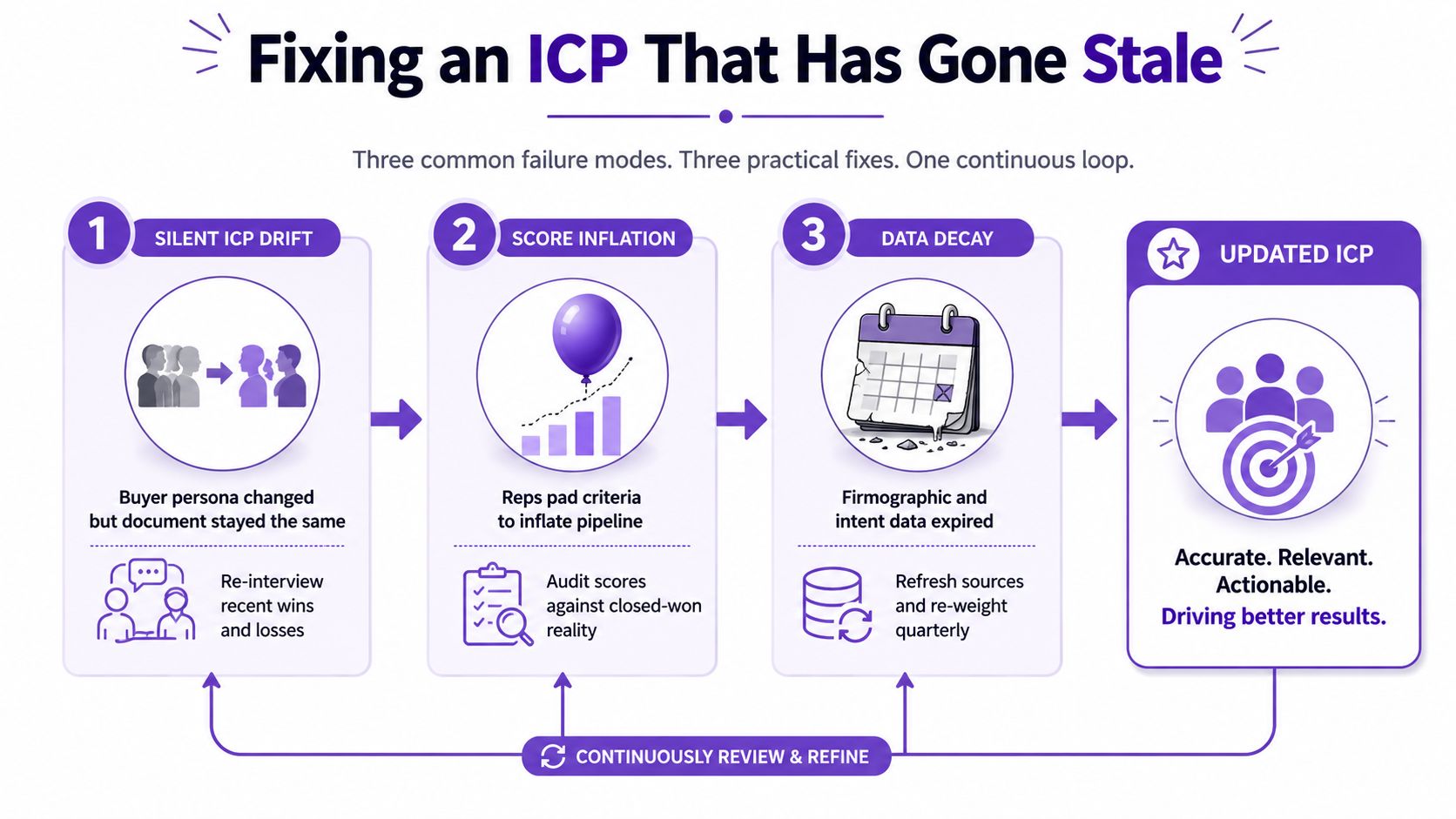
ICPs don't usually collapse with a dramatic announcement. They rot. The buyer changes, reps stretch the scoring rules, intent data piles up unused, and the document keeps pretending the market is standing still.
Three failure modes to catch
Silent ICP drift appears when recent wins and losses no longer resemble the documented profile. Your CRM shows new buyer roles, new use cases, or different implementation constraints, but the ICP still describes the old motion. Re-interview recent wins and losses, then update the account and persona layers together.
Score inflation appears when too many accounts qualify as top tier. Reps add soft criteria, mark vague interest as intent, or adjust fields until the pipeline looks healthy. Audit scores against closed-won reality. If high scores don't correlate with qualified progression, remove subjective inputs.
Signal blindness appears when your systems collect engagement, job, pricing, or technology activity but no workflow responds to it. Wire validated signals into routing, task creation, sequences, and alerts. Data that doesn't change behavior is expensive wallpaper.
Run a monthly 45-minute ICP ritual. Pull win and loss reasons, review churn and expansion by segment, refresh intent weights, remove attributes that no longer predict outcomes, and re-rank account tiers. Assign one owner. Shared responsibility often means nobody does it.
Ask these questions in every deal review:
Did this account match the ICP?
Did our score predict the outcome?
Which intent signal came closest to the actual buying moment?
Review behavioral criteria monthly because they change quickly. Revalidate firmographic criteria quarterly, or sooner when your market, product, pricing, or sales motion changes. The schedule matters less than the discipline of comparing the model with reality.
Your One-Page ICP Checklist and Next Moves
Ship one page by Friday. Not a 40-slide strategy deck, not a wiki page nobody opens, and not a spreadsheet with 70 fields that turns qualification into archaeology.
Include these seven essential blocks:
Ranked firmographic criteria: List industry, size, geography, business model, and technology requirements with weights. Explain why each attribute matters.
Three buyer titles: Name the economic buyer, champion, and user. Add each role's trigger, concern, and preferred proof.
Top three intent signals: Define the behaviors that indicate active research and the threshold that changes an account to active.
A/B/C/D scoring rubric: Tie each tier to a pipeline action, owner, response expectation, and disqualification rule.
Two automatic disqualifiers: Identify conditions that predict poor implementation, weak retention, or unacceptable economics.
Review ownership and cadence: Name the person responsible for the monthly ritual and the teams that must attend.
One validation experiment: Queue a test for the next sprint with a control, a behaviorally enriched segment, and lifecycle measures.
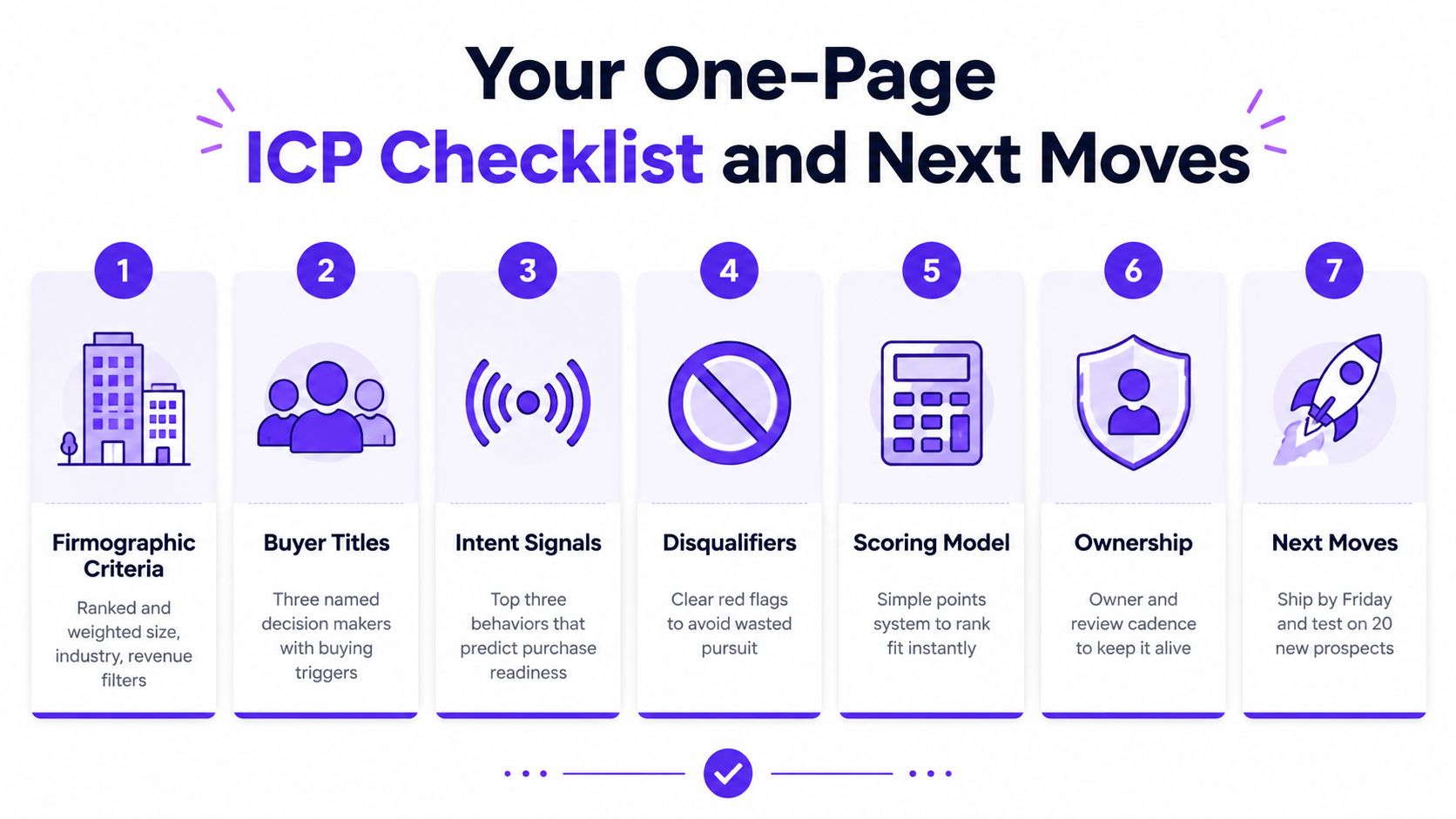
A good one-pager lets a rep answer four questions without opening another document: Who fits, why now, what do I say, and when do I stop? It also gives marketing a shared definition for campaigns and gives customer success a way to flag segments that look good at acquisition but fail after purchase.
Make these your next three moves this week:
Pull retention and expansion data from your top 20 closed-won accounts.
Draft the weighted rubric in a spreadsheet and separate fit from intent.
Book a 30-minute sales and marketing alignment meeting to ratify tier definitions before launching another campaign.
RoverLead AI lets teams define an ICP, competitors, niche experts, and topics, then monitor LinkedIn engagement and other buying signals to surface accounts that match the profile. Visit RoverLead AI to turn your static ICP into a live prospecting workflow, then test the signals against replies, meetings, opportunities, and retention.