What Is LinkedIn Lead Generation: A Practical Guide

LinkedIn lead generation is the process of identifying, engaging, and converting prospects into meetings on LinkedIn by targeting high-intent signals rather than broadcasting to cold audiences. 89% of B2B marketers use LinkedIn for lead generation, and 62% say it generates leads.
You've probably seen the alternative. A salesperson sends connection requests to strangers, publishes a few generic posts, adds “Let's connect” to every message, and then wonders why the inbox looks like a beautifully organized cemetery. The problem usually isn't LinkedIn. It's the assumption that more activity automatically creates more pipeline.
Table of Contents
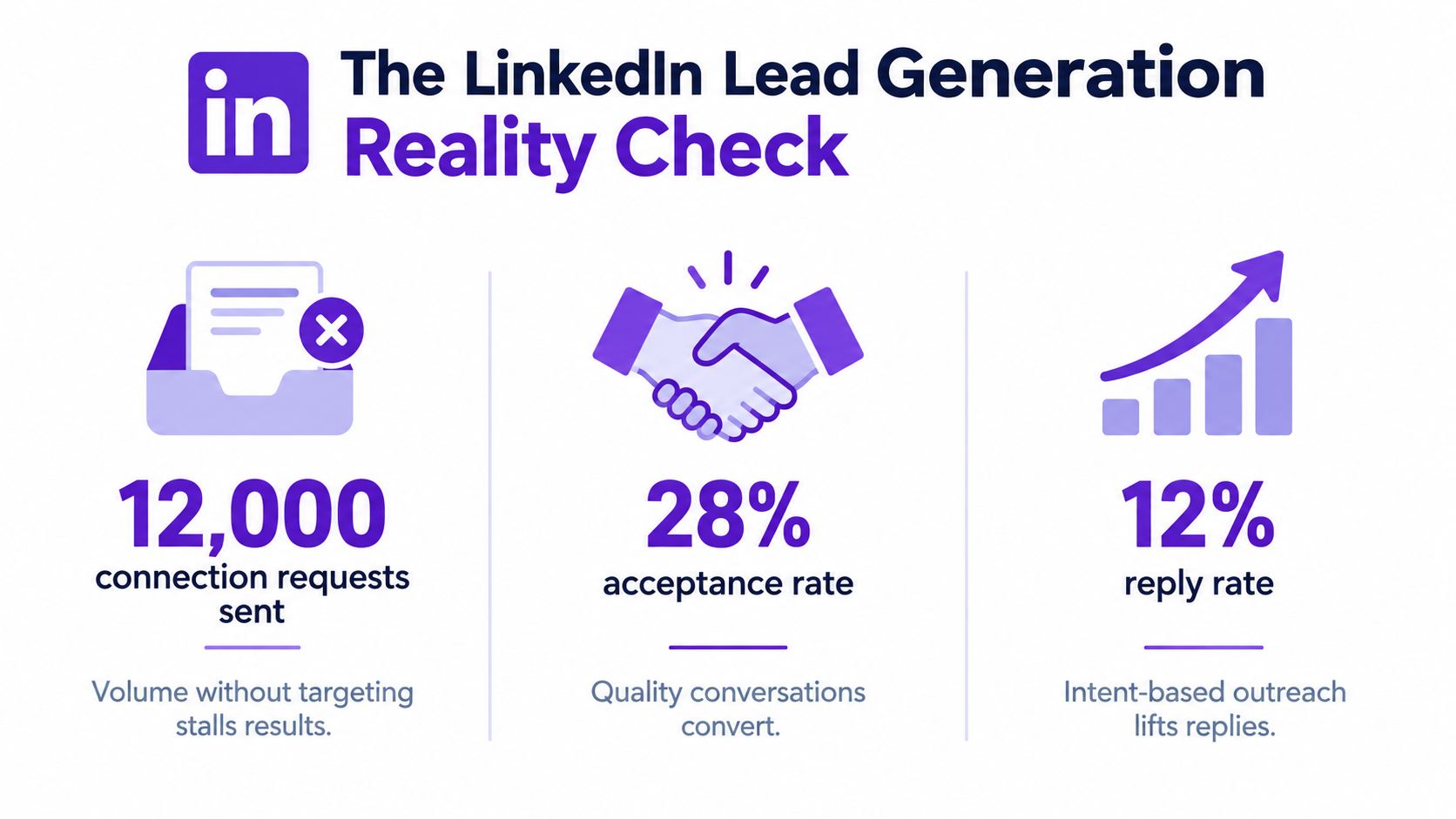
The LinkedIn Lead Generation Reality Check
A sales rep starts Monday with a spreadsheet of prospects and a simple instruction: “Just connect with more people.” By lunch, dozens of requests are out. By Friday, the rep has a larger network, a tired thumb, and almost no serious conversations.
That's spray-and-pray outreach. It treats LinkedIn as a contact database instead of a live source of buying context. The better definition of LinkedIn lead generation is narrower: identify a relevant person, recognize evidence that the problem matters to them, start a useful conversation, and move qualified interest toward a meeting.
LinkedIn's own lead-generation overview reports that 89% of B2B marketers use LinkedIn for lead generation, while 62% say it generates leads. The same page cites HubSpot data placing LinkedIn at 277% more effective for lead generation than Facebook and Twitter. Those figures help explain why LinkedIn remains especially important for software, professional services, and other high-consideration B2B offers, but they don't excuse lazy outreach. The platform gives sellers professional context. Sellers still need to use it intelligently. (LinkedIn's lead-generation overview)
The useful signals are often visible before a prospect replies:
A target account's leader comments on a post about a problem your product solves.
A buyer publishes content about a new initiative, hiring need, or operational bottleneck.
Someone changes roles and inherits a problem your team already understands.
A prospect engages with competitor content or asks a pricing and implementation question.
Practical rule: A lead isn't valuable because you found their profile. They're valuable because you can explain why a conversation makes sense now.
Core Channels and Tactics That Drive Results
LinkedIn lead generation has three working parts: content, direct outreach, and community engagement. They support one another, but they perform different jobs.
Content builds familiarity. A sharp post about a recurring operational problem can help a prospect understand your point of view before you ever contact them. It won't replace a sales conversation, and posting more often won't fix weak positioning, but useful content gives outreach a reason to exist.
Direct outreach creates the conversation. Search by role, company, industry, and relevant account characteristics, then use the prospect's recent activity to make the opening specific. A message that refers to a real business issue has a chance. “I help companies grow. Want to chat?” belongs in the recycling bin.
Community engagement earns context. Thoughtful comments on posts from target buyers, subject-matter experts, and relevant companies can make your name familiar without forcing a pitch. Groups and event discussions can work too, provided you contribute instead of treating every participant as a lead-shaped object.
A 2026 benchmark covering 13,218,869 connection requests found an average acceptance rate of 28.5%, an outbound message reply rate of 10.4%, and a connection-request note conversion rate of only 3.0%. The data shows where many campaigns fail: the first interaction lacks enough relevance to earn attention. (Expandi's 2026 LinkedIn outreach benchmark)
Channel | What it does well | What usually goes wrong |
|---|---|---|
Content | Builds authority and creates warm entry points | Generic advice attracts attention without buying intent |
Direct outreach | Reaches a defined account or role | Personalization gets reduced to inserting a first name |
Engagement | Creates familiarity around active topics | Comments become disguised pitches |
Treat these channels as a system. Content creates credibility, engagement reveals interest, and outreach converts relevant moments into conversations.
Intent Signals vs Spray-and-Pray Outreach
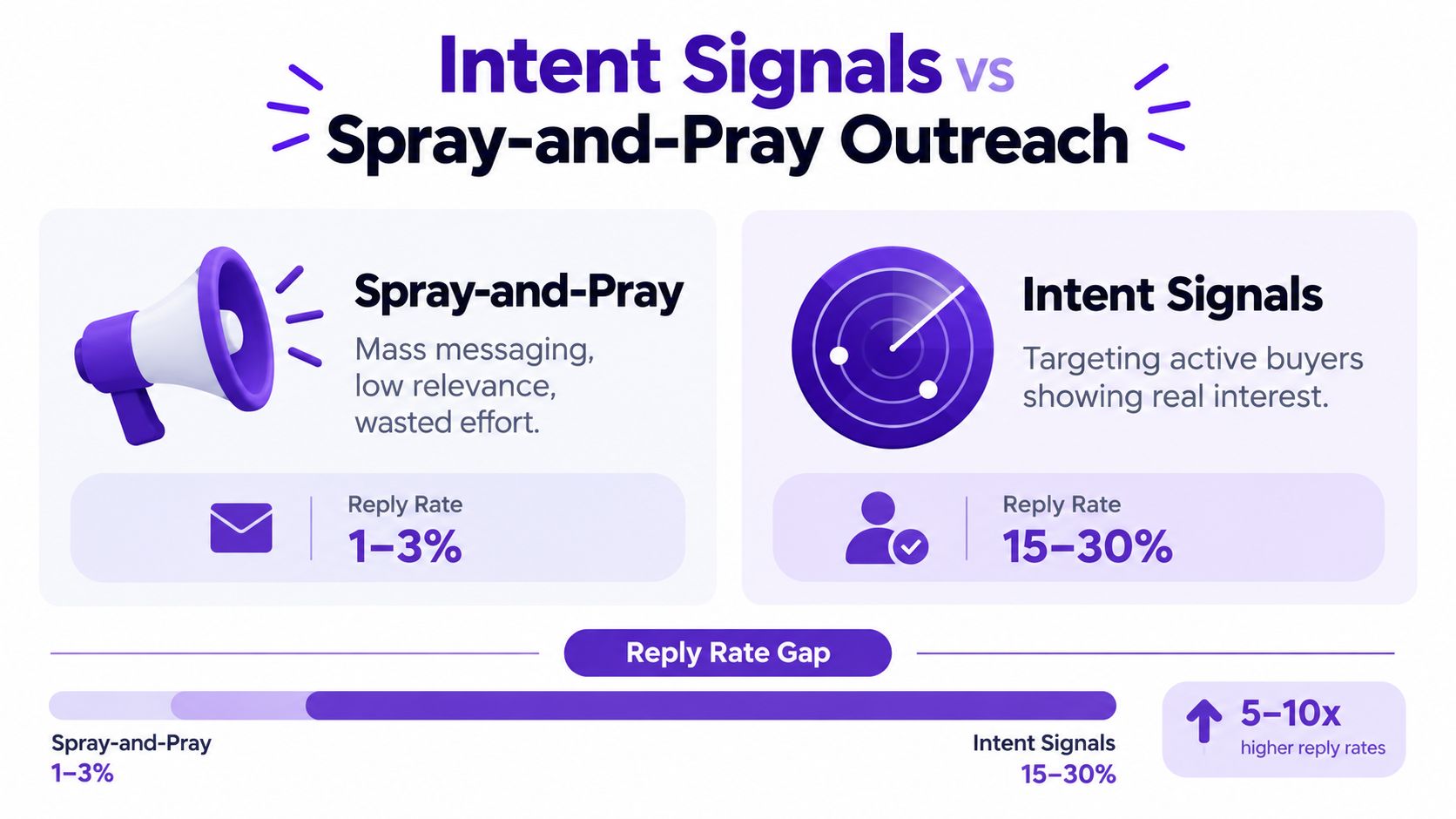
The difference is simple. Spray-and-pray asks, “Who can we message?” Intent-led prospecting asks, “Who is showing a problem we can help solve?”
A broad list might contain every VP of Sales in a market. A signal-based list contains the VP who just discussed forecast accuracy, interacted with a competitor's post, or announced a sales-operations initiative. The second list is smaller, but the reason for contact is much stronger.
Traditional throughput is limited too. Recent 2026 guidance notes that a single LinkedIn account sending 100 connection requests per week can produce about 400 to 450 invites per month, which puts a natural ceiling on manual volume. (LinkedIn lead-generation guide for 2026) More volume doesn't solve that ceiling if the underlying targeting is weak.
Spray-and-pray | Intent signals |
|---|---|
Starts with a static list | Starts with live activity |
Uses one message for many people | Uses context from the trigger |
Optimizes for sent requests | Optimizes for accepted conversations |
Interrupts cold prospects | Responds to visible interest |
Measures activity | Measures progression toward meetings |
The benchmark evidence points in the same direction. A report covering 96,051 LinkedIn outreach campaigns found that the median campaign gets about one accepted connection for every five requests and about one reply for every five conversations started. Acceptance and reply rates therefore matter more than the size of the sent queue. (HeyReach's 2026 outreach benchmark report)
For a practical framework for distinguishing research behavior from real buying activity, see how buying signals work in sales. The principle is worth keeping: act quickly when the signal is fresh, but don't confuse a casual like with a request for a sales call.
Building Your Intent-Based Workflow with RoverLead AI
A workable system starts with a clear ICP, not a tool. Define the roles, account types, problems, competitors, and topics that matter. Then decide which LinkedIn behaviors justify research, which justify an approved message, and which should be monitored.
RoverLead AI is one option for this workflow. Its Signal Agents monitor LinkedIn activity from creators, competitors, and niche topics, then surface potential buyers with the activity that triggered the lead and a contextual opener. The seller reviews and approves outreach rather than letting an unattended sequence fire at strangers.
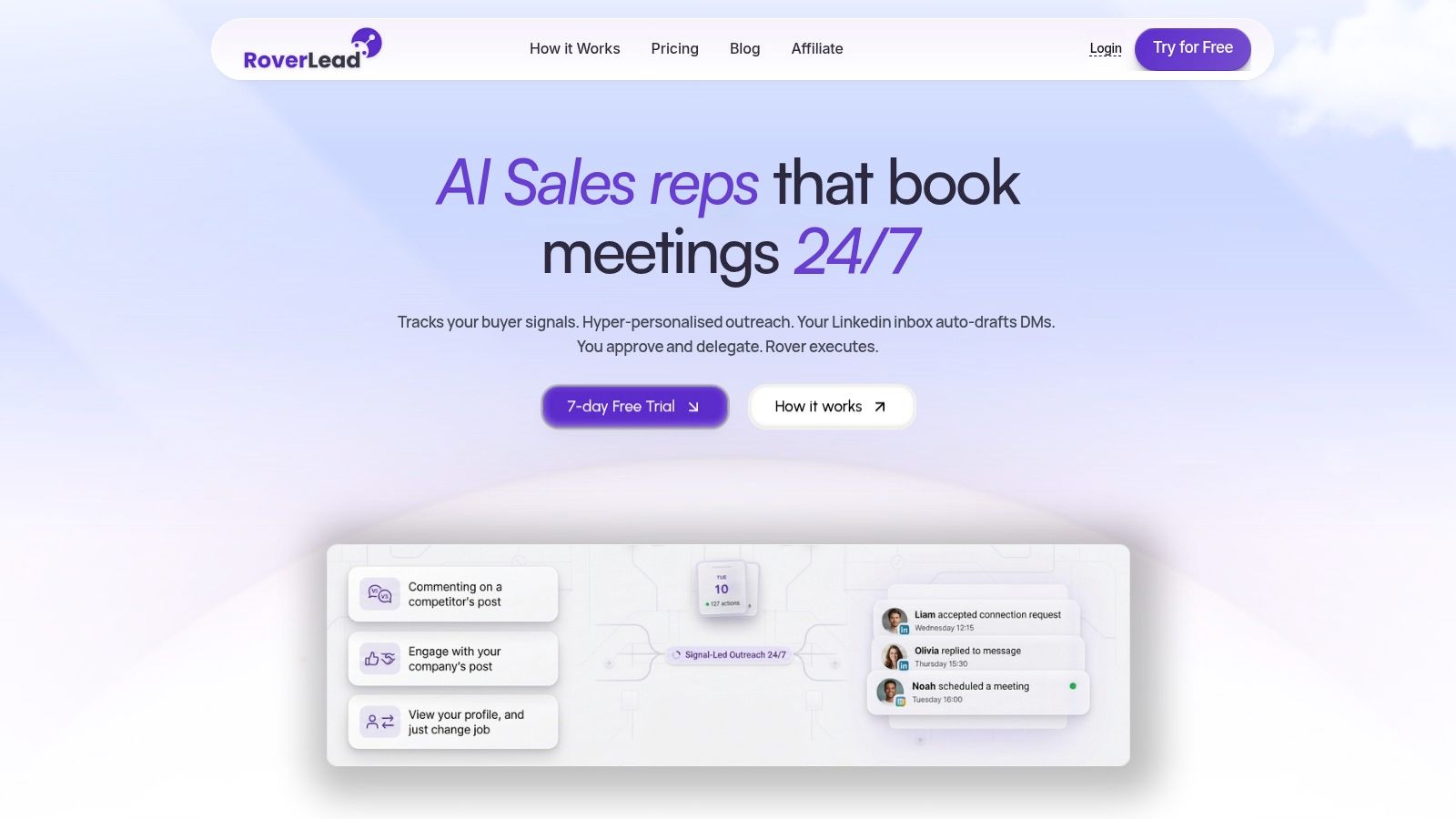
A practical setup looks like this:
Define the buying environment. Add ICP keywords, competitor names, relevant experts, and the topics your buyers discuss.
Choose meaningful triggers. Comments, competitor engagement, pricing or demo discussions, profile changes, and topic posts can all create research prompts.
Review the context. Read the post or comment before contacting anyone. If you can't explain the trigger in one sentence, don't message yet.
Approve a useful opener. Mention the issue or discussion, not the software category you want to sell.
Manage the follow-up. Pin, tag, nurture, and schedule next actions in the lead inbox so interested prospects don't disappear into an unmonitored queue.
The lead inbox can function as a lightweight CRM, with follow-up, tagging, auto-drafts, and auto-replies available for conversations that need a response. The important control is human approval. Automation should reduce repetitive research and drafting, not remove judgment.
Teams comparing prospecting software can also review prospect research tools for sales and assess whether each platform supports live signals, CRM handoff, approval controls, and compliant outreach.
Here's the operating model in visual form:
A signal-led workflow keeps campaigns living instead of turning Sales Navigator into a frozen list. It also creates a useful feedback loop: the messages you approve reveal which triggers and angles deserve more attention.
Measuring What Matters - KPIs and Benchmarks
A high lead count can hide a weak pipeline. If contacts do not progress from acceptance to conversation and opportunity, the campaign is collecting records, not creating sales value. Measure each handoff and inspect where intent disappears.
Track acceptance rate, reply rate, qualified conversations, meetings booked, opportunities created, and revenue influenced. Acceptance tests whether targeting and profile positioning fit. Replies test message relevance. Meetings test commercial interest. Opportunities show whether sales accepts the qualification. Revenue influenced tests whether LinkedIn contributes beyond activity.
RoverLead AI can connect these stages to the signals that preceded them, including engagement and other buying behavior. That gives teams a basis for checking whether personalized outreach reached prospects at a useful moment, rather than rewarding message volume alone.
LinkedIn Lead Gen Forms suit low-friction capture. A 2026 benchmark summary reported conversion of about 13% for LinkedIn Lead Gen Forms versus 2.35% for external landing pages. Native forms prefill profile details, reducing the steps between a prospect's interest and submission. (LinkedIn ads benchmark data for 2026)
Sopro cites 80% of leads never convert, a warning that a form fill is not pipeline. (Sopro's LinkedIn lead-generation statistics)
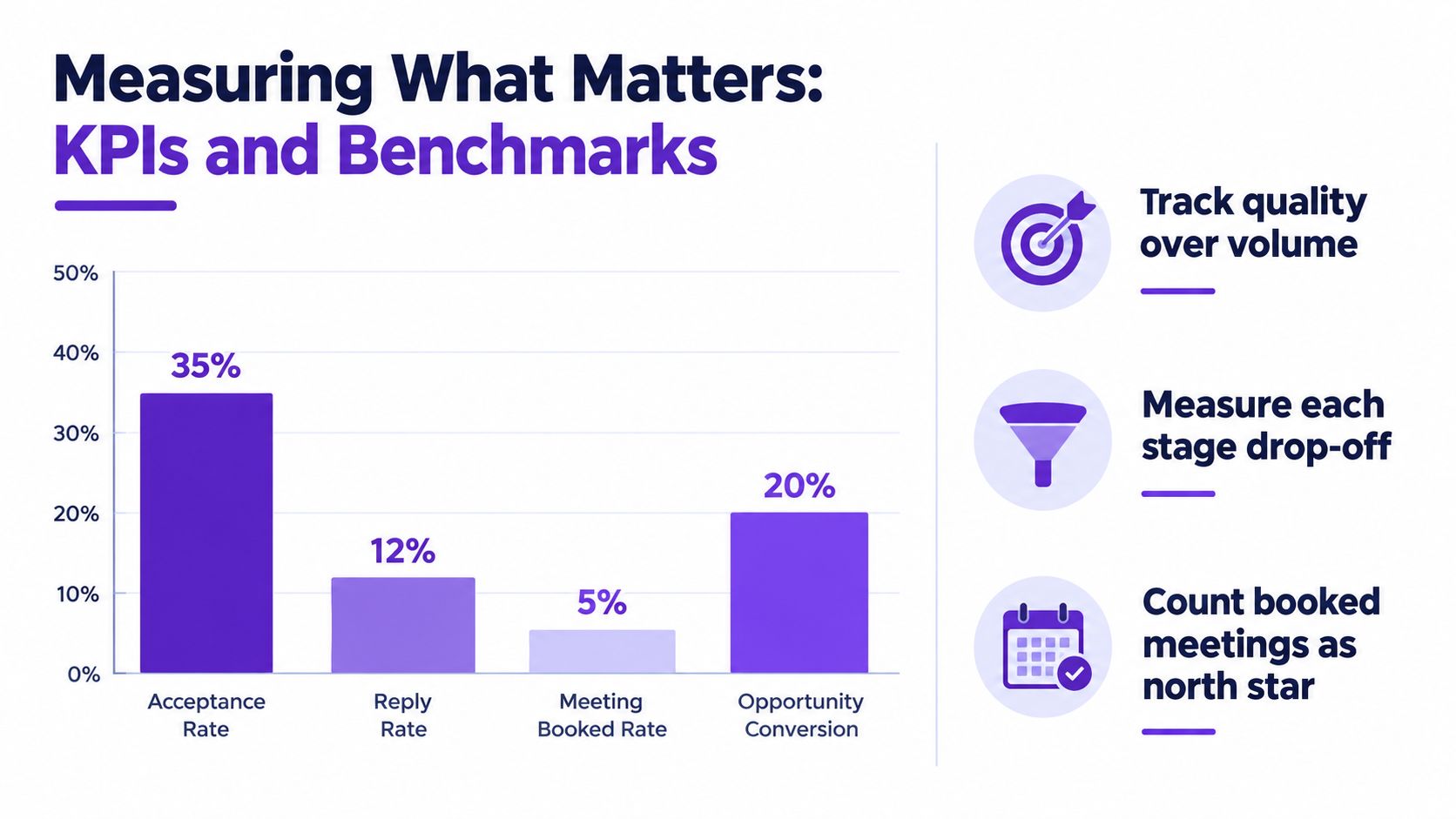
Use a simple diagnostic table:
Metric | What it tells you | If it's weak |
|---|---|---|
Acceptance | Whether targeting and profile positioning feel relevant | Rework the ICP and opening context |
Reply | Whether the message earns a response | Remove the pitch and improve specificity |
Meeting booked | Whether replies contain real business interest | Qualify the problem and next step |
Opportunity | Whether sales accepts the handoff | Tighten qualification and CRM follow-up |
For a broader measurement framework, review lead-generation metrics that connect activity to pipeline. The practical north star is the number of relevant conversations that progress without damaging trust or violating platform expectations.
Scaling Lead Generation with Automation and Tools
A growing sales team does not need a larger list. It needs faster access to relevant buying signals, with enough context to decide whether outreach is warranted. Scaling means increasing signal coverage while preserving approval, personalization, and follow-up quality.
Native lead capture reduces friction when the offer gives a prospect a clear reason to act. Use it for a focused asset, event, consultation, or similar exchange. The form can shorten the path from interest to submission, but it cannot compensate for weak targeting or an offer with little practical value.
Paid campaigns and outbound workflows serve different jobs:
Use Lead Gen Forms when the audience is ready to exchange contact details for something useful.
Use signal-led outbound when a prospect's behavior creates a timely reason for a one-to-one conversation.
Use CRM automation to route responses, retain the original signal, and prompt follow-up before context disappears.
Keep human review for message approval, qualification, and sensitive accounts.
The stack should show why a prospect entered the workflow, what they engaged with, and which action comes next. A dashboard that records clicks without preserving that context adds administration, not sales capacity.
RoverLead AI can monitor engagement and automate personalized outreach when a prospect shows enough interest to justify contact. The case for LinkedIn lead-generation automation is strongest when software handles monitoring and administration while sellers control the relationship, wording, and timing. More connections are not the goal. More relevant opportunities are.
Putting It All Together - Your Action Plan
Audit the last batch of outreach. Mark each prospect by the reason they were contacted, not just by title or company. If most records have no clear trigger, your team is working from a list rather than from intent.
Then build a focused workflow:
Define the ICP and the problems worth monitoring.
Select buying signals that justify research.
Create message openings around the signal, not the product pitch.
Approve outreach and record the trigger in the CRM.
Track acceptance, replies, meetings, opportunities, and follow-up speed.
Remove signals that create noise and strengthen the ones that produce useful conversations.
Frequently asked questions
What is LinkedIn lead generation?
It's the process of finding relevant prospects on LinkedIn, engaging them with useful context, and converting qualified interest into a sales conversation or meeting.
Is LinkedIn lead generation only cold outreach?
No. It can include organic content, comments, events, paid campaigns, Lead Gen Forms, and direct messages. The strongest programs combine these activities around buyer intent.
What makes a LinkedIn lead qualified?
A qualified lead matches your ICP and shows a credible business problem, relevant role, account fit, or buying signal. A job title alone isn't enough.
Should I send a note with every connection request?
Not automatically. A note helps when it adds genuine context. A generic pitch can add friction and make the request feel transactional.
What should the first LinkedIn message say?
Start with the event or problem that made the prospect relevant. Ask a focused question or share a useful observation instead of opening with a product catalogue.
Are LinkedIn Lead Gen Forms worth using?
They can be, especially when your offer is clear and the form stays low friction. Connect submissions to your CRM and follow up promptly, or the convenience benefits the platform more than your sales team.
How quickly should sales follow up?
As soon as your process can support a thoughtful response. Speed matters, but a fast irrelevant message is still irrelevant. Preserve the signal and respond to what the prospect did.
What should I automate?
Automate monitoring, lead organization, reminders, CRM updates, and draft preparation. Keep targeting decisions, message approval, qualification, and relationship management under human control.
How do I avoid spray-and-pray outreach?
Require a reason for contact before a message can be sent. The reason might be a relevant post, competitor interaction, role change, event activity, or a problem the prospect has publicly discussed.
Which LinkedIn KPI matters most?
Booked meetings and qualified opportunities matter more than raw lead volume. Use acceptance and reply rates to diagnose the stages that prevent those outcomes.
RoverLead AI helps teams monitor LinkedIn buying signals, surface ICP-matched prospects, and prepare personalized outreach for approval instead of blasting strangers. Visit RoverLead AI to turn intent-led prospecting into a repeatable workflow for booking more relevant meetings.