Social Media Sales Automation: The 2026 Playbook
You open LinkedIn before the first sales stand-up and find a familiar mess. A stack of cold connection requests, a follow-up queue full of people who never replied, and a sequence that sounds increasingly desperate after every automated touch. The activity looks impressive in a dashboard. The pipeline doesn't.
Social media sales automation has a better job than sending more messages. It should detect public evidence that a buyer may be researching a problem, help a rep interpret that evidence, and make a relevant response easier to approve. The winning system isn't the one with the biggest send volume. It's the one that finds the right signal before a competitor does.
Table of Contents
The SDR Morning That Proves Automation Has Changed
At 7:00 a.m., the old workflow starts with coffee and a list. The SDR sends cold connection requests in batches, often with the same generic note attached. Then comes the follow-up queue, a graveyard of unanswered messages that asks for more persistence when the core problem is missing context.
The rep can't tell whether a prospect ignored the message because the timing was wrong, the offer was irrelevant, or the person never saw it. So the system recommends another touch. More activity, less judgment. It's a treadmill wearing a sales dashboard.
The signal-based morning feels different. The rep opens an intent queue and sees a small set of people with visible reasons to pay attention: prospects who commented on a competitor's post, a contact whose new job title places them inside a target account, and buyers who engaged with a relevant case study. Each record carries context rather than just a name and a button.
The queue replaces the spreadsheet
Instead of pushing through dozens of cold requests, the SDR triages the queue. They remove weak fits, check the original post or conversation, and write a reply that reflects the trigger. A prospect who commented on pricing doesn't receive a generic pitch about transformation. They receive a useful answer to the concern they already raised.
The rep sends a few thoughtful replies instead of dozens of interchangeable ones. One conversation develops into a meeting before the morning is over, not because the automation found a magical phrase, but because it connected timing, relevance, and human approval.
That shift reflects a broader buying environment. A 2026 industry summary reports that 91% of B2B companies use social selling, up from 78% in 2021, while 85% of B2B decision-makers are active on LinkedIn and 95% say social media influences vendor selection. The social selling statistics summary also reports that 15% of B2B buyers make a purchase after interacting with a salesperson on social media, with social selling accounting for about 30% of the buyer journey.
The practical lesson is simple: automate signal detection, approval, inbox triage, and channel coordination. Don't automate judgment out of the process.
What Social Media Sales Automation Actually Means
Social media sales automation is software that monitors public buying signals across LinkedIn and related networks, qualifies or ranks the people behind those signals, routes them to the right rep, and supports approved outreach actions.
That definition matters because traditional outbound starts with a static list. The rep has a company, a title, and perhaps an account note. They don't necessarily know whether the prospect is researching a problem, evaluating a competitor, hiring for a relevant function, or completely uninterested.
Think intent radar, not cold-call roulette
A cold call asks the seller to interrupt a stranger. An intent radar listens for a prospect already raising a hand in public, then helps the rep respond while the context is still fresh.
The system can capture a job change, a comment on a relevant post, a competitor interaction, or a discussion about pricing. It can then score the event against the ideal customer profile, place the lead in a review queue, draft a contextual opener, and pass the approved activity to the CRM.
The workflow has four connected jobs:
Capture: Monitor public activity and identify meaningful events.
Qualify: Compare the person, account, role, and behavior with the ICP.
Sequence: Suggest a relevant next step across approved channels.
Handoff: Store the trigger and conversation context where sales can use it.
This is broader than scheduling social posts and narrower than handing the entire sales process to an agent. The system should prepare, prioritize, and route. A rep should decide whether the timing, tone, and offer make sense.
Teams that want to understand the listening layer can start with social media listening tools for sales intelligence. The useful question isn't “How can we automate LinkedIn?” It's “Which public behaviors deserve a response, and what should happen when they appear?”
The Four Automation Patterns That Book Meetings
The strongest workflows use four patterns in sequence. Each one removes a specific source of waste, and none of them depends on blasting every reachable account.
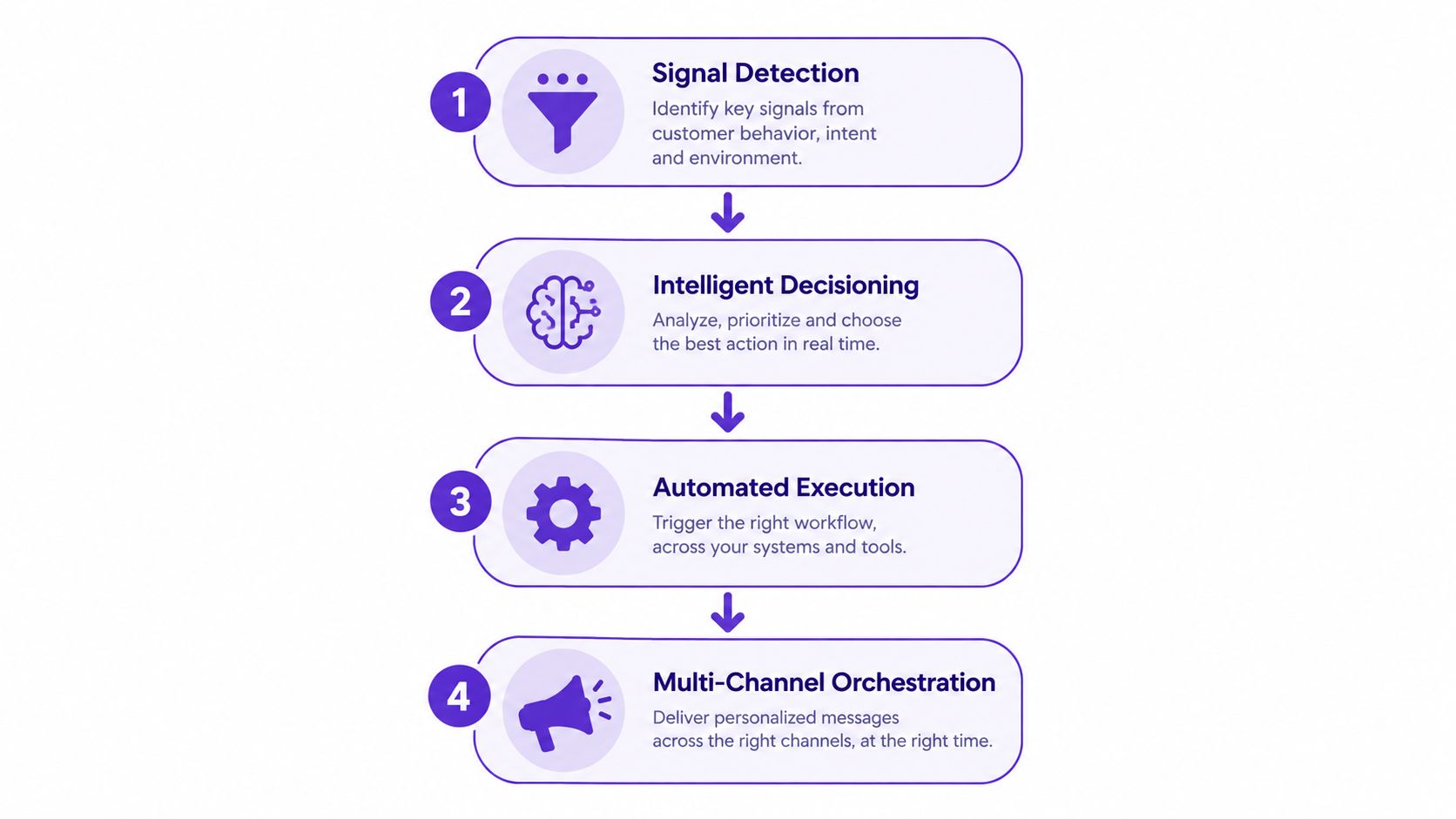
Signal detection
The input is a public behavior, such as a target buyer commenting on a competitor's post. The automation action is to collect the event, attach account and role data, and score it against the ICP. The expected output is a ranked lead with the original context visible to the rep.
A useful score should distinguish a relevant comment from a passive profile view. It should also avoid treating every competitor interaction as purchase intent. Context wins. A comment about implementation pain is more actionable than a generic reaction.
Approval workflows
The input is a flagged prospect and a proposed opener. The action is a human review gate where a rep or manager checks fit, relevance, tone, and policy. The output is either an approved message, an edited message, or a rejected lead.
This step protects the brand and keeps automation from turning a sensitive conversation into a clumsy pitch. LinkedIn's Social Selling Index helped formalize social selling as a measurable workflow, scoring users from 0 to 100 across four equally weighted pillars, each worth 25 points: professional brand, finding the right people, engaging with insights, and building relationships. The overview of LinkedIn social selling benchmarks connects that measurable discipline with sellers creating 45% more sales opportunities and being 51% more likely to hit quota.
Lead inbox triage
The input is engagement from an outbound message, including a reply, question, objection, or request for information. The automation action is to classify the response and route it to the correct rep quickly. The expected output is a prioritized inbox with a suggested next action.
A positive reply shouldn't sit beside an unsubscribe or a vague “not now” as if all three deserve the same treatment. Triage can separate buying questions from objections, route an account to an AE, and draft a response without pretending the draft is ready to send.
Multi-channel orchestration
The input is an approved LinkedIn touch tied to a clear signal. The action is to pair it with a relevant email task and a call task, each carrying the same context. The expected output is a coordinated sequence rather than three disconnected interruptions.
The benchmark logic supports this order. After a connection is accepted, follow-up messages average a 10.4% reply rate, compared with about 3.0% for connection-request notes, while overall connection acceptance is around 28.5%. The LinkedIn outreach benchmark shows why the thread after acceptance matters more than raw sending volume.
Traditional Outreach vs Signal-Based Automation
Traditional outreach isn't useless. It becomes expensive when reps use it as the default response to every account, regardless of timing or behavior.
Metric | Traditional Outreach | Signal-Based Automation |
|---|---|---|
Reply rate | Depends heavily on list quality and generic timing | Built around a visible trigger and contextual follow-up |
Compliance risk | Increases when teams push volume without review | Reduced through approval gates, limits, and audit trails |
Rep time cost | Research and personalization happen manually for every prospect | The queue prioritizes research and reserves rep time for judgment |
Pipeline quality | Often optimizes for contacts, sends, or MQL volume | Optimizes for qualified conversations and meeting-set rate |
Follow-up logic | Static sequences continue whether context changes or not | Signals can change routing, timing, and next action |
The public benchmarks make the difference clear. Warm, signal-based LinkedIn outreach has been reported at 15% to 45% reply rates, while cold outreach without context typically stays below 1%. The 2026 LinkedIn reply-rate analysis also notes that academic evidence supports a positive, moderate effect from social selling technology, with smaller impact than traditional salesforce automation and CRM systems.
That last point is important. Social media sales automation is a precision layer, not a replacement for lead management. A team can find a strong signal and still lose the opportunity through poor qualification, slow follow-up, or weak discovery.
The right comparison isn't effort versus laziness. It's unfiltered activity versus engineered prioritization.
Traditional outreach still earns a place in broad awareness campaigns and new-market testing, where the team needs to learn which messages attract attention. But once a market has enough behavioral data, continuing to treat every prospect identically is a process failure. Buying signals in sales explains the operating principle: sales should respond to evidence of interest, not merely to the existence of a contact record.
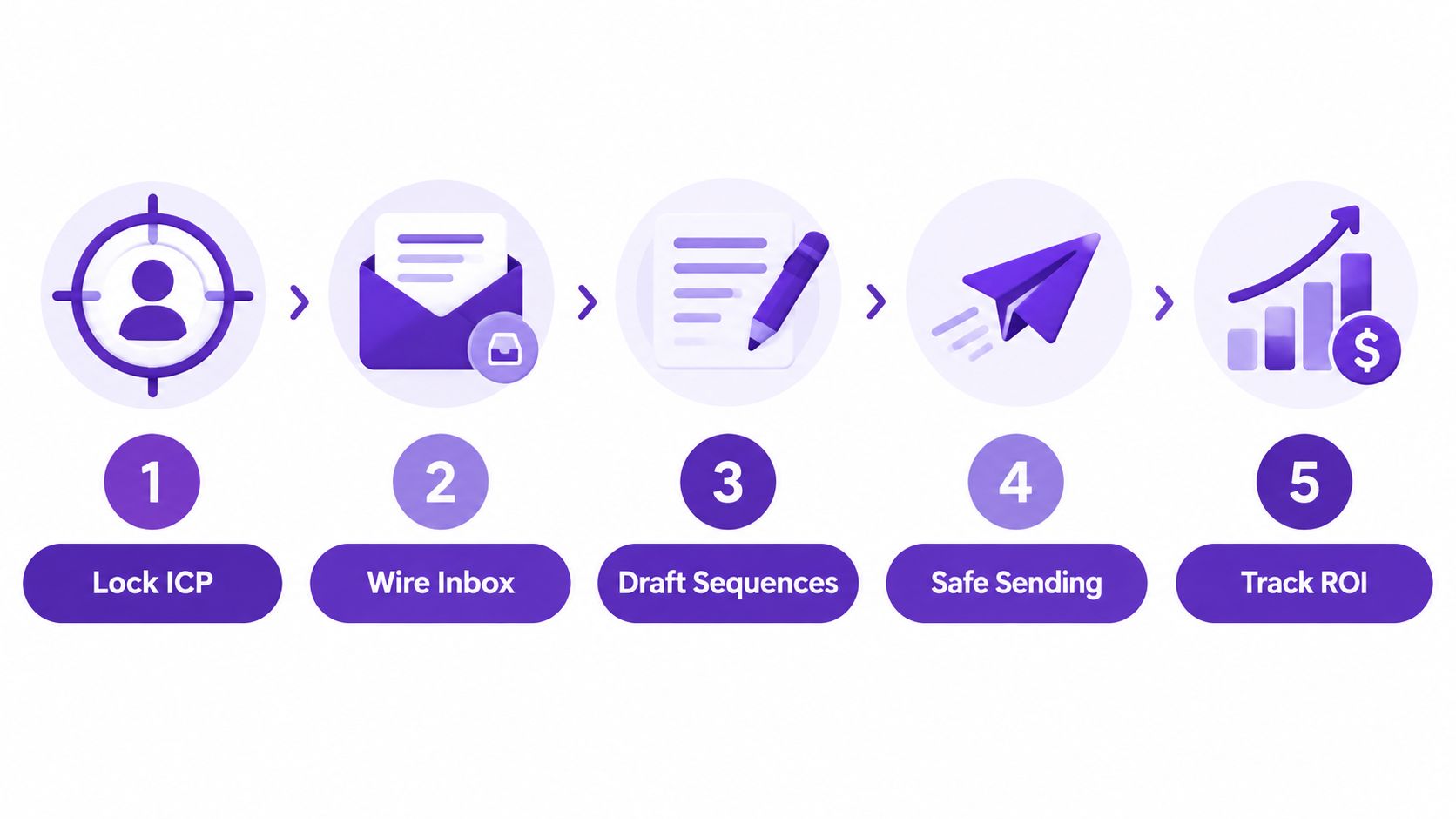
Your Five-Step Implementation Playbook
A signal-first system works when the operating rules are clear before the first campaign runs.
Lock the ICP
Define the accounts, roles, industries, business problems, and exclusion criteria that belong in the queue. Exclude students, irrelevant functions, competitors, consultants outside the buying committee, and roles that create noise.
Write the ICP as routing logic, not a paragraph in a strategy document. If a signal can't be evaluated against fit, it shouldn't enter the priority queue.
Wire the monitoring layer
Connect monitoring to public triggers such as LinkedIn job changes, post engagement, hiring activity, funding announcements, and competitor mentions. Tools such as Omev, Apollo, and Shield can fit different parts of the workflow, but the system should expose the original event and not just deliver an unexplained score.
Lead generation automation is most useful when it connects research, qualification, and follow-up instead of creating another isolated list.
Create a daily review window
Reserve a fixed morning block for queue review. The rep checks the source activity, confirms the account fit, edits the first line, and approves only messages that make sense in the visible context.
Don't allow the queue to become an unattended automation landfill. If the team can't review the leads, reduce the monitored topics or tighten the ICP.
Set safe sending rules
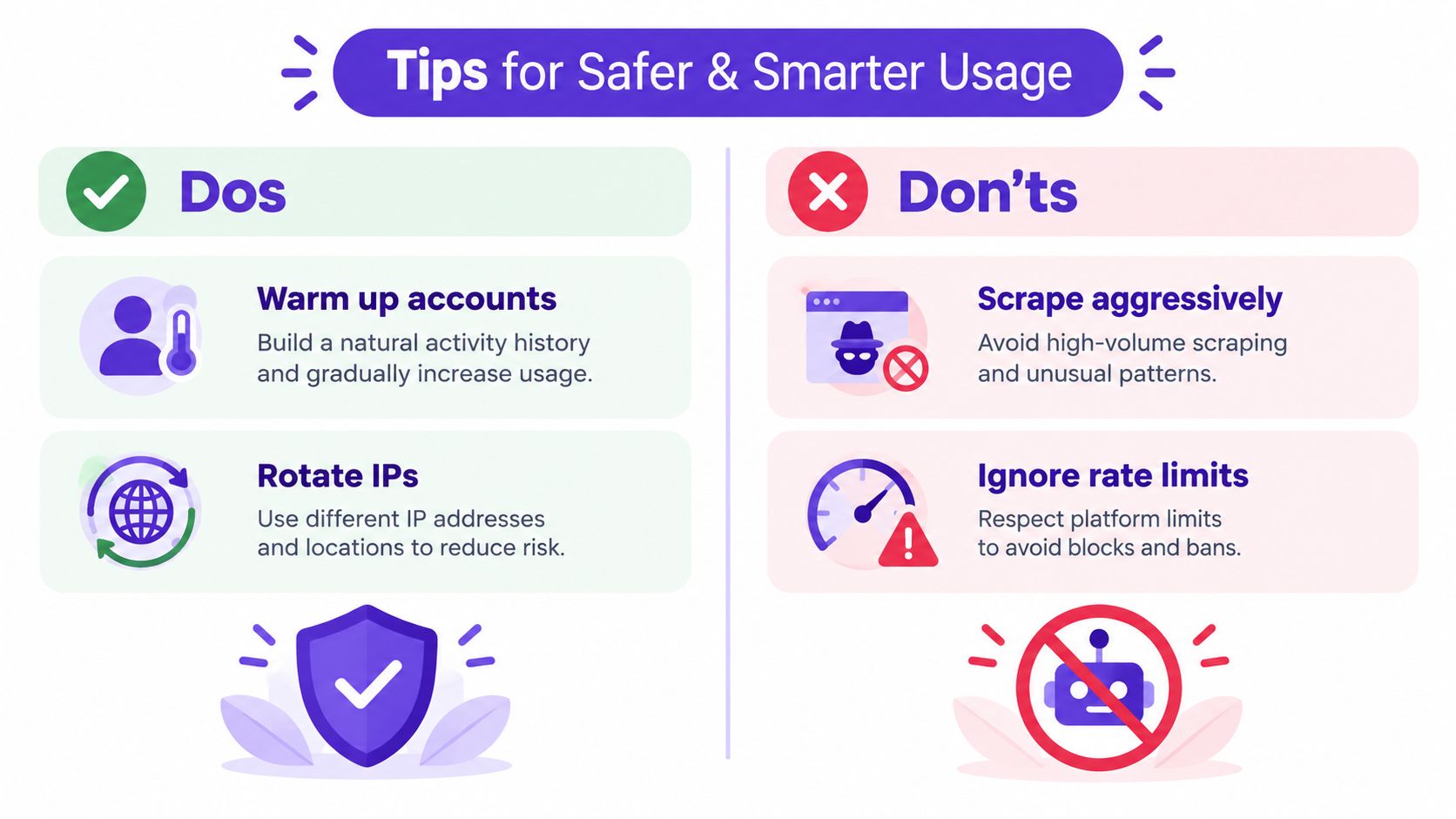
Create an approval cadence, a daily ceiling, and a hard stop when LinkedIn flags unusual activity. New accounts should warm up gradually. Messages should remain varied because the variation comes from genuine context, not from spinning synonyms through a template.
One operational alert is enough: notify the sales channel when the unreviewed queue exceeds its agreed threshold. That alert prevents the system from accumulating leads that nobody can responsibly handle.
Complete the CRM handoff
Every approved lead should land in Salesforce or HubSpot with the signal that triggered outreach, the original post or activity, the approved message, and the owner. The AE should be able to reference the buyer's stated context on the first call without asking the SDR to reconstruct it from browser tabs.
Use a simple rollout rhythm. Configure on the first day, test with a small internal group next, review false positives after the first live queue, then expand only when reps trust the context. The system earns adoption when it makes conversations easier, not when it produces the largest activity report.
Metrics and ROI That Prove the System Works
Leadership doesn't need another report showing sends, profile views, or queued tasks. Those numbers describe motion. They don't prove that the motion produces pipeline.
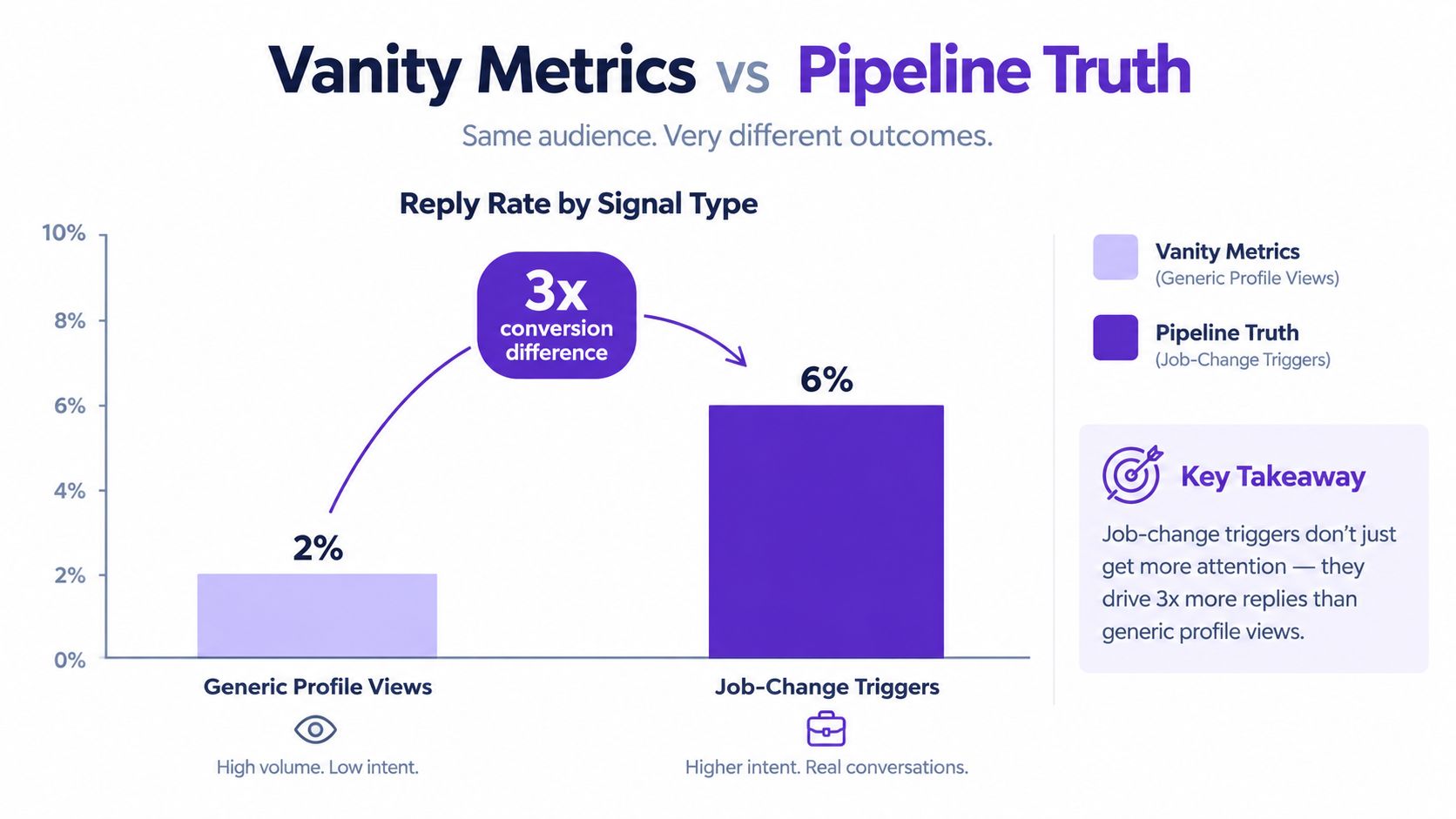
Start with reply rate by signal type. Separate job changes, meaningful post comments, competitor interactions, content engagement, and generic profile views. Don't blend them into one attractive average. A weak signal can make a good workflow look mediocre, while a strong signal can hide poor execution elsewhere.
The visual below makes the required distinction between vanity activity and pipeline truth.
Measure the path to revenue
Track time from first approved touch to booked meeting, cost per qualified meeting, SQL-to-opportunity conversion, and quota attainment by rep. Then compare cohorts over the same measurement window, separating reps who adopted signal-based automation from those who continued manual outreach.
The broader market context supports this focus. HubSpot's sales strategy research reports that 42% of sales professionals say social media delivers their highest cold-outreach response rate, 35% call it their top source of high-quality leads, and 74% say AI makes buyer research easier. HubSpot's sales strategy report points toward a response-quality problem, not a sending-volume problem.
Put three numbers on the leadership slide: meetings per SDR, SQL-to-opportunity conversion, and pipeline coverage. Add the cost of the system and the rep time recovered. If those measures don't improve, tune the signal definition or the offer before increasing volume.
Compliance Dos and Don'ts for LinkedIn Automation
Compliance-safe automation scales further because the account survives long enough to build trust. Reckless automation may create a short burst of activity, but it also creates a record of behavior that can damage the account, the brand, and the rep's credibility.
The non-negotiable dos
Respect platform limits: Stay inside LinkedIn's connection and message ceilings, and stop activity when the platform signals risk.
Warm up accounts: Increase activity gradually rather than launching a full campaign from a cold account.
Keep approval gates: Require human review before personalized outreach ships.
Log the context: Store the signal, message, owner, and outcome in the CRM.
Honor opt-outs quickly: Remove people from active outreach as soon as they ask, then verify the suppression record.
The shortcuts to reject
Don't scrape aggressively: Use approved data sources and avoid collecting profiles outside permitted workflows.
Don't run around the clock: Real people have working patterns. Continuous sending looks like a machine because it is one.
Don't reuse one script everywhere: A templated opener across hundreds of accounts is a brand liability.
Don't ignore connection decay: Low acceptance and weak engagement are signals to revise targeting.
Don't treat InMails as broadcast inventory: A paid message still needs a reason to exist.
The LinkedIn outreach automation guide is a useful reference for building safer workflows around review and relevance. Assign one rep each week to audit queued messages for tone, signal accuracy, and account fit. Compliance drift starts in the queue, long before someone notices the dashboard.
Frequently Asked Questions About Social Media Sales Automation
What is social media sales automation?
It's the use of software to detect public buying activity, qualify prospects, support approved outreach, triage replies, and pass conversation context to sales systems. It isn't just a social scheduler or a bulk-DM tool.
How is it different from ordinary LinkedIn automation?
Ordinary LinkedIn automation often focuses on sending actions at scale. Signal-based automation starts with observed buyer behavior and requires the workflow to explain why a prospect belongs in the queue.
Which signals deserve priority?
Prioritize behaviors tied to a business problem or buying process, such as relevant post comments, job changes, competitor discussions, pricing questions, and content engagement from a well-matched account. Treat passive views as weaker evidence.
Should every signal trigger a message?
No. A signal should trigger review, not an automatic pitch. The rep still needs to verify role, account fit, timing, and whether the proposed message contributes anything useful.
Can social media automation replace SDRs?
It shouldn't. Automation can reduce research and administrative work, but SDRs still need to interpret nuance, handle objections, personalize the offer, and run human conversations.
Is LinkedIn outreach compliant when automated?
Compliance depends on the workflow, platform rules, account behavior, data practices, and human controls. Use conservative limits, approval gates, accurate records, and immediate suppression for opt-outs.
Should LinkedIn be used alone?
Use LinkedIn when the signal appears there, then coordinate email or call tasks when those channels add value. Multi-channel activity should feel like one conversation, not several teams competing for attention.
What should a rep do with a positive reply?
Respond quickly, answer the question directly, and preserve the context that created the reply. Don't jump to a calendar link before understanding what the prospect is trying to solve.
Which metrics matter most?
Focus on qualified meetings, reply quality, time to meeting, SQL-to-opportunity conversion, pipeline coverage, and quota attainment. Sends and profile views are diagnostic metrics, not proof of revenue impact.
When should a team adopt this approach?
Adopt it when reps spend too much time researching static lists and too little time handling relevant conversations. Start with one ICP, a small set of signals, and a review process the team can maintain.
The One Habit That Makes the Whole System Click
The separating habit is signal review, not sending volume. A rep should inspect the queue every day, score each event against ICP fit, remove low-intent noise, rewrite the opening line around the actual trigger, and approve only the conversations they would be comfortable owning.
That discipline compounds. Reps stop spending their best hours on dead prospects. Marketers learn which buyer language creates useful engagement. Managers spend less time cleaning up irrelevant messages and more time coaching conversations that have a reason to exist.
Automation is a triage layer, not a substitute for judgment.
The team should review reply quality by signal, not just the blended rate. It should watch time-to-meeting, qualified meeting volume, conversion into opportunities, and pipeline coverage. When a signal produces activity without meaningful conversations, remove it from the queue. When a signal repeatedly creates relevant replies, give it better routing and sharper copy.
Buyers are already researching vendors before they speak with sales. LinkedIn reports that 75% of B2B buyers and 84% of C-level or vice-president-level executives use social media in purchasing decisions. The LinkedIn buyer research summary supports a practical conclusion: social channels are research surfaces, and sales teams should respond to useful evidence instead of interrupting at random.
The inbox is the product. The signal is the fuel. The daily review is the engine.
RoverLead AI offers a LinkedIn AI SDR that finds high-intent activity, drafts personalized openers and replies, and keeps every outreach action in an approval queue before it runs. Visit RoverLead AI to turn public buying signals into a cleaner, more deliberate meeting pipeline.