Top 10 LinkedIn Sales Navigator Alternative Options

Is your team stuck manually pulling static lists and praying for replies? LinkedIn Sales Navigator is powerful, but it still leaves you chasing old signals and sending generic messages to people who may have no reason to care. The better question isn't, “What has the same filters?” It's, “What turns buying intent into a useful sales conversation?”
LinkedIn Sales Navigator has broad adoption across major markets, with one industry dataset reporting usage by 31,161 companies. The same dataset places its market share at about 7.9% in the Marketing & Sales Intelligence segment, so this isn't a forgotten tool waiting politely to be replaced. It has scale, habit, and a seat at the table.
That also explains why a credible LinkedIn Sales Navigator alternative must do more than copy lead search. Some platforms add verified contact data and sequencing. Others focus on intent, enrichment, CRM workflows, or LinkedIn activity itself. The best choice depends on whether you need a bigger database, a cleaner workflow, stronger regional coverage, or a way to stop interrupting strangers.
Here are the ten options worth serious consideration.
Table of Contents
1. RoverLead AI
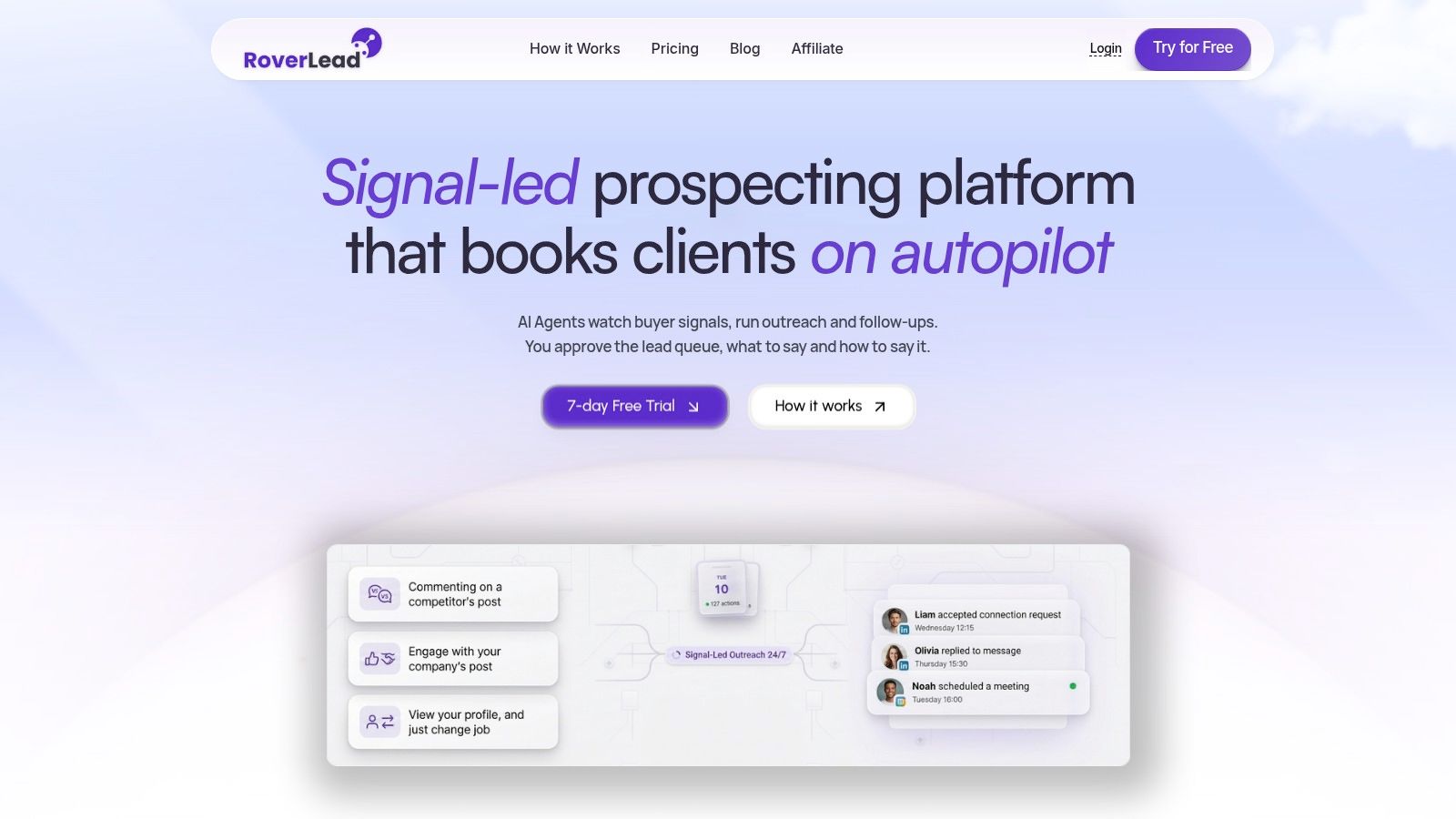
RoverLead AI is the strongest choice if your real problem isn't finding people, but knowing who is worth contacting now. It works as a signal-led LinkedIn AI SDR, monitoring real LinkedIn activity and surfacing prospects who appear to be in-market. Instead of handing you another static list, it builds a living feed from comments, content interactions, competitor discussions, niche threads, and pricing or demo conversations.
After a short ICP setup covering keywords, competitors, and niche experts, its Signal Agents monitor 10+ buying signals. When the system detects a relevant signal, you see the exact post context and a personalized opener. Nothing sends until you review and approve it, which keeps the workflow controlled rather than turning your account into an enthusiastic robot with questionable social skills.
Why RoverLead feels different
RoverLead's value sits in the gap between discovery and execution. You can pin, tag, follow up, auto-draft replies, and enable auto-replies from its lightweight inbox and CRM layer. The system learns from your approvals, so your campaigns become more aligned with the prospects and messages you want.
The product site cites 2–5x reply rates, 30–50% more meetings booked, and a 60% reduction in research time. Those are company-reported metrics, so treat them as performance claims to validate during your trial, not as guaranteed outcomes.
Practical rule: If your ICP rarely posts, comments, or discusses buying problems on LinkedIn, no signal-led tool can manufacture intent from thin air.
RoverLead starts with a Starter plan at $149 per user per month, including two Signal Agents, and a Growth plan at $449 per user per month, with up to ten agents. Enterprise is custom, and a 7-day free trial is available. The best background reading is this guide to what intent data means in sales.
Pros
Signal-led targeting: Finds prospects through real LinkedIn behavior instead of relying only on firmographics or scraped lists.
Approval-first outreach: Builds openers from the exact signal and waits for your approval before sending.
Living pipeline: Combines prospect discovery, follow-up, tagging, and inbox management.
LinkedIn-compliant design: Encourages relevant, human-reviewed conversations instead of indiscriminate volume.
Cons
Activity-dependent coverage: Quiet audiences may produce fewer useful signals.
Per-user economics: Larger teams should track return carefully before rolling it out broadly.
2. Apollo.io
Apollo.io is the practical pick for teams that want prospecting, contact data, and outbound engagement in one subscription. It combines a large B2B database with search filters, intent features, verified emails and phone numbers, sequencing, tasks, a dialer, and CRM-lite functionality.
That combination makes Apollo a natural alternative when Sales Navigator is only one part of your workflow. You can search for accounts and contacts, enrich records, and move prospects into email or calling sequences without stitching together several products. Apollo also connects with common systems such as Salesforce and HubSpot, which helps smaller teams avoid building a complicated stack before they've earned the right to complain about it.
Independent comparison coverage reports Apollo's published free plan, paid entry pricing around $49–$59 per user per month, a database of 275M+ contacts, and G2 ratings near 4.8/5. Those figures come from the comparison source, and pricing, database scope, and ratings can change.
Best use case
Choose Apollo when your sales motion depends on reachable contact details and multichannel follow-up, not LinkedIn research alone. Its 60+ prospecting filters, technographics, intent signals, sequencer, dialer, and exportable credit model cover a lot of ground.
The trade-off is complexity. Credit rules and pricing changes can frustrate users, data quality varies by segment, and phone coverage isn't universal. Apollo is powerful, but it rewards teams willing to learn the machine rather than clicking around until something interesting happens.
Use this guide to LinkedIn sales prospecting if you need a more activity-led approach.
3. ZoomInfo SalesOS
ZoomInfo SalesOS is built for organizations that need a go-to-market data system of record, not a lightweight prospecting tool. It brings together contact and company data, buyer intent, org charts, company news, technographics, and native products for sales, marketing, operations, and talent teams.
The platform makes sense when data governance matters as much as lead volume. Enterprise administrators get tools such as SSO, role management, compliance controls, and broader oversight across a complex revenue operation. Sales teams can research accounts, marketing teams can support account-based programs, and operations teams can manage how information flows into the rest of the stack.
Where ZoomInfo earns its place
ZoomInfo is particularly strong for large, US-focused teams with enough process and budget to use its breadth. Its frequent data refreshes, intent features, scoops, org charts, and modular approach give revenue leaders more control than a simple LinkedIn search interface.
It can also be excessive. Smaller teams may pay for functionality they won't use, while early-stage companies often need a faster path from signal to conversation rather than another administrative layer. Pricing is quote-only, and contracts are typically substantial, so don't buy it because the demo looked like a spaceship. Buy it when governance, coverage, and scale justify the machinery.
Visit ZoomInfo SalesOS
Teams comparing data-heavy platforms should also review how to qualify sales leads.
4. Cognism
Cognism is the clear recommendation for teams selling into Europe and other compliance-sensitive markets, especially when phone outreach matters. Its positioning centers on GDPR-oriented processes, permissioning, documentation, and phone-verified mobile numbers, with particularly strong relevance for EMEA campaigns.
The platform includes contact and company data, intent signals, enrichment, and integrations with CRM and sales engagement systems. Its human-verified data layers are useful when a generic database produces too many dead ends, especially among regional prospects whose information changes quickly or doesn't appear consistently across public sources.
Why EMEA teams choose it
Cognism's advantage isn't just having more records. It's the combination of regional coverage, mobile verification, and a compliance posture that helps teams build a defensible outbound process. That matters when legal review, data processing agreements, and do-not-call considerations are part of the buying decision.
Cognism isn't a self-serve bargain. It has no public list pricing and requires a sales-led contract. Its US dataset may also be less compelling than some competitors for particular segments. If your entire motion targets one domestic market and depends mostly on email, you may not need its regional strengths.
For EMEA outbound, though, Cognism deserves a serious evaluation before choosing a broad database that treats every geography as the same.
5. Lusha
Lusha is the straightforward option for SDRs who need to enrich a LinkedIn profile quickly and get back to selling. Its web app and Chrome extension can reveal email addresses, direct dials, and company details while a rep researches a person or account.
That simplicity is the product's appeal. Lusha doesn't ask a small sales team to become part-time data engineers. Reps can look up an individual contact, spend credits on the information they need, and send the record into a CRM or workflow.
A good fit for individual prospecting
Lusha works best when the rep already knows whom to investigate. It isn't the strongest choice for teams building vast, signal-rich account universes, but it is useful for fast enrichment during live research. Team management, usage reporting, API access, and CRM integrations give managers enough control without burying the user in configuration.
The honest downside is credit consumption. Phone-heavy workflows can burn through credits quickly, and coverage varies by industry and region. A seller working through a carefully selected list may find Lusha efficient, while a high-volume calling team may discover that “simple” gets expensive once every useful field costs something.
Read more about buying signals in sales before deciding whether lookup data is enough for your motion.
6. An AI-assisted contact discovery tool
Seamless.AI targets teams that need AI-assisted contact discovery with enrichment and signal features. The platform helps find email addresses and phone numbers through a prospector, enrichment tools, a Chrome extension, CRM integrations, and an API.
Its job-change and buyer-intent signals add timing to contact research. A recent role change can shift a prospect's priorities and make a previously cold account more relevant. Use this tool for list building with signals attached, then let your team write messaging that fits the situation. It is a prospecting engine, not a substitute for judgment.
What to check before signing
API access across plans suits teams that want to send data into internal systems or combine contact discovery with their own routing rules. That flexibility matters when prospecting feeds several workflows instead of one CRM.
The buying process deserves scrutiny. Pricing is sales-led, and users have raised concerns about credit clarity, plan limits, cancellation terms, and renewals. Ask for the exact credit rules, what happens when credits run out, and which features the contract includes before signing.
The platform can support productive prospecting, but unclear terms can turn an enthusiastic first export into an expensive surprise. Visit Seamless.AI before committing, and get the answers in writing.
7. LeadIQ
LeadIQ is designed around the moment an SDR finds a promising person while browsing LinkedIn or a company website. Its browser extension captures and enriches contact records, tracks sales triggers, adds account news and tags, and syncs information into systems such as Salesforce.
That makes LeadIQ a strong alternative for teams that want to improve manual prospect capture, not replace it with a giant searchable database. Reps can research in their natural workflow, capture the contact, and keep CRM records cleaner without repeatedly copying names, titles, and company details into spreadsheets.
Why the credit model matters
LeadIQ's credit logic is unusually easy to understand. An email uses one credit, while a phone number uses 10 credits, according to the product notes. That distinction gives managers a clearer way to estimate usage across email-first and phone-heavy teams.
LeadIQ also provides sales triggers, account tagging, CRM sync, and a public API for workflow automation. Its weakness is scale. Teams that need broad database searches may find the platform too capture-oriented, and coverage can vary by niche. Choose it when your SDRs already conduct targeted research and need a cleaner bridge from browsing to CRM.
8. RocketReach
RocketReach is a useful supplemental source when your main prospecting platform has gaps. It focuses on finding email addresses, phone numbers, and social handles, with browser extensions, CSV enrichment, integrations such as Zapier and Salesforce, and month-to-month self-serve plans.
The product is easy to understand. Search for a person or company, look up the contact details, and decide whether the record belongs in your outreach workflow. That makes RocketReach more of a data utility than a full sales operating system.
Best as a backup layer
Use RocketReach when you already have a target list and need another route to missing contact information. Its lower entry point than quote-only enterprise vendors can make it practical for solo sellers and smaller teams.
Don't expect the same depth as an enterprise database. Coverage and match quality may trail larger providers, and the dynamic pricing structure can make comparisons awkward. RocketReach earns its place as a backup source, particularly when a valuable prospect is visible but unreachable through your primary data vendor.

9. Clearbit
Clearbit is the right choice for teams whose revenue engine already runs through HubSpot. The platform focuses on real-time company and contact enrichment, firmographics, technographics, form shortening, lead routing, account intelligence, and website visitor de-anonymization.
It isn't primarily a LinkedIn replacement for building huge net-new lists. Clearbit's strength is what happens after someone enters your orbit. The platform can enrich an inbound record, help sales understand the account, and route the lead based on characteristics that a bare form submission won't reveal.
A HubSpot-first decision
Clearbit's deep HubSpot integration makes it attractive for marketing and sales teams that want native enrichment rather than another disconnected dashboard. It supports account-based motions by adding context to known visitors and leads, helping teams decide which records deserve attention.
The free tier was sunset in 2025, and the product is now paid and credit-based. Pricing isn't fully public and may depend on your HubSpot setup and sales requirements. If you need an outbound contact database, choose Apollo, ZoomInfo, or a specialized data provider instead. If your problem is routing and enrichment inside HubSpot, Clearbit is much more relevant.
10. Clay
Clay is the most flexible option for teams willing to build their own signal and enrichment workflows. It can ingest LinkedIn or search results, firmographic lists, CSVs, and CRM records, then run waterfall enrichment across multiple providers. Its Claygent AI agent can perform web research and add custom data points before sending records to a CRM or sales engagement platform.
Clay is not a plug-and-play database. It's closer to a workbench for revenue operations, which is excellent if you want control and less appealing if your definition of onboarding is “log in and find leads.”
Build a living lead feed
The platform can track job changes and other signals, build audiences, and hand contacts to native email or an external sequencer. Waterfall enrichment lets teams use several data sources instead of betting the pipeline on one vendor's coverage.
The trade-off is a learning curve and variable cost. Your total spend depends on which providers and AI steps you chain together, although bring-your-own-API options can improve control. Choose Clay when your team has someone who enjoys workflows, logic, and the occasional spreadsheet that evolves into a small software product.
Top 10 LinkedIn Sales Navigator Alternatives, Comparison
Solution | Core capability | ✨ Unique feature | 👥 Best for | 💰 Pricing / value | ★ Quality |
|---|---|---|---|---|---|
🏆 RoverLead AI | Signal-led LinkedIn AI SDR: curated leads + approval-first outreach | ✨ Monitors 10+ LinkedIn buying signals; personalized openers from post context | 👥 B2B sales leaders, SDR/BDR teams, solo founders, agencies | 💰 $149/mo Starter; $449/mo Growth; Enterprise custom; 7‑day trial | ★★★★★ |
Apollo.io | All-in-one prospect database + outbound sequencer | ✨ 60+ prospecting filters + native sequencer & dialer | 👥 SMBs & mid-market GTM teams wanting integrated data+outreach | 💰 Credit-based verified contacts; good mid-market value | ★★★★ |
ZoomInfo SalesOS | Enterprise B2B data platform & system of record | ✨ Org charts, scoops, broad governance & native apps | 👥 Large US-focused enterprises with data ops needs | 💰 Quote-only; typically high ACV | ★★★★★ |
Cognism | GDPR-first B2B data with EMEA phone verification | ✨ Phone-verified mobiles + strong EMEA coverage | 👥 Teams doing EMEA outbound & compliance-focused buyers | 💰 Sales-led contracts; enterprise pricing | ★★★★ |
Lusha | Fast contact lookup & Chrome extension for quick enrichment | ✨ Instant LinkedIn profile enrichment via extension | 👥 Individual reps, SMB SDRs needing quick contacts | 💰 Credit tiers; transparent, SMB-friendly | ★★★ |
Seamless.AI | AI-assisted contact discovery & enrichment | ✨ Job-change & buyer-intent signals + public API | 👥 Teams building lists with signal timing needs | 💰 Sales-led credits; plan terms reported as strict | ★★★ |
LeadIQ | SDR-centric capture & CRM enrichment tool | ✨ Real-time capture while browsing + clean CRM sync | 👥 SDRs focused on capture workflows & CRM hygiene | 💰 Clear credit logic (email=1 / phone=10) | ★★★★ |
RocketReach | Simple email/phone lookup with low entry price | ✨ Month-to-month self-serve lookup & CSV enrichment | 👥 Small teams needing a backup/cheap lookup source | 💰 Lower entry pricing; pay-as-you-go options | ★★★ |
Clearbit | Real-time enrichment & visitor de-anonymization (HubSpot native) | ✨ Deep HubSpot integration for routing & ABM | 👥 HubSpot-centric GTM teams needing enrichment | 💰 Paid/credit-based; pricing via sales | ★★★★ |
Clay | Signals + multi-provider enrichment automation platform | ✨ Claygent AI agent + enrichment waterfalls (BYO APIs) | 👥 Ops-heavy GTM teams building living lead feeds | 💰 Variable cost (depends on chained providers) | ★★★★ |
Picking the Right Tool for Your Team
The right LinkedIn Sales Navigator alternative depends on what Sales Navigator fails to solve for you.
Choose RoverLead AI if your priority is high-intent LinkedIn prospecting with contextual, approval-first outreach. It is the best fit for B2B sales leaders, SDR and BDR teams, founders, growth marketers, and agencies that want a living pipeline instead of another saved-search graveyard. Its Signal Agents watch creators, competitors, and niche topics for buying behavior, then turn that activity into a curated feed with personalized openers.
Choose Apollo.io if you want the broadest all-in-one compromise for a budget-conscious outbound team. It combines prospecting, contact data, sequencing, calling, and integrations, so you won't need to assemble every part of the workflow yourself. Expect to spend time learning its credit model and checking data quality for your specific market.
Choose ZoomInfo SalesOS when enterprise governance, account coverage, intent, org charts, and administrative control justify a sales-led contract. It is powerful, but smaller teams should resist buying enterprise machinery for a bicycle commute.
Choose Cognism for EMEA-heavy outbound where phone verification, GDPR-oriented processes, and regional compliance carry real weight. Choose Lusha, RocketReach, or LeadIQ when reps need quick enrichment during targeted research rather than a full data operation.
Choose Seamless.AI if AI contact discovery, job-change signals, and API access fit your workflow, but get the credit and renewal terms in writing. Choose Clearbit if HubSpot is the center of your stack and enrichment, routing, and visitor intelligence matter more than net-new list volume.
Choose Clay when you want to build a custom signal stack with multiple enrichment providers and have the operational talent to maintain it. It offers the most flexibility here, but flexibility is not the same as simplicity.
Sales Navigator itself remains a serious incumbent. One industry dataset reports that 44% of its customers are small companies under 50 employees, another 44% are medium-sized organizations, and 12% are large firms with more than 1,000 employees, with customer concentration in the United States, India, and the United Kingdom. Its scale isn't limited to enterprise giants, which means an alternative needs a sharp wedge, not a prettier filter menu.
The economic bar is also high. A Forrester Total Economic Impact study commissioned by LinkedIn reported 312% ROI over three years, $6.3 million in benefits against $1.5 million in costs, and payback in under six months, as summarized in LinkedIn's Sales Navigator business materials. LinkedIn also cites a 5x higher rate of connections to Director-level and above among average Sales Navigator users than non-users.
That evidence changes the buying question. Don't switch because another tool has more contacts. Switch because it gives your team better intent, better workflow coverage, stronger regional data, or more useful activation.
LinkedIn outreach also needs restraint. Widely reported guidance places the rolling invitation cap at about 100 invitations per week for most accounts, and Premium doesn't raise that cap, according to LinkedIn limits guidance. InMail operates through a separate quota system, with commonly cited Sales Navigator allowances around 50 credits per month, not unlimited messaging, as explained in this overview of LinkedIn message limits.
Enforcement responds to behavior patterns such as sending invitations too quickly, accumulating ignored or pending requests, or using suspected automation. Restrictions often last about one week, according to this LinkedIn compliance explainer.
The safest workflow is simple: detect a relevant signal, write from the context, review the message, and contact fewer people with a better reason.
FAQ
What is the best LinkedIn Sales Navigator alternative?
RoverLead AI is the best overall choice when you want real LinkedIn signals, contextual prospecting, and approval-first outreach in one workflow. Apollo is the better general-purpose option for teams that prioritize contact data and multichannel sequencing.
Is Apollo better than Sales Navigator?
Apollo is better when you need emails, phone data, sequencing, and CRM-style workflow coverage. Sales Navigator remains stronger for native LinkedIn search and relationship-based discovery.
Is RoverLead AI a database?
No. RoverLead AI is a signal-led LinkedIn AI SDR. It monitors LinkedIn activity, identifies relevant buying behavior, and surfaces prospects with the context needed for a human-approved conversation.
Can these tools replace LinkedIn entirely?
No. Most alternatives supplement or replace parts of the workflow. Database tools replace contact discovery, enrichment tools improve CRM records, and signal-led tools help identify timing and relevance.
Which alternative is best for EMEA prospecting?
Cognism is the clearest recommendation for EMEA-heavy teams that need phone-verified mobile data and a GDPR-oriented operating model. Validate coverage against your exact industries and countries before signing.
Which tool is best for small sales teams?
Apollo is the strongest all-in-one option for many smaller outbound teams. Lusha and LeadIQ are better when reps need lightweight enrichment, while RoverLead AI is better when the team wants intent-led LinkedIn conversations.
Which tool is best for HubSpot users?
Clearbit is the obvious choice when HubSpot enrichment, routing, account intelligence, and visitor context are the priority. Apollo can be a better fit if the main need is outbound prospecting and sequencing.
Does Sales Navigator allow unlimited outreach?
No. Invitation limits and InMail quotas still apply. Commonly reported guidance places most accounts near a rolling weekly invitation cap of about 100, while Sales Navigator InMail is described through a separate monthly credit system.
How can I prospect on LinkedIn without spamming?
Use relevant signals, personalize the opener around the prospect's actual activity, keep volume controlled, and review messages before sending. A tool should improve relevance and workflow discipline, not just make it easier to send more interruptions.
Should I choose a database or an intent platform?
Choose a database when you lack reachable contact details and need broad account coverage. Choose an intent platform when your bigger problem is timing, relevance, and identifying which prospects are already discussing the problem you solve.
RoverLead AI turns real LinkedIn activity into a curated feed of high-intent prospects, then drafts contextual outreach that you approve before anything sends. If static Sales Navigator lists are leaving your team with too much research and too few useful conversations, visit RoverLead AI and start the 7-day free trial.