B2b Lead Generation Linkedin

Most advice about B2B lead generation on LinkedIn starts with volume. Build a large list, send connection requests, automate follow-ups, and celebrate the activity dashboard. That approach can keep an SDR busy while wasting working hours, weakening sender reputation, and training buyers to ignore another templated pitch.
LinkedIn deserves a more disciplined role. About 80% of B2B leads generated through social media come from LinkedIn, with planning ranges often placed between 75% and 85%, according to 2026 LinkedIn marketing benchmark summaries. The opportunity is substantial, but the platform's value doesn't come from reaching everyone. It comes from finding the right people when their behavior suggests that a business problem has become commercially relevant.
Intent-led prospecting treats LinkedIn as a living stream of evidence, not a static directory. You identify a fit, observe meaningful activity, prioritize the account, approve a relevant message, and manage the relationship after the first reply. That operating system is what turns attention into a forecastable pipeline.
Table of Contents
Why Predictable LinkedIn Lead Generation Starts With Intent
More outreach does not automatically create more pipeline. Unqualified activity creates sorting work, weakens message relevance, and leaves SDRs explaining offers that do not match a prospect's priorities. A predictable system starts by deciding which signals deserve attention before anyone sends a message.
B2B lead generation on LinkedIn means identifying companies and decision-makers who match a commercial profile, spotting evidence of a relevant business need, and engaging them with useful context. Exporting search results or counting accepted invitations is only activity. A lead becomes operationally valuable when the team can answer why this account, why this person, and why now.

LinkedIn remains a major professional prospecting channel because B2B marketers use it heavily for lead generation, and the cited LinkedIn lead generation statistics report that it generates leads for more marketers than the next-best social channel in their comparison. The practical lesson is not to contact everyone. It is to identify relevant activity and give sales reps enough context to act responsibly.
Volume creates activity, intent creates decisions
A static prospect list shows who might fit. Intent evidence shows why a conversation may be timely. Examples include a comment about a recurring operational problem, engagement with a competitor's post, or a public discussion of evaluation criteria. The 2026 LinkedIn outreach benchmark reports materially stronger reply rates for warm, signal-based outreach than for cold outreach without context, although performance still varies by segment.
That difference changes the workflow. A rep reviews the signal, confirms the account and role fit, approves a message tied to the observed context, then records the response as part of a living relationship pipeline. The signal supports a relevant opening. It does not guarantee a reply or make the buyer ready to purchase.
Use behavioral intent data to distinguish ordinary visibility from activity that may indicate a developing business need. Keep the evidence specific enough that another teammate can review the decision without guessing.
Practical rule: If a rep cannot state the trigger in one sentence, the prospect probably is not ready for a personalized outbound message.
The operating goal is simple: improve the quality of the next conversation, not the size of the list.
Build an ICP That Guides Every LinkedIn Decision
A useful ideal customer profile isn't a paragraph describing “growing companies.” It is a set of decisions your team can apply consistently in search, content, qualification, and outreach.
Start with the commercial basics:
Firmographic fit: Define the industries, business models, company maturity, headcount range, geography, and operating complexity where your offer is relevant.
Role fit: Name the economic buyer, daily user, technical evaluator, and likely internal champion. A VP of Sales, RevOps leader, founder, or procurement stakeholder may each need a different message.
Problem fit: Describe the operational issue in the buyer's language. “Low outbound efficiency” is less useful than a specific breakdown in targeting, handoff, response quality, or pipeline visibility.
Exclusions: Remove competitors, partners, students, job seekers, existing customers, and roles that cannot influence the purchase. Exclusions protect the team from flattering but useless engagement numbers.
Document the profile before opening LinkedIn search. The ICP definition framework can help turn broad market language into filters and qualification rules.
Add triggers, then rank the accounts
A strong ICP also describes when fit becomes urgency. Useful triggers include recent funding, leadership changes, compliance deadlines, expansion into new markets, a hiring push, or public discussion of a process your product improves. A trigger doesn't prove buying intent. It tells the rep where to investigate.
Use three tiers:
Tier 1, must-close accounts: Strong company fit, a relevant decision-maker, and at least one current trigger. These accounts deserve research, thoughtful engagement, and human approval before every direct message.
Tier 2, high-fit nurture: Good commercial fit but weaker or older evidence of urgency. Add them to content and relationship workflows rather than forcing a sales conversation.
Tier 3, monitor-only: Possible fit with insufficient evidence. Keep the account visible, but don't spend scarce rep attention until activity changes.
A sales leader can use Tier 1 for named-account planning. An SDR team can use it to prioritize daily research. A founder can focus on a small set of accounts instead of trying to look larger than the team is. An agency can create separate ICPs by service line, avoiding one generic audience for every client.
Team | Tier 1 Profile | Tier 2 Profile | Exclusions |
|---|---|---|---|
Sales leadership | Revenue owner at a strong-fit account showing an active trigger | Decision-maker with fit but no current commercial signal | Existing customers, partners, competitors |
SDR team | Named buyer with relevant activity and a clear problem context | Relevant role engaging with educational content | Students, job seekers, unrelated departments |
Founder or solo seller | Founder or operator with direct pain and visible urgency | Adjacent company worth nurturing | Low-fit industries and non-buying roles |
Agency or consultancy | ICP account discussing a service need or strategic change | Good-fit company engaging with niche expertise | Competitors, suppliers, agencies outside the offer |
Feed those tiers into LinkedIn search parameters, saved account lists, keyword rules, and CRM tags. If the resulting queue doesn't resemble the accounts that produce revenue, revise the ICP. Targeting drift is rarely a platform problem. It usually means the team never wrote down what “qualified” means.
Turn LinkedIn Activity Into Qualified Buying Signals
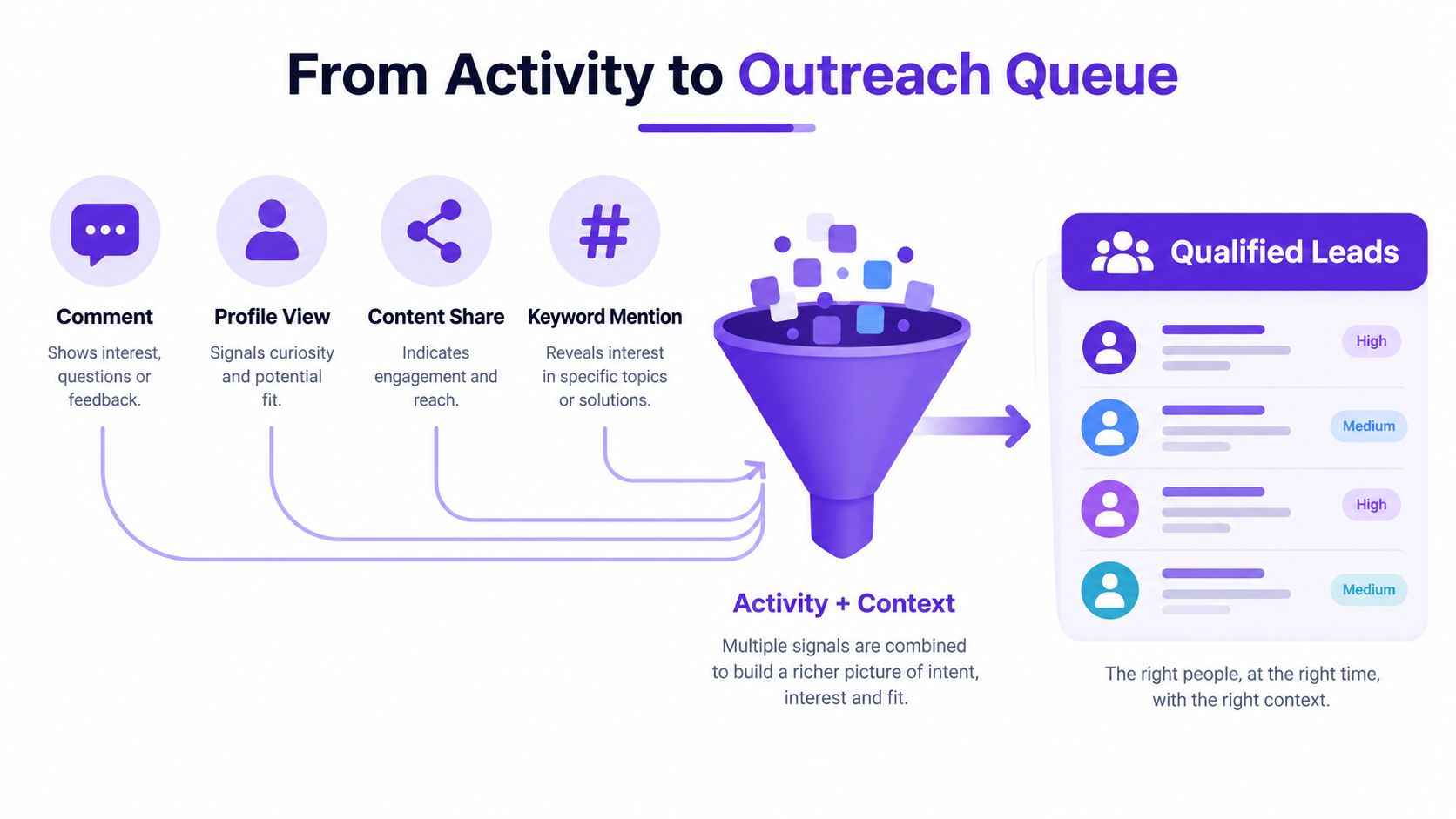
Static firmographic targeting shows who could buy. LinkedIn activity helps determine who deserves attention now. The practical shift is from collecting names to interpreting evidence, assigning priority, and routing each account through human review.
A profile view alone is weak evidence. A relevant comment carries more context because the buyer chose the topic publicly. Competitor engagement may reveal an active evaluation, while pricing or demo discussions can point to a direct commercial question. None of these actions should trigger outreach automatically. The useful unit is the signal combination.
Separate weak signals from useful context
Build the review queue around four categories:
Profile engagement: A profile view or connection request indicates awareness. Send it to investigation, not straight to a pitch.
Content interaction: Comments, reactions, shares, and repeated engagement with relevant posts reveal topic-level interest. Record the subject and wording, not merely the activity type.
Competitor activity: Follows, competitor-post engagement, job changes, and group discussions can expose a changing evaluation set or a new responsibility.
Commercial signals: Pricing-page visits, demo discussions, matched-audience ad clicks, and public evaluation language deserve faster review because they connect activity to a buying process.
Give every signal a priority and response window. A single profile view can remain in monitoring. A decision-maker commenting on a competitor comparison after a company change may warrant same-day review. A public vendor request should prompt immediate human research, while still requiring approval before outreach.
Consider a VP of Operations at a 200-person SaaS company. The person fits the ICP, the company recently raised funding, and the VP engages with a competitor post about scaling operational workflows. Store those facts as one lead record with a concise context note, rather than creating three disconnected tasks. An approved message can address the operational question raised in the discussion without assuming budget, timing, or dissatisfaction.
For a practical taxonomy, use this guide to buying signals in sales. Preserve the evidence: store the post, topic, trigger, date, account fit, and proposed next action. That record lets a rep personalize from facts and lets a manager audit why the account entered the queue.
A signal is useful only when it changes what the rep should do next.
Measure the queue by ICP-fit rate, not total activity alone. General content may attract broad engagement, while niche content can produce a higher share from people who match the ICP, as noted in the 2026 benchmark roundup. The operating lesson is simple: separate engagement volume from engagement by buyers the team can serve.
Run an Engagement First LinkedIn Outreach Playbook
Cold outreach often fails before the first message. The profile gives no clear reason to care, the prospect does not recognize the sender, and the opening request jumps straight to a meeting. An engagement-first workflow builds context through relevant LinkedIn activity, while treating a like as a signal to assess, not proof of a relationship.
Use a seven-day cadence, then adjust it when the prospect responds or publishes something materially relevant. Buying signals should change the next action, not sit in a static list.
A practical seven-day cadence
Day 1, prepare the sender. Align the personal profile headline, banner, summary, and featured proof with the buyer's problem. A prospect who checks the sender should understand the relevance quickly.
Day 2, observe and respond. Review recent posts and add a substantive comment where you can contribute. Skip “great post.” Add a useful distinction, example, or question that fits the discussion.
Day 3, publish an insight. Share a practical observation for the ICP. The post should stand alone as useful advice, rather than act as a disguised connection request.
Day 4, connect with context. Send a short invitation tied to a shared topic, role, market shift, or recent post. Keep the commercial offer out of the invitation. The average acceptance rate in a benchmark dataset was 28.5%, while connection-note replies were 3.0%, according to Expandi's 2026 outreach benchmarks. The note should establish relevance, not attempt to close a deal.
Day 5, send a low-friction opener after acceptance. Use the observed signal:
“You mentioned [specific operational issue] in your post. How are you handling that internally?”
“I noticed your team is working through [relevant trigger]. Is [problem] part of that transition?”
“Your point about [topic] stood out. Are you seeing more pressure from [specific consequence] or [another consequence]?”
Day 6, follow up with value. If there is no response, share a relevant observation or ask a narrower question. “Would a short checklist for [problem] be useful?” creates less friction than “Can I show you a demo?”
Day 7, invite the next step only when earned. If the prospect has engaged, propose a short conversation about the issue they discussed. If the signal remains weak, move the lead into nurture. Silence means the evidence or urgency is insufficient, not that the account is permanently lost.
Keep the relationship visible
Use a lightweight CRM routine:
Pin the account: Keep active conversations and high-priority signals visible.
Label interest: Record the problem, trigger, role, and current buying stage.
Date the next action: Every reply should produce a next step, including nurture.
Nurture stalled interest: Share useful content tied to the original problem, then revisit when a new signal appears.
The workflow improves as each interaction adds context to the account record. Keep the relationship active with a clear reason to return, not theatrical persistence or another generic follow-up.
Integrate RoverLead AI Into Your LinkedIn Pipeline
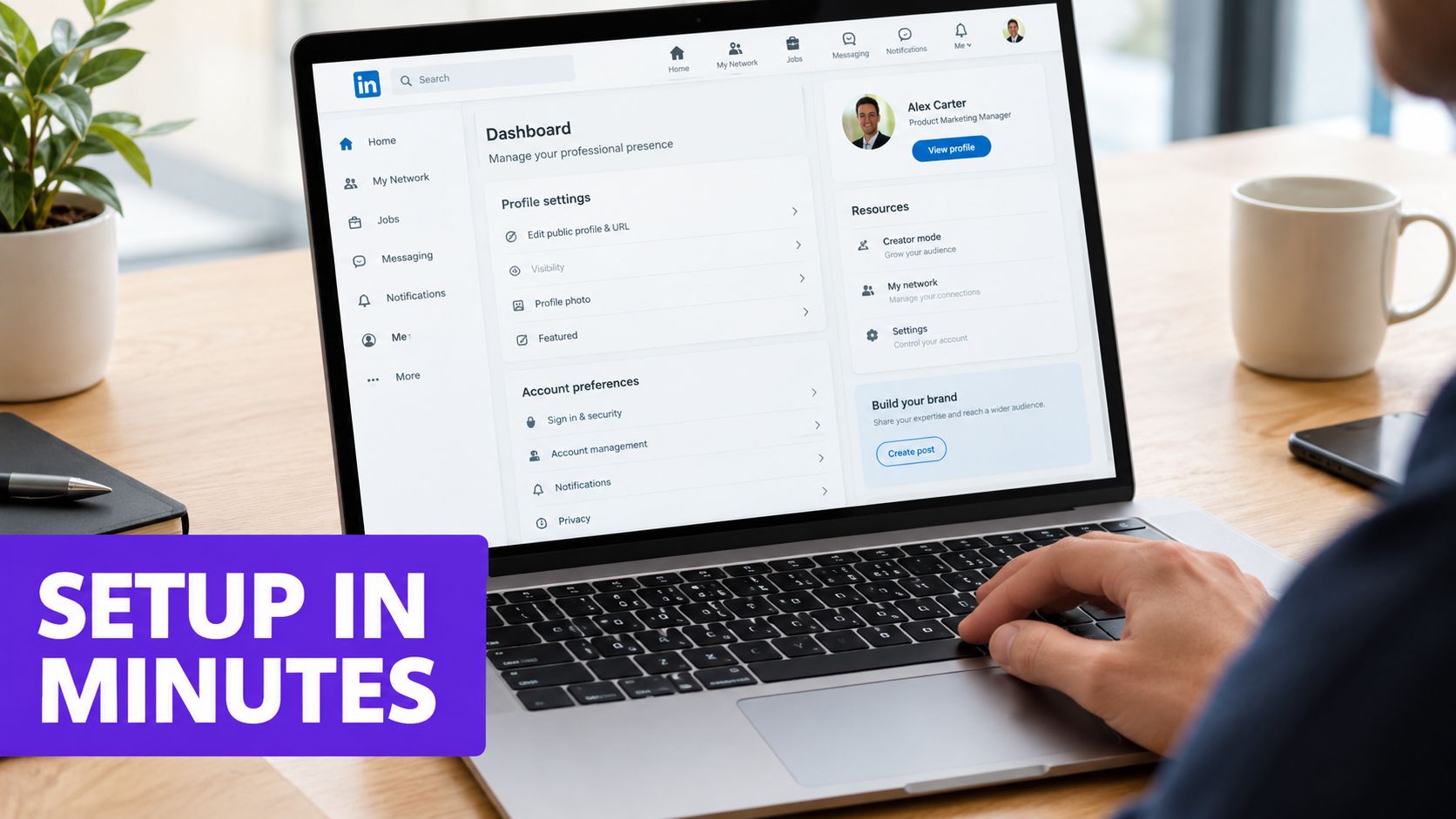
AI should reduce research friction, not remove sales judgment. A practical setup begins with the ICP, then connects the activity sources that help you recognize a live buying conversation.
Start by defining filters for company type, roles, geography, industries, exclusions, competitors, experts, and buyer language. Add phrases such as “looking for,” “evaluating,” “comparing,” “RFP,” and “contract renewal.” These keywords don't prove intent by themselves, but they give the system useful material to surface for review.
Signal Agents can scan LinkedIn activity such as comments, post interactions, profile views, competitor engagement, and buyer keywords. The useful output is a ranked prospect card containing the account fit, observed trigger, context snippet, and a suggested opener. A rep should be able to answer three questions from that card: what happened, why it matters, and what message would be appropriate.
Approval turns automation into a controlled workflow
The human reviewer can edit or reject the opener before anything sends. That control matters because a system may detect a relevant topic while misunderstanding the buyer's position. A comment about an RFP might be research, advice for a colleague, or a genuine vendor search. The rep supplies the judgment.
After approval, the lead inbox can act as a lightweight relationship workspace. Pin active accounts, add interest labels, assign next-action dates, and use auto-drafts for stalled conversations. Auto-replies can handle common questions while flagging hot accounts for a human rep. The objective is not to maximize automated touches. It is to improve response quality, qualified meetings, and pipeline movement.
For teams evaluating AI-assisted selling, this guide to using AI in sales provides useful context. The right configuration keeps the system close to the evidence and keeps the rep responsible for the commercial decision.
Automate Outreach Without Losing Human Control
Automation is safe when it accelerates repetitive preparation. It becomes risky when it impersonates judgment, sends irrelevant messages, or treats platform limits as a challenge to defeat.
Never automate the parts that require interpretation:
Final approval: A human should approve the recipient, trigger, wording, and timing before sending.
Sensitive escalation: Complaints, legal questions, pricing objections, and requests for removal need a person.
Relationship decisions: Decide whether to pursue, nurture, pause, or close based on the full account context.
Claims and proof: Don't let generated copy invent outcomes, customer names, or product capabilities.
LinkedIn outreach also has explicit operating constraints. Connection requests are capped at 100 invitations per rolling seven-day window, with a practical daily soft limit of about 20 to 25 invitations before throttling may begin, according to LinkedIn outreach limit guidance. Treat those limits as boundaries, not targets.
Use guardrails that protect trust
Before launch, check:
Message language: Remove spam-trigger phrases, exaggerated promises, and generic urgency.
Profile quality: Complete the sender profile so recipients can verify who is contacting them.
Pacing: Build activity gradually and avoid sudden bursts that look unlike normal human use.
Variation: Personalize from real triggers instead of rotating cosmetic synonyms through one template.
Account health: Monitor warnings, unusual restrictions, declining replies, and complaint signals. Pause activity when the pattern changes.
Access hygiene: Avoid random device or location behavior that makes account activity look abnormal.
Review approved messages monthly with RevOps. Audit samples for relevance, factual accuracy, consent signals, suppression handling, and escalation quality. A monthly review is frequent enough to catch drift without turning every rep into a compliance analyst.
The sustainable model is straightforward: automate discovery, sorting, enrichment, and drafting. Reserve voice, approval, interpretation, and escalation for humans. Speed is useful. Unsupervised sameness is not.
Measure and Improve Your LinkedIn Lead System
A LinkedIn lead system should answer three operating questions every week: which signals indicate real interest, which conversations deserve sales time, and which activity produces qualified pipeline? Connection volume cannot answer them. A useful measurement model follows the prospect from signal to approved outreach, reply, meeting, opportunity, and next action.
Start with a funnel that separates activity from commercial progress:
Signal quality: How many monitored actions came from ICP accounts and relevant roles?
Engagement quality: Which signals led to accepted connections, meaningful replies, or profile visits from target accounts?
Conversation quality: How many replies showed a relevant problem, active project, timing change, or buying responsibility?
Pipeline quality: How many qualified meetings, opportunities, and future actions came from those conversations?
Economic efficiency: What labor and software cost produced each qualified meeting and opportunity?
A profile view may justify research. A relevant post, a comment about a known operational problem, and a recent role change create a stronger case for review. The measurement system should preserve that context, rather than flattening every action into the same lead score.
KPI | What to Track | Useful Comparison | Weekly Action |
|---|---|---|---|
ICP signal volume | Relevant activity by account, role, and signal type | Compare with the prior period and target-account coverage | Remove noisy signals and improve monitoring rules |
Approved outreach rate | Prospects approved for contact after human review | Compare by signal type and account tier | Tighten approval criteria where review rejects are high |
Positive reply rate | Replies that confirm relevance, interest, or a business problem | Compare by opener, persona, and trigger | Rewrite weak openers and remove unsupported claims |
Qualified meetings booked | Meetings from ICP-fit accounts with a defined reason to talk | Compare by source, rep, and approval path | Inspect qualification and handoff quality |
Opportunity value created | Pipeline connected to LinkedIn conversations | Review by account tier and signal category | Shift effort toward signals that produce sales-stage progress |
Cost per qualified meeting | Labor and tool cost divided by qualified meetings | Compare with other acquisition channels | Prune low-yield segments and workflows |
Next-action completion | Conversations with an assigned, completed follow-up | Compare by owner and pipeline stage | Fix stalled records and clarify ownership |
Review the system every week
The weekly review should examine signal-to-conversation conversion, not just response totals. Sample approved messages and ask whether the trigger was real, the account fit the ICP, and the opener reflected the prospect's context. A high reply rate built on weak-fit accounts can waste more time than a lower rate from accounts with genuine buying potential.
Review performance by signal category. Separate content engagement, leadership changes, hiring activity, company announcements, technology changes, and direct problem statements. A broad “LinkedIn activity” label hides the difference between a casual like and a detailed comment about a process the company may be trying to fix.
Use the results to change one operating input at a time. If qualified replies fall, inspect signal quality and opener relevance. If meetings are booked but opportunities do not progress, review qualification, stakeholder fit, and the handoff to the account owner. If strong conversations stall, check whether the next action was specific and timely.
Keep a short learning log. Record the trigger, approved message, response pattern, qualification result, and follow-up outcome. After several review cycles, the team has evidence for updating its scoring rules and message library instead of relying on whoever has the loudest opinion in the sales meeting.
FAQ
1. How narrow should my LinkedIn ICP be?
Start with a segment a rep can recognize without debating every record. Define the industry, company characteristics, relevant roles, business problem, and buying context. Expand only after the team can identify which combinations produce qualified conversations.
2. Should I target companies or individual buyers first?
Use both levels. Account fit establishes commercial relevance, while role fit identifies the person who may evaluate, champion, approve, or influence the purchase. Store both in the CRM so outreach reflects the account situation rather than one isolated profile.
3. Which LinkedIn signal matters most?
A relevant commercial conversation usually carries more weight than passive activity. Several aligned signals are stronger than one isolated action, especially when they connect account fit, role relevance, and a plausible business problem.
4. Can a profile view justify outreach?
Usually, it justifies research. Look for another context signal, such as a relevant post, comment, role change, or company event, before treating the view as a reason for direct contact.
5. How do I avoid generic replies?
Record the exact post, comment, trigger, or problem that prompted the message. Ask about that issue, and avoid replacing the observation with a company description or a list of product features.
6. Should every accepted connection enter a sequence?
No. Acceptance permits the relationship to continue. It does not make a pitch relevant. Segment by account fit, role, signal strength, and timing before choosing a follow-up.
7. What should automation handle?
Automation can collect activity, enrich records, sort signals, apply labels, and prepare first drafts. Human reviewers should approve outreach, handle sensitive replies, interpret ambiguity, and decide when a conversation belongs in an active pipeline.
8. How should sales and marketing share LinkedIn leads?
Agree on ICP definitions, signal labels, qualification requirements, ownership, and response expectations. A useful handoff includes the account context, observed trigger, approved message, reply summary, and next action.
9. How do I connect LinkedIn activity to my CRM?
Use consistent account and contact records. Capture the signal source, date, category, approval decision, message, response, qualification status, owner, and next action. The record should show how a prospect moved from observed activity to an active or nurture relationship.
10. What should I do with prospects who aren't ready?
Assign a nurture label and a specific future action date. Keep the original context, share relevant insight when appropriate, and return when activity shows a new problem, responsibility, project, or commercial trigger.
Start Monday by selecting one ICP segment and reviewing a small signal queue by hand. Create three lead tiers, define the evidence required for approval, prepare context-based openers, connect CRM labels to next actions, and measure qualified conversations rather than connection volume.
RoverLead AI helps sales teams find high-intent LinkedIn activity, prepare personalized openers, and organize approved conversations in a living lead inbox. Visit RoverLead AI to see how its Signal Agents can support a more deliberate B2B lead generation workflow.