LinkedIn Engagement Strategy That Books Real Meetings

A LinkedIn engagement strategy that books meetings starts with intent, not reach. In 2026, average LinkedIn engagement was 3.85%, carousel posts reached 6.60%, and posts holding attention for 61+ seconds reached 15.6% engagement, compared with 1.2% for posts holding attention for 0 to 3 seconds.
You've probably seen the usual routine. Someone publishes a polished post, watches impressions climb, celebrates a pile of likes, and then discovers that none of those interactions came from the accounts their sales team wants. The dashboard looks healthy. The pipeline doesn't.
Most LinkedIn engagement strategies chase likes and impressions, while the signal in 2026 is dwell time, saves, and intent-rich comments from people who already fit your ICP. Engagement becomes useful when it tells an SDR who is paying attention, what problem they're discussing, and whether a relevant conversation is welcome.
Table of Contents
Why Most LinkedIn Engagement Strategies Fail
The most common mistake is treating engagement as a scoreboard. Teams report impressions, follower growth, and reaction counts because those figures are easy to collect and pleasantly large. Meanwhile, a target-account operator saves a framework, comments on a competitor's post, or spends a minute reading a teardown, and nobody records it as a sales signal.
A B2B engagement strategy is a deliberate system for surfacing conversations with named accounts and relevant buyers. Content creates the context. Outreach responds to demonstrated interest. Those motions should work together, not sit in separate departments where marketing celebrates reach and sales complains that social “doesn't convert.”
Social selling becomes commercially useful when your team can connect a public interaction to a private, relevant follow-up. Without ICP filtering, engagement is just noise collection with nicer graphics.
Three failure modes keep showing up
Vanity-metric reporting: Impressions and likes dominate weekly reviews, even though they say little about buyer fit or urgency.
Generic commenting pods: Coordinated reactions and empty comments produce activity without commercial relevance. They also train your team to value volume over judgment.
Brand-only publishing: The company page carries the whole burden, while founders, operators, and sellers remain invisible to the people they need to influence.
The format data points in a different direction. LinkedIn benchmark coverage reported 3.85% average engagement in 2026, up from 2.67% in 2025, with carousels at 6.60%. The same benchmark reported video views up 36% year over year and comments up 37%. Those figures don't prove that every carousel creates pipeline, but they do show that richer formats earn more stopping, swiping, watching, and discussing than a plain static message.
The useful question isn't “How much engagement did we get?” It's “Which qualified people did something that reveals interest?”
Dwell time is especially revealing. An independent 2026 analysis found 15.6% engagement for posts with 61+ seconds of dwell time, compared with 1.2% for posts viewed for 0 to 3 seconds. That makes attention retention a measurable signal, not a vague content-marketing virtue, as documented by LinkedIn algorithm analysis.
For an SDR, relevant engagement is one of the cheapest intent-data sources available. It shows you where a buyer is already talking before you interrupt them with a pitch.
Defining ICP and Buying Signals That Matter
Start with an ICP that can guide a decision, not a paragraph that sounds impressive in a strategy deck. Define the account, the technology environment, and the person who feels the problem strongly enough to act.
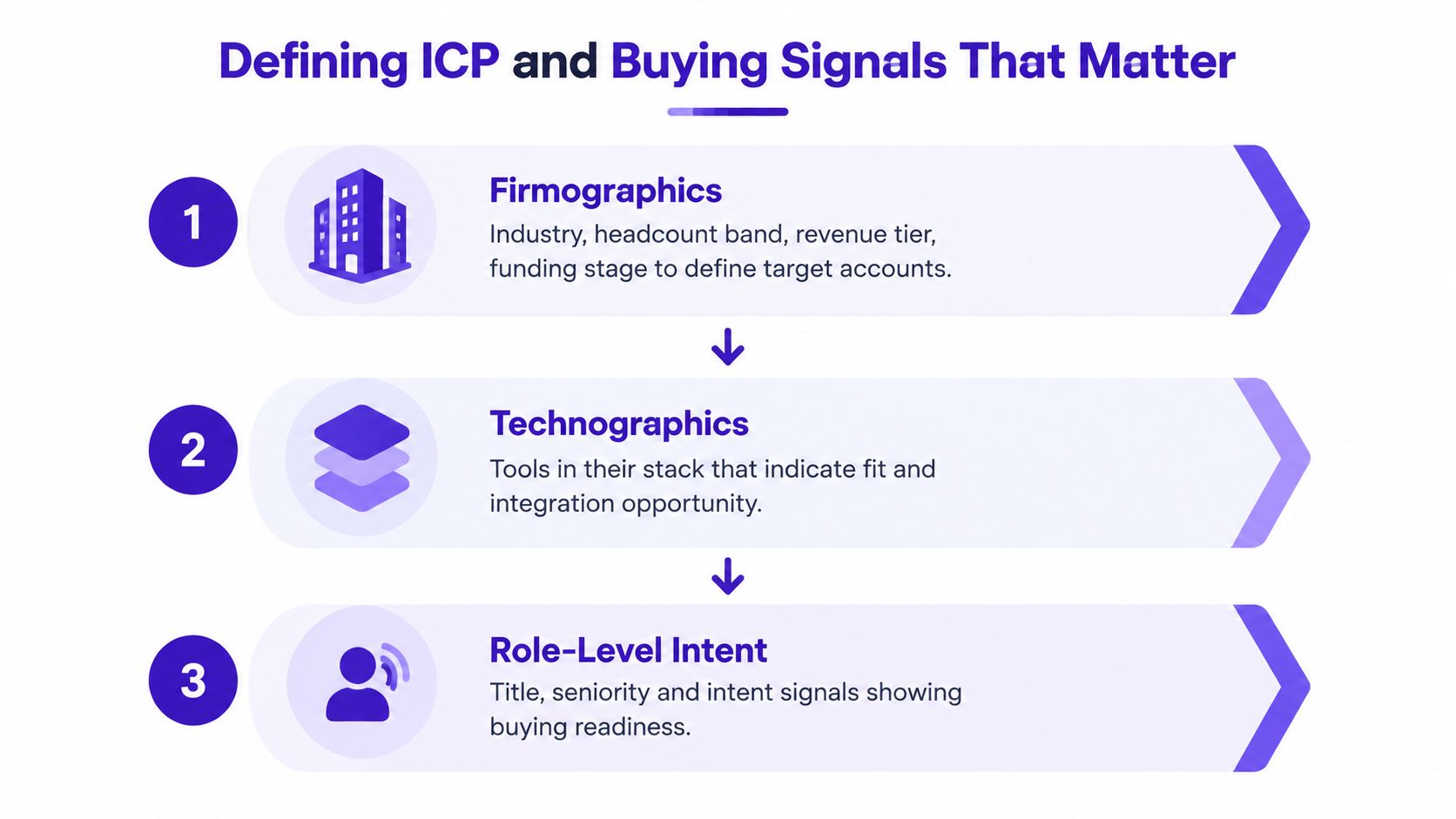
Build the ICP from three layers
Firmographics establish account fit. Use industry, headcount band, revenue tier, funding stage, operating geography, and business model. A Series B software company with a growing sales team may fit your motion, while a similarly sized agency may not.
Technographics reveal the environment you'll enter. Identify tools in the prospect's stack, including CRM, sales engagement, enrichment, analytics, and customer-support systems. Technology signals help you explain integration value and avoid pitching a workflow the account can't adopt.
Role-level intent identifies the human context. Track title, seniority, function, recent promotions, team changes, and public commentary. A newly promoted VP of Revenue Operations may be more open to process improvement than an established executive who hasn't discussed the problem.
Turn those layers into a living watchlist in LinkedIn Sales Navigator. Create Boolean strings for titles and functions, save searches for priority personas, build account lists, and refresh those lists weekly. A static list goes stale quickly because people change jobs, teams change priorities, and public conversations reveal new context.
Sort signals by commercial meaning
First-party intent comes directly from the prospect or account. Job changes, funding announcements, earnings language, leadership commentary, and posts about a problem you solve belong here.
Second-party intent appears when target accounts engage with category or competitor content. A comment can reveal more than a profile headline because it shows what the buyer is willing to discuss publicly.
Third-party intent comes from sources such as Bombora, G2, and public review activity. Use it as supporting evidence, not as permission to send a generic “saw you're researching” message.
Negative signals matter just as much. Layoffs, hiring freezes, restructuring, and churn indicators can change timing or make a hard pitch tone-deaf.
Consider two practical triggers. A VP of Revenue Operations at a Series B SaaS company comments thoughtfully on a post about consolidating sales tools. A Head of Sales publishes about Q4 pipeline gaps. Neither event guarantees a purchase, but both justify research and a relevant response.
Your watchlist needs an action for every signal. A job change may trigger profile research. A problem-focused comment may trigger a value-add reply. A negative signal may trigger suppression or a later nurture task. A signal without a next action is just a notification wearing a tiny business costume.
For a more rigorous construction process, use this guide to define your ICP.
Choosing Content Formats That Earn Real Attention
Format isn't decoration. It determines how much work the reader does with your idea, and that affects whether the interaction reveals genuine interest.
LinkedIn format benchmarks show a steep performance spread. In the cited Q1 2026 B2B company-page benchmark, median engagement was 5.10%, with the 75th percentile at 8.61% and the 90th percentile at 21.63%. Another study of 673,658 posts across 63,108 accounts found 2.60% average engagement for personal profiles and 1.74% for company pages, estimating that personal profiles delivered 63% higher engagement rates.
That's why I'd rank formats by buyer attention and qualified response, not by the number of easy reactions they generate.
Format | Dwell Time | Save Rate | ICP-Qualified Comments | Best Intent Stage |
|---|---|---|---|---|
Native carousel or document | Highest | High | High when built around a practical framework | Consideration |
Native video | High | Moderate to high | Strong when a practitioner explains a specific problem | Awareness to consideration |
Text-only post | Moderate | Variable | High when the author has a sharp, relevant point | Awareness to decision |
Poll | Low to moderate | Low | Often broad and weakly qualified | Awareness |
Newsletter | High for committed readers | Moderate to high | Useful for recurring topic authority | Consideration |
Long-form article | High for problem-aware readers | High when reference-worthy | Fewer, deeper responses | Consideration to decision |
Carousels win because they make the thumb pause and ask the reader to continue. A useful framework, teardown, or checklist gives an operator a reason to swipe and save. The 2026 benchmark reported 6.60% engagement for carousel posts, the highest of the measured formats, which supports prioritizing native documents when you want sustained attention.
Polls and reaction-bait one-liners are fine for lightweight awareness, but they're poor substitutes for qualification. A question about how teams handle forecast accuracy attracts a better audience than “Agree?” attached to a motivational sentence.
Match format to intent stage. Awareness content earns reach. Consideration content earns saves and profile visits. Decision content earns replies and DMs. RevOps, Sales Ops, and Marketing Ops practitioners usually value frameworks, teardowns, and implementation detail. Founders and investors often respond better to sharp opinions and contrarian market observations.
My weekly mix is simple: two frameworks, one opinion, one teardown, and one personal story. If you want the opinion layer to support revenue rather than personal-brand theater, build it around a real operating decision. Thought leadership strategy should make the right buyer think, “That's exactly the problem we're dealing with.”
Building a Daily Content Engagement Workflow
Good engagement doesn't happen because someone remembers to “be active.” Give the team a repeatable routine that prioritizes target accounts before the feed turns into a swamp of motivational posts.
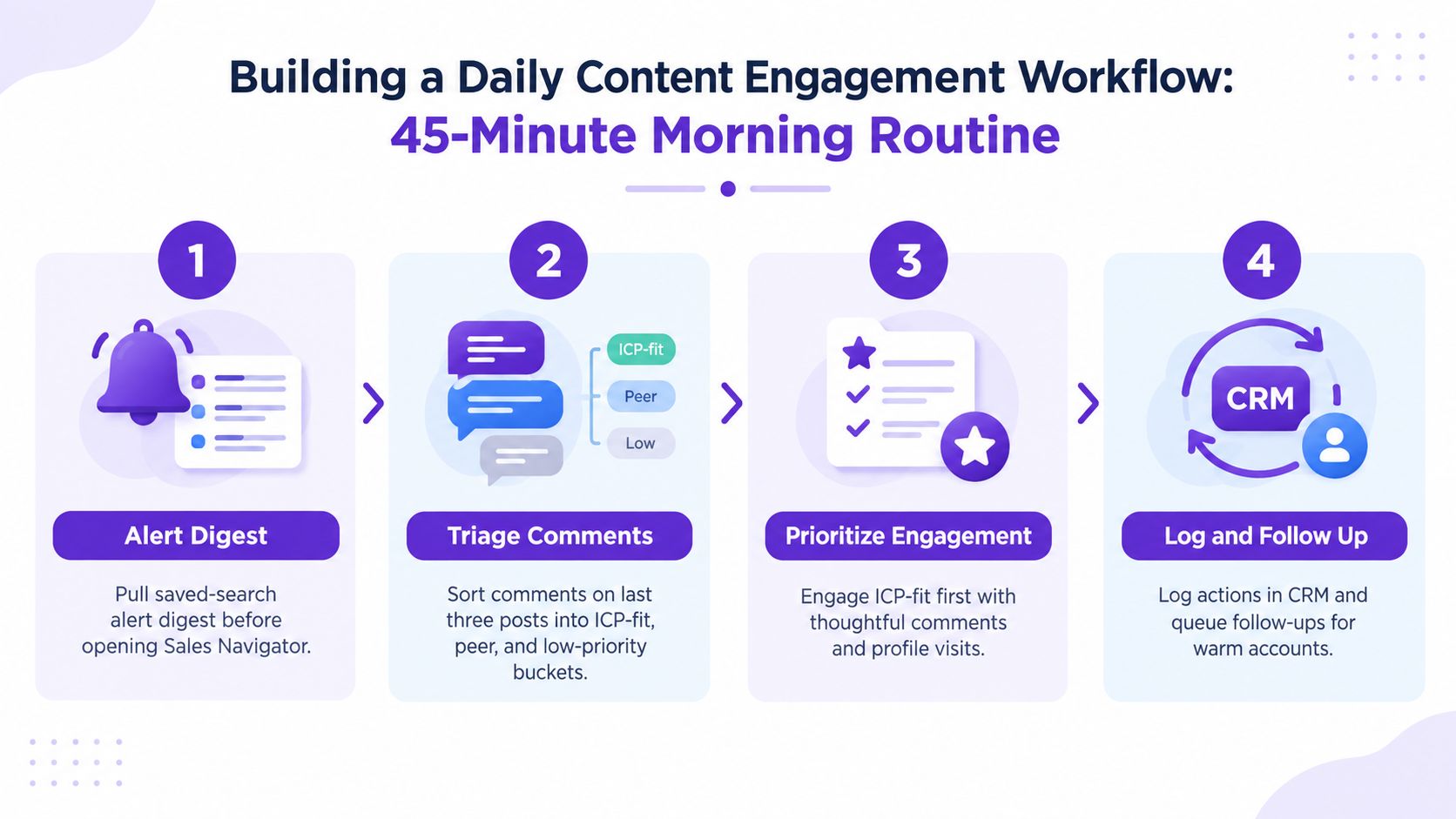
Start with a 45-minute morning block before opening Sales Navigator properly or beginning outbound calls.
Pull the saved-search alert digest. Review job changes, new posts, account updates, and relevant conversations. Don't treat every alert equally. Sort for ICP fit, problem relevance, and timing.
Triage comments on your last three posts. Place them into three buckets: ICP-fit, peer, and noise. An ICP-fit comment deserves a useful response. A peer comment deserves a thoughtful exchange. Noise can remain noise.
Reply to meaningful comments early. The available benchmark reports that replying to every comment within the first 2 hours boosts engagement by 30%. Use that as an operating rule, while remembering that a good reply must add substance rather than merely arrive quickly. See the comment-response benchmark for the cited finding.
Log the signal and next action. Record the account, person, post topic, interaction type, and planned follow-up in your CRM.
Take a concrete trigger. A VP of Operations at a 200 to 500 employee SaaS company comments on a competitor's post about tool consolidation. The right response isn't “We help companies consolidate tools, want a demo?” That's not personalization. That's a mail merge wearing a blazer.
Reply within 30 minutes with a useful observation about the consolidation problem. Visit the profile to understand the person's role and current priorities. Then send a soft connection request that references the thread, not your product. If they accept and engage further, move them into the outreach cadence.
The afternoon routine should include warm-up replies to existing DMs and substantive comments on target accounts' posts. Comment seeding doesn't mean dropping your company slogan everywhere. It means adding an informed point, asking a specific follow-up, or sharing a relevant operating detail.
End the day by logging outcomes. Mark whether the person viewed your profile, replied, accepted, saved, or showed a negative signal. That turns engagement into a first-class sales input instead of a feel-good habit.
Running Outreach Cadences That Earn Replies
Don't start with a pitch. Start after a prospect has accepted your connection and either viewed your profile or engaged with a relevant post. That approval-first sequence respects context and gives the first DM a reason to exist.
A practical six-step cadence looks like this:
Value-first DM: Reference something they reacted to, commented on, or published. Offer a useful observation or resource tied to that topic.
Relevant proof: Send a case study, benchmark, or teardown 48 hours later, only if it advances the conversation.
Light bump: Follow up on day 5 with a short question that's easy to answer.
Breakup message: On day 10, close the loop politely. Don't manufacture urgency.
Trigger-based re-engagement: Return after 30 days only when a new signal gives you a legitimate reason.
Clean break: Stop when the person doesn't respond or indicates poor fit.
The outreach benchmark is blunt. One dataset reports a 28.5% connection-request acceptance rate, a 10.4% outbound reply rate, and just a 3.0% response rate for connection-request notes, making targeting and the first post-acceptance message more important than clever note copy. The same source recommends treating performance below roughly 20% acceptance as a targeting or persona problem. Review the LinkedIn outreach benchmark for those figures.
Cadence Type | Acceptance Rate | Reply Rate | Meetings / 100 Sends |
|---|---|---|---|
Connect and pitch | Not established here | Not established here | Not established here |
Warm engagement | Not established here | Not established here | Not established here |
Signal-triggered | Not established here | Not established here | Not established here |
I'm leaving those cells blank on purpose. There's no verified dataset here that provides comparable acceptance, reply, and meeting ranges for each cadence type. “Realistic 2025 ranges” would be invented evidence, and invented evidence is a poor foundation for a sales process.
A separate dataset covering 180,155 matured connection requests found 27.1% accepted, 27.6% of accepted requests replied, and 2.0% of accepted requests booked a meeting, as reported in this outbound prospecting analysis. Treat those figures as benchmarks, not promises.
Use approval-first automation only. No mass blasts, scraped lists, or automated comments. Your system should help a rep notice intent and prepare a relevant message. The rep should still decide whether the message deserves to be sent.
For practical variations on this motion, review these LinkedIn outreach ideas.
Measuring What Actually Books Meetings
Priya, an SDR on a B2B sales team, starts Monday by logging profile views from target accounts. She doesn't celebrate every view. She checks the viewer's company, role, recent activity, and whether the account belongs on the active watchlist.
On Tuesday, two ICP-fit prospects comment on her framework post. One asks about implementation. The other describes a forecasting problem. Those comments matter more than a larger pile of generic reactions because both expose context that Priya can use.
Follow the signal through the week
By Wednesday, Priya sends a value-first DM to the prospect who engaged with the implementation section. She links the message to the public discussion and asks a narrow question. On Thursday, a meeting is booked from a thread that began with a save and a sustained read, then moved through a relevant comment and a post-acceptance reply.
This is a representative workflow, not a claimed customer case study. The point is attribution discipline. A LinkedIn post rarely deserves full credit for a meeting, but the engagement event can be the first identifiable touch in a chain.
Track these KPIs:
Qualified profile views: Views from people at target accounts and relevant seniority.
ICP-fit comment count: Substantive comments from accounts you'd sell to.
Accepted target-account connections: Acceptance filtered by fit, not a blended network total.
Step-one DM reply rate: Whether the first post-acceptance message earns a response.
Meetings by engagement-sourced touch: Meetings where a documented LinkedIn interaction started or materially advanced the conversation.
Cost per meeting: Total program cost divided by meetings attributed under your agreed model.
Ignore follower growth and impressions as primary pipeline metrics. They can help diagnose distribution, but they don't tell you whether a buyer cares.
A dashboard might show $50K of pipeline attributed to engagement-sourced touches, but only if your CRM records the source, account, person, interaction, message, and opportunity. Don't backfill attribution from memory at the end of the quarter. That's how every channel becomes “influential” and no channel becomes accountable.
Use a 90-day data pull, calculate median engagement by impressions, segment by format, and set the next month's goals about 20% to 50% above baseline, as recommended in LinkedIn benchmark guidance. Watch comment-to-impression ratio too. The same source identifies anything below 0.5% as weak conversation performance.
Scaling With Automation Without Breaking Trust
Automation should remove repetitive monitoring, not remove human judgment. The safe version watches signals, syncs records, schedules approved content, and queues drafts. The risky version connects with strangers at scale, scrapes questionable data, and sends AI-generated messages that sound like every other “personalized” DM in your inbox.

Keep the human at the approval gate
Use four eyes for outbound decisions:
Signal watcher: The system surfaces the account, interaction, and context.
Message drafter: A draft ties the opener to the specific behavior.
Manager review: A second person checks fit, relevance, tone, and compliance.
Approved send: The rep sends only after review. If automation is involved, use a one-line disclosure where required by your policy.
The exact gate is simple:
Drafted message → manager review → one-line disclosure if automated → send
Set daily volume caps per rep, maintain a stop-list, and halt activity when account restrictions or unusual response patterns appear. Never automate mass auto-connects, scraped data imports, generic comments, or messages that pretend a human personally researched a prospect when nobody did.
A 14-day pilot should answer three questions before expansion:
Are acceptance rates healthy for the selected ICP?
Are replies coming from the right personas, not merely increasing in volume?
Are meetings being booked from the signal-triggered motion?
Use the verified benchmarks as reference points, not fabricated go/no-go guarantees. The accepted-request dataset found 2.0% of accepted requests booked a meeting, while the outreach benchmark reported 10.4% outbound message replies. Your team should establish its own baseline by persona, signal type, and rep.
RoverLead AI is one option for this workflow. It monitors LinkedIn activity against a defined ICP, surfaces signals such as comments and competitor engagement, and creates contextual openers that a user reviews and approves before sending. Its inbox also supports follow-up, tagging, nurturing, auto-drafting, and auto-reply functions, so the team can manage warm conversations without relying on static lists.
Scale is clean signal collection plus disciplined approval. It isn't permission to spam faster.
The right question for week one isn't “How many people can we contact?” Ask, “Which behavior earns a relevant next step, and can we repeat that without damaging trust?”
Frequently Asked Questions
What is a LinkedIn engagement strategy?
It's a system that connects content, audience monitoring, qualification, and outreach. In B2B, the goal isn't maximum activity. The goal is to identify relevant buyers showing useful behavior, then start a conversation that matches their context.
Should I optimize for likes or comments?
Optimize for qualified comments, saves, sends, profile views, and dwell time. Likes can help diagnose whether a post is visible, but they rarely explain whether a target buyer has a problem worth discussing.
Are personal profiles better than company pages?
Personal profiles often perform better for organic engagement because buyers respond to identifiable expertise and lived experience. A 2026 study cited earlier found 2.60% average engagement for personal profiles versus 1.74% for company pages, with personal profiles estimated to deliver 63% higher engagement rates. Use the company page for credibility and distribution support, but put human experts in front of the market.
What content format should a B2B team prioritize?
Start with native carousels or documents for frameworks, teardowns, and practical guides. Add native video for demonstrations and practitioner explanations, then use text posts for opinions and operating lessons. Let the buyer's behavior determine which format deserves more production effort.
How long should a LinkedIn video be?
The verified data supports video as a richer format and reports that video views rose 36% year over year. It doesn't establish a reliable length comparison for sub-30-second clips versus 60 to 90 second explainers, so choose length based on the complexity of the idea and whether the viewer needs to save or discuss it.
When should I message someone who engaged with my post?
Message when the engagement is relevant, the person fits your ICP, and you can add context. A save or thoughtful comment can justify research. A random reaction by an unqualified profile shouldn't trigger a pitch.
Do connection-request notes improve outreach?
Not reliably. The cited benchmark reports a 3.0% response rate for connection-request notes, compared with a 10.4% reply rate for outbound messages. Focus on targeting and the first post-acceptance message instead of spending hours polishing a tiny note nobody asked for.
What should I record in the CRM?
Record the account, persona, post or thread, signal category, interaction type, date, response, and next action. Add opportunity attribution only when the engagement materially starts or advances a sales conversation.
Is automation safe for LinkedIn outreach?
Automation is safer when it monitors signals, syncs CRM data, schedules approved content, and drafts messages for review. Mass auto-connects, scraped data, generic AI comments, and unattended sending create trust and compliance risk.
What if acceptance rates are low?
Check the ICP and targeting before blaming LinkedIn. The outreach benchmark recommends treating performance below roughly 20% acceptance as a targeting or persona problem. Narrow the account list, improve role fit, and use behavioral signals instead of adding more volume.
How quickly should reps reply to comments?
Reply while the conversation is active, particularly during the early period after publishing. One benchmark reports that replying to every comment within the first 2 hours boosts engagement by 30%. Speed helps, but a useful response still matters more than a fast “Great point.”
The best LinkedIn engagement strategy is not the one that produces the largest audience. It's the one that helps a seller recognize a qualified problem early, respond with relevance, and earn permission for the next conversation. Stop reporting social activity as if it were pipeline, and start treating engagement as behavioral evidence inside the outbound process.
RoverLead AI helps B2B teams monitor real LinkedIn activity, surface high-intent ICP leads, and draft personalized outreach that stays behind your approval gate. Visit RoverLead AI to turn comments, competitor engagement, and problem-focused conversations into a cleaner path to meetings.