Lead Generation Agency Pricing Explained and Compared

Monthly retainers for B2B lead generation agencies commonly cluster at $3,500 to $12,000, while performance pricing often lands at $150 to $600 per qualified lead or $300 to $900 per booked appointment. The price is tiered by service scope, channel mix, and how close the agency gets to a sales-ready outcome.
You've probably discovered this after collecting three proposals that seem to describe the same service, yet somehow look like they came from entirely different planets. One agency wants a monthly retainer, another charges for every lead, and a third promises “performance pricing” without defining performance very clearly.
That's not a minor paperwork nuisance. The pricing model decides who carries the risk, what the agency optimizes for, and how much control your team keeps over lead quality. A cheap appointment can become an expensive calendar decoration if the prospect has no budget, authority, or reason to buy. A higher retainer can be sensible if it funds the research, messaging, qualification, and follow-up needed for a difficult sales cycle.
Table of Contents
Introduction Why Lead Generation Pricing Feels So Confusing
A sales leader comparing a $5,000 monthly retainer with a $300 appointment fee might assume the second proposal costs less. The comparison can mislead. The retainer may include ICP research, verified data, email and LinkedIn outreach, SDR follow-up, qualification, CRM updates, and optimization. The appointment fee may cover only meetings that meet a narrow definition, while strategy and setup cost extra.
That is why lead generation agency pricing rarely works like a simple menu. An invoice reflects the agency's delivery model, the difficulty of reaching your buyers, and the point where the opportunity moves to your sales team. A clearer B2B lead generation definition also matters because “lead” can describe anything from a contact record to a genuine sales conversation.
The pricing model is a risk-allocation choice. It decides who carries more uncertainty about lead quality, how the agency is paid to improve the pipeline, and how closely payment follows revenue.
Why quotes diverge
Agencies use terms that sound similar but set different expectations. “Qualified lead,” “sales-qualified lead,” “booked meeting,” and “sales opportunity” are not interchangeable. One vendor may charge for a contact matching your industry. Another may charge only after a prospect accepts a calendar invitation. Their unit prices cannot be compared until the definitions match.
The difference works like catering. You can buy ingredients, hire a chef to prepare the meal, or pay a team to plan, cook, serve, and clean. Each option transfers a different amount of work and risk. Agency pricing follows the same logic.
A retainer gives the agency predictable funding to research, test, and improve a pipeline. Pay-per-lead gives your team tighter control over output, but volume can outrun quality if acceptance criteria are vague. Pay-per-appointment moves the billable event closer to a sales conversation. Revenue-share or hybrid structures tie payment more closely to downstream results, while also making the sales cycle and attribution rules more important.
What this guide will help you do
The sections ahead provide a comparison table, market benchmarks, practical ROI math, negotiation questions, contract safeguards, and a decision checklist. Use them to compare proposals by scope, lead quality, accountability, and commercial risk, rather than choosing the lowest figure as if it were a clearance sticker. Your sales cycle should guide the choice: a long, research-heavy cycle may suit a retainer, while a clearly measurable funnel may support performance pricing.
What Lead Generation Agency Pricing Actually Covers
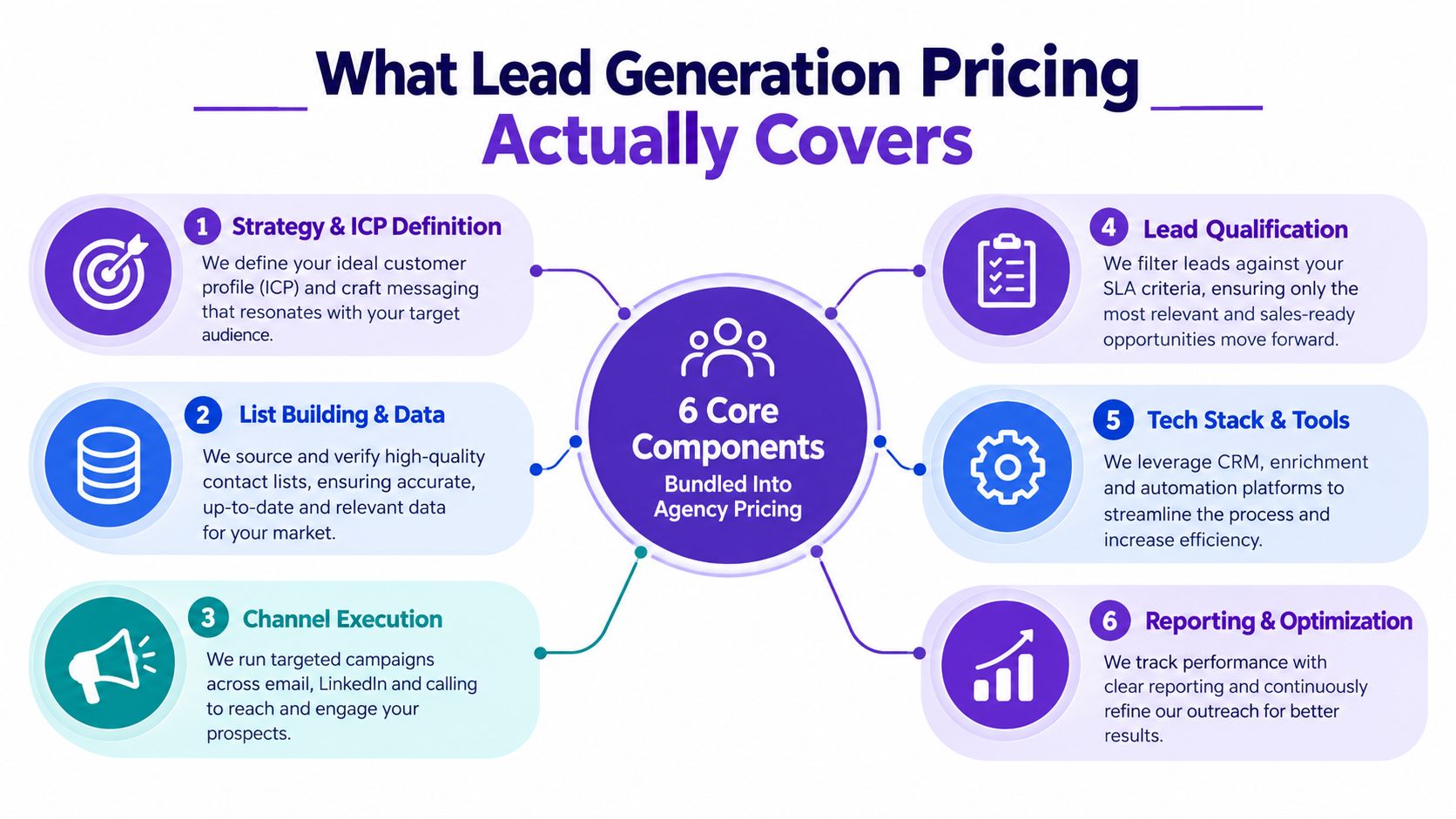
An agency quote usually bundles several kinds of work. The headline deliverable might say “qualified meetings,” but the work behind those meetings often includes strategy, data, technology, campaign execution, human qualification, and reporting.
The six layers inside the price
Strategy and ICP definition determine who the agency targets and what message it uses. A broad audience produces a large list, but a useful ICP specifies company type, buyer role, business problem, trigger, and exclusion criteria.
List building and data cover sourcing, enrichment, verification, and maintenance. A clean list reduces wasted outreach, but the agency should explain how it handles outdated roles, duplicate records, and unsuitable accounts.
Channel execution may include cold email, LinkedIn, calling, paid media, content, or a coordinated combination. Channel count matters, but coordination matters more. A prospect who sees related messaging across channels receives a more coherent experience than someone who gets disconnected campaigns from several teams.
Lead qualification determines whether a response counts. Ask whether the agency checks role, company fit, need, timing, authority, budget, or another agreed criterion. The more demanding the qualification standard, the closer the deliverable is to a sales-ready opportunity.
Technology and tools can include CRM integration, enrichment platforms, sequencing software, scheduling systems, reporting dashboards, and automation. Some agencies include these costs, while others pass them through as separate line items.
Reporting and optimization turn activity into learning. Useful reporting should show which audiences, messages, channels, and qualification outcomes deserve more attention, not just how many emails were sent.
A practical guide to lead generation metrics can help your team distinguish activity measures from indicators that sales can actually use.
Terms that change the economics
A qualified lead is a prospect who meets agreed criteria and shows some level of relevant interest. A booked appointment is a scheduled conversation, but its value depends on whether the prospect attends and fits the qualification standard. An exclusive lead goes to one buyer, while a shared lead may be sold or distributed to multiple companies.
Those distinctions explain why two agencies can quote very different prices without either one necessarily being unreasonable. One is selling ingredients. The other is promising dinner, delivered to the table, with the guest already interested in the menu.
Comparing the Four Core Pricing Models
The four common structures differ mainly in where risk sits. Your company may carry more risk through a fixed retainer, or the agency may carry more risk by accepting payment only when a lead or meeting appears. Neither structure automatically creates quality. The contract still needs clear definitions and feedback loops.
Pricing Model | How You Pay | Risk Allocation | Best For |
|---|---|---|---|
Monthly retainer | Fixed recurring fee for agreed capacity and services | Buyer funds delivery risk, agency gets predictable operating budget | Ongoing pipeline programs and complex campaigns |
Pay per lead | Fee for each accepted qualified lead | Agency carries volume risk, buyer carries quality-verification risk | Teams seeking tighter control over output |
Pay per appointment | Fee for each accepted booked meeting | Agency carries booking risk, buyer still carries conversion risk | Businesses with clear qualification rules and sales capacity |
Revenue-share or hybrid | Base fee plus performance fee or share of downstream value | Risk is shared, with the contract carrying more complexity | Buyers and agencies willing to align incentives closely |
Monthly retainers
A retainer pays for ongoing capacity. The agency can spend time on research, message testing, deliverability, follow-up, qualification, and optimization without treating every action as a separate transaction.
The advantage is continuity. If your sales cycle requires education and repeated touches, a retainer gives the agency room to improve the system instead of chasing only the easiest contacts. The trade-off is that you pay even when the pipeline is still being built, so reporting and performance gates matter.
Retainers suit companies that know their ICP, have enough sales capacity to handle opportunities, and want a partner operating as an extension of the team. They're less comfortable for buyers who need immediate proof of output or have no agreed definition of success.
Pay per lead
Pay-per-lead pricing feels tidy because every invoice line has a unit attached to it. It can work when the qualification criteria are objective and your team can quickly accept, reject, and route records.
The danger is the word “lead.” If the agency counts every positive reply, the sales team may receive contacts who are curious but unsuitable. Include rejection rules, replacement terms, duplicate handling, and a time window for disputing a lead. Otherwise, the model rewards delivery volume rather than useful conversations.
Pay per appointment
Pay-per-appointment shifts the purchase closer to a sales event. You pay when a qualified prospect accepts a meeting, which can make budget planning easier than paying for a large contact list.
However, the agency may still be judged on bookings rather than revenue. Require agreement on attendance, seniority, company fit, meeting purpose, rescheduling, and no-show treatment. A full calendar isn't a healthy pipeline if the attendees can't buy.
Revenue-share and hybrid structures
A hybrid model might combine a smaller fixed fee with fees for accepted leads, meetings, opportunities, or closed revenue. This can align incentives, but it also creates more room for disputes about attribution, timing, refunds, renewals, and sales-team performance.
Revenue share is most workable when your CRM is reliable, your sales cycle is visible, and both sides can agree on what the agency influenced. If attribution is foggy, the contract can become a courtroom drama performed in spreadsheets. A hybrid model is useful when you want shared accountability without asking the agency to finance every cost of delivery.
Typical Price Ranges and What Drives Cost Up or Down
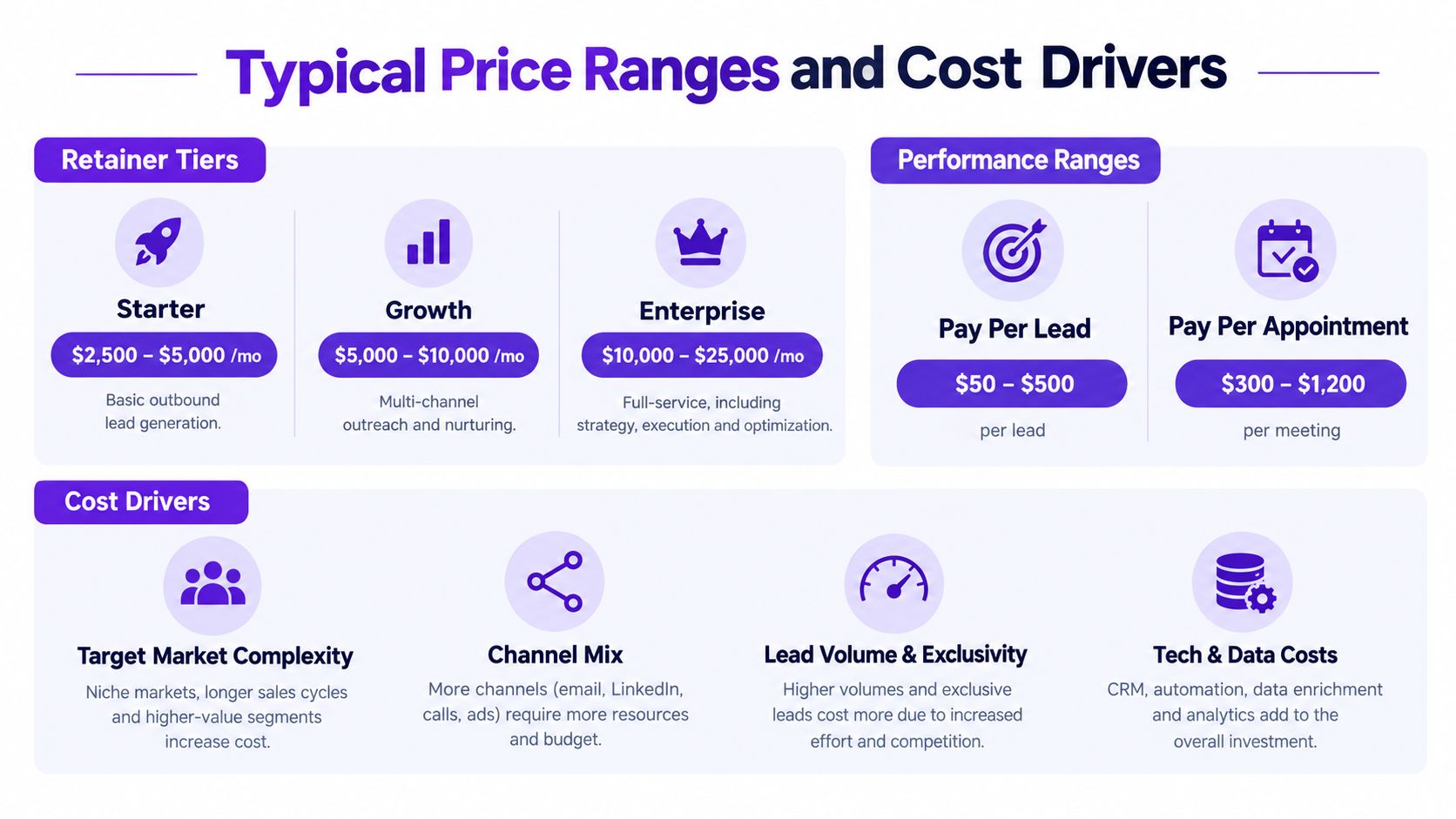
The market offers several useful anchors. A widely cited 2026 benchmark places managed B2B retainers at $3,500 to $12,000 per month, with omnichannel programs exceeding $20,000. The same benchmark places performance pricing at $150 to $600 per qualified lead or $300 to $900 per booked appointment. See the lead generation agency cost benchmark for the underlying ranges.
A broader historical benchmark puts managed retainers around $3,000 to $15,000 per month, with many mid-market engagements near $5,000 to $8,000. It also reports performance ranges of $50 to $500 per qualified lead and $300 to $800 per appointment, while full-service programs combining outbound SDR work with content or paid media can reach $8,000 to $25,000 per month. Setup fees of $2,000 to $5,000 may sit on top of the monthly charge, as outlined in this B2B lead generation pricing guide.
Several 2026 pricing guides place the mid-market retainer cluster at $5,000 to $10,000 monthly, with premium and enterprise programs around $10,000 to $25,000 or more. That gives buyers a practical tiering lens, though scope still matters more than the label on the tier. The lead generation service pricing overview provides that benchmark.
Six factors that move the quote
Industry and ICP difficulty: A narrow market with scarce decision-makers requires more research and persistence than a broad segment.
Qualification depth: A contact match costs less to validate than a meeting with a specific senior buyer and a documented business need.
Channel mix: Email-only execution usually involves fewer delivery resources than coordinated email, LinkedIn, calling, content, and paid media.
Exclusivity and territory: Exclusive access and a tightly protected territory reduce the agency's ability to distribute the same opportunity elsewhere.
Decision-maker seniority: Reaching a senior executive usually requires sharper positioning, better data, and more careful timing.
Geography: Regional coverage, language requirements, working hours, and local sales practices can alter staffing and execution needs.
A pay-per-appointment comparison from Reachly's pricing analysis shows why published meeting ranges vary, with benchmarks around $150 to $600 in one source and $50 to $500 in another. Another pricing comparison from Toplead places qualified meetings around $200 to $1,000, with higher prices associated with senior buyers, exclusive territories, and harder-to-reach accounts.
The practical rule: price rises when the agency must solve a harder targeting problem or deliver an outcome closer to revenue.
The cost per acquisition guide is useful for connecting these acquisition costs to your wider customer economics.
Budget Planning and ROI Math With Real Examples
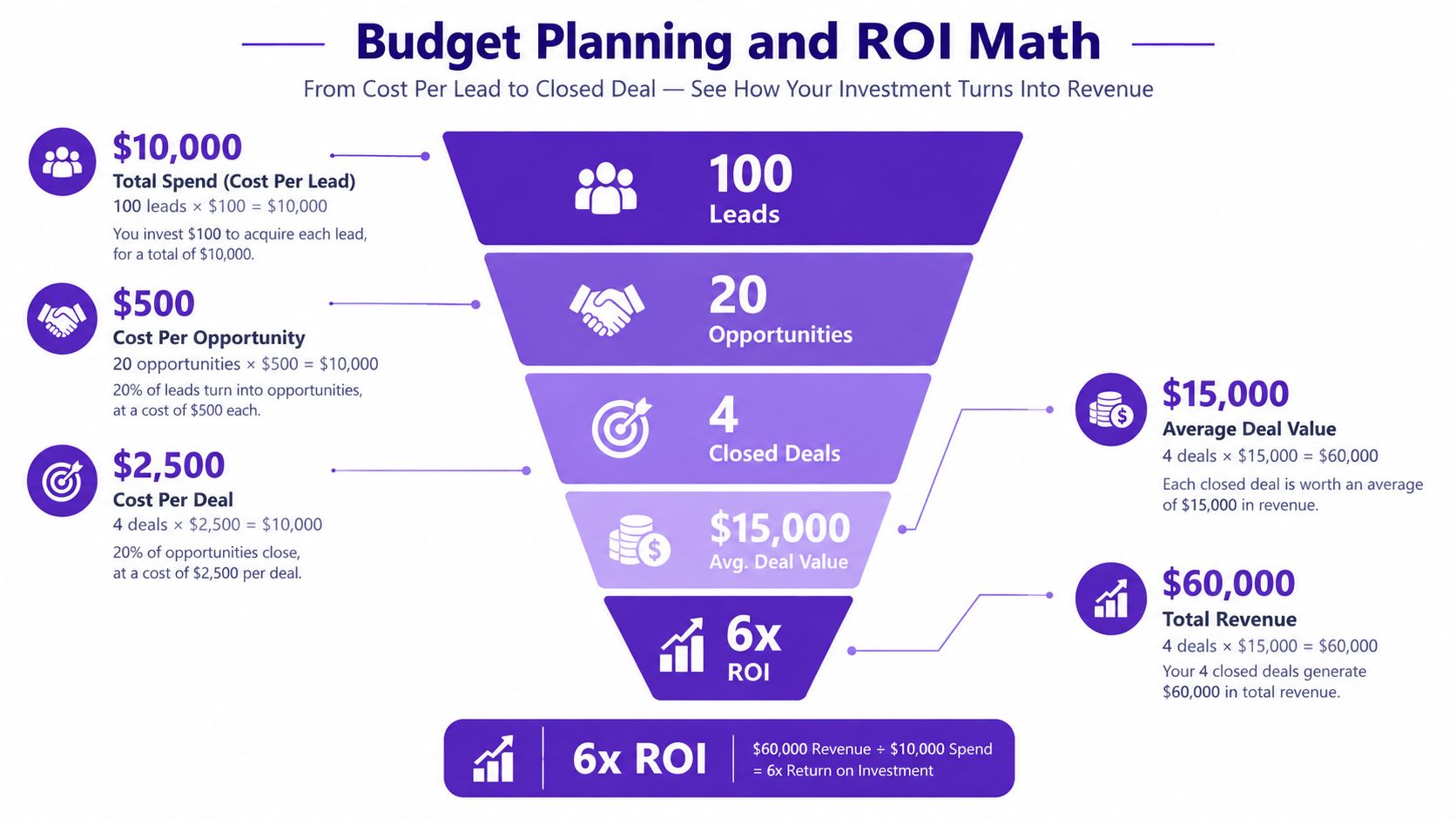
Pricing only becomes meaningful when you connect it to your funnel. Start with four inputs: total program cost, accepted leads, opportunities created, and closed deals. Then calculate the cost at each stage instead of stopping at cost per lead.
A worked example
Use a hypothetical program with 100 leads at $100 each, producing $10,000 in spend. If 20 leads become opportunities, the cost per opportunity is $500. If 4 opportunities close, the cost per closed deal is $2,500. Those inputs appear in the supplied ROI illustration and are useful because the arithmetic is easy to replicate.
Assume each closed deal is worth $15,000. Four deals produce $60,000 in revenue, and the simple revenue-to-spend ratio is 6x ROI. This is a teaching example, not a promised agency result, so replace every input with your own historical conversion data.
Build your own calculation
Start with the revenue target. Decide how much new revenue or pipeline your sales team needs.
Work backward from closed deals. Divide the target by your average deal value.
Estimate required opportunities. Apply your opportunity-to-close rate to the number of deals needed.
Estimate accepted leads. Use your lead-to-opportunity rate, then account for rejection and no-show rules.
Compare total investment. Include setup fees, retainers, performance charges, internal sales time, and technology that isn't included in the proposal.
A simple formula is:
Revenue generated ÷ total acquisition investment = revenue ROI ratio
For pipeline-focused businesses, track the same logic through opportunity value and expected revenue rather than celebrating raw activity. Your revenue attribution models guide can help clarify which touchpoints deserve credit when several channels influence one deal.
Agency versus internal execution
Don't compare an agency invoice only with an SDR salary. Compare the complete operating system, including hiring, management, training, data, tools, campaign production, supervision, and the time your sales leaders spend fixing weak execution.
An agency can be more economical when you need speed or several capabilities at once. An internal team may be more suitable when you already have experienced operators, strong data processes, and enough management capacity to run the program consistently.
Negotiation Tips Contract Terms and Red Flags to Watch
A proposal becomes safer when the contract defines what happens before, during, and after delivery. Start with the setup fee. Ask what it covers, who owns the resulting messaging and data, and whether the work remains useful if the engagement ends.

Terms worth putting under a bright lamp
Setup and onboarding: Specify strategy, ICP work, campaign creation, technical preparation, and handoff documents.
Minimum commitment: Match the commitment to your sales cycle, but add review points so a long contract isn't a blind tunnel.
Lead replacement: Define invalid, duplicate, out-of-territory, unsuitable, and previously contacted leads.
Exclusivity: State whether an opportunity is exclusive and whether the agency can work with direct competitors.
Qualification SLA: Write down the exact attributes a lead or appointment must meet.
No-show policy: Decide whether an unattended meeting is billable, replaceable, or treated differently after rescheduling.
Exit rights: Include notice periods, data export, campaign asset ownership, and a clear termination process.
Ask the salesperson to walk through a rejected lead. If the answer relies on phrases such as “good fit” or “interested prospect” without operational criteria, the contract still has fog on the runway.
Red flags that deserve a pause
An unrealistically cheap per-lead promise may indicate broad targeting, weak verification, or a definition of “lead” that your sales team won't accept. Shared lead resale is another concern, particularly when the proposal doesn't explain who else receives the contact.
Vague qualification language, long lock-ins without performance gates, and guarantees that exclude nearly every realistic failure condition should also trigger questions. A guarantee isn't valuable because it exists in bold type. It's valuable when the remedy, measurement period, exclusions, and evidence requirements are clear.
Ask, “What would make you replace this lead, and how quickly would you do it?” The answer often tells you more than the headline price.
For a pilot, negotiate a defined audience, channels, acceptance criteria, reporting cadence, review date, and exit option. The point isn't to force an agency into a tiny test that cannot work. It's to make both sides agree on what learning and delivery should look like before expanding the commitment.
Choosing the Right Pricing Structure for Your Business
Use your business context to choose the model, not the other way around.
Large deal value and a long sales cycle: A retainer or hybrid model usually gives the agency enough room to research, nurture, and optimize.
Clear qualification and limited sales capacity: Pay per accepted appointment can work, provided your team can follow up quickly.
Early market testing: Pay per lead or a tightly scoped pilot can limit exposure while you validate audience and message fit.
Strong CRM and attribution discipline: A revenue-share or hybrid agreement becomes easier to govern because both sides can inspect the same funnel.
Internal LinkedIn expertise: A tool-led approach may make sense when your team can own messaging, approvals, and follow-up. Signal-led prospecting and LinkedIn outreach deserve separate evaluation from outsourced appointment setting.
RoverLead AI is one example of a tool-led option. Its Signal Agents monitor LinkedIn activity such as comments, content interactions, pricing discussions, and demo talk, then surface prospects with context and draft personalized openers for approval. The product is positioned as a LinkedIn AI SDR that supports reviewed outreach and follow-up, rather than replacing the need for a defined ICP, qualification process, or sales capacity.
The best pricing structure aligns incentives with the part of the funnel your business can manage. Compare proposals using scope, qualification, risk, conversion assumptions, ownership, and exit terms. Then choose a small, measurable pilot where the agency must earn expansion through evidence, not enthusiastic adjectives.
If you want to evaluate a lower-risk alternative to agency retainers, visit RoverLead AI to see how its LinkedIn AI SDR workflow identifies intent signals, drafts outreach for your approval, and helps your team manage follow-up. Use the same questions from this guide, especially around ICP fit, qualification, ownership, and measurable pipeline outcomes, before choosing the plan that fits your sales motion.