
How to Prioritize Sales Prospects with Signal-Based Scoring

It's 11:47 a.m. and your SDR queue looks like a junk drawer with a CRM login. New demo requests. Old webinar leads. A company that matches your ICP perfectly but hasn't done a thing in weeks. Another account that's a little messy on paper but suddenly has three people poking around your category on LinkedIn.
Many teams call this a lead volume problem. It usually isn't. It's a prioritization problem.
If you want a practical answer to how to prioritize sales prospects, stop treating lead scoring like a magic number that settles every argument. The score is only useful if it tells reps what to do next, how fast to do it, and whether the prospect belongs in human follow-up at all. That's triage, not scoring theater.
Table of Contents
The SDR Midday Panic and Why Triage Beats Scoring
Three reps can burn half a day arguing over who should call whom first. Meanwhile the buyer talks to the vendor that replied before lunch.
That's why I treat prioritization like an ER desk, not a spreadsheet. A score can summarize signals. It can't replace judgment about urgency. The practical question isn't “who crossed the threshold?” It's “who needs action now, who needs a sequence, and who needs to stay in nurture until the signals change?”
Start with a hard ICP filter
Before you score anything, define who belongs in the pool. If your ICP lives in a slide deck full of adjectives like "growth-minded," reps will interpret it six different ways by Thursday.
Use binary filters first:
Firmographic must-haves such as industry, employee range, geography, and business model
Role fit such as function, seniority, and title patterns tied to your pain point
Explicit disqualifiers such as students, agencies, tiny firms, or roles with no buying influence
If you sell a RevOps tool, “VP Revenue Operations,” “Director Revenue Operations,” and “Head of GTM Analytics” belong in the conversation. “VP Marketing” might be adjacent, but adjacent is where pipeline goes to nap.
Practical rule: If a junior SDR can't apply your ICP without Slack debates, the filter is too fuzzy.
The setup matters because a lot of teams waste good intent data on accounts that were never closeable. The opposite mistake is just as common. They obsess over fit and ignore live buyer behavior. In a two-stage predictive model tested on a B2B legal consulting dataset, combining profile fit with observed intent outperformed both intuition-based qualification and a classification-only approach, with a 19.30% conversion rate versus 5.81% for the intuition baseline and 13.67% for classification-only in the PRISM study.
Scoring is input. Triage is output
The rep doesn't need “87 points.” The rep needs a next move.
A perfect-fit account with no urgency is not the same as a mid-fit account showing fresh buyer activity. One belongs in planned follow-up. The other deserves same-day action. Timing changes ownership, channel, and response speed.
Here's a clean way to document that ICP gate before any scoring logic starts.
Filter Category | Hard Rule (Binary Gate) | Soft Rule (Adds Signal Weight) | Example Match | Example Reject |
|---|---|---|---|---|
Industry | Must be in target vertical list | Adjacent vertical gets lower weight | B2B SaaS | Local retail chain |
Company size | Must fall in target employee band | Near-range companies get partial weight | Mid-market software firm | Ten-person agency |
Geography | Must sellable by territory and compliance | Secondary regions get lower priority | US or UK account | Unsupported region |
Role | Must map to buying problem | Influencer role can add partial weight | VP RevOps | Junior coordinator |
Seniority | Manager and above | Director+ adds stronger weight | Director of Revenue Ops | Intern |
Business model | Must match product use case | Mixed models get reduced weight | SaaS with inside sales team | Consumer-only brand |
Negative filters | Any hard disqualifier removes from routing | None | No agencies, students, competitors | Competitor account |
Why triage beats the universal cutoff
A lot of teams still run one handoff line and hope for the best. That's easy to administer and lousy in practice.
One independent benchmark says only 44% of companies use any lead scoring system, and only about 39% consistently apply qualification criteria, which leaves a large share of leads inadequately assessed or untouched. The same benchmark notes that sales teams spend about 25% of their week on prospecting-related work, including 8% on prioritizing leads, so bad ranking creates a direct productivity tax. It also highlights a brutal speed penalty: qualification success drops 10x when response time stretches beyond five minutes, with a further 400% drop at ten minutes versus five in the SPOTIO sales statistics roundup.
That's the whole game in one ugly package. If your model can't separate “call now” from “work later,” it isn't helping reps. It's just decorating the queue.
The Four Signal Families That Actually Move Replies
The scoring models that collapse in production usually have one problem: they treat every signal like a raffle ticket. Opened an email. Visited a page. Has the right title. Congratulations, 10 points each. That's how you end up with fake precision and flat reply rates.
Break signals into four families instead.
What each family tells you
Fit tells you whether the account could buy.
Intent tells you whether the account may be actively shopping.
Engagement tells you whether the person has interacted with you before.
Timing tells you whether something changed that makes the conversation more urgent.
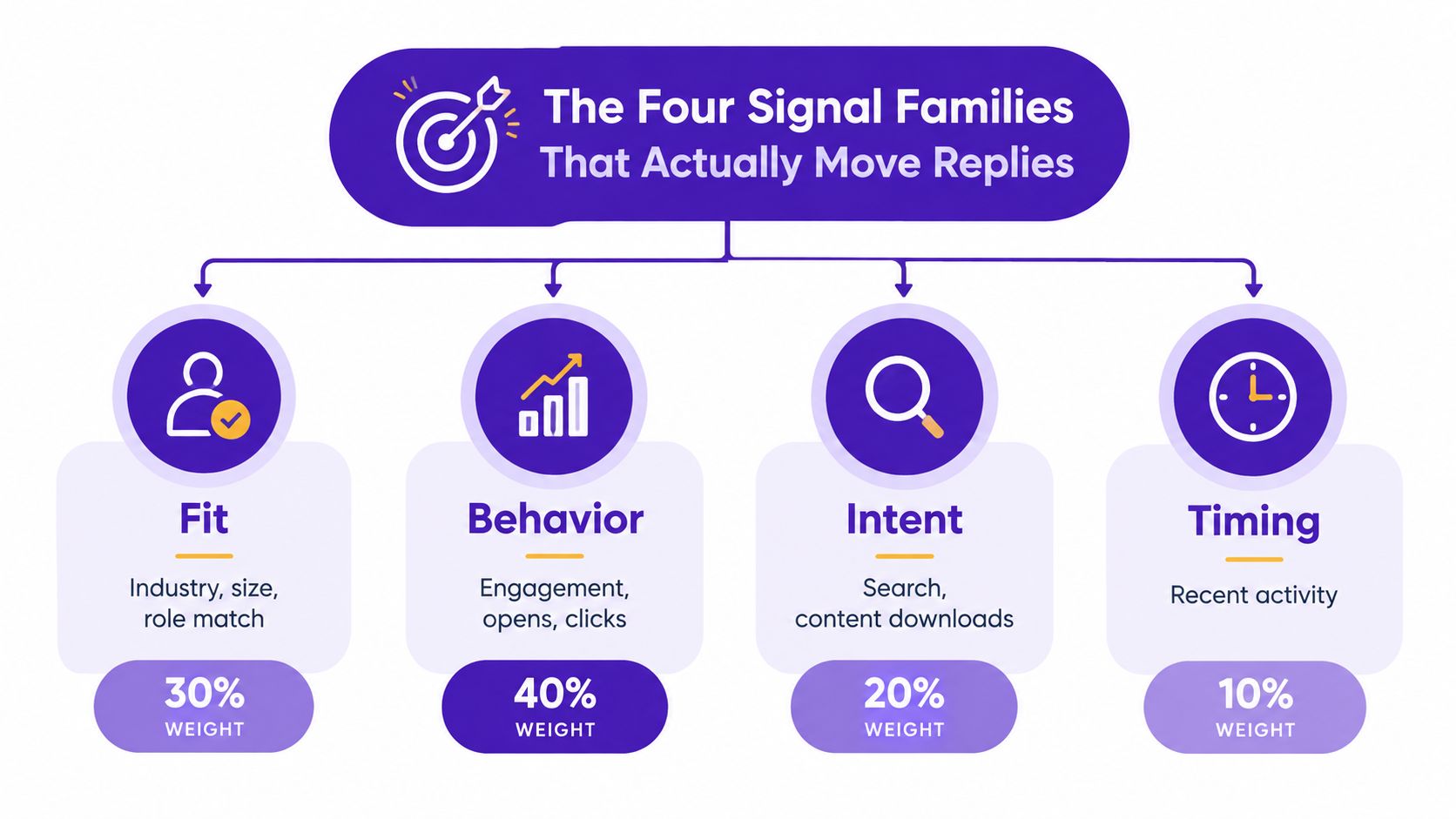
A practical model weights fit lightly, intent heavily, engagement in the middle, and timing as an accelerator rather than a vanity boost. That doesn't mean fit is optional. It means fit is the cover charge, not the whole evening.
For teams working social-led outbound, the newer wrinkle is that buying behavior often starts before a prospect ever hits your site. Public LinkedIn activity can show up as profile views, company page follows, post engagement, or several people from the same account interacting in a short window. That clustering matters because a “quiet” CRM can hide a very active buying committee, as discussed in this piece on what intent data looks like in modern prospecting.
The strongest prospect often isn't the one with the prettiest firmographic profile. It's the one whose behavior says “the project is alive.”
Weak signals versus strong ones
A strong signal stack usually includes first-party actions like pricing-page visits, product-page visits, comparisons, demo interest, or webinar participation. External research also counts. Review-site browsing and competitor comparison behavior are meaningful account-level buying signals in the buyer intent signal guide from NetworkHQ.
Weak signals still matter, but they shouldn't outrank everything else. Two email opens from a perfect-fit title are not the same thing as repeat category research or active comparison shopping. The easiest scoring mistake is double-counting polite curiosity as purchase intent.
Fit Versus Intent Versus Timing and How to Rank Them
Reps get into trouble when they act like fit, intent, and timing are interchangeable. They're not. Each answers a different question.
Dimension | Fit (ICP Match) | Intent (Buying Behavior) | Timing (Trigger Event) |
|---|---|---|---|
Core question | Should this account even be on my list? | Is this account actively researching the category? | Is there a reason to act fast right now? |
Strong signal | Clear industry, size, and role match | Repeated high-intent research, comparison behavior, demo-related activity | Leadership change, budget window, hiring surge, visible project motion |
Weak signal | Broad adjacency to target market | One-off click or casual content interaction | Old trigger with no recent movement |
Common false positive | Looks like past customers but has no active need | Consumes content without budget or authority | Trigger event happened, but initiative died |
Best use | Binary gate and baseline priority | Main driver of who gets worked first | Speed modifier and routing accelerator |
The ranking rule is simple.
If fit is missing, intent and timing can't save the lead. If fit is present and timing is hot, lower intent can still justify outreach. If fit is present but timing is cold, push it into nurture unless intent is unusually strong.
That trade-off shows up in conversion data too. Independent lead generation data published in 2026 reports a median MQL-to-SAL acceptance rate of 47.1%, while MQL-to-SQL conversion rises from 11.2% with behavioral plus demographic scoring to 16.4% when third-party intent is added and 19.7% with predictive AI scoring. The same dataset shows SQL-to-opportunity rates of 58%, 67%, and 71% across those three tiers, with lead-to-won rates increasing from 0.96% to 2.21% in the published dataset summary.
That's why I'd rather rank a decent-fit account with fresh buying behavior above a beautiful-fit account doing absolutely nothing.
Building a Scorecard With Tiers Not Just Numbers
If your scorecard ends at a total number, reps will game the threshold or ignore it. Build the output as tiers with clear action rules.
Score the categories, cap the noise
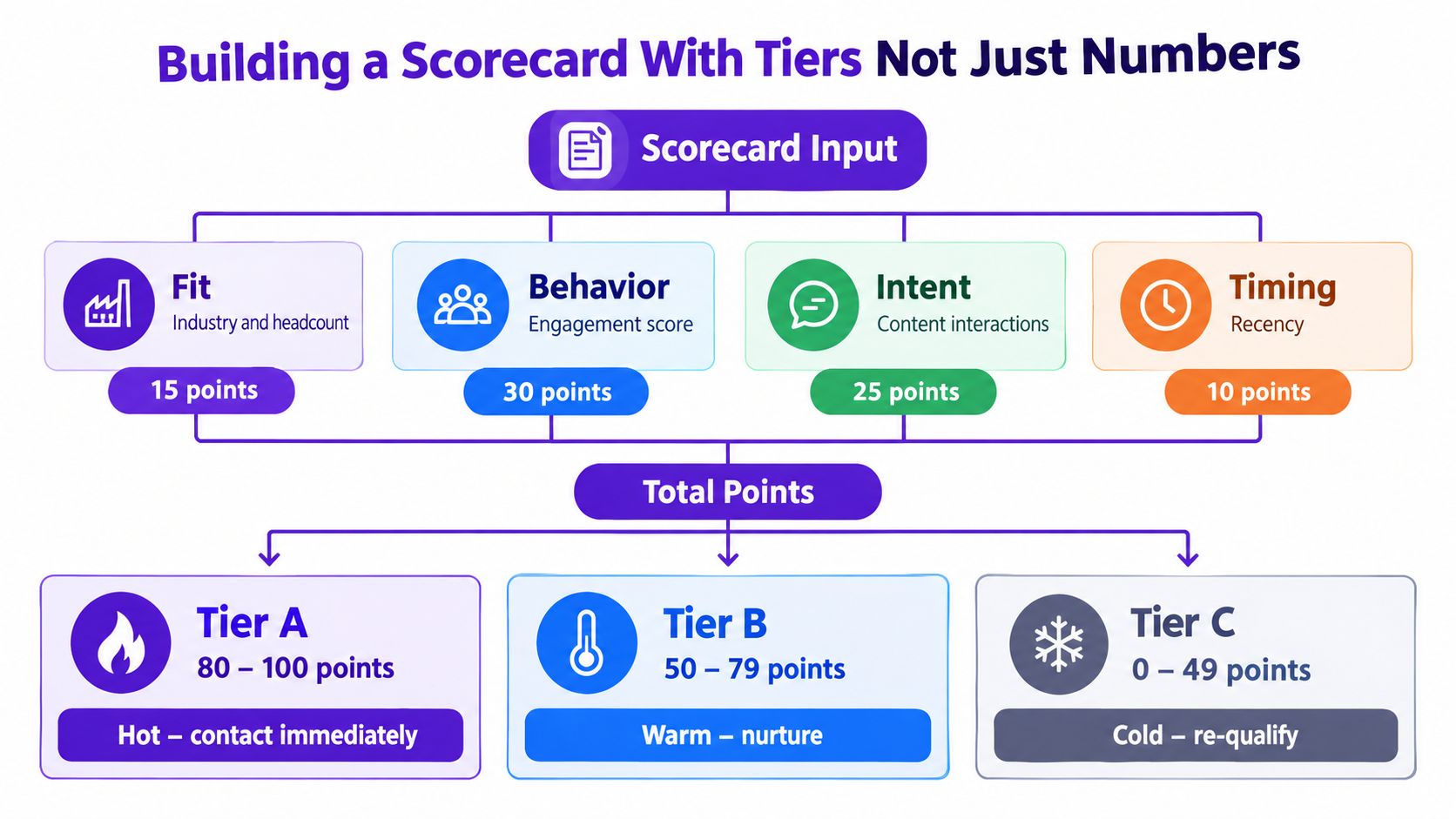
Use category caps so one type of activity doesn't drown out the others.
A workable example:
Fit points for industry, headcount, geography, and role
Intent points for category research, comparison actions, pricing or demo behavior, and clustered account activity
Engagement points for webinar attendance, replied nurture, or meaningful email interaction
Timing points for fresh trigger events that justify faster routing
The exact weights will vary by sales motion, but the principle doesn't. Cap each family. Otherwise one hyperactive contact can rack up nonsense points and leapfrog better opportunities.
Most B2B teams use a handoff threshold on a 0 to 100 scale. One commonly cited model routes 75 to 100 points to sales, keeps 50 to 74 in nurture, and holds anything below 50 with marketing in this guide to B2B lead scoring thresholds. Another practical guide says MQLs often sit at 50 to 70 points, SQLs usually start at 80+, and the initial SQL cutoff should be set about 10 to 15% below the average score of closed-won deals at first contact in this write-up on how to qualify sales leads and the scoring calibration advice from Cleverly.
Turn the score into routing
A score should trigger a lane:
Tier A gets immediate human follow-up
Tier B gets structured sequence enrollment
Tier C stays in nurture until fresh signals appear
Recycle catches anything blocked by a hard disqualifier, regardless of score
For teams doing LinkedIn-led outbound, tools can reduce the manual research load. RoverLead AI, for example, can enrich firmographic context and surface LinkedIn intent signals so reps review a prioritized feed instead of hunting account by account.
A quick visual helps when you're rolling this out to reps. Then use the video below to sanity-check how your team handles qualification.
The Daily Triage Workflow a Rep Should Match
A scorecard no one uses is just a very organized lie.
Monday morning should feel boring in the best way. The rep opens the queue and works by lane, not mood.
What the morning actually looks like
From 8:30 to 9:00, review the top tier only. Every top-tier prospect gets a personalized opener queued, a call task, or a handoff note to the AE.
From 9:00 to 9:30, set the week-one cadence for the middle tier. Confirm channel mix. Make sure the message matches the strongest observed signal instead of using a generic “just bumping this up” email that nobody asked for.
From 9:30 to 10:00, batch the lower tier into nurture and move on. Don't keep reopening those tabs like they're going to become urgent through positive thinking.
Ownership has to be obvious
SDRs own high-priority and mid-priority lanes
Marketing owns nurture until the score changes
Ops owns recycle and data cleanup
AEs step in when the account context or deal size justifies early involvement
Good triage removes decisions from the busiest part of the day.
Then run a short Friday audit. Pull a few closed-lost deals and compare their original tier to what happened. If the model overrated dead accounts or missed active buyers, fix the weight, not the rep lecture.
Teams that want better consistency usually need a cleaner operating rhythm, not another dashboard. That's also why a disciplined SDR outbound strategy matters. Prioritization and execution are one system.
Sequencing Outreach by Tier With Sample Openers
Different tiers deserve different cadences. Sending the same sequence to every prospect just with extra enthusiasm is not segmentation. It's laziness with merge fields.
Match the cadence to the buying temperature
Top-tier prospects should get short, fast sequences because the buying window may already be open. A hiring trigger, active comparison behavior, or clustered account research deserves immediate outreach.
Mid-tier prospects need a longer arc. They've shown enough to justify effort, but not enough to earn the full-court press yet. Lower-tier prospects belong in low-touch nurture until the signal stack changes.
Tier | Touchpoints | Channel Mix | Spacing | Re-score Trigger |
|---|---|---|---|---|
Tier 1 | Short sequence with quick follow-up | Email, phone, LinkedIn | Tight spacing over the first two days | Pricing, demo, comparison, or direct reply activity |
Tier 2 | Multi-touch nurture | Email plus LinkedIn engagement | Spread across roughly two weeks | New intent signal, webinar attendance, or repeat page visits |
Tier 3 | Low-touch nurture | Broadcast email and occasional social monitoring | Reviewed on a slower cadence | Any meaningful engagement spike or account-level research signal |
Sample openers that don't sound mass-produced
For a hiring-based Tier 1 lead:
Saw you're building out a RevOps team. Curious how you're thinking about lead routing and handoff while that function takes shape.
For a LinkedIn-intent Tier 2 lead:
Your post on signal-based outbound caught my attention, especially the part about chasing activity that looks good in a dashboard but never turns into pipeline.
For a softer Tier 3 opener:
Putting together a short benchmark on how mid-market SaaS teams are handling prospect triage. Would love your take if it's useful to compare notes.
The useful habit here is simple. Reference the strongest signal, not your product pitch. If a Tier 2 prospect suddenly clicks into pricing or comparison content, bump them up and switch the sequence. Don't make them wait for your next scheduled nurture touch. If you need message ideas, this library of cold email templates is a solid starting point, assuming you rewrite them around the actual trigger.
Common Pitfalls That Kill a Scoring Model
Most scoring models don't fail loudly. They just become background furniture. Reps stop trusting them, managers stop inspecting them, and everyone goes back to gut feel dressed up as experience.
The three quiet killers
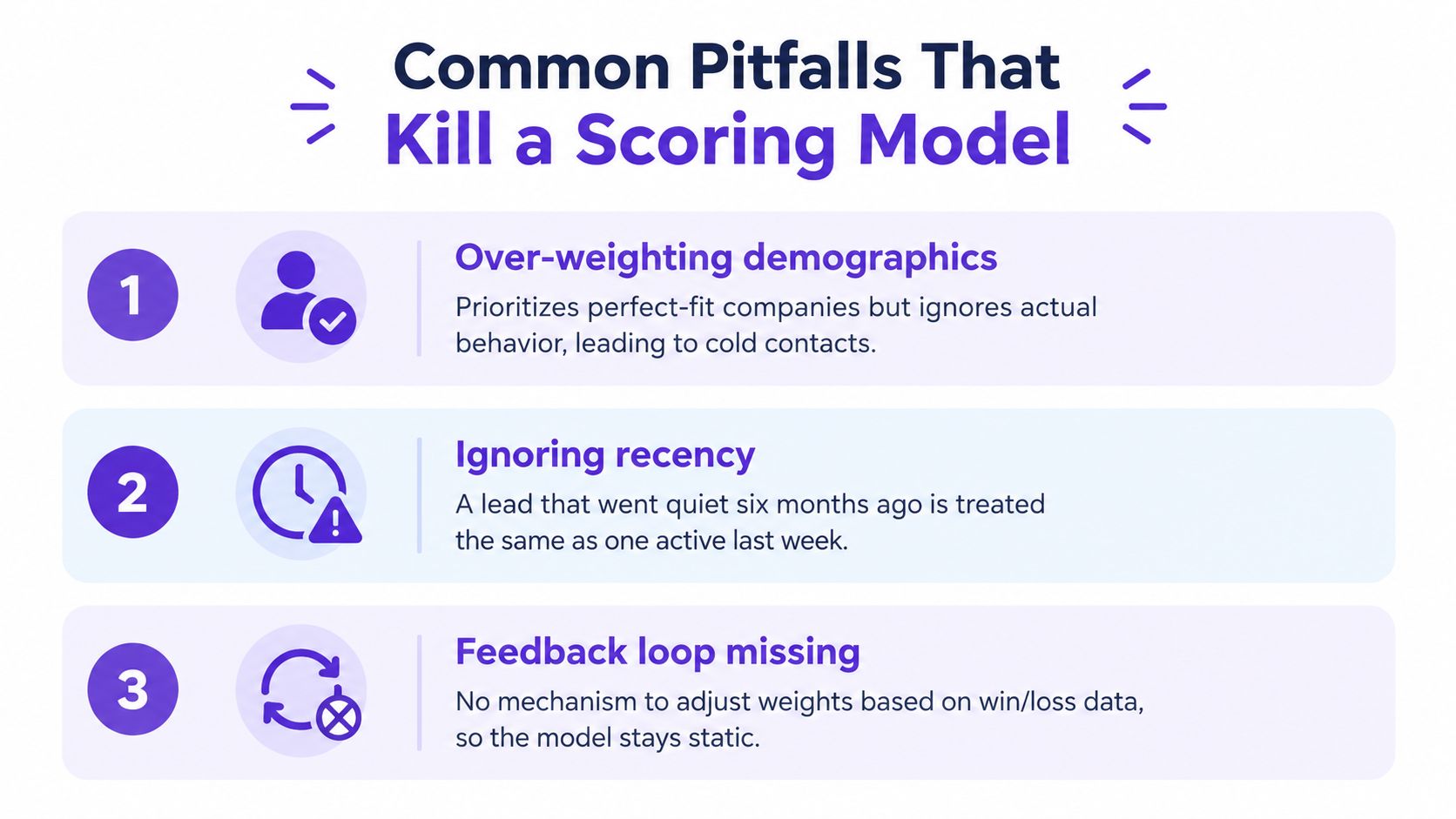
First, teams over-weight demographics. That gives you a lovely list of perfect-fit accounts with all the urgency of a dentist reminder.
Second, they ignore recency. A prospect who was active months ago gets treated like one who was active this morning. That's how hot leads turn into archaeology projects.
Third, they skip the feedback loop. If closed-won deals keep coming from low starting scores while high-scoring deals keep dying, the model is wrong. Not mysterious. Wrong.
A 2026 Salesforce-based summary reports that 79% of B2B marketing and sales teams are using or piloting AI lead scoring, up from 48% in 2023. The same summary says AI-powered models reach 72% to 85% predictive accuracy versus 48% to 54% for traditional rule-based threshold scoring, and teams using AI scoring report 2.1 times higher MQL-to-SQL conversion rates. It also notes reps save an average of 3.2 hours per week on lead-prioritization tasks in this AI lead scoring statistics summary. The lesson isn't “buy AI and relax.” It's that static rules decay fast unless the model keeps learning from outcomes.
A practical 30-day rollout
Days 1 to 7. Document ICP filters, disqualifiers, and the four signal families.
Days 8 to 14. Build the scorecard, set tier thresholds, and backtest it on a sample of existing opportunities.
Days 15 to 21. Run the model in shadow mode next to the current process and compare what reps would have worked.
Days 22 to 30. Switch to tier-based routing and enforce the daily triage rhythm.
What to watch every week
Meetings booked per top-tier cohort
Time to first touch on urgent prospects
Promotion rate from nurture into active follow-up
Forecast quality by tier
A separate benchmark summary on response speed says leads contacted within five minutes convert at 21% to 32%, while next-day replies convert at 2.3% to 12%, and contact odds can fall 100x after the first five minutes in this roundup of lead response time statistics. If your “highest priority” leads still wait around, the model isn't your problem anymore. The workflow is.
FAQ
What's the simplest way to prioritize sales prospects?
Start with hard ICP filters, then rank the remaining prospects by fit, intent, timing, and authority. After that, assign action speed by tier instead of relying on one universal cutoff.
Should fit outrank intent?
Not automatically. Fit tells you whether the account belongs in the pool. Intent tells you whether the project may be active. In practice, a decent-fit account with fresh buying behavior often deserves faster action than a perfect-fit account doing nothing.
How important is response time?
Very. The first few minutes are a major conversion cliff, so urgent leads need immediate routing, not end-of-day cleanup.
What's the difference between scoring and triage?
Scoring summarizes signals into a model. Triage tells the rep what to do next, who owns it, and how quickly it should happen.
Should every signal add points?
No. Some signals should act as gates, some should add weight, and some should accelerate routing. If everything earns equal points, the model becomes noisy.
What signals usually matter most?
Fresh buying behavior tends to carry the most practical value. That includes pricing interest, comparison activity, demo-related behavior, and clustered account research.
How often should we update the model?
Review it weekly at the workflow level and monthly against closed-won and closed-lost outcomes. A scoring model that never gets tuned eventually turns into folklore.
What should happen to low-tier leads?
Keep them in nurture unless the signal stack changes. Don't ask reps to manually revisit every low-priority record out of guilt.
How do I handle weak-fit but high-intent accounts?
If the account still clears your minimum sellability bar, route it differently rather than discarding it. High intent can justify a faster test, especially when authority and timing are present.
Do I need AI to do this well?
No. You can build a solid triage system with clean ICP rules, signal families, and disciplined reviews. AI becomes useful when you need help processing more signals, spotting patterns, and keeping the model current.
RoverLead AI helps teams operationalize this kind of prioritization by monitoring LinkedIn buying signals, matching them to your ICP, and surfacing a daily feed of prospects with context instead of a bloated list to research manually. If you want a workflow that treats prioritization like triage, not scorekeeping, take a look at RoverLead AI.