GTM Tech Stack: 10 Tools for Smarter Growth

Your GTM stack should not need a rescue team. Yet a lot of teams build one anyway, then spend their days cleaning duplicates, reconciling stale fields, and wondering why “more tools” somehow created less pipeline. A gtm tech stack is the connected operating layer for acquisition, activation, engagement, analytics, and sales operations, not a trophy shelf of logins. The best ones keep signals, enrichment, routing, outreach, and conversation data moving without turning RevOps into unpaid plumbing.
The popular advice says to buy the biggest all-in-one and call it strategy. That works right up until the stack starts lying to you. A smarter approach is to pick tools by the job they do, then match them to the company size and workflow you run, not the org chart you wish you had. The comparison below is built that way, with ten complementary options, not a shopping list that says “buy everything and pray.”
Table of Contents
1. RoverLead AI
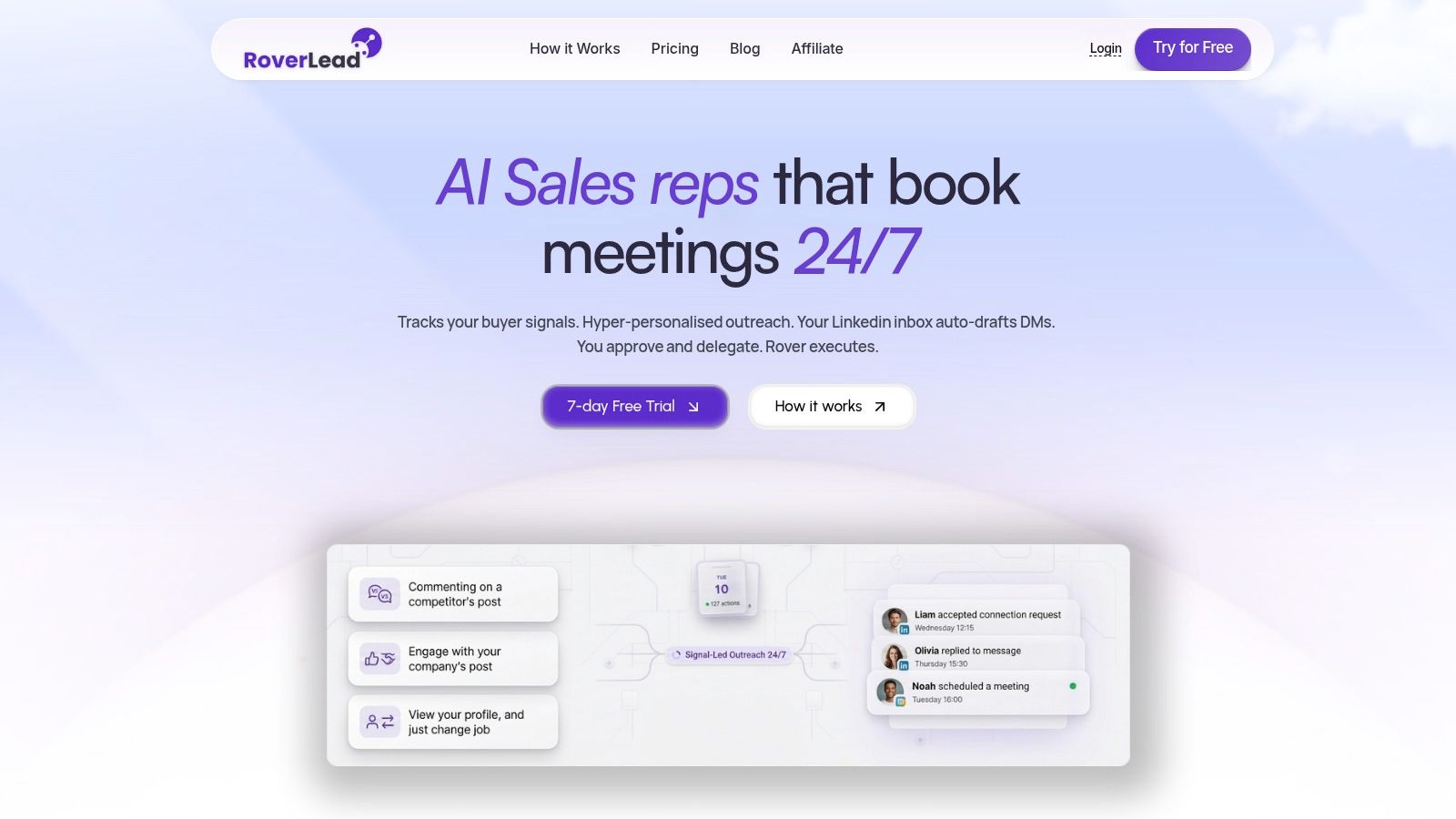
LinkedIn activity is useful only when it changes who your team contacts and why. RoverLead AI turns that activity into a prospecting workflow, helping teams prioritize visible buying signals instead of working through static cold lists. It suits founders who need speed, and SDR managers who need outreach with fewer irrelevant touches.
Signal first, pitch later
Set the ICP, then RoverLead monitors creators, competitors, and niche LinkedIn conversations for activity that may indicate buying interest. It presents each signal with context and suggests an opener tied to the conversation. Nothing sends without approval, so reps can keep judgment in the loop rather than handing their voice to an automation rule.
Use it when your buyers are active on LinkedIn. If they are not, choose a data or intent platform built around channels your market uses.
The built-in inbox provides lightweight conversation management through pins, tags, follow-ups, auto-drafts, and auto-replies. That makes it useful for founders, solo sellers, GTM marketers, agencies, and SDR teams that need a focused workspace rather than another full CRM. RoverLead also positions itself as LinkedIn-compliant by design. It syncs approved outreach and inbox activity to HubSpot and Salesforce via native CRM sync, with optional LLM-assisted drafting.
Pros
Signal-led targeting: prioritizes prospects showing relevant activity on LinkedIn.
Approval-first outreach: lets users review openers and follow-ups before sending.
Lightweight conversation handling: keeps replies organized and follow-ups visible.
Useful for varied GTM teams: supports founders, SDRs, marketers, and B2B agencies.
Cons
LinkedIn dependence: its value falls when target buyers rarely engage there.
Per-user pricing: $149/month/user for Starter and $449/month/user for Growth require enough qualified conversations to justify the spend.
RoverLead is a practical choice for teams that want to move from a visible buying signal to a booked meeting without adding a large prospecting system. Compare it with other LinkedIn-focused approaches in the Apollo alternatives breakdown.
Website: RoverLead AI
2. Apollo.io
Apollo.io is the practical choice when you want one system to cover data, enrichment, intent, sequencing, and inbound capture without assembling a small museum of tools. For lean teams, that is a feature, not a compromise. Fewer moving parts mean fewer handoffs, fewer sync issues, and fewer excuses.

Best when speed matters more than specialization
Use Apollo when you need to launch quickly and keep the stack tight. It gives you B2B data, enrichment, CRM bi-sync, email, call, and LinkedIn sequences, plus a Chrome extension for fast prospecting. The intent topics, alerts, visitor ID, meeting scheduler, and inbound forms make it a solid operating core for smaller revenue teams.
The trade-off is plain. Broad coverage is useful, but broad coverage also means you still need to check data quality by segment and avoid overcomplicating the setup with too many add-ons. Apollo works well as a base layer. It gets awkward when you force it to do everything a specialist point tool should own.
Use it if your team wants one platform to do most things well enough. Replace pieces only when a workflow hurts enough to justify the switch.
Website: Apollo.io
Internal comparison: Apollo alternatives and stack trade-offs
3. Clay
Clay is for teams that treat prospecting like a craft, not a checkbox. It gives you a composable workspace for enrichment, research, and personalized first lines, which is exactly what you want when generic blasts are producing generic results. It's the power tool in this list, and power tools reward discipline.
Use it when the list itself needs intelligence
Clay shines when you need to build workflows around firmographics, tech signals, and intent data, then enrich accounts and contacts before outreach. It integrates with CRMs, sequencers, and webhooks, so it can sit between your source data and your outbound motion instead of duplicating both. That makes it especially useful for high-intent campaigns where the first line matters more than raw send volume.
The catch is the learning curve. Clay can save money by replacing several point tools, but only if someone on the team knows how to operate it well and keeps an eye on credit usage. This is not a platform you casually “set and forget.”
Practical rule: if your team can't explain the workflow on a whiteboard, Clay is too early for you.
Website: Clay
4. ZoomInfo
ZoomInfo is the heavyweight data and intelligence option for teams that need more than a decent contact database. It's the sort of platform you buy when buying committee mapping, org charts, and enterprise coverage matter more than lightweight convenience. In larger organizations, that often means it earns its seat at the table.

Enterprise depth with enterprise friction
ZoomInfo's strength is breadth plus orchestration across data, intent, account triggers, and visitor identification. That makes it a strong fit for ABM teams and revenue orgs that need a fuller picture of who's in the buying group and what they're doing. It also plugs into major CRMs and marketing automation tools, which is table stakes at that level.
The downside is the usual enterprise tax. Packaging can get opaque, add-ons can pile up, and annual commitments can make the bill feel like it was drafted by someone who enjoys suspense. For the right team, that's acceptable. For smaller teams, it's often overkill.
Website: ZoomInfo
Internal comparison: Sales intelligence tool selection guide
5. 6sense
6sense belongs in stacks where account prioritization is the problem, not lack of activity. It's built for teams that want to predict which accounts are in market, then coordinate ads and sales around that signal. That's valuable when too many accounts look “interesting” and too few are ready.
Good for orchestration, not casual dabbling
Use 6sense if you have enough volume to justify account-based motion across marketing and sales. Its predictive intent and buying stage models help direct SDR and AE effort, while ad activation and audience building let marketing reinforce the same accounts. That coordination is the whole point.
The trade-off is implementation weight. This is an enterprise-shaped product, so scope needs to be defined clearly and confirmed before rollout. If your team can't commit to the process, you'll buy sophistication and get confusion.
Pros
Strong ABM focus: it helps revenue teams prioritize accounts that look ready.
Multi-channel activation: ads and sales motions can work from the same account logic.
Useful for larger teams: it fits orgs that need structured orchestration.
Cons
Enterprise implementation: setup takes real planning and ownership.
Scope can shift: credits and feature sets need to be pinned down early.
Website: 6sense
6. HubSpot Sales Hub
HubSpot Sales Hub is the sensible choice when you want your CRM and sales motions to stop arguing with marketing. It gives smaller and mid-market teams a clean path to a unified system without hiring an admin army first. That alone makes it a serious contender.
Fast time to value beats theoretical perfection
Sales Hub includes sequences, meeting scheduling, quotes, reporting, and a smart CRM that ties into marketing, service, and content hubs. That matters because many teams don't need more features, they need fewer places to look for the same lead. The self-serve buying model and no seat minimums make it approachable for smaller companies.
The main trade-off is packaging drift. As teams grow, higher tiers and add-ons can make a previously simple setup more complicated than expected. Still, if your team values speed, visibility, and alignment over custom everything, HubSpot is an easy recommendation.
Website: HubSpot Sales Hub
7. Salesforce Sales Cloud
Salesforce Sales Cloud is what you buy when “single source of truth” is not a slogan but an operating requirement. It's built for organizations with messy process complexity, serious governance needs, and a strong appetite for customization. In plain English, it's the grown-up CRM for teams that have outgrown improvisation.
The cost of control
Sales Cloud handles opportunity management, forecasting, pipeline analytics, role-based security, and a giant ecosystem of extensions. That depth makes it ideal for large revenue organizations that need consistency across regions, products, and reporting layers. It also integrates widely, which is why it becomes the default center of gravity for enterprise GTM.
The price of that power is admin overhead and longer implementation timelines. If your team doesn't have the patience or the internal operator to own the system, Salesforce can turn into a very expensive filing cabinet. If you do have that discipline, it's hard to beat.
Website: Salesforce Sales Cloud
8. Outreach
Outreach is the platform for teams that want sales execution, forecasting, and coaching in one place without stitching together three separate systems. It's especially useful when leadership wants cleaner deal inspection and tighter rep behavior. That's not flashy, but it pays rent.

Execution depth with governance baked in
Outreach combines multichannel sequences, task orchestration, deal insights, forecasting, and conversation intelligence into a single revenue workflow. That makes it attractive for teams that want prospecting and forecast discipline under one roof. Governance controls are another plus for larger orgs that care about consistency.
The caution is budget predictability. Public pricing isn't the point here, and the AI credit model can complicate planning if your team doesn't know how much it will use. If your process is standardized, Outreach is strong. If your process is still changing every month, it's a bad fit.
Website: Outreach
Internal comparison: Sales engagement platform guide
9. Salesloft
Salesloft is the option for teams that want engagement and revenue orchestration to feel connected instead of bolted together. It runs cadences across email, phone, and LinkedIn, then ties the motion into deals, forecasting, and analytics. That makes it a natural fit for teams with a fairly mature outbound rhythm.
Better when the process is already real
Salesloft's strength is workflow depth. It works best when your team has standardized motions and wants the platform to reinforce them, not invent them from scratch. The investments in AI agents and integrations are a sign that the product is moving toward more connected execution.
The downside is that complexity only pays off if the team uses the system consistently. If managers aren't inspecting the work and reps aren't following the cadence discipline, you're paying for orchestration and getting chaos with a dashboard.
Website: Salesloft
10. Gong
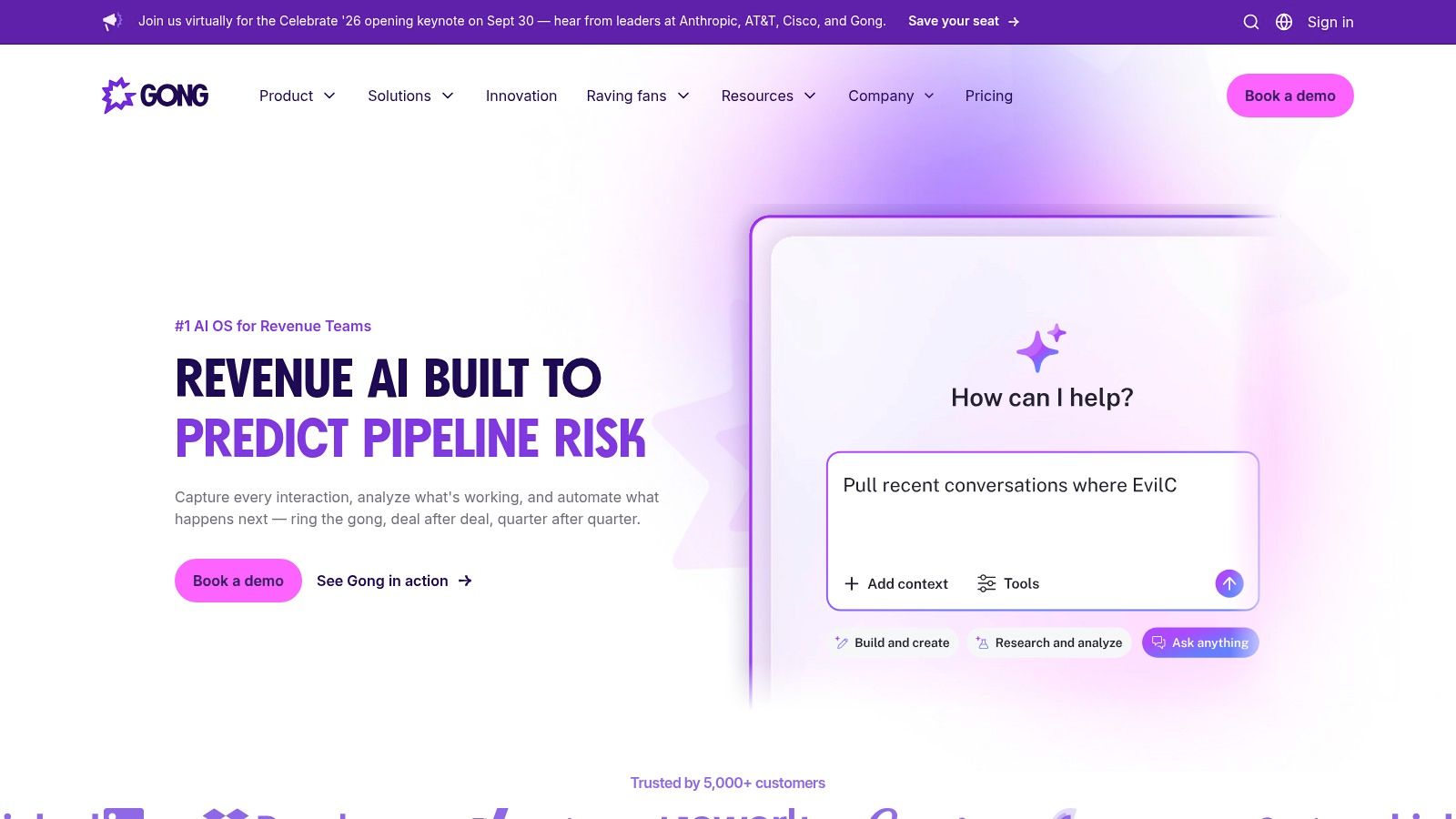
Gong is the conversation layer you buy when leadership is serious about learning from real calls, not just pipeline screenshots. It captures calls, emails, and meetings to show what buyers are saying, how deals are moving, and where coaching should happen. That makes it one of the cleanest ways to connect execution with improvement.
Use it when coaching has to be real
Gong is strongest for pipeline inspection, deal health, forecasting, and rep coaching. Its AI summaries, trackers, and topic analysis help managers move from “I think” to “I heard this in the call.” That's a meaningful upgrade for teams trying to coach to the actual conversation instead of the CRM fantasy.
The main trade-off is cost and process discipline. It works best when calls are recorded consistently and managers use the insights, not just admire the charts. For teams willing to enforce that habit, it becomes one of the most useful tools in the stack.
Website: Gong
Internal comparison: Conversation intelligence guide
GTM Tech Stack, Top 10 Tools Comparison
Product | Core features | UX / Quality (★) | Value & Pricing (💰) | Target audience (👥) | Unique strength (✨) |
|---|---|---|---|---|---|
RoverLead AI 🏆 | Signal-led LinkedIn lead discovery, approval-first outreach, lightweight inbox CRM, auto-drafts & follow-ups | ★★★★★ (2–5x replies reported) | 💰 Starter $149/mo/user · Growth $449/mo/user · Enterprise custom · 7‑day free trial (no card) | 👥 B2B sales leaders, SDRs/BDRs, founders, agencies | ✨ Signal-driven personalized openers tied to exact activity; approval workflow; LinkedIn-compliant |
Apollo.io | B2B data & enrichment, sequences (email/call/LinkedIn), intent (Bombora), visitor ID | ★★★★ | 💰 Self-serve tiers; accessible entry pricing | 👥 SMB → mid-market GTM teams | ✨ All-in-one data + sequencing at lower entry cost |
Clay | Composable data tables, AI research & writing, enrichments, workflow automation | ★★★★ (power-user) | 💰 Token/fixed pricing; variable by usage | 👥 Teams building bespoke, high-personalization prospecting | ✨ Extreme workflow flexibility & deep LLM integrations |
ZoomInfo | Large contact/company DB, intent & Scoops, org charts, direct dials, CRM integrations | ★★★★ | 💰 Enterprise pricing; opaque, annual contracts | 👥 Large enterprises, ABM, buying-committee mapping | ✨ Deep data breadth + buying committee/org-chart mapping |
6sense | Predictive account intent, buying-stage models, ad activation, orchestration | ★★★★ | 💰 Enterprise-focused pricing & implementation | 👥 Enterprise ABM, revenue ops, SDR/AE prioritization | ✨ Predictive account intent with cross-channel activation |
HubSpot Sales Hub | CRM, sequences, meeting scheduler, quotes/CPQ, AI assistants | ★★★★ | 💰 Transparent self-serve tiers; scalable per-seat | 👥 SMBs → mid-market wanting marketing alignment | ✨ Unified CRM + marketing hub for fast time-to-value |
Salesforce Sales Cloud | Opportunity mgmt, forecasting, automations, AppExchange, governance | ★★★★★ | 💰 High TCO; seat/add-on costs; longer implementation | 👥 Large enterprises needing scale, security, customization | ✨ Enterprise-grade extensibility & ecosystem |
Outreach | Multichannel sequences, deal insights/forecasting, conversation intelligence, governance | ★★★★ | 💰 Custom pricing; AI-credit model may affect budgeting | 👥 Mid-market → enterprise sales execution teams | ✨ End-to-end sales execution with forecasting controls |
Salesloft | Cadences across channels, conversation intelligence, deals, analytics/forecasting | ★★★★ | 💰 Custom/opaque pricing; best with standardized processes | 👥 Sales teams focused on cadence-driven workflows | ✨ Deep cadence orchestration + revenue workflow integration |
Gong | Conversation intelligence, call/email capture, deal health, coaching & AI summaries | ★★★★★ | 💰 Premium pricing; high ROI with disciplined recording | 👥 Revenue leaders, enablement, sales coaches | ✨ Rich CI for coaching, objection tracking, forecast accuracy |
Build the Smallest Stack That Can Learn
The best gtm tech stack is the smallest one that can learn from the market without breaking under its own weight. Start with one system of record, one acquisition or intent layer, one engagement motion, and only the analytics or conversation layer your team can operationalize. Anything beyond that should earn its place by removing a real bottleneck, not by looking impressive in a board deck.
For lean teams, the cleanest path is usually HubSpot Sales Hub plus one acquisition layer like RoverLead AI or Apollo.io, with no extra ornamentation. You need speed, decent data, and a workflow your team can run without a full-time operator. If your process leans heavily on personalized outreach, choose RoverLead. If you need broader coverage and quick deployment, Apollo is the more general-purpose bet.
For growing teams, the decision is about focus. Add Clay when enrichment and personalization are the bottleneck, or Salesloft when engagement discipline and workflow consistency matter more than another source of leads. If buyers are clearly showing intent at the account level, 6sense can make sense too, but only if marketing and sales will use it together. The wrong move is adding all three because each one sounded strategically refined.
For enterprise organizations, Salesforce Sales Cloud usually has to remain the system of record, then the rest of the stack should orbit around it. Layer in ZoomInfo for depth, Outreach or Salesloft for execution, and Gong for coaching and forecast quality. That's not glamorous, but it's operationally sane, which is usually what large revenue teams need.
Use the same discipline across the stack. Define ownership for CRM fields and integrations, validate data quality before expanding coverage, and review usage plus pipeline impact before buying the next tool. If a platform isn't changing routing speed, reply quality, conversion rate, or forecast confidence, it's decoration.
Practical rule: the next tool should solve the next bottleneck, not the last one you got annoyed by.
For related guidance, these internal pages are the right next stop: lead generation, CRM selection, sales engagement, intent data, revenue operations, and LinkedIn outreach.
Frequently Asked Questions
1. What is a GTM tech stack?
It's the connected set of tools your revenue team uses to find demand, enrich and route leads, run outreach, manage pipeline, and learn from conversations.
2. Which core categories belong in a GTM tech stack?
You need a system of record, an acquisition or intent layer, an engagement layer, and either analytics or conversation intelligence, depending on how your team works.
3. Which tool combination fits a small team best?
A lean team usually does best with HubSpot Sales Hub plus one acquisition tool like RoverLead AI or Apollo.io.
4. When should a team choose Salesforce over HubSpot?
Choose Salesforce when process complexity, governance, and enterprise reporting matter more than fast setup and simplicity.
5. Is intent data worth it?
Yes, if your team uses it to prioritize outreach and not just to admire dashboards. Intent only helps when it changes who you contact and when you contact them.
6. Do enrichment tools replace a CRM?
No. Enrichment tools improve the data around accounts and contacts, but the CRM remains the system of record.
7. What's the best engagement platform for structured outbound?
Outreach and Salesloft are the strongest picks when you want sequenced outreach, workflow control, and forecasting in one environment.
8. How should integrations be planned?
Map the data flow first, define field ownership, then connect only the tools that serve a clear workflow. Don't wire everything together just because the logos look nice.
9. How do you keep budget under control?
Limit overlap, choose tools by job rather than hype, and review whether each platform is affecting pipeline or just consuming attention and license fees.
10. How do you measure whether the stack is working?
Track whether it improves routing speed, data quality, reply quality, meeting volume, pipeline visibility, and forecast confidence. If none of those move, the stack is bloated.
RoverLead AI gives you a cleaner way to do LinkedIn-led prospecting inside a modern gtm tech stack. It finds high-intent buyers from real activity, turns those signals into approved outreach, and helps teams book meetings without spray-and-pray nonsense. If that's the bottleneck in your stack, visit RoverLead AI and see how it fits your workflow.