AI for Sales Prospecting: The Smart Guide for 2026

Are your sales reps struggling because they lack prospects, or because they're contacting the right prospects at the wrong moment? That distinction explains why AI for sales prospecting is moving beyond automated email writing. The useful systems don't produce more messages. They identify live buying behavior, assemble context, and help sellers act while interest is visible.
AI has become part of mainstream sales workflow use. Salesforce's 2026 State of Sales reporting says 87% of sales organizations use some form of AI for activities such as prospecting, forecasting, lead scoring, or email drafting. But adoption alone doesn't create pipeline. Signal quality, human judgment, deliverability, and disciplined measurement determine whether AI becomes a revenue lever or a faster way to annoy strangers.
Table of Contents
Why Traditional Prospecting Feels Broken
A sales team can start Monday with a clean Sales Navigator list, carefully chosen titles, and a polished sequence. By Wednesday, several contacts have changed roles, posted about unrelated priorities, or already received nearly identical messages from competitors. The list still looks tidy in the CRM. It no longer reflects the market.
That's the problem with static prospecting. A profile can match your ideal customer profile without showing any reason to speak with you today. Reps then compensate with volume, adding more contacts and more follow-ups. Buyers experience the result as a steady stream of interruptions, while sellers experience it as declining replies and an increasingly expensive guessing game.

The list is not the moment
A list answers, “Who might fit?” Modern prospecting also needs to answer, “Why now?” That second question requires activity, not just firmographic or job-title data.
A contact who comments on a post about reducing sales research, follows several operators in your category, or discusses a new technology initiative has given you a usable context clue. A contact who merely occupies the right role has not. Intent data is behavioral intelligence that helps identify accounts actively researching products or services, rather than leaving teams with static lead lists, as ZoomInfo's explanation of intent data makes clear.
The shift is from interruption to relevance. Instead of sending a generic message because a database says someone qualifies, a seller can respond to something the prospect has actually done. That doesn't guarantee a reply, but it gives the conversation a defensible reason to exist.
Practical rule: A good prospect is not only a person who can buy. It's a person whose current behavior gives you a credible opening.
The channel itself isn't innocent either. LinkedIn outreach data cited by Salesforce's AI prospecting overview shows AI campaigns at 20.4% acceptance and 6.5% reply rates, compared with 17.3% acceptance and 4.6% replies for non-AI campaigns. Yet connection-request reply rates fell from 3.5% in May 2025 to 2.2% in April 2026, a sign that buyer fatigue is rising. The answer isn't more automation. It's better timing and stronger context.
Understanding How AI Detects Buying Signals
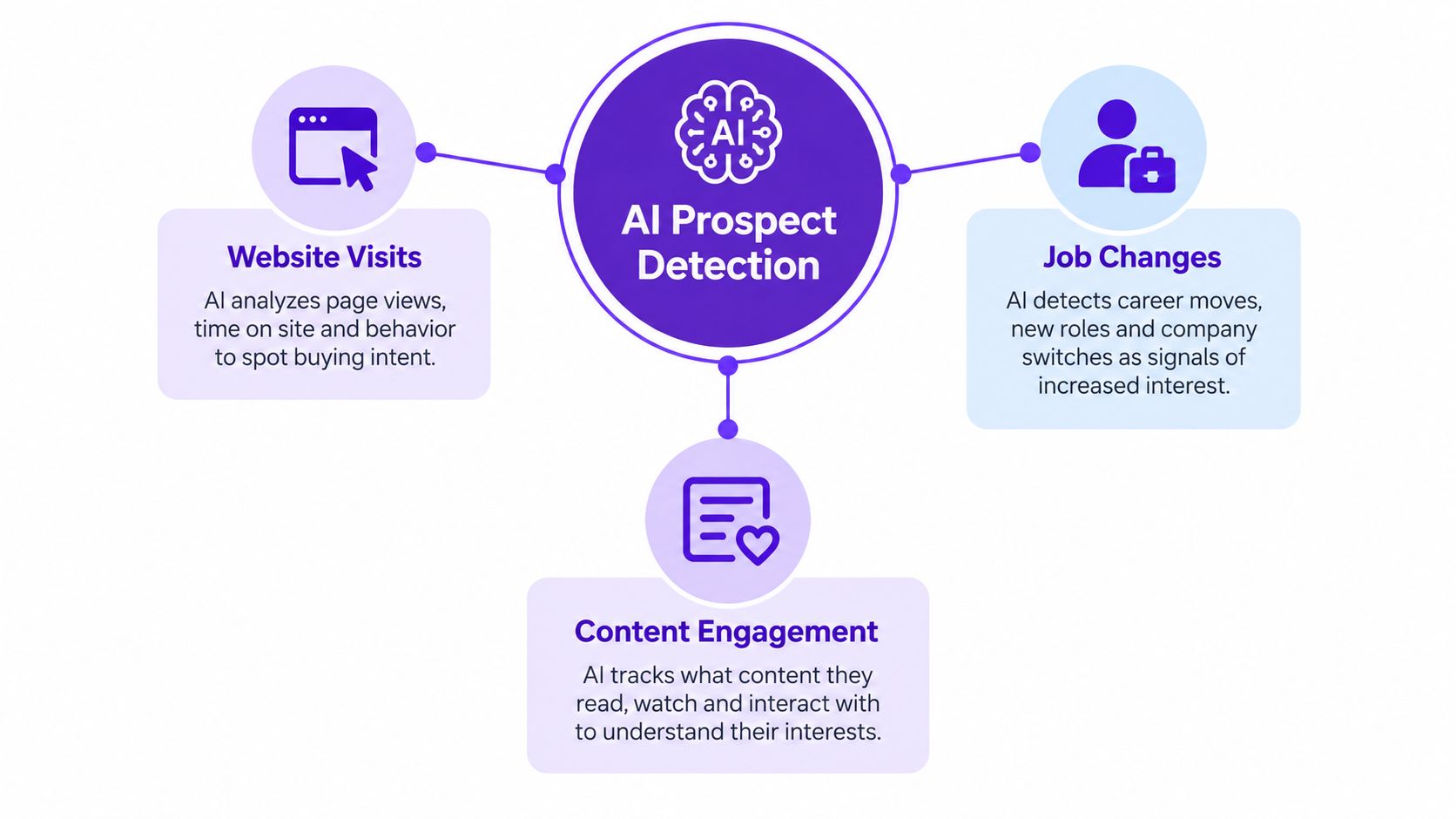
AI prospecting works best as a prioritization layer. It watches multiple sources of activity, weighs their relevance to an ICP, and surfaces the prospects most worth a seller's attention. The important distinction is between identity data and behavioral data.
Identity data tells you who someone is. Behavioral data suggests what they may care about now.
From profile matching to active intent
Useful signals can include:
Content engagement: Comments, reactions, and discussions around a problem your product addresses.
Job changes: A new role can bring new targets, responsibilities, budgets, or pressure to change existing processes.
Hiring activity: Open roles may reveal a team expansion, operational bottleneck, or strategic initiative.
Funding announcements: New capital can create urgency around growth, systems, or efficiency.
Technology changes: A new tool in the stack can indicate a migration, integration need, or competitive displacement.
Website behavior: Visits to pricing, product, or demo pages can support the case that an account is researching solutions.
No single signal should dictate outreach. A job change might be irrelevant, and a comment might be casual. Strong systems combine signals with ICP fit, recency, role relevance, and the account's existing relationship with your company.
Why deep research beats token personalization
Token personalization inserts a name, company, or job title into a template. It looks customized in a spreadsheet and often feels generic in a buyer's inbox. Deep research connects the message to a meaningful business event or public behavior.
LinkedIn research cited by Fin's analysis of AI sales agents reports that AI-personalized emails received 57% more replies, while deep research produced 4x the baseline and title-only personalization performed 26% below baseline. These figures point to a practical lesson: AI doesn't improve outreach uniformly. It amplifies the quality of the context it receives.
A useful opener might refer to a prospect's recent discussion about a workflow problem, then connect that problem to a specific observation about their company. A weak opener says, “I saw you're the VP of Sales at an exciting company.” The first creates a conversation. The second creates a delete action.
For a deeper explanation of the underlying framework, see behavioral intent data in sales prospecting. The operational principle is simple: let AI collect and rank evidence, then let a human decide whether the evidence justifies contact.
Comparing List Building Versus Live Intent Feeds
List building still has a place. Sales teams need account coverage, territory planning, and a reliable way to define their market. The mistake is treating a list as a live prospecting queue. Lists are maps. They aren't weather reports.
A live intent feed adds movement to that map. It can tell a rep which account has become more interesting today, what triggered the alert, and what context might support a natural opener.
Criteria | List-Based Prospecting | Live Intent Feeds |
|---|---|---|
Relevance | Based primarily on ICP, firmographics, title, and account filters | Combines ICP fit with current behavioral activity |
Timeliness | Can become stale as people, priorities, and tools change | Refreshes as new activity and signals appear |
Personalization | Usually relies on templates and profile fields | Uses recent content, engagement, changes, or buying discussions |
Engagement potential | Variable, often weak when no current trigger exists | Stronger when the signal provides a timely reason to reach out |
Rep effort | Research happens manually after list creation | AI pre-screens and summarizes the reason for prioritization |
Best use | Market coverage and account planning | Daily outreach prioritization and timely conversations |
Main risk | Scaling stale targeting | Overreacting to weak signals or noisy activity |
The difference affects conversation quality, not just workflow speed. A list-based rep asks, “How do I personalize this account?” A signal-led rep asks, “What happened, and is it relevant enough to mention?” That second question produces better judgment.
You can still use prospect list building as a foundation, especially for defining territories and excluding poor-fit accounts. Then place a live signal layer on top. The list establishes who belongs in the universe. Intent determines who deserves attention first.
Implementing LinkedIn-Focused AI Workflows
A LinkedIn workflow should feel less like a robot operating a sequencer and more like a research assistant bringing you the right conversation at the right time. The human still owns the judgment call, particularly when the signal is ambiguous or the message could affect a strategic relationship.
Start with a narrow ICP
Define the customer profile in operational terms. Include company type, role, market, use case, exclusions, and the problems that indicate urgency. “B2B SaaS decision-makers” is too broad to guide a useful agent. “Revenue leaders at companies hiring sales development staff and discussing outbound efficiency” gives the system something sharper to watch.
Then choose the LinkedIn activity that matters. Monitor creators your buyers follow, competitors they discuss, niche topics connected to your solution, and language that signals active evaluation. Don't collect every interaction. Noise is still noise when AI delivers it faster.
Build the workflow around approval
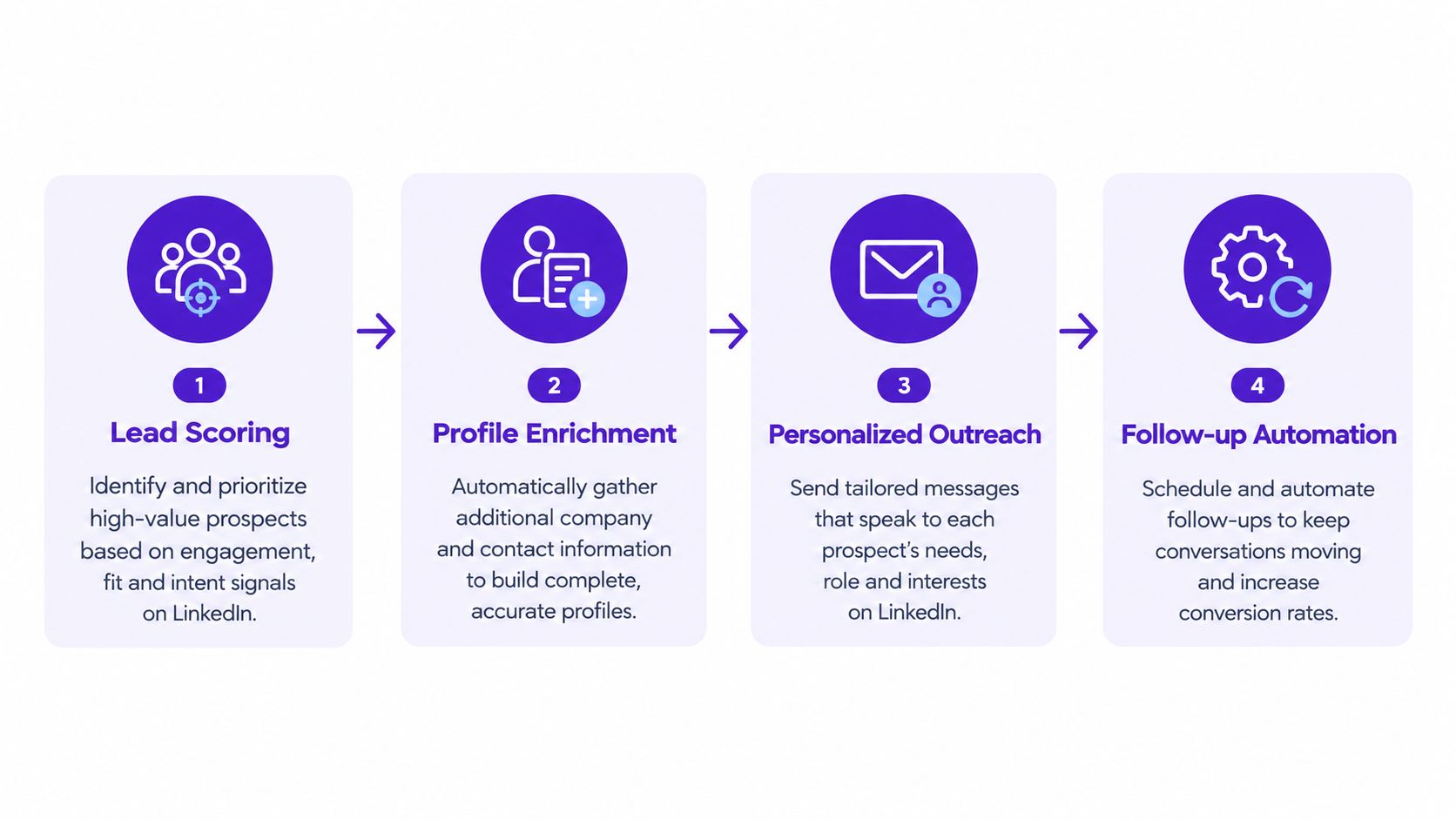
A practical sequence looks like this:
Lead scoring: AI filters activity against your ICP and ranks prospects by fit, signal strength, and recency. A high-fit prospect with no relevant activity shouldn't automatically outrank a good-fit prospect who has just raised the problem you solve.
Profile enrichment: The system gathers the prospect's role, company context, relevant activity, and relationship history. The output should explain why the person surfaced, not merely repeat their headline.
Personalized outreach: AI drafts an opener tied to the signal. The draft should sound like a human noticed something specific, not like a template found a new noun.
Follow-up automation: Approved conversations receive sensible follow-up prompts, while replies and relationship notes return to the lead inbox or CRM. Automation should preserve context rather than restart the conversation every time.
Keep the seller in the loop
Approval is not a ceremonial button. It's where the rep checks whether the signal is genuine, whether the interpretation is fair, and whether the message fits the relationship. A prospect may have commented on a competitor's post because they disagree with it. An AI system can spot the event, but a seller must judge the meaning.
Use clear rules for what can be sent automatically and what requires review. A low-stakes follow-up to an existing conversation may need less scrutiny than a first message to a senior buyer. Keep outreach narrow enough that every approved message has a reason behind it.
LinkedIn automation also needs restraint. LinkedIn outreach automation guidance should be treated as a workflow design problem, not a license to maximize send volume. The objective is to surface better opportunities, not to turn a thoughtful network into a queue of identical touches.
Measuring ROI and Improving Reply Rates
Reply rate is useful, but it's not the whole scoreboard. A campaign can produce replies from poor-fit prospects and still waste the sales team's time. Measure the chain from signal to qualified conversation, then connect it to pipeline progression.
Track the metrics that expose quality
Start with four layers:
Signal quality: How often do surfaced prospects match the ICP and show a relevant behavior?
Message quality: Do replies address the message, ask a question, or show buying interest?
Conversation quality: Are meetings booked with people who have a credible business problem?
Commercial quality: Do those meetings progress into qualified opportunities and shorter sales cycles?
LinkedIn's 2025 research found that 56% of sales professionals used AI daily, and 38% of sellers using AI to research leads and companies saved more than 1.5 hours per week, according to LinkedIn AI sales research summarized by Overloop. The same source reports an average 28% improvement in response rates, while 69% of sellers said AI helped reduce sales cycles by about one week and 68% said it helped them close more deals. Treat those figures as benchmarks, not promises. Your baseline, market, offer, and execution still matter.
Cold outreach remains a modest-conversion activity. Apollo's 2026 cold prospecting benchmark places average reply rates around 3% to 4%, with top performers reaching 8% to 12%. That's why a reply should be evaluated for relevance, not celebrated as a vanity metric.
Personalization cannot rescue bad infrastructure
Woodpecker's analysis of more than 20 million cold emails found reply rates near 18% for advanced personalization versus roughly 9% for basic templates, while Lemlist's personalization benchmark cites an average reply rate of 3.43%, with top-quartile senders above 5.5% and the top 10% above 10.7%. The numbers vary because campaign quality, audience, and definitions vary. The consistent lesson is that meaningful context beats decorative customization.
Deliverability sets a hard ceiling. One benchmark recommends verified contact data that keeps bounce rates at or below 1%, treats 2% as a hard ceiling, suggests warmed inboxes for at least 30 days, and limits sending to no more than 30 emails per inbox per day, as explained in Instantly's AI sales agent conversion analysis. AI-generated relevance won't help if the message never reaches the inbox.
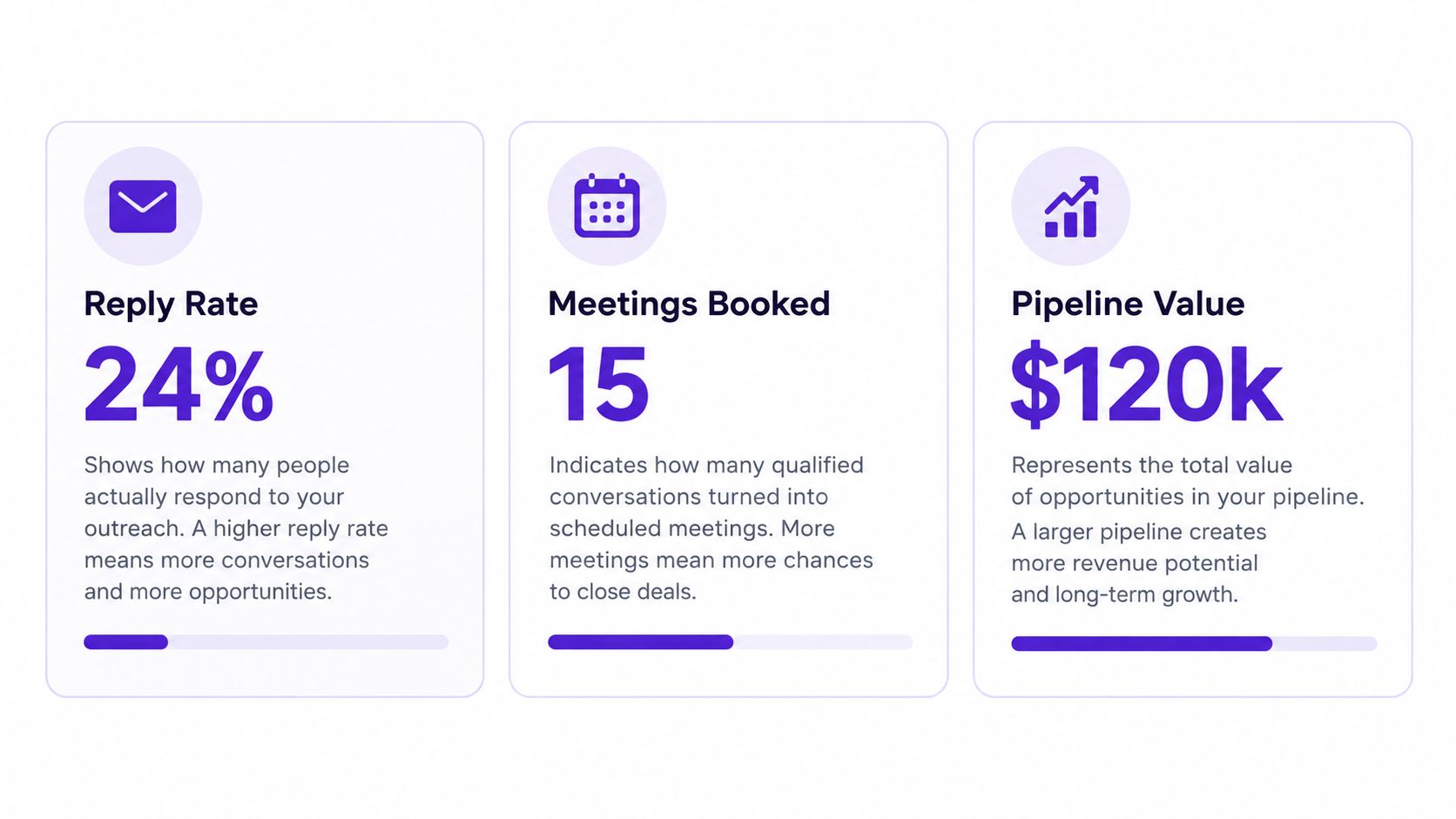
Use the dashboard as a prompt to connect activity with outcomes, not as a reason to chase one impressive number.
Navigating Compliance and Platform Limits
Compliance isn't a final checklist item. It should shape the workflow before anyone writes the first message. Signal-based prospecting helps because it encourages teams to focus limited outreach on people with a credible reason to hear from them, rather than pushing generic automation across a large audience.
LinkedIn has platform limits that make volume-led strategies especially fragile. An independent LinkedIn cold outreach compliance guide states that LinkedIn enforces a hard cap of 100 connection requests per week. The same guide notes that GDPR applies to messages sent to EU residents and requires a lawful basis, such as legitimate interest, along with an easy opt-out.
Design for permission and restraint
A defensible workflow should:
Explain the context: Make the message relevant to the activity that prompted it.
Avoid sensitive assumptions: Don't infer private circumstances from a public action.
Provide an opt-out: Respect a clear request to stop and record it.
Control access: Give teams visibility into what data the system uses and why a person was surfaced.
Keep approval meaningful: Don't turn human review into an automatic rubber stamp.
The same logic applies to email infrastructure. Verified data, conservative sending practices, and suppression rules protect the sender reputation that every campaign depends on. If the workflow needs mass volume to work, it probably hasn't solved targeting.
Choosing the Right AI Prospecting Vendor
The vendor shortlist should begin with the workflow, not the feature count. Ask whether the platform identifies live signals, explains why each prospect matters, drafts from real context, and lets sellers approve outreach before it goes out. A beautiful contact database can still leave reps doing the hardest work themselves.
Test vendors against a small, clearly defined segment. Compare the quality of surfaced prospects, the usefulness of the context, the naturalness of the opener, and the ease of returning replies and notes to your CRM. Also check whether the system supports exclusions, approval controls, audit trails, and sensible activity limits.
A tool focused on LinkedIn buying signals should monitor more than static Sales Navigator filters. It should help sellers notice relevant engagement from creators, competitors, and niche topics, then turn that activity into a reviewable prospect feed. RoverLead AI is one example of this approach, using Signal Agents to surface ICP-matched LinkedIn activity and draft openers for human approval.
For a broader evaluation framework, use this guide to sales prospecting tools. The right choice is the one that improves decisions and conversation quality without adding another dashboard that reps must babysit.
Frequently asked questions
What is AI for sales prospecting?
AI for sales prospecting uses software to identify, research, prioritize, and support outreach to potential buyers. Strong systems combine ICP data with behavioral signals so sellers can focus on prospects who show relevant activity.
Does AI replace sales development representatives?
No. AI can handle research, enrichment, scoring, drafting, and parts of follow-up. Sellers still provide judgment, relationship skill, discovery, objection handling, and commercial decision-making.
What buying signals matter most on LinkedIn?
Relevant comments, content interactions, discussions about a business problem, job changes, hiring activity, and conversations about pricing or demos can be useful. The signal matters only when it connects to the prospect's role and your offer.
Is title-based personalization enough?
Usually, it's not. A title confirms responsibility, but it rarely gives a compelling reason to start a conversation. Deep research tied to a current business context is more useful.
Should teams use email or LinkedIn?
Channel choice depends on the buyer, relationship, offer, and signal. LinkedIn can provide rich public context, while email may be better for a developed business message. Many teams use both, but they shouldn't duplicate the same interruption across channels.
How much outreach should AI send?
There isn't a universal volume target. Sending limits, deliverability, platform rules, audience size, and signal strength should determine activity. A smaller queue of well-qualified prospects is often more valuable than a large queue of weak matches.
How do teams measure AI prospecting ROI?
Track time saved, qualified replies, meetings with ICP-fit prospects, opportunity creation, progression, and sales cycle length. Don't judge the system by connection requests or generated drafts alone.
Is LinkedIn AI prospecting compliant?
It can be designed more responsibly, but compliance depends on the workflow, data, consent or lawful basis, platform rules, and local requirements. Human approval, clear opt-outs, restrained activity, and careful data handling are essential.
Can small sales teams benefit from AI prospecting?
Yes. Small teams often need AI most because research and follow-up compete directly with selling time. The system should remain simple enough to manage and focused enough to avoid creating more operational work.
What should a vendor demo prove?
Ask the vendor to show a real signal, the evidence behind it, the generated opener, the approval step, the follow-up path, and the CRM record after a conversation begins. If the demo only shows a large database and a send button, you haven't seen the part that creates relevance.
RoverLead AI helps B2B teams find high-intent prospects from real LinkedIn activity, review the context, and approve personalized outreach before anything sends. Visit RoverLead AI to build a signal-led prospecting workflow that replaces stale lists and spray-and-pray messaging with timely conversations.