10 Apollo Alternatives for Smarter Sales Outreach

The popular advice is to find the biggest Apollo replacement and move on. That's the wrong question. The best Apollo alternative depends on what's slowing your team down: inaccurate contacts, weak intent detection, poor inbound enrichment, manual LinkedIn research, email verification, or sales engagement.
Apollo is widely positioned as an all-in-one prospecting platform with a database of about 230 million contacts and a starting price of roughly $49 per seat per month, according to independent coverage of prospect research tools. Apollo alternatives are tools that replace the whole platform or one specific job inside it. That distinction matters. A focused tool can outperform a larger bundle when it fixes the bottleneck your reps feel every day.
The market is broad. B2B sales prospecting tools reached $4.49 billion in 2026 and are growing at more than 16% annually, while sales intelligence is projected to grow from USD 4.42 billion in 2025 to USD 9.15 billion by 2031, according to SalesMotion's market coverage and Mordor Intelligence. That growth gives buyers more choice, but also more ways to purchase the wrong category.
Treat pricing and packaging as a starting point, not a promise. Verify current limits, credits, contracts, integrations, and compliance requirements before you buy.
Table of Contents
1. RoverLead AI
RoverLead AI is the strongest choice when your team wants to replace cold LinkedIn list-building with signal-led prospecting. It monitors creators, competitors, and niche conversations for buying behavior such as comments, content interactions, and pricing or demo discussions. Instead of handing reps another static list, it surfaces the exact post that triggered the lead and drafts a contextual opener.
Setup takes roughly 5–10 minutes, using keywords, competitors, and niche experts. Signal Agents then monitor 10+ buying signals, while a rep or manager approves each message before it sends. That approval step is important. RoverLead is designed for human-controlled LinkedIn selling, not an unattended spray-and-pray machine.
The platform's lead inbox works as a lightweight CRM. Reps can follow up, pin, tag, and nurture leads, while the system drafts replies and follow-ups so good conversations don't disappear into the queue. Campaigns also learn from approvals and replies instead of remaining frozen like a Sales Navigator export.

Practical rule: If your buyers actively discuss problems on LinkedIn, start with intent discovery before buying a larger database.
Independent LinkedIn benchmarking reports first-message reply ranges of 25–55% for signal-based outreach, compared with 3–8% for cold static-list outreach in the cited dataset, as documented by Chattie's LinkedIn prospecting benchmarks. RoverLead's own positioning is built around that difference, although results depend on audience activity, message quality, and market.
The Starter plan is $149 per month per user with a 7-day free trial, two Signal Agents, and core features. Growth is $449 per month per user with up to ten Signal Agents, while Enterprise pricing is custom. The trade-off is clear: LinkedIn activity drives the product's value, and per-user pricing can become expensive for large teams. Founding plans include priority support, roadmap input, and a locked lifetime rate. See the guide to AI prospecting tools for more context.
Best for: B2B sales leaders, founders, SDR teams, and agencies that want approval-based LinkedIn outreach from live intent.
Website: RoverLead AI
2. ZoomInfo
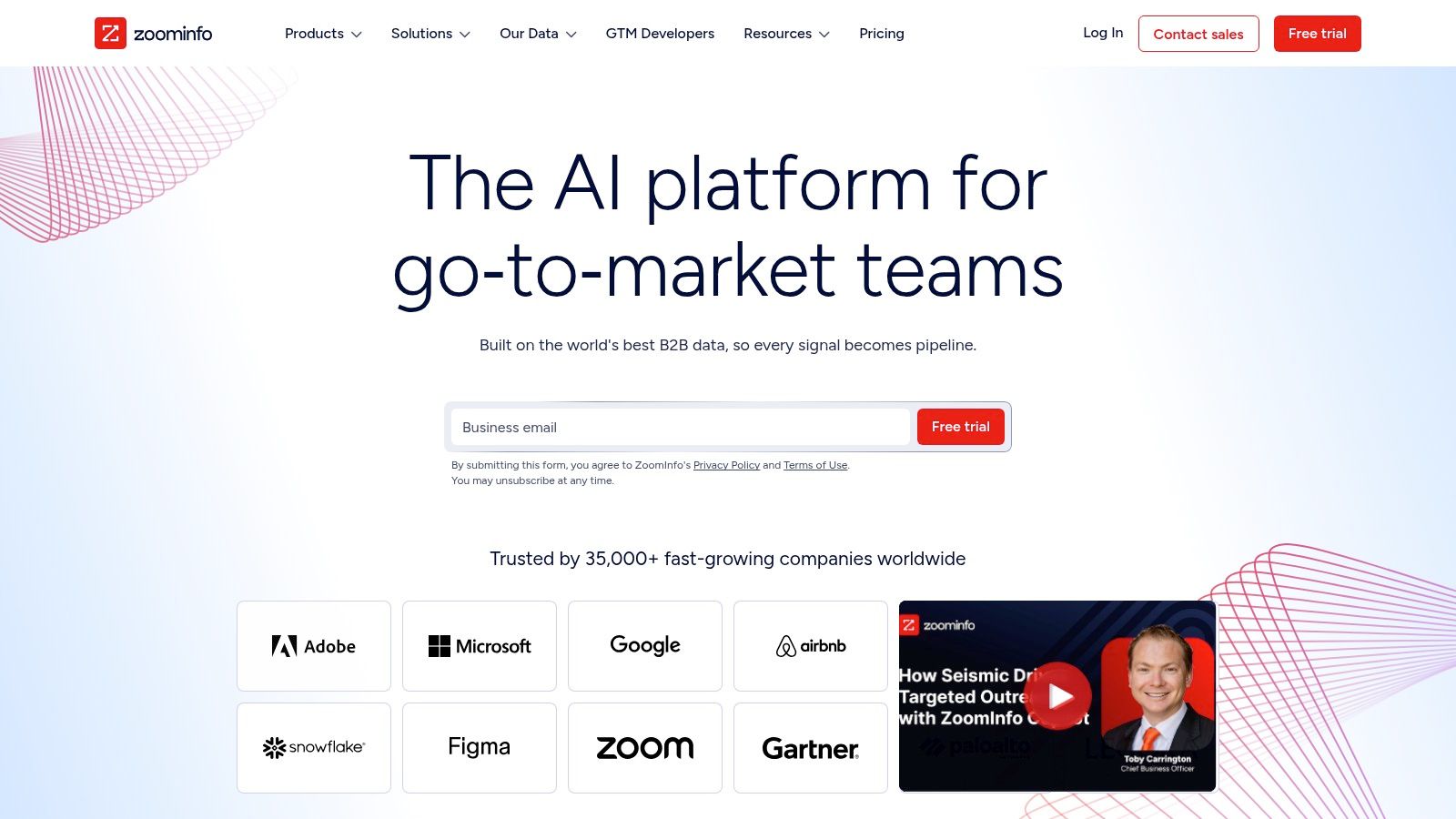
ZoomInfo is the enterprise answer when Apollo's database and workflow breadth aren't enough. It combines company and contact data with buyer intent, technographics, website visitor tracking, enrichment, orchestration, and AI-assisted workflows. Product lines cover Sales, Marketing, Operations, and Talent, with options such as DaaS, API access, GTM Workspace, Studio, and Copilot.
That breadth is useful for organizations trying to reduce tool sprawl. A revenue operations team can build workflows around account changes and buying signals, while sales and marketing teams work from a shared data foundation. ZoomInfo is also built for enterprise integrations, governance, and administrative control.
The downside is equally obvious. Pricing is opaque and contract-based, and the platform can be heavy for a small sales team. You'll need a clear operating model before rollout, because buying ZoomInfo without assigning ownership often produces an expensive database that reps barely use.
ZoomInfo is a data and governance decision, not a casual software subscription.
Choose it when you need enterprise-scale coverage, intent programs, APIs, and security processes. Don't choose it just because its database sounds larger. If your real problem is that reps don't know whom to contact today, a narrower signal-led workflow may create more value.
Best for: Enterprise GTM teams with complex data requirements and the administrative capacity to manage a large platform.
Website: ZoomInfo
For a broader category view, compare it with other sales intelligence tools.
3. Cognism
Cognism is the data-first Apollo alternative for teams that care about compliant global coverage, especially across the United States and Europe. Its Diamond Data offering focuses on human phone-verified mobile numbers, with Diamonds-on-Demand for teams that need additional verification during prospecting.
The product includes Prospector, a Chrome extension, enrichment, data-quality filters, and AI recommendations layered over verified contacts. That makes Cognism particularly useful for sales motions where phone connection quality matters more than having a native all-in-one engagement suite.
Cognism's compliance positioning is a meaningful advantage for teams operating across privacy-sensitive markets. Still, buyers should separate the platform's data strength from their own outreach responsibilities. A verified number doesn't automatically make every campaign relevant, proportionate, or lawful.
The main drawback is cost structure. The best data generally sits behind premium Diamond tiers, pricing is quote-based, and add-ons can raise the total bill. Cognism also works best when paired with a dedicated sales engagement platform, so budget for the complete workflow rather than only the data contract.
Best for: US and EMEA teams that need stronger mobile accuracy, compliant prospecting, and verified contact records.
Website: Cognism
4. Lusha
Lusha is a practical Apollo alternative for fast contact access, not a full sales operating system. Its credit model, free tier, and browser extension give smaller teams a quick way to find email addresses and phone numbers without entering an enterprise buying process. Reps can research prospects and capture contact details without leaving the browser.
The credit logic is straightforward: email lookups cost one credit, while phone numbers cost five credits, according to Lusha's credit documentation. That makes usage easier to forecast. Call-heavy teams should still watch consumption, since phone searches use credits faster.
Lusha also covers prospecting, enrichment, recommendations, an API, and CRM or browser workflows. Use it as a focused data layer beside an existing sender or CRM. That setup keeps implementation light, while teams needing complex sequencing or multi-channel coordination will need another platform.
Choose Lusha for quick research and practical contact access. Choose something else if your priority is intent discovery, approval-based LinkedIn selling, or broad sales engagement orchestration.
Best for: Small teams and individual sellers that want fast contact research, clear credits, and low implementation effort.
Website: Lusha
5. Clearbit by HubSpot
Clearbit is the right Apollo alternative when the bottleneck sits in inbound enrichment, not outbound list creation. It enriches leads, contacts, and accounts with company information, industry structures, and IP intelligence. RevOps teams can use that data to normalize records, score leads, and route them to the right owner.
The product also supports form shortening, which helps teams collect less information from prospects while filling in additional context behind the scenes. That makes Clearbit useful for marketing teams that want cleaner inbound conversion without asking every visitor to complete a miniature census form.
Clearbit is now part of the HubSpot ecosystem, so it makes the most sense for organizations already invested in HubSpot workflows. It isn't a full sequencing and engagement replacement for Apollo. You'll likely pair it with a sales engagement tool if outbound email or LinkedIn execution is central to your process.
Pricing details aren't publicly listed and the buying process is sales-led. That's a disadvantage for smaller teams trying to compare costs quickly, but the deeper issue is category fit. Clearbit improves the records entering your revenue process. It doesn't solve every problem after the record reaches a rep.
Best for: HubSpot-based RevOps and marketing teams that need enrichment, scoring, routing, and anonymous traffic intelligence.
Website: Clearbit
6. LeadIQ
LeadIQ is built around the moment a rep finds a promising person online. Its browser extension captures prospects from LinkedIn and other web pages, syncs them into CRM and engagement tools, and supports job-change tracking for former champions.
That workflow is valuable because a job change can reopen a relationship that looked closed. A rep doesn't need to rebuild the account from scratch. LeadIQ can help identify the new company and push the contact into Salesforce, HubSpot, Outreach, or Salesloft.
The platform also offers AI account prospecting, enrichment, API access, and integrations with common sales systems. Its strength is not necessarily owning the largest proprietary database. Its strength is helping reps capture useful context quickly and move it into the system where follow-up happens.
Pricing isn't fully public, and larger tiers are sales-led. Teams should also expect to pair LeadIQ with other data feeds when they need broader coverage or deeper verification. That isn't a flaw, but it means LeadIQ is a workflow component rather than a universal Apollo replacement.
Best for: LinkedIn-active reps and teams that care about browser capture, CRM hygiene, and job-change workflows.
Website: LeadIQ
7. UpLead
UpLead suits buyers who need a transparent, credit-based B2B database without a lengthy procurement process. It combines prospecting, enrichment, a Chrome extension, email verification, technographics, and API access with published plans and trial options.
Its strongest advantage is cost control. Teams can choose a record volume, test coverage against a small slice of their ICP, and avoid committing to a large platform before the workflow proves useful. That makes UpLead a data replacement for a specific Apollo bottleneck, not an all-in-one sales system.
A practical test matters more than broad accuracy claims. Check the industries, job roles, and geographies you target, then review email validity and direct-dial coverage. UpLead offers verified emails and many direct dials, while intent data and advanced capabilities are reserved for higher tiers. Coverage and refresh cadence can fall behind larger vendors in narrow markets.
Use UpLead when contact data, enrichment, and integrations are the priority. Pair it with a full engagement platform for sequencing, or with a LinkedIn-native workflow when live buying signals matter. It will not replace either one on its own.
Best for: SMBs, solo sellers, and lean sales teams that want public pricing, clear credits, and a quick path to testing.
Website: UpLead
8. Seamless.AI
This tool targets teams that want a large contact supply with outreach and automation built into the same environment. It includes email and phone data, AI workflows, an API, a Chrome extension, onboarding content, and built-in sending or agent capabilities.
That setup fits volume-focused outbound teams. Reps can find records and launch workflows without stitching together several separate tools. API access across plans also makes it easier to connect the platform with existing systems.
The trade-off is validation effort. Pricing is opaque and sales-led, so review subscription and renewal terms carefully. Some users report uneven data quality, and contact volume does not guarantee usable records. Test deliverability, job-title coverage, and record accuracy against your target market before launching a large campaign.
It is best viewed as a prospecting engine with embedded automation. It can replace several Apollo functions for teams that value scale, but a focused tool may create less operational work when the requirement is a small, high-intent list. For approval-based LinkedIn selling from live buying signals, RoverLead AI is the more specialized option.
Best for: Teams that prioritize contact volume, embedded outreach, API access, and automation over maximum pricing transparency.
Website: Seamless.AI
9. SalesIntel
SalesIntel combines AI with human-verified B2B contact data, buying signals, ICP modeling, and engagement workflows. Its Research-on-Demand layer adds a human verification option for teams that need more confidence than an automated database lookup can provide.
The platform also tracks intent, news, hiring, and funding signals, then uses ICPIntel modeling to help identify accounts resembling your best prospects. That makes SalesIntel a strong middle ground between a raw database and a signal-led workflow. You get contact data, but the product also helps decide which accounts deserve attention.
Pricing is primarily handled through sales, and public performance benchmarks are limited. Newer modules may also need onboarding before they become part of a rep's daily routine. In other words, SalesIntel can be powerful, but it won't deliver value by sitting unused behind a complicated implementation.
Human verification helps with data confidence. It doesn't replace message relevance or good account selection.
Choose SalesIntel when contact accuracy and buying signals need to live together. For a clearer explanation of the category, see what sales intelligence means.
Best for: Sales teams that need human-verified records, ICP modeling, and multiple buying signals.
Website: SalesIntel
10. Hunter
Hunter is the cleanest Apollo alternative for an email-first workflow. It focuses on Domain Search, Email Finder, Email Verifier, lightweight sequences, AI-assisted writing, and an API-only Data Platform option for programmatic enrichment and verification.
The product's value comes from narrow focus and predictable usage. Teams can find an address, verify it, and send a sequence without buying a full sales intelligence suite. Hunter also offers a free plan and transparent pricing, which makes it straightforward to test before expanding.
Hunter isn't the right choice if your team depends on phone data, deep intent signals, or native LinkedIn workflows. It works best when verified email is the primary channel and phone is secondary. You may still need a dialer, intent source, or CRM automation layer around it.
Email verification also deserves attention in any cold outreach program. A valid address doesn't guarantee a reply, but sending to poor records can create avoidable deliverability problems. Use Hunter as the clean email layer, then keep targeting and compliance disciplined.
For adjacent research, see this guide to reverse lookup for an email address.
Best for: Founders, agencies, and sales teams that want simple email finding, verification, and sequences.
Website: Hunter
Top 10 Apollo Alternatives, Features & Pricing
Product | Core features / Approach | UX & Quality (★) | Price & Value (💰) | Target audience & USP (👥 ✨) |
|---|---|---|---|---|
RoverLead AI 🏆 | Signal-led LinkedIn AI SDR; autonomous Signal Agents monitor 10+ buying signals; curated contextual feed & personalized openers | ★★★★☆, intent-driven, self-learning, approval workflow | 💰 Starter $149/mo; Growth $449/mo; Enterprise custom, high ROI claims | 👥 B2B founders & SDR teams; ✨ Converts real LinkedIn activity into booked meetings; LinkedIn-compliant |
ZoomInfo | Large B2B database + intent, technographics, website tracking; Copilot & GTM workflows | ★★★★☆, broad coverage, enterprise-grade | 💰 Enterprise, contract-based (opaque), all-in-one value | 👥 Mid-to-enterprise GTM teams; ✨ Depth of data + integrations |
Cognism | Diamond Data (phone-verified mobiles), prospector & enrichment, compliance focus | ★★★★☆, strong mobile connect rates | 💰 Quote-based; premium tiers for best data | 👥 Teams needing accurate mobiles & EU compliance; ✨ Human-verified mobile numbers |
Lusha | Credit-based finder/enrichment, Chrome extension, API, free tier | ★★★☆☆, simple, fast setup | 💰 Credit pricing; free tier, predictable small-team costs | 👥 SMBs & solos testing data; ✨ Transparent credits & quick time-to-value |
Clearbit (by HubSpot) | Global enrichment, IP intelligence, real-time scoring/routing | ★★★★☆, strong enrichment & RevOps fit | 💰 Sales-led; HubSpot-integrated pricing | 👥 RevOps & marketing teams; ✨ Precise enrichment + inbound conversion tools |
LeadIQ | Prospecting extension, AI account prospecting, CRM sync & job-change alerts | ★★★★☆, excellent capture & rep workflows | 💰 Pricing sales-led; optimized for reps | 👥 Reps using LinkedIn/CRMs; ✨ Fast capture from Sales Navigator + champion alerts |
UpLead | Credit-based verified database, technographics, public pricing & trials | ★★★☆☆, clear UX, solid email accuracy claims | 💰 Public credit plans; free trial, low commitment | 👥 SMBs & solo sellers; ✨ Transparent pricing & high claimed verification |
Seamless.AI | Large contact counts, AI workflows, embedded outreach/agents | ★★★☆☆, high-volume access; quality varies by niche | 💰 Opaque sales-led pricing | 👥 Teams needing volume + embedded sending; ✨ AI-assisted outreach + agents |
SalesIntel | Human-verified contacts, Signals, ICP modeling, Research-on-Demand | ★★★★☆, verified quality & signal focus | 💰 Sales-led; add-ons for research | 👥 Teams wanting verified data + signals; ✨ Human verification + ICPIntel |
Hunter | Email-first stack: Finder, Verifier, sequences, API | ★★★☆☆, reliable email verification | 💰 Clear pricing & annual credit buckets; free tier | 👥 Email-led teams & SMBs; ✨ Strong email verification & predictable scaling |
Choose the Bottleneck, Then Choose the Tool
Don't choose among Apollo alternatives by counting contacts. Choose by the job your current workflow fails to do.
Pick RoverLead AI for LinkedIn-native, intent-driven selling. It's the best fit when prospects publicly discuss the problem you solve and your team wants to approve contextual outreach before anything sends. Pick ZoomInfo or Cognism for enterprise-scale data and coverage. ZoomInfo is broader across intelligence and orchestration, while Cognism is the sharper choice for verified mobile data and global compliance needs.
Choose Lusha or UpLead for simpler credit-based prospecting. Lusha is faster for direct lookups, while UpLead is better when public plans and structured database access matter. Choose Clearbit for enrichment, routing, scoring, and inbound data quality, especially if HubSpot already anchors your revenue stack.
Use LeadIQ for LinkedIn capture and job-change workflows. Choose SalesIntel when human-verified data and buying signals belong in the same process. Choose Seamless.AI when high-volume contact access and embedded automation are more important than transparent packaging. Choose Hunter when verified email is the main channel and you don't need a full intent or phone platform.
LinkedIn workflows need extra care. Compliance involves LinkedIn's Terms of Service, privacy laws such as GDPR, CASL, and CAN-SPAM, plus your internal data policy. One cited 2026 compliance guide says LinkedIn enforces a cap of 100 connection requests per week, with safer daily practice around 15–20 requests and tighter 5–10 request limits for new accounts, as outlined by Gangly's LinkedIn compliance guide. Under GDPR, legitimate interest for professional-profile outreach still requires relevance, proportionate frequency, an easy opt-out, a privacy notice, processing records, and immediate suppression of opt-outs, according to Infonet's GDPR guidance.
Use this implementation checklist before switching:
Define the ICP: Document industries, roles, company traits, buying triggers, exclusions, and the channel your buyers use.
Validate a small segment: Test records from your real market before trusting a vendor with the whole pipeline.
Map CRM fields: Decide where source, signal, consent status, enrichment date, owner, and suppression data will live.
Choose the channel: Use LinkedIn for visible intent, email for verified address-led outreach, and phone when mobile accuracy justifies the workflow.
Review compliance: Check platform rules, privacy obligations, opt-out handling, retention, and internal approval requirements.
Measure the trial: Track reply quality, meetings booked, data corrections, and time saved rather than vanity activity.
Review weekly: Keep the winning signals, remove weak segments, and coach reps on the messages that create useful conversations.
For deeper planning, connect this comparison with guides on sales intelligence, AI prospecting tools, lead enrichment, intent data, and outbound email. The best stack often isn't another all-in-one platform. It's a smaller set of tools that fixes the exact point where your pipeline gets stuck.
RoverLead AI gives B2B teams a LinkedIn AI SDR that finds high-intent prospects from live activity, drafts contextual outreach, and waits for your approval before sending. If you're replacing Apollo because static lists and generic sequences aren't producing enough useful conversations, visit RoverLead AI and test a signal-led workflow built for LinkedIn AI SDRs that book meetings 24/7.