10 B2B Sales Techniques That Build Pipeline
More activity isn't the same as more pipeline. A team can send more messages, add more prospects, and keep every SDR busy while qualified opportunities remain stubbornly scarce. The problem usually isn't effort. It's timing, relevance, weak qualification, or a follow-up process that treats every contact as equally valuable.
B2B sales techniques are repeatable methods for finding the right buying context, creating relevant conversations, qualifying real opportunity, and advancing deals without forcing momentum that isn't there. Modern buyers often complete most of their research before speaking with a vendor. McKinsey reports that B2B customers now use an average of 10 interaction channels, compared with 5 in 2016, while Gartner-based reporting indicates buyers spend about 17% of buying time with vendors and self-direct roughly 83% through research, internal discussion, and peer input. Buyer Enablement's summary of the data explains why interruption-based prospecting has given way to signal-based engagement.
The table below compares ten techniques across the buyer journey. The practical analysis covers when each method fits, what LinkedIn activity changes, sample language, trade-offs, and the metrics that should determine priority for SDRs, sales leaders, and founders.
Table of Contents
1. Intent-Based Prospecting
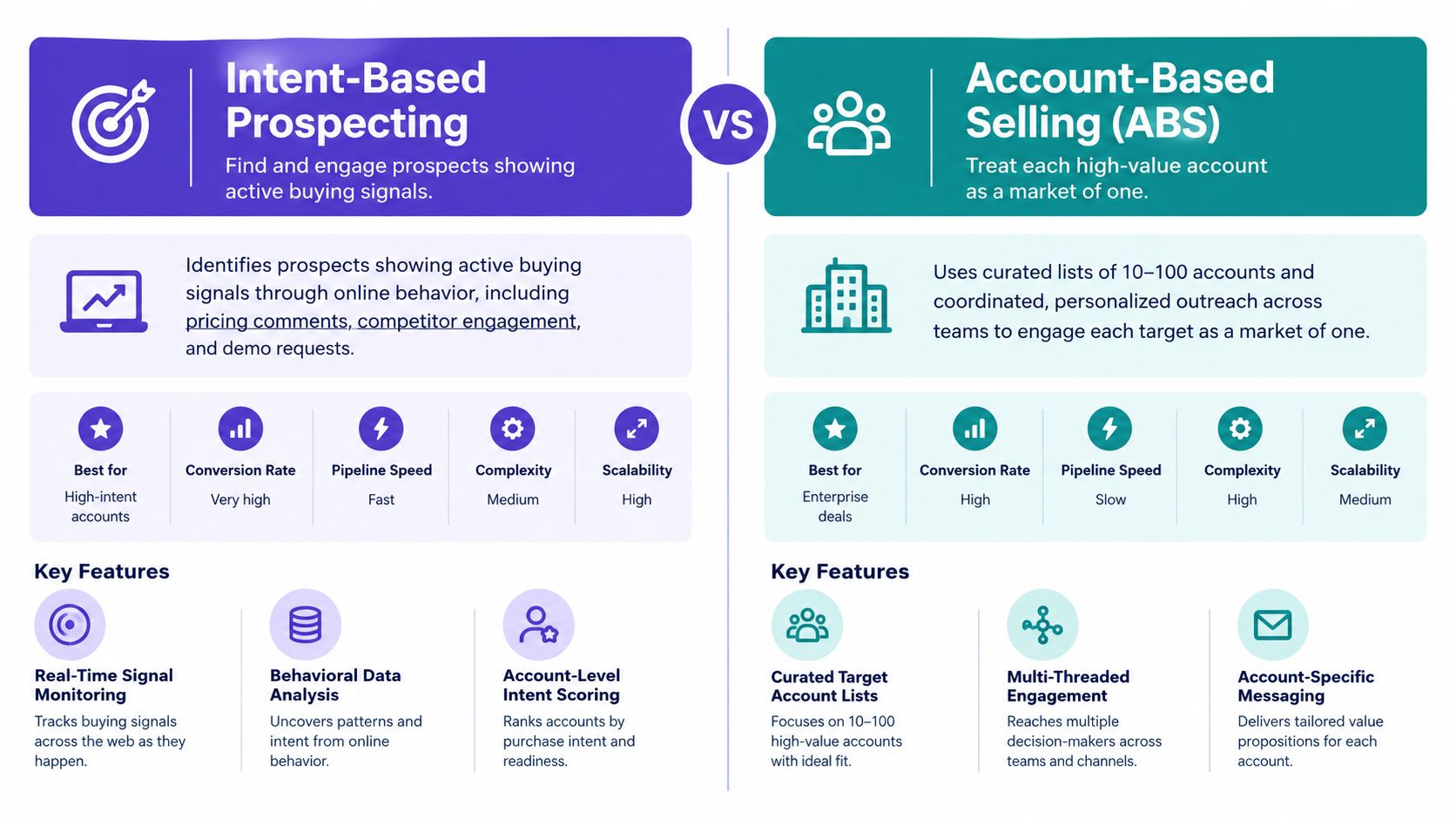
Intent-based prospecting starts with a buying signal, not a static account list. A prospect commenting on a competitor's pricing announcement, discussing demo requirements, or engaging with content about a known operational problem has given you useful context. That context doesn't prove a deal exists, but it gives you a reason to earn attention now rather than spray another generic message into the void.
Buyers typically engage sellers after completing about 70% of their journey, according to 6sense's research summary. The same source reports that an average 2023 buying journey lasted 11 months, with sellers contacted after about 8 months. Your job is therefore less about introducing a category from scratch and more about helping an informed buyer validate a choice, reduce risk, or move faster.
Build a signal stack
A single click is weak evidence. Combine fit, intent, and timing, then classify activity by recency, frequency, depth, and seniority, as recommended in this guide to actionable B2B buying signals.
Useful scenarios include:
Competitor pricing discussion: “Saw your question on pricing for [competitor]. Teams usually compare implementation effort as closely as license cost. Is that part of your evaluation?”
Creator engagement: Monitor accounts responding to posts about marketing automation pain points, then contribute a useful observation before proposing a conversation.
Budget conversations: Track companies discussing upcoming sales-tool budgets and reach out while the initiative is still being shaped.
Set urgent workflows for pricing, competitor, and demo signals. Use rapid approval so a fresh signal doesn't become stale by the time someone reviews it. Track signal-to-reply rate, positive reply rate, and meetings booked by signal type, then invest in patterns that match your ICP. For a deeper foundation, see what intent data means for sales teams.
2. Account-Based Selling
Account-based selling (ABS) treats a high-value company as its own market. Choose a focused group of strategic accounts, then coordinate sales, marketing, and customer success around each one. The method fits enterprise opportunities where several stakeholders shape the decision and one relationship can disappear without warning.
Start with a small account set. For each company, identify the CFO, CRO, operations leader, technical evaluator, likely champion, and procurement contact. Record business priorities, active initiatives, known relationships, objections, and the proof each stakeholder needs. LinkedIn activity can sharpen this map: recent posts, role changes, comments, and shared connections may show who has influence or an opening for a relevant conversation.
Build a coordinated account motion
Match the message to the person and buying stage. Give the operations leader an industry case study, the CFO an assumptions-based financial model, and the technical evaluator a security summary. Sales can handle direct outreach, marketing can support a relevant event or executive briefing, and customer success can identify an existing relationship that creates a credible introduction.
Use a short account brief rather than forcing every opportunity into the same sequence:
Account objective: Earn a discovery conversation about sales-process consistency.
Stakeholder motion: Lead revenue leadership with an outcome narrative, operations with workflow detail, and finance with a business case.
LinkedIn action: Engage with a relevant post or shared connection before requesting an introduction, when that activity provides genuine context.
Review trigger: Revisit the plan after a reply, new stakeholder, meaningful LinkedIn activity, or material change in the opportunity.
The trade-off is clear. ABS demands research and coordination, so it wastes time on low-value, transactional deals. It earns its place when opportunity value, complexity, and stakeholder count justify the effort. Prioritize accounts using stakeholder coverage, engaged accounts, meetings by account, opportunity conversion, and pipeline value. Touch volume alone can make a busy account look healthy while no decision-maker is engaged.
Teams building this motion can use account-based selling tools to support account planning and coordination.

3. Social Selling and LinkedIn Relationship Building
LinkedIn should earn its place in the sales motion by adding context, not by increasing message volume. A prospect discussing pipeline quality, competitor pricing, or a process change has already supplied a reason to listen. A specific comment can demonstrate judgment before a direct message arrives, then give the rep a credible reason to reconnect.
Generic outreach now has less room for error. A 2026 benchmark covering more than 15 million contacts reported an overall reply rate of 7.2%, compared with 8.2% for personalized requests and 5.3% for requests without a note. Belkins' LinkedIn outreach study separates shallow personalization from signal-based engagement, including activity around competitors, creators, and topic posts.
Use a simple sequence, then stop if the interaction stays passive:
Read the signal: Check whether the prospect is discussing a problem your offer addresses.
Add judgment: Comment with a specific observation, useful question, or concise counterexample. “Great post” contributes nothing.
Create value: Share a relevant insight or make an introduction without attaching a sales request.
Ask with context: “Your point about low-quality inbound stood out. We've seen teams improve prioritization by separating repeated decision-stage activity from one-off engagement. Is that distinction part of your current process?”
The trade-off is time. Thoughtful engagement can improve message relevance, but it does not prove budget, authority, or urgency. LinkedIn activity should therefore change contact priority, not replace qualification. A profile visit after a relevant comment deserves more attention than a passive connection acceptance, while neither should automatically create an opportunity.
Track meaningful comment engagement, profile visits, connection acceptance, positive replies, and meetings from engaged contacts. For practical guidance on building credibility without turning every comment into a pitch, see social selling on LinkedIn.

4. Personalization at Scale
Personalization works when it changes the buyer's reason to respond. Automate research and message logistics, then keep the judgment human. A company name or job title adds little unless the detail connects to a current business problem.
Start with the signal most likely to affect the buying conversation: a recent LinkedIn post, competitor interaction, product launch, hiring pattern, shared connection, or stated initiative. AI can collect these inputs and suggest an opener. A seller still needs to verify the source, timing, and implication before sending. Otherwise, the workflow scales inaccurate or awkward outreach. For a practical approval-based process, see this guide to using AI in sales.
Use one strong detail, then earn the next conversation.
Practical rule: If the prospect can delete the personalized sentence and the message means the same thing, the research did not change the message.
Try language such as:
“I noticed your comment on competitor pricing. The comparison often gets harder when implementation effort is missing from the business case.”
“Your post about rebuilding the sales process stood out. Are you standardizing qualification before adding outbound volume?”
“We share a connection at a company working through a similar handoff problem. I can introduce you if that context helps.”
Review every AI-generated draft for accuracy, tone, and relevance. Test hooks by buyer segment and source, then prioritize positive reply rate, meetings booked, and opportunity conversion by personalization source. LinkedIn activity can raise contact priority, but it cannot establish budget, authority, or urgency. A relevant post may justify a sharper opener, not an automatic opportunity.
5. Multi-Channel Outreach
A sequence across LinkedIn, email, and phone should behave like one conversation. Each channel earns a different job: LinkedIn tests relevance, email supplies detail or an asset, and a call resolves ambiguity. Sending the same pitch through three inboxes is not coordination. It is repetition with better logistics.
Use LinkedIn when a prospect has shown activity or when your email needs a human context. A connection request can reference the issue, email can explain how similar teams frame it, and a call can ask whether the problem is active. Recent benchmarks report acceptance around 25% to 45% for well-targeted personalized connection requests, while generic cold DMs often produce 3% to 8% replies. Warm, value-first sequences can reach 15% to 25% or more, according to LeadRiver's 2026 outbound analysis.
Assign the next action, not just the next channel
A workable rhythm:
Day 1: Send a LinkedIn message tied to the observed signal.
Day 3: Email the business context and a relevant asset.
Day 5: Call, reference the earlier touches, and ask whether the issue is active.
Leave 3 to 5 days between channels. Change the purpose of each touch. For example, ask about the problem on LinkedIn, show how teams build the business case in email, then test urgency by phone. The trade-off is speed versus attention. Shorter gaps may capture active intent, but they can also make the sequence feel crowded.
Measure reply rate by channel, positive response by sequence step, meetings booked, and channel contribution to opportunities. Give priority to the channel and step that create qualified conversations, not the one producing the most activity. A multichannel sequence can outperform email alone when the message develops logically. Three coordinated touches still fail if none gives the buyer a clear reason to respond.
6. MEDDIC Sales Methodology
MEDDIC is a deal-quality test for complex B2B sales. It examines Metrics, Economic Buyer, Decision Criteria, Decision Process, Identify Pain, and Champion. The method fits opportunities with multiple stakeholders, formal approval, and meaningful implementation risk.
Apply it during discovery, then use the evidence to choose the next action. Ask:
What business result must change?
Who controls the budget?
How will the buying group compare options?
What steps and approvals shape the decision?
Which pain creates urgency?
Who will advocate internally when you are absent?
The framework is useful because it exposes weak assumptions before a forecast turns them into bad news.
Let the missing evidence set the priority
A painful operational problem and a supportive manager do not prove that a deal is qualified. If decision criteria are unclear, replace the next demo with a conversation about how the buying group will evaluate alternatives. If the Economic Buyer is unknown, keep the opportunity in discovery. If no Champion exists, test whether anyone has enough influence and personal value to carry the project internally.
Vague Metrics also deserve attention. Confirm the current state with the buyer before preparing a proposal. LinkedIn activity may reveal a stakeholder's role or interest, but it does not replace evidence of budget, process, or internal sponsorship.
Use this review rhythm:
Evidence documented: Advance the opportunity.
Evidence missing: Assign one discovery action and an owner.
Gaps that persist: Requalify, reassign, or close it.
The trade-off is pace. MEDDIC can slow optimistic stage movement, yet it limits wasted effort on deals that cannot progress. Track qualification completeness, stage aging, opportunity conversion, and reasons for disqualification. Let those measures decide whether to add discovery, involve another stakeholder, or stop investing.
7. Value-Based Selling and ROI Frameworks
Value-based selling earns attention by translating a product feature into a business result. The relevant result might be revenue, savings, efficiency, risk reduction, or a shorter sales cycle. The buyer should recognize the problem and see how the proposed change affects operating decisions.
Build the case from the prospect's own inputs. Ask about current volume, process costs, cycle time, conversion rates, staffing effort, and the consequences of delay. Separate buyer-provided figures from estimates, then let stakeholders challenge each assumption. An impressive spreadsheet built on invented certainty is still a weak business case.
Turn discovery into a defensible decision
Use the buyer's answers to create a compact model:
Current state: What does the existing process consume, delay, or prevent?
Target state: Which measurable outcome should change?
Assumptions: Which figures came from the buyer, and which need validation?
Scenarios: What do conservative, moderate, and aggressive outcomes show?
Ownership: Who will measure the result after implementation?
A sales operations leader may focus on reducing manual administration. The CFO will examine the financial effect, while operations may test whether the change fits the existing workflow. Present those views together and connect them to one operating reality.
Buyers don't need a prettier calculator. They need a business case they can defend when finance, procurement, and operations ask difficult questions.
Bring the Economic Buyer into the discussion early if financial approval is required. LinkedIn activity can help identify relevant stakeholders or reveal interest, but it does not validate the model. Use business-case completion, buyer-validated assumptions, proposal progression, opportunity conversion, and post-close value tracking to decide whether the opportunity deserves more investment.
A credible ROI framework can support premium positioning. An inflated model creates distrust that no closing line can repair.
8. Warm Introduction and Referral Leveraging
A warm introduction transfers trust before the first sales conversation. The source might be a customer, partner, colleague, investor, consultant, or connector who already understands the target buyer's world. The introduction works because the buyer receives context from a person they recognize, not because the seller has discovered a magical referral script.
Start by mapping relationships around your best-fit accounts. LinkedIn can reveal shared connections, but a shared connection isn't automatically a qualified introduction. Ask whether the connector knows the person well enough to make a relevant recommendation and whether the timing makes sense.
Make the request easy to forward
Weak request: “Do you know anyone who might need our solution?”
Better request: “You're connected to the VP of Revenue at Acme. We help sales teams separate high-intent LinkedIn activity from static prospect lists. If that's a current priority for them, would you be comfortable forwarding this two-sentence note?”
Give the introducer enough context to make a good handoff. Explain the problem, why the account fits, and what you're asking for. Then close the loop quickly and thank them, whether the introduction becomes a meeting or not.
Build relationships with connectors before you need them. A referral program can support customer and partner introductions, but incentives shouldn't replace relevance. Track warm introductions separately, acceptance, positive replies, meetings booked, opportunity conversion, and pipeline value from referrals. The trade-off is patience. Networks compound through useful interactions, not emergency requests sent when the forecast looks nervous.
9. Rapid Follow-Up and Conversation Velocity
A reply is an open door, not a closed deal. Slow response tells the prospect that the problem may not be important to you, even if you're privately celebrating the notification. Rapid follow-up keeps the buyer's context fresh and gives the conversation a clear next step.
The 2026 benchmark from Perspective on lead response time reports that only about 7% of teams respond within 5 minutes. It also reports lead-to-opportunity conversion of roughly 21% for sub-five-minute responses versus about 2.3% when leads are contacted after 24 or more hours. Treat those figures as a benchmark, not a promise. Your market, lead source, qualification standards, and response quality still matter.
Design the response loop
Route high-intent alerts to the right owner and require human approval where judgment matters. After a prospect replies, send a useful next step, such as a concise agenda, a relevant comparison, or two scheduling options. If someone opens but doesn't answer, change the angle instead of forwarding the same message with a new subject line.
Follow-up deserves persistence. One independent benchmark reports that 80% of successful sales require five or more follow-up attempts, while 44% of reps stop after one. Thunderbit's sales follow-up benchmark supports treating follow-up as process, not motivational theater.
Track response time, reply rate by sequence step, positive reply rate, meeting conversion, and time between buyer actions. Belkins' follow-up study reports that follow-up emails generated 58.6% of all replies, even though the first email had the highest per-step reply rate at 0.59%. The lesson is practical: follow up with a new reason, and stop when the evidence says the timing is wrong.
10. Creator and Thought Leader Engagement Strategy
Creators, podcast hosts, and respected practitioners influence how your ICP frames problems. A relationship with the right person can create access to an audience that already cares about your category, along with third-party credibility that your own product page can't manufacture.
Start with audience fit, not follower count. Read the creator's work, understand who engages, and identify whether their audience includes the roles and industries you sell to. A large audience with weak ICP overlap is a vanity channel wearing a business costume.
Contribute before you collaborate
Engage meaningfully before proposing anything. Comment on a specific argument, share a useful response, or offer a perspective that improves the discussion. Then suggest a value-first partnership:
Podcast appearance: Bring a useful operating lesson for the audience, not a disguised product demo.
Joint webinar: Build the session around a real buyer problem and give the creator a strong role.
Co-created guide: Combine practical expertise with a format the audience already consumes.
Track engaged audience members, qualified conversations, meetings, opportunity conversion, and pipeline value by creator. Don't judge the channel by reach alone. The best partnership may produce fewer visible interactions but stronger buying context.
A creator relationship also supports intent-based prospecting. When target accounts repeatedly engage with the creator's content about a problem you solve, that activity can justify a relevant conversation. The outreach should reference the shared topic, not imply that the creator endorsed your product.
10-Point Comparison of B2B Sales Techniques
Technique | 🔄 Implementation complexity | 💡 Resource requirements | ⚡ Speed to pipeline | ⭐ Expected outcomes & key advantages | 📊 Ideal use cases |
|---|---|---|---|---|---|
Intent-Based Prospecting | Medium, needs signal-detection & rapid workflows | Intent data platforms, monitoring tools, analytics, fast-response team | Fast ⚡ | ⭐ Very High conversion; contextual outreach; less wasted effort | High-intent accounts; timely buying signals |
Account-Based Selling (ABS) | High, cross-team orchestration & deep customization | Dedicated ABM teams, account intelligence, tailored content, long research cycles | Slow ⚡ | ⭐ High conversion & deal value; stronger retention; aligned teams | Enterprise deals; strategic accounts |
Social Selling & LinkedIn Relationship Building | Medium, consistent authentic engagement required | Time for daily engagement, content creation, community tools | Medium ⚡ | ⭐ Medium–High conversion; builds trust and credibility | Relationship building; long-term pipeline |
Personalization at Scale | Medium, automation + human review balance | AI personalization tools, clean real-time data, reviewer capacity | Fast ⚡ | ⭐ High conversion; scalable yet authentic outreach | Mid-market volume where personalization improves reply rates |
Multi-Channel Outreach (LinkedIn + Email + Phone) | High, sequencing and compliance complexity | Sales engagement platform, trained reps, unified tracking | Medium ⚡ | ⭐ High contact & conversion rates; meets prospects on preferred channels | Raising contact probability; complex outreach to decision-makers |
MEDDIC Sales Methodology | High, training and consistent application | Training, CRM process changes, disciplined discovery | Slow ⚡ | ⭐ Very High win rate for qualified deals; better forecasting | Complex B2B/enterprise deals needing rigorous qualification |
Value-Based Selling & ROI Frameworks | High, needs deep discovery and modeling | SMEs, ROI/calculator tools, finance-level discovery time | Slow ⚡ | ⭐ High conversion and deal value; justifies premium pricing | Deals requiring business case and executive approval |
Warm Introduction & Referral Leveraging | Low, processable but network-dependent | Relationship cultivation, referral workflows, CRM tracking | Fast ⚡ | ⭐ Very High conversion (3–5x); faster cycles; higher trust | High-quality deals where network access exists |
Rapid Follow-Up & Conversation Velocity | Medium, requires discipline and automation | CRM triggers, automation tools, team SLAs | Real-time ⚡ | ⭐ High conversion; prevents deals from going cold; competitive advantage | Momentum maintenance; high-velocity sales teams |
Creator & Thought Leader Engagement | High, long-term relationship and content work | Creator outreach, co-creation resources, PR/marketing support | Very Slow ⚡ | ⭐ Medium conversion; amplified reach and third-party credibility | Audience access, brand amplification, indirect pipeline |
Choose the Technique Your Pipeline Actually Needs
The comparison table should help you choose based on the bottleneck, not the technique currently trending in your sales Slack. If your team has plenty of contacts but weak replies, start with intent-based prospecting and personalization. If replies arrive but opportunities stall, examine qualification, stakeholder coverage, business-case quality, and follow-up speed.
Founders usually need a narrow operating loop before they need a sales methodology. Begin with intent signals, concise personalization, and rapid follow-up. A founder can often learn more from reviewing ten relevant conversations than from launching another broad sequence that generates activity without insight.
SDRs and BDRs can combine social selling, warm introductions, and coordinated outreach. LinkedIn should help identify context and create familiarity, while email adds detail and phone creates a live decision point. Don't force LinkedIn to carry the entire motion. Recent outbound benchmarks suggest that combining channels can outperform email alone, and LeadRiver's analysis reports stronger results from coordinated email, phone, and LinkedIn outreach than from single-channel efforts.
Sales leaders should add ABS, MEDDIC, and ROI frameworks when deals involve multiple stakeholders, larger commercial risk, or longer internal approval. A sales engagement layer can support the operating discipline. One 2026 industry summary reports that 81% of B2B sales organizations with 50 or more employees use at least one sales engagement platform, up from 68% in 2025, with the category at $4.2 billion in global spend and 38% CAGR. The industry summary presents those figures as evidence of a shift from manual prospecting to stack-based workflows.
Choose metrics before adding activity
Track the metrics that reveal movement:
Signal-to-reply rate: Which buying signals create relevant responses?
Positive reply rate: Are conversations commercially meaningful?
Meetings booked: Which motions create accepted next steps?
Opportunity conversion: Do meetings become qualified opportunities?
Sales-cycle velocity: Where do deals slow down?
Pipeline value: Which techniques create economically useful coverage?
Channel contribution: Which channel starts, advances, or influences opportunities?
For LinkedIn prospecting, see this LinkedIn prospecting guide. For better targeting, tighten your ICP definition. Teams refining qualification can use sales qualification guidance, while reps needing practical copy should review sales outreach templates. Operational teams should connect the motion to CRM workflows and pipeline forecasting.
RoverLead AI fits the signal-led part of this system as an approval-based LinkedIn AI SDR workflow. Its Signal Agents monitor creators, competitors, niche topics, comments, content interactions, pricing discussion, and demo talk, then surface curated prospects with context and personalized openers. You review and approve outreach before anything sends, while the lead inbox supports follow-up, tagging, nurturing, auto-drafts, and auto-replies. The product's positioning is LinkedIn AI SDRs that book meetings 24/7, but the useful principle is simpler: prioritize buying context over stranger volume. Visit RoverLead AI to evaluate whether that workflow matches your sales motion.
Frequently asked questions
What B2B sales technique should a small team choose first?
Start with intent-based prospecting, concise personalization, and rapid follow-up. Those techniques help a small team learn which problems and signals deserve attention before it invests in complex account programs.
How should LinkedIn support B2B selling?
Use LinkedIn to detect relevant activity, build credibility, and create context. It can start a conversation, but email, phone, and live discovery may still be better for detail and commitment.
Which intent signals matter most?
Prioritize repeated, recent, deep, and senior activity from accounts that fit your ICP. Competitor engagement, pricing discussion, demo interest, and decision-stage topic activity deserve more attention than isolated low-intent clicks.
How much personalization is enough?
Use one specific, truthful detail tied to a business problem. A concise signal-based opener is better than a long paragraph of generic company research.
What should a multi-channel cadence include?
Coordinate LinkedIn, email, and phone so each channel adds new value. Reference previous touches, vary the message, and avoid making the buyer repeat the same conversation.
When should a team use MEDDIC?
Use MEDDIC when opportunities involve multiple stakeholders, formal decisions, and meaningful commercial risk. It's less useful as a rigid script for simple transactions.
How can salespeople prove ROI credibly?
Build the business case from buyer-validated assumptions. Show the current state, target outcome, scenarios, risks, and how the buyer will measure value after purchase.
How do referrals become a repeatable channel?
Map shared relationships, cultivate connectors, make specific requests, provide forwarding context, and track introductions separately from cold-sourced opportunities.
When should reps follow up?
Respond quickly to active buying signals and prospect replies. For nonresponsive contacts, follow up with a different useful angle rather than repeating the original pitch.
How should leaders measure B2B sales techniques?
Measure signal-to-reply rate, positive replies, meetings, opportunity conversion, sales-cycle velocity, pipeline value, and channel contribution. Activity matters only when it explains commercial movement.
RoverLead AI offers signal-led LinkedIn prospecting, approval-based outreach, and follow-up workflows for teams that want to prioritize real buyer activity over static lists. Visit RoverLead AI to see how its LinkedIn AI SDRs that book meetings 24/7 can support a more relevant B2B sales motion.