What Is Stakeholder Mapping: Master Stakeholder Mapping

You had the deal. Or so you thought.
The demo landed. Your champion loved it. Procurement didn't flinch. Budget sounded real. Then the account went strangely quiet. Replies slowed, meetings slipped, and your once-enthusiastic contact started sounding like someone forwarding your emails into a black hole.
That's not random. It's not “timing.” It's not even usually pricing.
It's politics.
In B2B sales, a deal rarely dies because one person changed their mind. It dies because you sold to the visible contact while the actual decision happened in a room you never mapped. Someone in finance got nervous. Someone in IT saw risk. Someone senior didn't like being bypassed. Your champion wasn't lying. They just weren't the whole buying committee.
If you want more predictable revenue, you need a way to see the internal environment before it bites you. That's where stakeholder mapping stops being a project-management buzzword and becomes a closing tool. It helps you identify who matters, who influences whom, who can block progress, and who needs a very different message than the one you sent your champion.
If you're tired of post-mortems that end with “we thought we had it,” start treating account politics as part of the sales process. That's how teams close the deal with less guesswork.
Table of Contents
That Perfect Deal That Just Went Dark
A founder I know had a classic “done deal.” The Head of Sales wanted the platform. The team had already discussed rollout ideas. The buyer said the budget existed and the timing was right. Then a week passed. Then two. Then the phrase every seller hates showed up: “We're pausing this internally.”
No one had mapped the account.
The founder had one strong relationship and a lot of optimism. What he didn't have was visibility into the operator who'd own implementation, the finance lead who cared about spend control, or the executive who didn't want another tool creating workflow mess. The internal conversation kept moving. He just wasn't in it.
Selling one contact isn't the same as winning an account.
This is the core problem stakeholder mapping solves. Not “alignment.” Not “visibility.” Those words are too soft. Stakeholder mapping helps you figure out who can move a deal forward, who can subtly stall it, and who needs attention long before the final approval stage.
The nasty part is that most deals don't fail with a dramatic no. They fade. They drift. They get “re-prioritized.” That's usually a sign you never understood the political structure inside the account.
In sales, the cost of that blind spot is brutal. You waste follow-ups on the wrong person, build messaging for the wrong outcome, and mistake enthusiasm for authority. Then you act surprised when the committee votes without you.
What Is Stakeholder Mapping for Sales Teams
For sales teams, stakeholder mapping is an account intelligence exercise. You're building a visual model of who's involved in the buying decision, how much influence they hold, how much they care, and what kind of engagement each person needs.
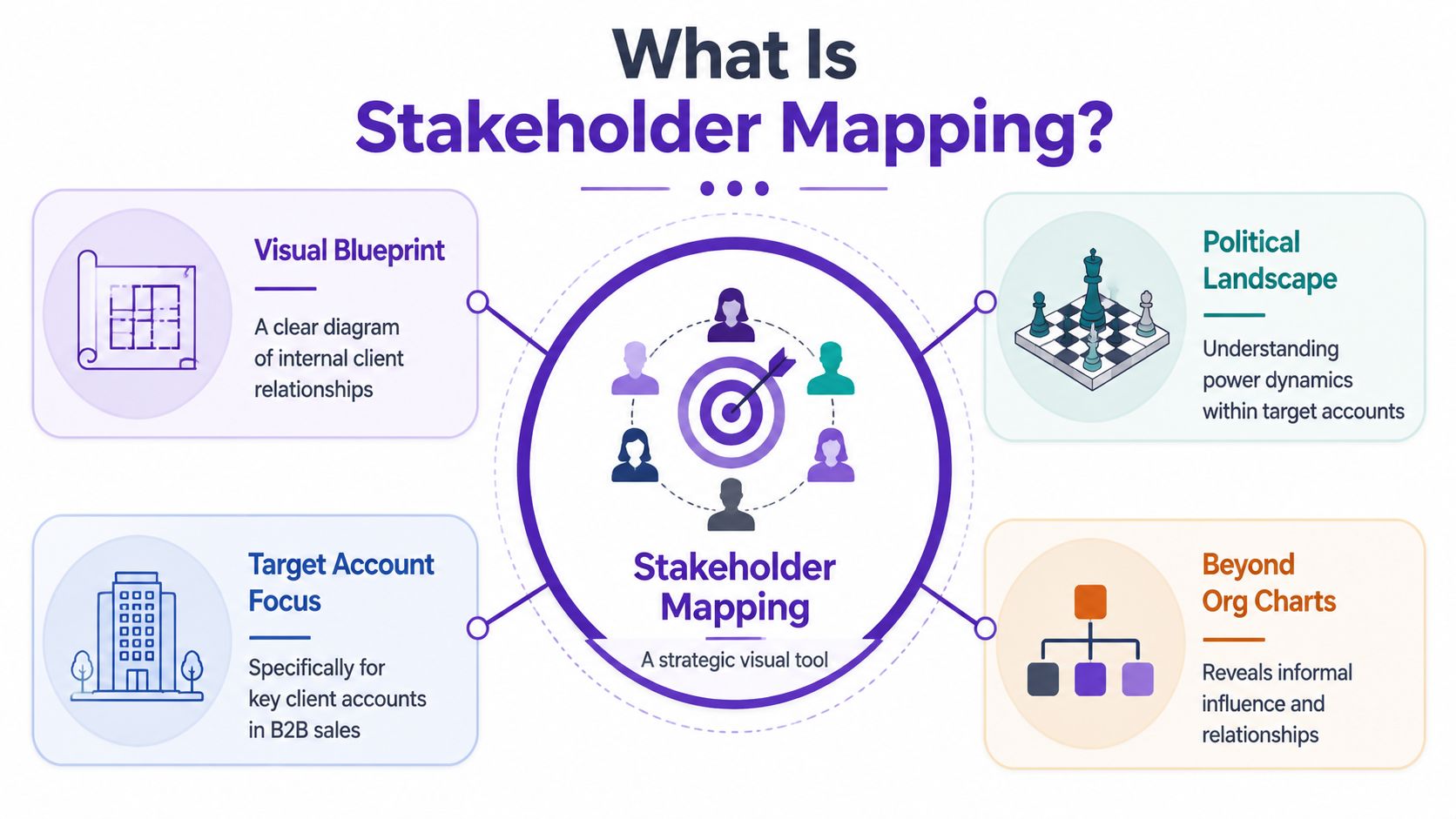
Forget the dusty textbook definition. In practice, this is your organizational X-ray. It shows the people behind the org chart, not just the boxes on it.
What sales teams are actually mapping
You're not mapping names for the sake of admin work. You're mapping:
Decision power: Who can approve, delay, or kill the deal
Interest level: Who cares enough to push for change
Influence: Who shapes other people's opinions even without formal authority
Buying role: Champion, blocker, evaluator, signer, end user
Message fit: What each stakeholder needs to hear to stay engaged
That's what turns outreach from generic to strategic. The message that works for an end user usually falls flat with a CFO. The note that wins over a department lead may annoy an executive sponsor. One account. Several agendas.
Why this matters in complex B2B sales
Stakeholder mapping builds on stakeholder theory, which gained prominence with R. Edward Freeman's 1984 book Strategic Management: A Stakeholder Approach, a shift that pushed management thinking beyond a shareholder-only view toward identifying groups that can affect or be affected by an organization, according to PMI's discussion of stakeholder analysis and its roots.
That sounds academic until you're inside a messy enterprise deal. Then it becomes practical fast.
Practical rule: If you only know the person who booked the demo, you do not know the account.
Good sales teams stop treating job titles as truth. They use LinkedIn, call notes, meeting behavior, and internal referrals to figure out who drives the buying process. That's the difference between “we had a good conversation” and “we built a deal path.”
Choosing Your Stakeholder Mapping Framework
A lot of teams overcomplicate this part. Don't.
You don't need a beautiful Miro board with color-coded avatars and corporate theater. You need a framework that helps your team decide who to engage, how often, and with what message. If the map doesn't change action, it's decoration.
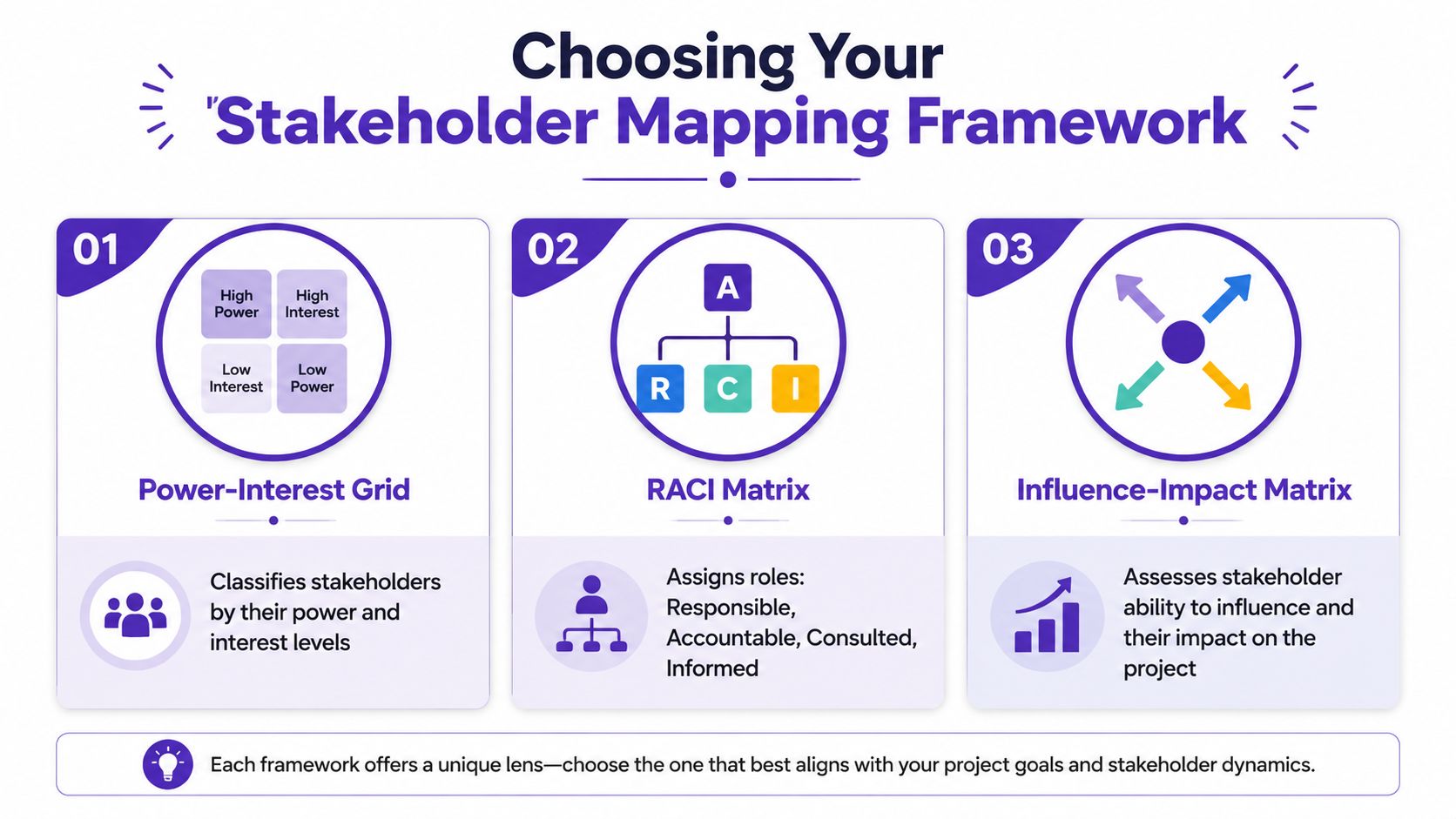
Three frameworks worth using
Here's the simple version.
Framework | Best use in sales | What it tells you | Main weakness |
|---|---|---|---|
Power Interest Grid | Early account planning | Who deserves the most attention | Doesn't explain task ownership |
Influence Impact Grid | Hidden dynamics | Who shapes outcomes beyond title | Can get subjective fast |
RACI Matrix | Late-stage buying or rollout planning | Who's responsible, accountable, consulted, informed | Weak on politics |
The Power Interest Grid is the workhorse. The UK Government Analysis Function recommends scoring stakeholders on power and interest from 1 to 10, averaging the scores, and placing them into four quadrants: manage closely, consult with, keep satisfied, keep informed, as explained in its guidance on stakeholder mapping and engagement planning. That's useful because it forces prioritization instead of treating every contact the same.
The Influence Impact Grid is where sales teams identify key areas of influence. The official org chart says one thing. Reality says the operations manager who's been there forever can sway the whole evaluation. This model helps you spot the people your champion listens to, fears, or needs on side.
The RACI Matrix is less sexy, but it's handy once the buying process starts looking like implementation planning. If legal, security, procurement, and operations are all involved, RACI helps your team understand who's doing what and who just needs updates.
Which one should sales teams pick
A good starting point is the Power Interest Grid. It's fast, practical, and doesn't require a consulting workshop. If you're selling into a new account, this should be your first move after discovery.
Then layer on other tools when needed.
Use Power Interest when you need fast prioritization
Use Influence Impact when the account has obvious internal politics
Use RACI when the deal has turned into a cross-functional buying process
If you're still tightening target account selection, get that right first. A clean map won't save a bad-fit account. This is why sales teams pair stakeholder work with a sharper ideal customer profile definition.
The best framework is the one your team will actually update after each call.
How to Create Your First Stakeholder Map
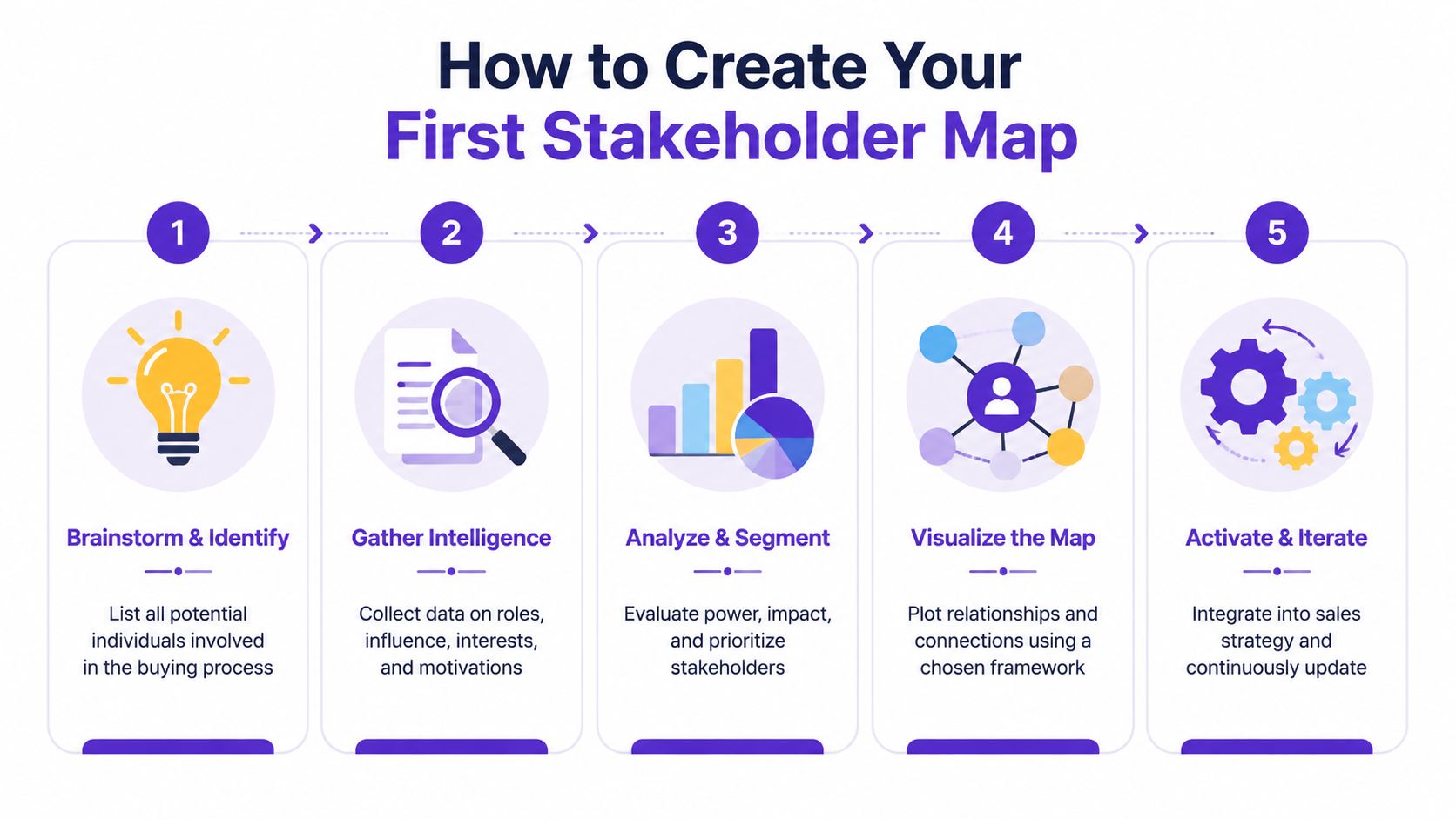
Most reps make this harder than it is. You don't need perfect information. You need a working draft that gets smarter as the deal moves.
Start wide, then get sharper
Start by listing everyone who might touch the decision. Not just the buyer. Include the user, the manager, the executive sponsor, finance, procurement, IT, security, and anyone likely to inherit the consequences of saying yes.
Then gather context. Real context.
A useful map captures more than job titles. Guidance on dynamic stakeholder mapping recommends collecting attributes such as authority, resource control, influence over others, and communication preferences, which turns the map into an input for engagement strategy rather than a static diagram, as described by 6Sigma's stakeholder mapping overview.
That means your notes should answer questions like:
Authority: Can this person approve budget, access, or rollout?
Resource control: Do they control people, time, systems, or internal attention?
Influence over others: Who listens when they speak?
Communication style: Do they want a short executive summary or a detailed walkthrough?
A quick explainer can help if your team is new to the process.
Use LinkedIn heavily here. Review profiles, reporting lines, recent activity, shared posts, job changes, and who engages with whom. Then compare that with what happens in meetings. The loudest person in a call isn't always the key stakeholder. Sometimes the quiet person asking one sharp question is the one your champion is nervous about.
Turn the map into action
Once you have the names, plot them using your chosen framework. Then write an action line for each one.
Not a paragraph. An action line.
Stakeholder type | What to do next |
|---|---|
Champion | Arm them with internal language and proof points |
Budget owner | Tie value to cost control, timing, or risk reduction |
Technical evaluator | Address integration, workflow, and operational concerns |
Executive sponsor | Keep updates tight and decision-focused |
Possible blocker | Surface objections early and answer them directly |
At this point, the map becomes useful. Every stakeholder should have a message, a channel, and a next move.
If your stakeholder map doesn't change who you contact this week, it's still a sketch.
Keep it alive. Update it after every call, every org change, every strange delay, and every new name that enters the deal. Buying committees shift. Reorgs happen. Champions leave. Good sales teams don't act shocked when the map changes. They expect it.
Stakeholder Maps in Action Real World Examples
Theory is lovely. Pipeline is better.

Example one LinkedIn outreach with actual strategy
An SDR is targeting a mid-market SaaS company. Without a map, they'd probably message the VP, then chase one reply until the thread dies. With a map, the outreach looks different.
They identify a sales leader with pain, an operations person who'll care about workflow, and a finance stakeholder who'll eventually care about spend discipline. Each gets a different message on LinkedIn.
The sales leader gets a note about pipeline friction. The operations person gets a message about process clarity. The finance stakeholder gets a tighter business case once interest appears. Same account, different narrative.
That's how multi-threading should work. Not spraying variants of the same pitch. Sales teams using account research this way usually pair it with stronger account-based marketing tools for coordinated outreach.
Example two Product launch without internal chaos
This isn't just for closing logos. Product and GTM teams need stakeholder maps too.
Say a product marketing team is preparing a feature launch. If they only coordinate with product leadership, the rollout will wobble. Sales won't know how to position it. Support won't know how to handle questions. Customer success will get dragged into avoidable confusion.
A simple map fixes that. The team identifies who needs early input, who needs enablement, who needs messaging, and who needs advance notice because they'll deal with fallout if things go sideways.
Internal launches fail for the same reason deals fail. Someone important was left out until it was inconvenient.
The practical lesson is simple. Stakeholder maps reduce surprises. In sales, that means fewer ghosted deals. In launches, that means less internal friction and fewer ugly handoffs.
Common Pitfalls and How to Avoid Them
A bad stakeholder map can give you false confidence. That's worse than having none.
Here are the mistakes I see constantly:
Confusing titles with power: The senior title looks impressive. Influence sits with the operator everyone trusts. Map behavior, not vanity.
Only mapping supporters: Reps love champions and avoid skeptics. That's exactly backward. A blocker ignored early becomes a deal obituary later.
Creating it once: Accounts move. People leave. Priorities shift. Update the map whenever the deal changes shape.
Keeping it in your head: If the AE knows the politics but the SDR, SE, and manager don't, your team still isn't coordinated.
Using one message for everyone: Different stakeholders care about different risks. Tailor the story or expect polite indifference.
A useful map is shared, updated, and tied to action. If it lives in a forgotten tab, it's office wallpaper.
Stakeholder Mapping Frequently Asked Questions
Question | Answer |
|---|---|
What is stakeholder mapping in simple terms? | It's a way to identify everyone involved in a decision and sort them by influence, interest, and role so you know how to engage them. |
Why does stakeholder mapping matter in B2B sales? | Because deals usually involve multiple people, and one enthusiastic contact rarely controls the whole outcome. |
Is stakeholder mapping only for enterprise deals? | No. It matters most when there's any shared decision-making, even in smaller accounts. |
How often should I update a stakeholder map? | Update it after key meetings, when new stakeholders appear, or when the account goes quiet for unclear reasons. |
What's the difference between a stakeholder and a shareholder? | A shareholder owns part of a company. A stakeholder is anyone who can affect or is affected by the decision or project. |
Which framework should I start with? | Start with a power-interest view. It's the fastest way to prioritize outreach and meeting strategy. |
How do I map stakeholders when I have very little information? | Start with known contacts, infer likely roles around them, use LinkedIn and company context, then refine as you learn more. |
Should SDRs and BDRs do this, or only AEs? | Both. Early-stage mapping helps prospecting, and later-stage mapping helps deal control. |
Can stakeholder mapping help with LinkedIn outreach? | Yes. It helps you write different messages for different people inside the same account instead of sending one generic pitch. |
How does stakeholder mapping connect to ABM? | ABM targets accounts. Stakeholder mapping tells you which people inside those accounts need which messages and when. |
Stakeholder mapping is one of those practices that sounds formal until you realize it's just disciplined deal strategy. The teams that use it don't magically avoid politics. They just stop being surprised by it.
If you want better visibility into who matters inside your target accounts, RoverLead AI helps you find the right people based on LinkedIn buying signals instead of static lists. It gives sales teams a faster way to spot intent, identify likely stakeholders, and start smarter conversations while the account is still paying attention.