What Is Sales Lead Generation: B2B Strategies for 2026

Your reps are sending emails. They're making calls. Someone on the team is proudly exporting another spreadsheet like it's a sacred ritual. And still, the pipeline looks like a roadside cactus garden. Sparse. Stubborn. Slightly insulting.
That's usually the moment founders ask the right question the wrong way. They ask, “Do we need more leads?” Often, no. They need better timing, tighter qualification, and a process that finds people who might want to buy. That's the core conversation behind what is sales lead generation.
Most advice on this topic still treats lead gen like list building with a motivational poster taped on top. Build a list. Blast a sequence. Follow up until someone either books or blocks you. That playbook still exists, but it's aging badly. Modern B2B lead generation is less about brute force and more about signal hunting.
Table of Contents
That Feeling When Your Pipeline Is a Desert
A familiar scene. The SDR team says activity is up. The founder says revenue isn't. Marketing says leads are coming in. Sales says those leads are junk. Everyone has dashboards. Nobody has calm.
This is what a broken lead generation system looks like in the wild. Plenty of motion, very little momentum. You can send a decent cold email to the wrong person at the wrong time and still learn absolutely nothing from the result.
Sales teams rarely fail because they did nothing. They fail because they repeated low-signal work with impressive consistency.
The frustrating part is that organizations often perform aspects of the job correctly. They have Apollo, HubSpot, LinkedIn, maybe a Clay workflow, maybe a BDR with heroic caffeine tolerance. But the system still leaks because nobody has defined what makes a lead worth pursuing right now.
Sales lead generation exists to solve that exact problem.
So What Is Sales Lead Generation Anyway
Sales lead generation is the process of identifying potential buyers, attracting their attention, and turning that early interest into a sales conversation. Not a bloated database. Not a vanity list of job titles. A conversation with someone who could realistically become a customer.
Imagine fishing, if fishing had procurement cycles and six stakeholders. You don't just dump nets into the ocean and hope for a CFO. You choose the right waters, watch for movement, and use the right bait for the species you're after. In B2B, that means matching your offer to the right accounts, roles, pain points, and timing.
The reason this matters is simple. Lead generation isn't some side quest owned by marketing interns and form fills. It sits at the center of revenue creation. The global sales lead generation industry is projected to hit $295 billion by 2027, and 61% of marketers say generating enough high-quality leads is their single biggest challenge, according to lead generation market data collected here.
What a lead actually is
A lead is a person or account that shows some combination of relevance and interest.
That sounds obvious, but teams blur it constantly. A downloaded ebook isn't automatically a sales opportunity. Neither is a scraped contact with the right title. A lead becomes useful when you can answer two questions:
Are they a fit? Do they match the kind of company and buyer you can help?
Are they showing intent? Have they done anything that suggests active interest or buying motion?
If you can't answer both, you probably don't have a lead. You have a record in a CRM wearing a fake mustache.
What good lead generation is supposed to do
A healthy lead gen system should:
Create focus: Point reps toward accounts that deserve attention.
Reduce waste: Stop sales from chasing anyone with a pulse and a company email.
Improve timing: Get outreach closer to the moment a buyer is paying attention.
The Two Paths Inbound vs Outbound
There are two broad ways to generate leads. You can attract buyers to you, or you can go find them. Most strong teams do both, but they do them for different reasons.

The magnet approach
Inbound is the magnet. You publish useful content, rank for searches, host webinars, create guides, build landing pages, and let interested buyers come to you. Done well, inbound feels less like interruption and more like good timing.
That matters because content marketing now accounts for over 50% of all lead acquisition strategies, which shows how much B2B buying has shifted toward self-education, as noted in this content marketing lead acquisition breakdown.
Inbound works best when buyers actively research before talking to sales. SaaS, agencies, consultancies, and technical services often benefit here. The trade-off is patience. Inbound compounds, but it rarely rescues next quarter by itself.
The hunter approach
Outbound is the hunter. Your team identifies target accounts and starts the conversation directly through email, calls, LinkedIn, partnerships, or referrals. Outbound is useful when you know exactly who you want to reach and can't wait for them to discover your blog post on their lunch break.
Outbound gives you control. You choose the accounts, the message, and the pace. It also punishes sloppy targeting fast. A weak list plus generic copy equals ignored sequences and reps who start blaming “the market.”
Practical rule: Inbound is great at capturing existing demand. Outbound is great at creating conversations where demand is possible but not yet expressed.
Inbound vs Outbound Lead Generation At a Glance
Criterion | Inbound (The Magnet) | Outbound (The Hunter) |
|---|---|---|
Primary motion | Buyers come to you | You go to buyers |
Best for | Long-term trust and demand capture | Fast account targeting and direct pipeline creation |
Typical tactics | Content, SEO, webinars, forms, lead magnets | Cold email, cold calling, LinkedIn outreach, referrals |
Speed | Slower to build | Faster to launch |
Messaging style | Educational and trust-building | Direct and personalized |
Main risk | Producing content nobody actually needs | Sending irrelevant outreach to the wrong people |
Best use case | Buyers already researching solutions | High-value accounts you want to reach proactively |
The mistake isn't choosing one path. The mistake is using the wrong path for the problem in front of you.
From Stranger to Customer The Lead Generation Funnel
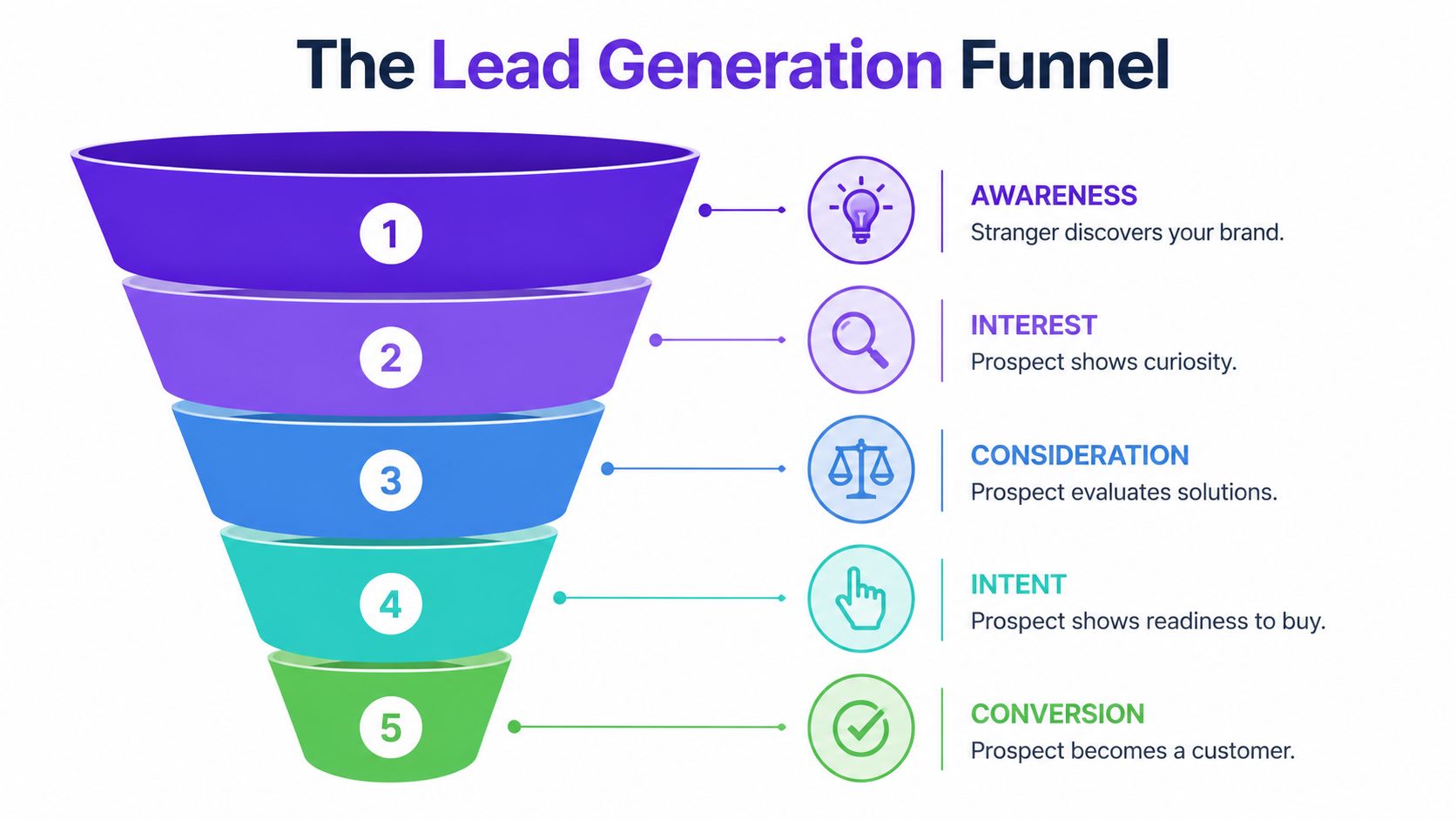
Most funnels are described like a corporate flowchart. Real funnels behave more like dating. Someone notices you, gets curious, compares you with other options, decides whether you're worth a conversation, and only then considers commitment.
What happens at each stage
Here's the plain-English version of the funnel:
Awareness
A prospect discovers your company through content, outreach, referrals, events, or social activity.Interest
They engage. Maybe they reply, visit key pages, comment on a post, or sign up for something.Consideration
They start evaluating options. During this phase, messaging has to sharpen. Generic benefits stop working.Intent
Now you're seeing buying signals. This could be a request for pricing, product questions, or repeated engagement around a specific problem.Conversion
Sales closes the deal, or at least gets the conversation into a genuine opportunity stage.
A few terms matter here. An MQL is a marketing qualified lead. They've shown enough engagement to deserve attention. An SQL is a sales qualified lead. They've crossed the line from “interested” to “worth active pursuit by sales.”
If you want a more detailed walkthrough of handoffs and stage design, this guide on a B2B lead generation funnel is useful.
Why lead scoring changes everything
Funnels break when teams treat every lead the same. That's why lead scoring matters. It assigns value based on fit and intent, then tells the team who deserves immediate action. According to ZoomInfo's explanation of lead scoring and routing, fit reflects ICP alignment, while intent comes from behavioral signals. High-scoring leads should go to sales within minutes, not hours.
That changes the whole operating model.
Fit looks at company size, industry, role, and other ICP clues.
Intent looks at behavior, such as content engagement or pricing-related interest.
Routing decides who gets the lead and how fast they respond.
A lead that matches your ICP but shows no buying motion needs nurture. A lead with strong intent needs speed.
One more thing usually gets ignored. Sales and marketing need a clear handoff agreement. If marketing says a lead is qualified but sales ignores it for a day, the score was theater.
The 2026 Playbook From Lists to Live Signals
The old playbook starts with a list. Export contacts. Filter by title. Add a sequence. Pray over deliverability. Repeat until morale improves or the domain catches fire.
The better playbook starts with behavior.
Why static lists underperform
Static lists tell you who someone is on paper. They don't tell you whether this week is the moment they care. A VP of Sales at the right company can still be a terrible prospect today if they're buried in another priority, loyal to a current vendor, or nowhere near a buying cycle.
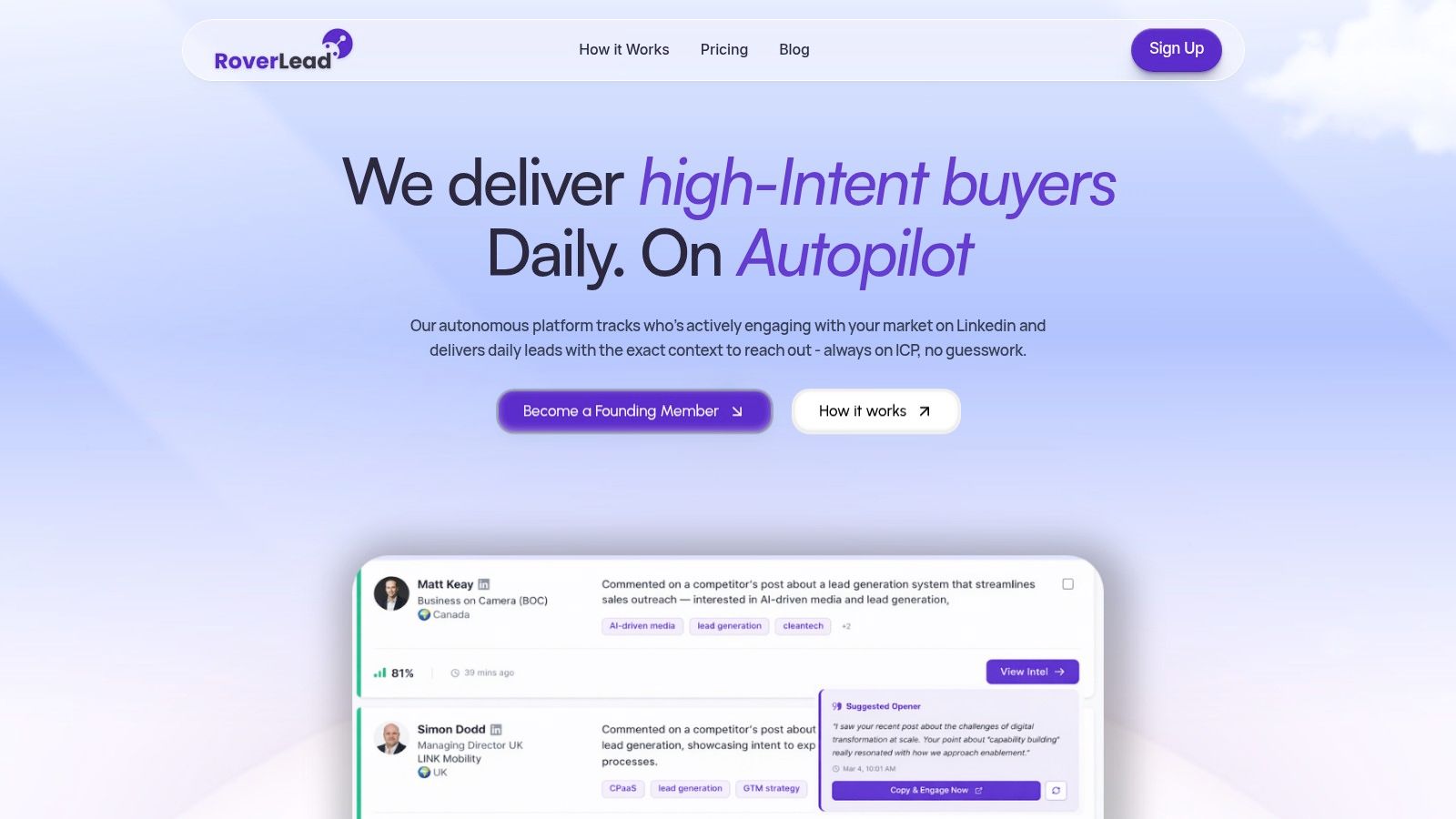
That's why modern prospecting is moving toward signal hunting. You look for signs that a buyer or account is active now. Social engagement, pricing discussions, comments on a competitor's post, interactions with niche creators, repeat visits to high-intent content. Those clues matter more than “works at a company with 200 employees.”
LinkedIn works when you treat it like a signal feed
LinkedIn is where many B2B teams get this wrong. They use it like a static database instead of a living stream of intent. The result is robotic connection requests and messages that sound like they were written by a committee of overconfident templates.
The better move is behavioral timing. The LinkedIn Intent Paradox is that it's a top channel, but generic outreach fails. Timing outreach to real behavior, such as comments or pricing discussions, boosts positive reply rates by 2-3x compared to static targeting, according to this analysis of LinkedIn intent-based outreach.
That's the shift. Stop asking, “Who fits?” Start asking, “Who fits and is showing signs of movement?”
A practical workflow looks like this:
Track relevant conversations: Follow creators, competitors, and topic clusters your buyers engage with.
Watch for intent clues: Comments, repeated interactions, and public questions often tell you more than a job title does.
Lead with context: Reference the behavior, not just the profile.
Keep it conversational: Buyers increasingly prefer relevance over canned outreach, which is why intent-based thinking also overlaps with intent-based marketing strategies.
Here's a short demo worth watching if you're rethinking LinkedIn prospecting:
This approach doesn't mean volume disappears. It means volume comes after relevance, not before it.
How to Know It's Working Key Metrics and Common Pitfalls
Lead generation gets weird when teams measure the wrong things. Opens look nice. Clicks look busy. Even lead volume can flatter a broken process. Revenue teams need metrics that answer one question: are we creating qualified pipeline efficiently?
The metrics that tell the truth
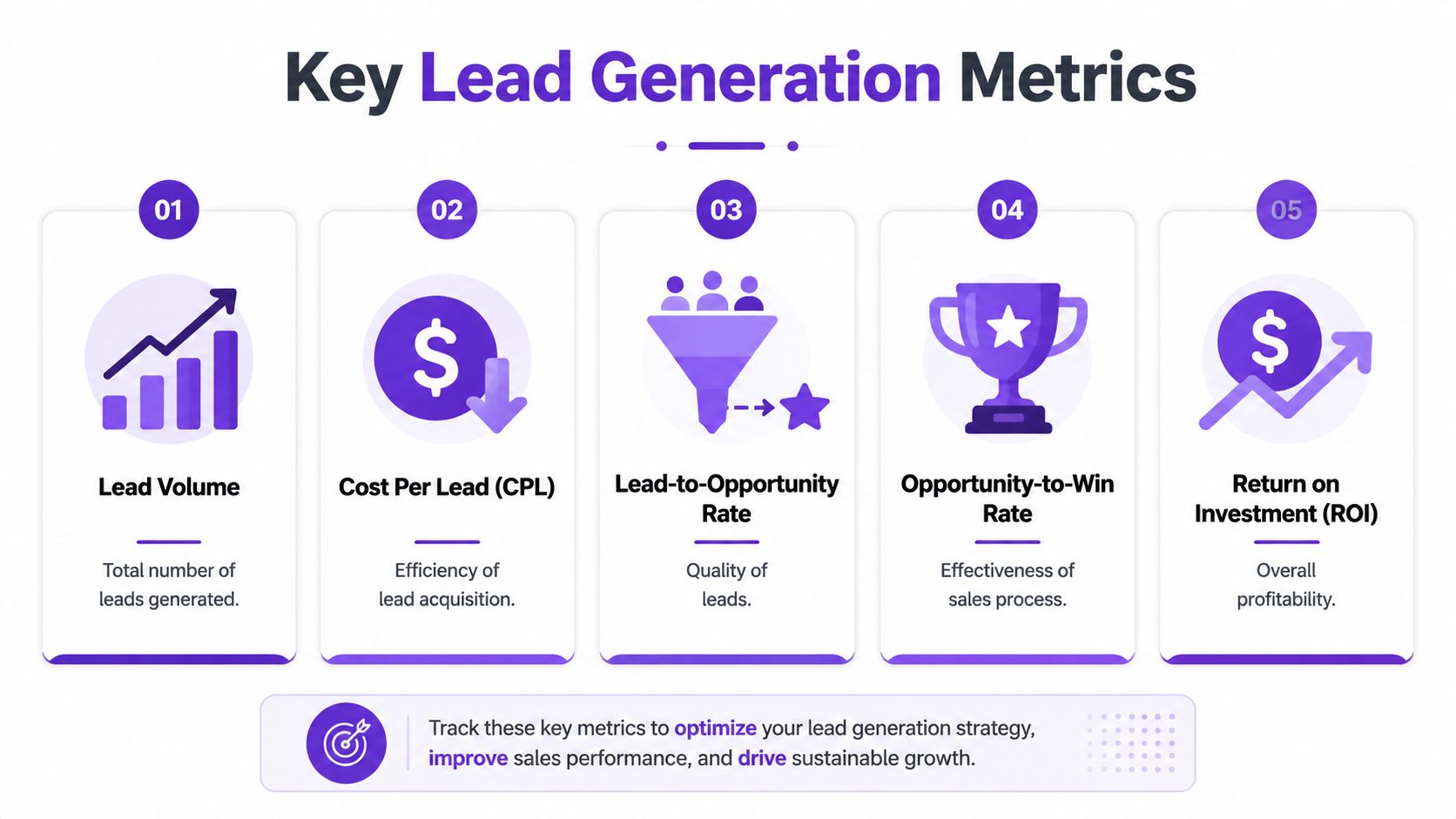
Start with a small set of operational metrics you can act on.
Lead volume: Are you creating enough opportunities to keep the team busy?
Cost per lead: How expensive is each lead source relative to the value it creates?
Lead-to-opportunity rate: Are the leads becoming real sales conversations?
Opportunity-to-win rate: Is sales converting qualified interest into revenue?
Pipeline velocity: How quickly do leads move once they show intent?
These metrics work together. A channel can produce cheap leads and still be a bad bet if nothing converts. Another channel can look expensive on the surface but generate strong-fit opportunities that close cleanly.
There's also a sampling issue many teams overlook. Campaign managers recommend waiting until you've reached 100–150 prospects before analyzing performance, because smaller samples often produce misleading conclusions, as explained in this guide to lead generation measurement thresholds.
Don't kill a campaign after a handful of replies. Small samples create fake confidence and fake panic.
The mistakes that quietly wreck results
A few errors show up over and over.
No clear ICP
If your ideal customer profile is fuzzy, every downstream metric gets noisy. Reps personalize for the wrong personas. Marketing attracts mismatched accounts. Leadership thinks the problem is messaging when the problem is targeting.
Slow follow-up
Warm leads cool fast. If someone shows clear interest and your team responds later, you've taught the market that your process is slower than your competitors.
Bad qualification discipline
Some teams call everything a lead because it makes dashboards prettier. It doesn't help sales. Qualification needs criteria, not vibes. A practical place to tighten this is your process for how to qualify sales leads.
Overreacting to early results
Teams launch a campaign, collect a thin slice of data, then rewrite messaging, switch lists, and blame the channel. That creates chaos, not learning.
A better diagnostic rhythm looks like this:
Problem you see | Likely cause |
|---|---|
Plenty of leads, few meetings | Weak qualification or poor targeting |
Good replies, poor conversions | Messaging sets the wrong expectation |
Strong meetings, slow pipeline | Sales follow-up or handoff friction |
Inconsistent results | Sample size too small or process changes too often |
The point of metrics isn't reporting theater. It's faster diagnosis.
Your Sales Lead Generation Questions Answered
Is inbound or outbound better for a startup?
Usually a mix. Use outbound for targeted pipeline now, and build inbound so future buyers can find and trust you without a rep chasing them.
What's the biggest mistake teams make?
Treating list size as strategy. A big list of low-interest contacts is just organized disappointment.
How do I know if a lead is qualified?
Check two things. Are they a fit for your ICP, and are they showing intent? If one is missing, treat them carefully.
What's the difference between an MQL and an SQL?
An MQL has shown enough engagement to deserve attention. An SQL is ready for active sales follow-up.
Should every lead go straight to sales?
No. Some need nurturing. Sending weak-fit or low-intent contacts to reps wastes time and lowers trust in marketing.
How should I use LinkedIn without sounding spammy?
Lead with context. Mention something they did, said, or engaged with. Skip the fake flattery and the “just checking if this is on your radar” nonsense.
How long should I wait before judging a campaign?
Long enough to get a meaningful sample. Early judgments are often wrong, especially when volume is thin.
What matters more, volume or relevance?
Relevance first. Volume matters only after you know the audience and timing are right.
When should I disqualify a lead?
When the account is clearly outside your ICP, the pain isn't real, or there's no sign of active interest after reasonable follow-up.
Do small teams need fancy tooling?
Not at first. They need a clear ICP, a repeatable follow-up process, decent CRM hygiene, and messaging tied to buyer context. Tools amplify discipline. They don't replace it.
If your team is tired of building static lists and wants a smarter way to spot real buyer intent on LinkedIn, RoverLead AI is worth a look. It helps sales teams turn live engagement signals into high-intent leads matched to their ICP, so outreach starts with timing and relevance instead of guesswork.