What Are the Use Cases? 10 RoverLead AI Examples

A rep sends the same LinkedIn template to a long list of strangers, waits, and then wonders why the inbox stays quiet. The problem usually isn't effort. It's timing, context, and the assumption that every contact is equally ready to talk. What are the use cases for intent-led LinkedIn outreach? They're the specific situations where observable activity helps a seller decide whom to contact, why now, and what to say. The practical shift is from static lists to signals such as competitor engagement, pricing questions, creator discussions, and company changes. That approach complements a broader master outbound lead gen process, but keeps the day-to-day workflow focused: detect the trigger, review the evidence, approve the message, and track the outcome.
Table of Contents
1. Competitor engagement monitoring
Someone asking questions beneath a competitor's compliance webinar has already shown interest in the category. That doesn't make them a ready-to-buy lead, but it's far more useful than treating every IT manager in your database alike. RoverLead AI's Signal Agents can monitor competitor activity, surface matching ICP profiles, and preserve the context behind the alert.

A cybersecurity seller might review comments on a rival's webinar post and find IT managers asking about audit timelines. The seller checks the exact comment, confirms the person fits the ICP, then approves an opener built around the question. The KPI is approved outreach to qualified conversation rate, not raw engagement volume.
Start with three to five direct competitors, review the activity weekly, and lead with a useful observation rather than a comparison attack. A short guide on monitoring competitor activity can help structure the workflow.
2. Creator audience mining
Industry creators often attract the buyers a sales team wants to reach. Their audiences reveal where decision-makers spend attention, which topics create discussion, and whether a prospect is already thinking about a problem your product addresses. That makes creator engagement a discovery signal, not an invitation to pitch everyone who clicked Like.
A HR-tech startup could track three people-operations experts and notice several VP People profiles engaging with posts about attrition. The trigger is repeated, relevant interaction. The approval step is checking whether the prospect's role, company, and recent activity support a genuine conversation. The KPI is positive-reply rate by creator and topic.
Practical rule: Choose creators for audience fit, not follower counts.
Track engagement across at least three posts before prioritizing a prospect. Then open with the specific retention issue discussed, rather than writing “I saw you follow several HR influencers.” If you're building a broader creator research process, this guide to influencer identification for developers offers a related angle.
LinkedIn's 2024 Business of Influence research surveyed more than 1,700 B2B buyers and decision-makers in the United States, United Kingdom, and India. Among respondents who use industry influencers during buying, 67% said influencer content plays a critical role during the consideration stage of IT purchasing, and 53% identified subject-matter expertise as the most important influencer trait. LinkedIn's research announcement supports treating expert content as a meaningful context signal.
3. Pricing and demo intent detection
Pricing questions are among the clearest public signs that a prospect is evaluating options. A project-management SaaS team might catch someone asking, “Anyone know what this costs for 50 seats?” The seller reviews the wording, confirms the company and role, then approves a response offering a relevant pricing overview and a short call.
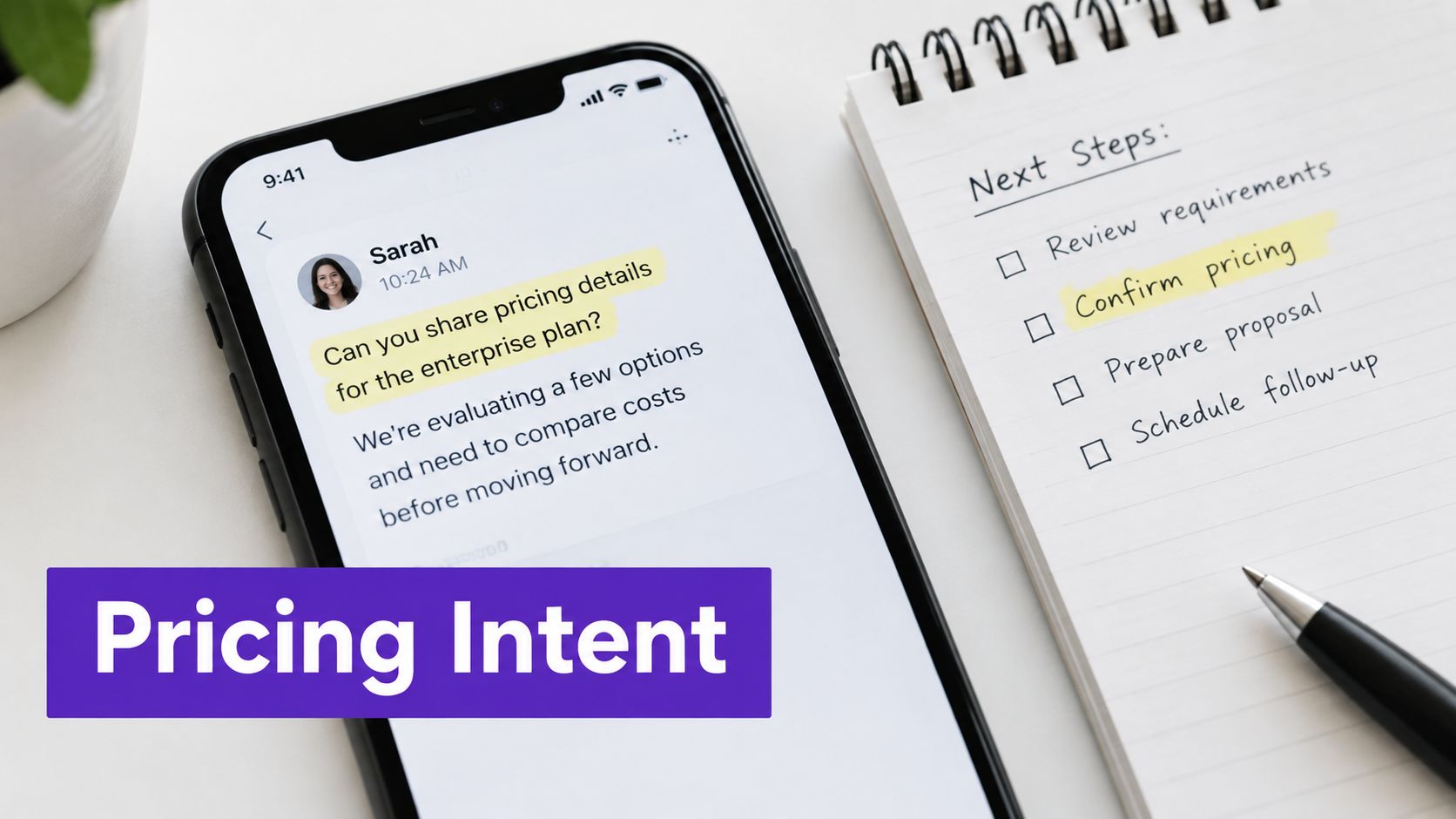
The important distinction is value first, meeting second. Send a calculator, implementation note, or clear explanation before asking for calendar time. The KPI is signal-to-approved-outreach rate, followed by reply and qualified-conversation rates. If the trigger text is ambiguous, don't force a sales interpretation onto it.
A response drafted within the hour can be useful because the question is still active. It can also be awkward if the seller pretends a public comment was a direct request for a pitch. Review the evidence before approving the message.
Here's a practical visual example of how pricing intent can fit into a monitored outreach workflow:
4. Buying-trigger monitoring
Company changes create timing signals. A new VP of Sales, a funding announcement, or a team that starts hiring SDRs can indicate that priorities and budgets are shifting. None of these events guarantees a purchase, so a seller should combine the trigger with role fit, relevant content engagement, or a stated operational problem.
Consider a recruiting-automation vendor that notices a company hiring five SDRs. The system surfaces the Head of Revenue, attaches the hiring activity, and drafts an opener about ramp time for new reps. The seller approves it only after checking that the contact owns the relevant function. The KPI is opportunity creation by trigger type.
Use at least two signals before prioritizing an account. Mention the company change briefly in the first line, then connect it to a practical question. A useful framework for separating genuine activity from noise appears in this guide to buying signals in sales.
A trigger earns attention. It doesn't earn entitlement to a sales pitch.
That distinction keeps the outreach human. A promotion may be interesting, but it isn't permission to invent a need.
5. Niche topic conversation engagement
Broad industry content creates broad engagement. Niche conversations create better context. Posts about a specific compliance rule, tool migration, or accounting treatment tend to attract people close to the problem, even when they aren't using commercial buying language.
A fractional CFO agency could monitor SaaS revenue-recognition discussions, add a practical checklist in the thread, and then review interested commenters. The approval step happens before any direct message. The seller checks whether the commenter is in the target market and whether the conversation reflects an active issue. The KPI is reply-to-qualified-conversation rate by topic.
Keep a running list of pain-point phrases, product names, and migration terms. That vocabulary makes monitoring more precise over time.
Reply publicly first: Add useful information before mentioning the offer.
Separate education from intent: A thoughtful comment may show relevance without showing urgency.
Record the wording: The prospect's own language often makes the strongest opener.
A good workflow sometimes ends with no outreach. If the thread is educational and the person never indicates a project, leave the interaction alone. Relevance includes knowing when not to send.
6. Approval-first outbound for compliance-minded teams
Some teams need speed, but they need control more. Healthcare consultancies, regulated businesses, enterprise brands, and agencies managing client reputations can't treat generated copy as ready-to-send just because it sounds polished.
A healthcare consultancy might route every draft to a senior partner before contacting a hospital CFO. The AI gathers the public context and proposes the opener. The partner checks tone, factual claims, sensitive references, and whether the message crosses from helpful into presumptuous. The KPI is approved-send rate alongside qualified-reply rate.
Set the approval criteria before launching. Include banned claims, tone requirements, escalation rules, and suppression conditions for opt-outs or negative replies. Batch reviews twice daily if the team needs predictable throughput, but don't let batching become a rubber stamp.
This workflow also protects against hallucinated personalization. The seller can see the evidence behind each recommendation, edit the draft, and retain ownership of the relationship. Automation handles preparation. A person handles judgment.
7. Context-rich personalized openers
“Hope you're well” isn't personalization. A context-rich opener names the actual activity that caused the lead to surface, such as a comment, post, stated challenge, or comparison question.
After a prospect comments about slow onboarding, a draft might say, “You mentioned onboarding taking six weeks. We cut that to 10 days for a fintech team last quarter. Worth a quick look?” That example should only be used if the claim is accurate and approved. Otherwise, the seller should remove it rather than decorate the message with invented proof.
The trigger is specific activity. The approval step is evidence checking and editing. The KPI is positive-reply rate, with qualified meetings as the quality check. Keep the opener under 60 words, mention the concrete detail, and end with a low-pressure question.
For teams refining the quality of AI-generated context, context engineering for outreach is a useful related resource. The principle is simple: personalization should explain why this person, this topic, and this moment belong in the same message.
8. Lightweight lead inbox as a CRM
Small teams often don't need a large CRM on day one. They do need a reliable place to see who replied, what they care about, and when the next follow-up belongs. A lead inbox with tags, pins, reminders, and conversation history can cover that basic relationship layer without creating another administrative project.
A solo founder might manage 40 active conversations using tags such as pricing-asked and nurture-Q3. The trigger is a meaningful interaction or reply. The approval step is deciding the next action from the full thread, rather than drafting a response from memory. The KPI is follow-up completion rate, with qualified conversations tracked by intent tag.
Use tags that answer operational questions quickly:
Intent: Pricing, competitor, implementation, integration, or research.
Stage: New, replied, qualified, nurture, or no-fit.
Next action: Send resource, answer objection, schedule call, or review later.
Run a weekly cleanup. Close dead threads, update stale tags, and remove prospects who have opted out. An inbox is useful only when it reflects reality.
9. Auto-draft and auto-reply conversation rescue
A reply arriving during a meeting shouldn't disappear until next week. Auto-draft can prepare an answer for approval, while limited auto-reply can handle simple scheduling or FAQ responses when the team has already signed off on the wording.
Suppose a prospect asks at 9 p.m., “Do you integrate with HubSpot?” The system drafts a yes-with-details response. The rep checks the integration information the next morning, edits where necessary, and adds a calendar link. The KPI is reply-to-next-action time, not the number of automated messages sent.
Automate only predictable, low-risk exchanges. Product objections, negotiations, security questions, and sensitive relationship issues need human review. Review approved templates weekly so they don't start sounding like a robot trapped in a help center.
For teams defining the boundary between drafting and sending, this overview of LinkedIn auto-message workflows provides a relevant starting point. The safest pattern is assisted continuity, not unattended persuasion.
10. Evergreen campaigns replacing static lists
A Sales Navigator list can preserve fit data, but it won't necessarily tell you who started discussing pricing this morning. Evergreen campaigns keep watching for relevant behavior, add new prospects when signals appear, and retire contacts who no longer show useful activity.
A B2B agency might build campaigns around three competitors and two niche topics. Each morning, the seller reviews the feed, checks the trigger, approves the strongest drafts, and tags the result. The KPI is meetings and pipeline velocity by signal class, not total leads collected.
Refresh ICP keywords and competitor names quarterly. Track whether competitor engagement, creator interaction, pricing questions, or niche discussions produce qualified conversations, then give the strongest signal types more attention. Intent research also recommends measuring signal coverage across target accounts and the conversion from alert to salesperson action, as outlined in this B2B funnel optimization guidance.
The campaign should age signals, not hoard them. A fresh pricing discussion deserves more attention than an old generic like, while repeated engagement without a reply may eventually belong in nurture.
Side-by-Side Comparison of 10 Use Cases
Technique | 🔄 Implementation complexity | ⚡ Resource requirements / efficiency | ⭐ Expected outcomes | 💡 Ideal use cases | 📊 Key advantages |
|---|---|---|---|---|---|
Competitor Engagement Monitoring | Medium, set competitor list + filters | Moderate, monitoring tools + weekly review | High ⭐, warm, ranked leads with intent | Capture active evaluators from competitors | Higher reply rates; uncovers hidden evaluators |
Creator Audience Mining | Medium, track multiple creators & history | Low–Moderate, creator list + ongoing tracking | High ⭐, finds topic-aligned decision‑makers | Content-driven outreach; find where buyers hang out | Builds relevant audience without buying lists |
Pricing and Demo Intent Detection | High, near‑real‑time NLP and ranking | High, intent engines & alerting required | Very High ⭐, catches hot, ready-to-buy moments | Rapid response to pricing/demo queries | Speeds response; ranks leads by intent strength |
Buying-Trigger Monitoring | Medium, monitor role/hiring changes + scoring | Moderate, profile feeds + scoring rules | High ⭐, timing advantage when priorities shift | Outreach after hires, funding, hiring surges | Natural reason to reach out; timely engagement |
Niche Topic Conversation Engagement | Low–Medium, keyword/thread monitoring | Low, focused monitoring, lower volume | Medium–High ⭐, strong authority; limited scale | Specialist services; compliance, migrations, niche pain | Builds credibility with less competition |
Approval-First Outbound (Compliance) | Medium, approval workflows + audit trail | Moderate, human reviewers; process overhead | High ⭐, protected brand & safer outreach | Regulated industries, enterprise, client-facing agencies | Protects brand; auditability; controlled scaling |
Context‑Rich Personalized Openers | Low–Medium, context extraction + tailoring | Low, AI drafts; human review required | High ⭐, noticeably higher engagement | SDR outreach referencing specific prospect actions | Scales true personalization; higher reply rates |
Lightweight Lead Inbox as a CRM | Low, simple setup, minimal training | Low, few resources; easy adoption | Medium ⭐, keeps warm conversations visible | Solo founders, small sales teams needing tracking | Fast to set up; reduces admin burden |
Auto‑Draft & Auto‑Reply Conversation Rescue | Medium, templates, rules, human‑in‑loop | Moderate, rules management & oversight | High ⭐, reduces response time from days to minutes | High‑volume inboxes; FAQ and scheduling replies | Prevents leads going cold; speeds throughput |
Evergreen Campaigns Replacing Static Lists | High, continuous signals + learning loop | High, ongoing monitoring & ICP tuning | High ⭐, living pipeline that improves over time | Teams needing continuous, up‑to‑date lead flow | Keeps pipeline current; auto-refreshes and learns |
Where to start with one signal for 30 days
Pick one signal and run it for 30 days. Competitor engagement is a sensible starting point for a category with visible alternatives. Pricing or demo language is better when prospects already discuss products publicly. Creator engagement works when the creator's audience closely matches your buyer persona.
Before launching, define the ICP, the exact trigger, the approval rule, and the KPI. Then establish a simple baseline using your existing outreach. Track signal-to-approved-outreach rate, approved outreach to reply rate, reply to qualified conversation rate, and meetings or opportunity creation by signal type. Don't judge the system by how many alerts it produces. A noisy feed is just another list wearing a smarter hat.
Keep evidence attached to every lead. The seller should see the post, comment, competitor reference, or company event that caused the recommendation. Buyers increasingly research independently: Gartner's 2024 survey of 632 B2B buyers found that 61% preferred an overall rep-free buying experience, while 73% avoided suppliers that sent irrelevant outreach and 69% reported inconsistencies between website and seller information. Gartner's survey release makes the operating lesson clear. Relevance and consistency matter more than message volume.
A buying group can also include five to 11 stakeholders across approximately five business functions, according to Gartner's B2B buying research. The Gartner B2B buying report supports using an inbox with shared context and follow-up ownership, especially for enterprise sales, agencies, and consultancies. One person may start the conversation, but several people can influence the decision.
FAQ
What are the use cases for RoverLead AI?
RoverLead AI is useful for monitoring competitor activity, creator audiences, niche topics, pricing and demo discussions, buying triggers, personalized openers, approval-first outreach, lead tracking, conversation rescue, and evergreen campaigns.
How does intent-led outreach differ from a static list?
A static list mainly records who fits the ICP. Intent-led outreach adds observable context about what a prospect is discussing or engaging with, then helps the seller decide whether the timing is relevant.
Which signal should a small sales team start with?
Start with the signal your team can verify quickly and act on consistently. Pricing questions, competitor discussions, and a focused niche topic are often easier to review than broad engagement.
Should every LinkedIn engagement trigger outreach?
No. A generic Like or educational comment may indicate relevance without showing buying intent. Rank signals by commercial specificity, recency, ICP fit, and whether multiple activities appear across the account.
Does AI send messages automatically?
RoverLead AI is designed around approved outreach. The system can monitor activity, surface context, and draft a personalized opener, while the seller reviews and approves what gets sent.
What should the seller check before approving a draft?
Check that the trigger is real, the interpretation is fair, the person fits the ICP, and the message doesn't imply consent or urgency that the prospect never expressed. Remove unsupported claims and awkward personalization.
Can an inbox replace a full CRM?
It can cover lightweight tracking for small teams that need conversation history, tags, reminders, and next actions. Larger teams may still need a CRM for forecasting, account hierarchies, reporting, and governance.
What KPIs matter most?
Track the full path from signal to action: approved outreach rate, reply rate, positive-reply rate, qualified conversations, meetings, and opportunity creation by signal type. Lead volume alone says very little.
How should teams handle negative replies and opt-outs?
Tag them clearly, stop outreach, and apply suppression rules. A negative reply is operational information, not an invitation to try a different template.
How long should a pilot run?
Run one focused signal for 30 days, keep the approval standard consistent, and compare results with your existing baseline. Review cohorts by signal, persona, timestamp, and campaign rather than relying only on aggregate activity.
RoverLead AI fits this governed workflow by monitoring LinkedIn activity, attaching evidence to each lead, drafting context-rich messages, and keeping follow-up visible in a lightweight inbox. Start narrow, measure what turns into a real conversation, and let the evidence decide which signals deserve more attention.
RoverLead AI helps B2B teams monitor LinkedIn buying signals, review curated ICP leads, approve personalized outreach, and keep conversations moving with inbox tools and assisted replies. Visit RoverLead AI to connect your prospecting workflow to real activity instead of another static list.