Selling a Script: A Practical Guide for 2026

Most advice about selling a script starts with the wrong question: How many queries can you send? That's a vanity metric. A better question is, which buyer already has a reason to want this exact project?
The spec market has never been a dependable volume business. Verified sales peaked at 173 deals in 1995, stayed above 100 annually through much of 1994 to 1998, then fell into a bust from 2003 to 2010, with 610 total deals across that period. The same dataset records 62 spec sales in 2017, 40 in 2018, 32 in 2019, and 25 in 2020. The historical spec-market analysis at Go Into The Story makes the central point plainly through its data: outright original-script sales swing with buyer appetite, production pipelines, and industry cycles.
That makes selling a script a buyer-matching problem, not a contest to see who can irritate the most assistants. Indie financiers, boutique production companies, sales agents, and emerging-platform buyers may be better targets than a major studio that only wants a script with talent already attached. Your job is to find the buyer whose mandate, slate gap, format, and budget fit your project, then make that one buyer care.
Table of Contents
Why Selling a Script Is a Buyer-Matching Game Now
The old playbook says to blast queries until someone bites. That approach treats every producer, manager, studio, and agency as interchangeable. They aren't. A contained horror script, an expensive historical epic, and a half-hour animated comedy belong in different buyer ecosystems, even when all three are technically screenplays.
Current market commentary points toward a more fragmented 2026 market, shaped by selective commissioning, IP, global appeal, and contained scope. It also argues that indie production companies, boutique distributors, and sales agents account for more deal activity in some tracker data than the major studios. The 2026 screenplay-market analysis at Screenplay.biz supports the useful contrarian conclusion: the biggest logo isn't automatically the best route.
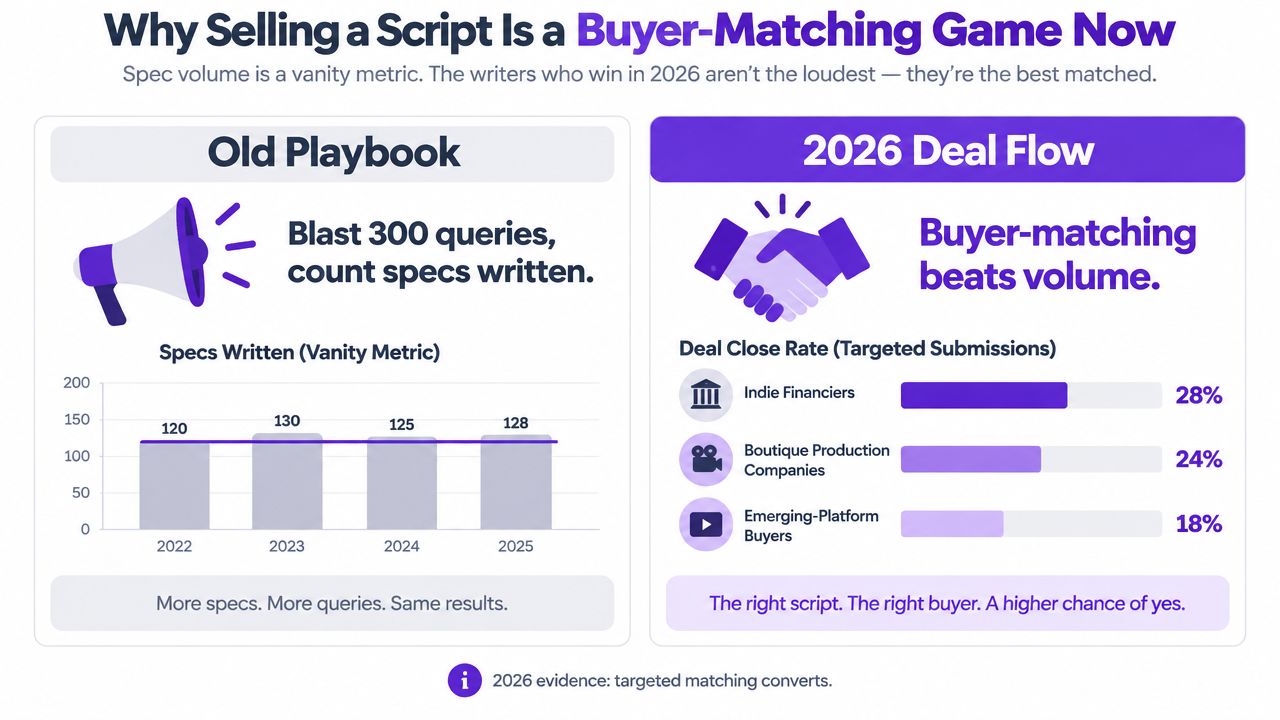
Cold outreach still has a place, but it must be tightly targeted. Independent guidance puts a positive response or script request from cold letters and emails at roughly 5% to 10%, while another benchmark says writers are doing well when 3% to 5% of production companies or agents request the script. Selling Your Screenplay's guidance on contacting producers supplies those benchmarks. The lesson isn't to panic over every pass. It's to stop confusing activity with traction.
Practical rule: Send fewer queries, but make each one prove that you've researched the buyer.
Selling a script works when your project answers a buyer's current problem. Does it fill a genre gap? Fit a contained budget? Offer a role that could attract talent? Extend an existing IP strategy without requiring an expensive rights battle? The operating system is simple: prepare the material, map the buyer, earn the read, separate options from sales, and adjust your route when the evidence says you're targeting the wrong lane.
Prepping Your Script Before It Leaves Your Desk
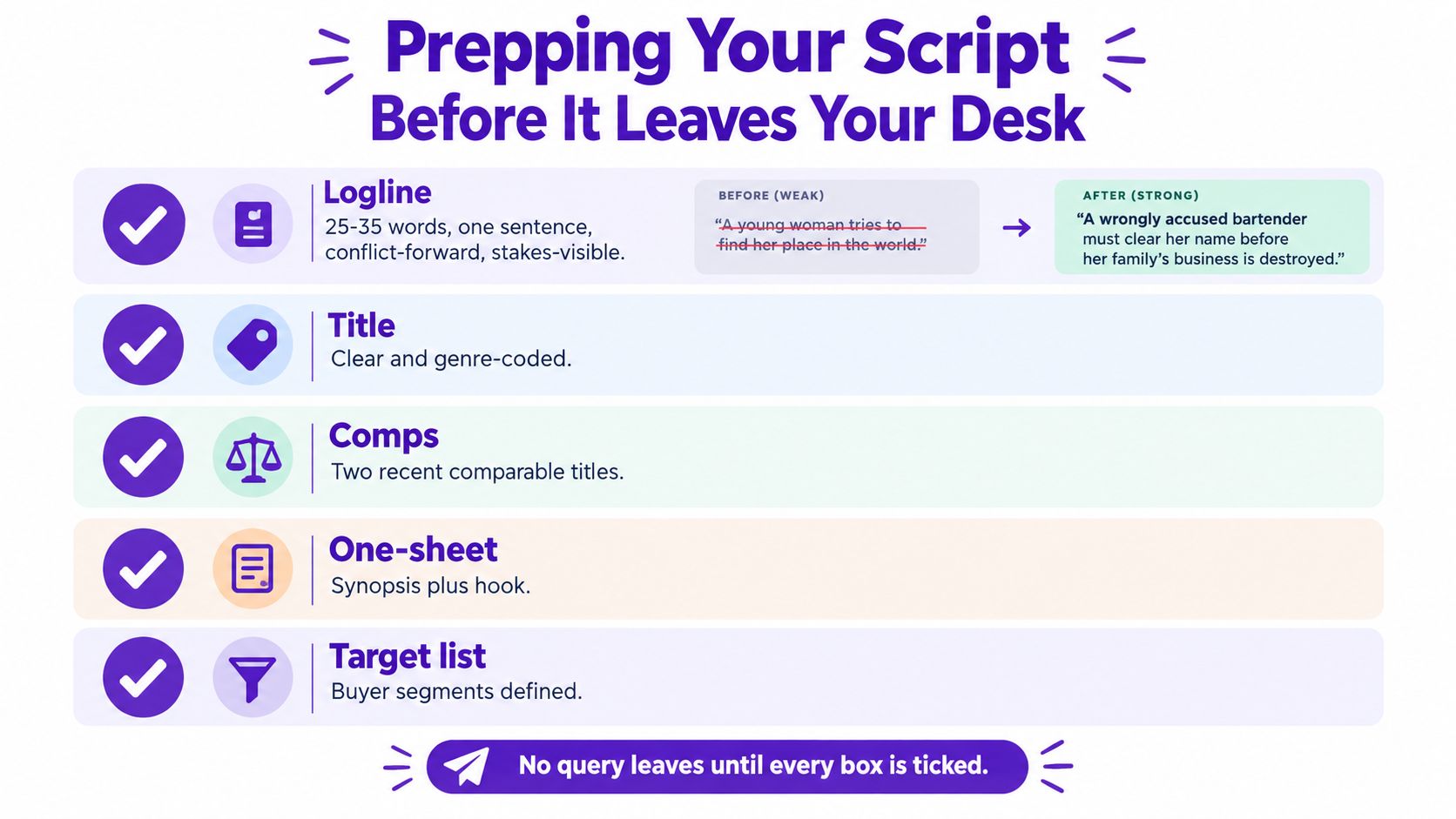
A buyer can't champion a script they can't understand quickly. Start with the logline, not the query letter. Write one sentence of roughly 25 to 35 words, make the conflict visible, and show what the protagonist stands to lose.
Weak: “A troubled detective returns to her hometown and confronts her past.”
Stronger: “When a disgraced detective returns home to bury her father, she must expose the serial killer he protected before the final victim becomes her estranged daughter.”
The second version gives the reader a protagonist, inciting problem, antagonist pressure, deadline, and personal stakes. It also tells the buyer what kind of movie they're being asked to imagine.
The first ten pages need the same discipline. Final Draft's guidance on why screenplays fail to sell emphasizes fast clarity around concept, conflict, and stakes, especially early in the script. Plant the inciting incident, establish the dilemma, and show the difference between what the protagonist wants and what they actually need. Don't spend those pages warming up the engine while the reader waits for the movie to begin.
Clear rights make buyers less nervous
Before outreach, confirm your chain of title. Know whether the work is wholly original, whether it uses underlying intellectual property, and whether any prior option, shopping agreement, collaboration, or assignment could interfere with a sale. Decide what you're offering, screenplay rights, life rights, adaptation rights, or a license with defined limits. If you can't explain the rights position in plain English, hire an entertainment lawyer before a buyer asks.
Pricing requires restraint. Don't anchor your debut script to a spectacular headline sale. Use the WGA Screen Compensation Guide as a floor for applicable union deals, then evaluate the buyer, budget, attachments, and rights package. Preparation means having a registered draft, a copyright filing, clean PDF and watermarked copies, and a one-page synopsis ready. A polished script with messy paperwork is still a messy opportunity.
Who Buys Scripts and When to Target Each One
The buyer should follow the script, not the writer's wish list. A major studio can offer the largest upside, but it may require attachments and a package before anyone treats the material as a live opportunity. An independent producer may act faster when the script fits an active slate, a financeable budget, or a clear audience.
Use the comparison below as a routing tool, not a promise of pricing. The market has no universal price bands. A deal may be an outright sale, setup, option, development agreement, or writing assignment.
Script Buyer Types at a Glance
Buyer Type | Typical Price Band | Decision Timeline | Entry Point | Best Fit |
|---|---|---|---|---|
Major studios and mini-majors | Premium deals when the project has commercial attachments | Slow and attachment-driven | Agent, manager, producer, or packaged submission | High-concept material with talent potential |
Independent production companies and financiers | Budget-sensitive, from development arrangements to meaningful purchase offers | Often more direct than studio review | Targeted query, producer referral, festival or market contact | Contained, producible scripts with clear audience |
Management companies and talent agencies | Not usually script buyers | Varies by relationship and roster needs | Referral, contest credibility, recommendation, or targeted introduction | Writers with a strong voice and more than one viable project |
Streamers and platform buyers | Usually accessed through producers, packagers, or representatives | Formal and selective | Production company, agency, or established package | IP-aware, globally legible, series-ready or tightly scoped features |
Sales agents and international partners | Budget and territory dependent | Market and financing cycle dependent | Film markets, producer introductions, festivals | Strong genre, foreign-language, and financeable projects |
Boutique buyers | Flexible, mandate-specific arrangements | Can be comparatively nimble | Direct research and highly relevant outreach | New media, brand, podcast-to-screen, and specialist concepts |
The useful concept is ideal customer profile, even though writers rarely use that business language. This explanation of ICP applies directly to script sales: define the buyer's appetite before you pitch.
Major studios are aspirational targets, not default targets. Start with production companies and financiers when the script has a realistic budget footprint and a clear audience. In the current deal flow, indie and boutique buyers can move more specs than major studios because they control narrower mandates and often make faster decisions.
Streamers rarely operate as open inboxes for unknown writers. Reach them through production companies already supplying their pipeline.
Sales agents and international partners become stronger prospects when the concept travels across language or territory, or when the production plan depends on presales. Boutique buyers suit unusual formats and narrow mandates. Match budget, tone, format, and IP status to the buyer's business. The biggest name is often the least useful name on your list.
Running Outreach That Earns a Read
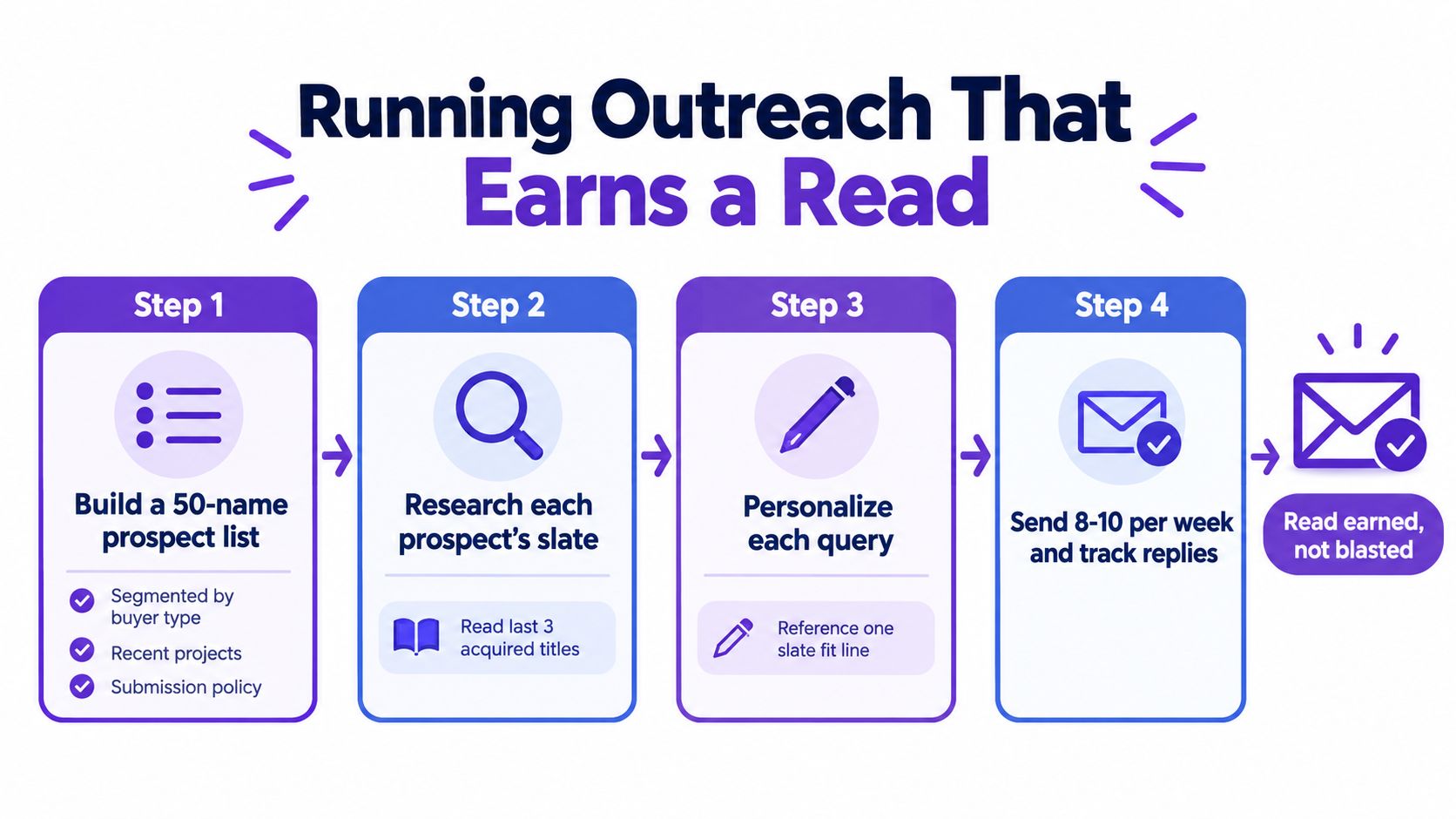
Build a prospect list of 50 names, segmented by buyer type, recent projects, and submission policy. The number isn't magic. It forces you to research a finite group instead of hiding behind an endless spreadsheet.
For each prospect, study the slate. Look at recent acquisitions, produced titles, announced projects, genres, formats, and the kinds of writers they already support. Your query should answer one question before the recipient asks it: Why this buyer, for this script, now?
The four-step outreach system
Build the list. Remove anyone who doesn't accept material through your route or has no visible fit.
Find the mandate. Identify a comparable title or a stated appetite that connects to your project.
Write the query. Keep it under 200 words. Include the title, genre, logline, concise personalization, relevant credentials, and a direct request to read.
Follow up carefully. Send one follow-up after 7 days and another after 21 days, then move on without theatrics.
Use a subject line such as: Query, [TITLE], [GENRE], for fans of [COMPARABLE TITLE]. Open with two personalized sentences. First, mention the buyer's relevant project or mandate. Second, explain the specific overlap with your script. End with a call to action that asks for a read, not a meeting: “If this fits your current slate, may I send the screenplay?”
Don't attach the full PDF to a cold query unless the recipient explicitly requests it. Send the logline and, where permitted, the first ten pages. A cold attachment can trigger security filters, violate policy, or make the recipient feel you've ignored their process.
For email mechanics, this cold email template guide is useful as a structural reference, but don't copy business-sales language into a screenplay query. Track every response in a simple sheet with columns for buyer, date, personalization used, response, requested material, pass reason, and next action. A pattern of “not for us” may indicate targeting. A pattern of “love the writing, not the concept” points to positioning. A silence pattern can mean the pitch, timing, policy, or recipient is wrong. Diagnose before rewriting the entire screenplay.
Negotiation, Options, and What Your Contract Really Says
An option isn't a sale. It gives a producer exclusive rights to purchase the script during a defined period. The rights transfer only if the producer exercises the option through a separate purchase or literary purchase agreement, as explained in this legal overview of option and shopping agreements.pdf).
Term | Option Agreement | Full Purchase |
|---|---|---|
Rights | Exclusive control during the option period | Rights transfer under the purchase agreement |
Payment | Option fee, if negotiated | Purchase price, subject to contract terms |
Duration | Defined period, potentially with extensions | No option clock, though other conditions may apply |
Reversion | Rights can return if not exercised, subject to the agreement | Usually governed by contractual rights and conditions |
Writer leverage | Attachments, timing, and extension terms matter | Credit, compensation, backend, and reserved rights matter |
Read six terms before you celebrate: option fee, option period, extension windows, purchase price, backend participation, and credit. Add reversion rights to that list. A small option payment can be acceptable if the period is short and the buyer has a credible path to production. A nominal fee paired with broad extensions and no meaningful reversion protection is a different proposition.
The WGA's 2025 to 2026 Low Budget Agreement lists $15,266 as 25% of the minimum for an original screenplay, excluding treatment, with that full amount due upon sale for spec sales. The same filing cites a $61,064 minimum for that category. The WGA filing provides those figures. The WGA's Low Budget Agreement also limits guild-protected narrative feature screenplay sales to theatrical films budgeted at or below $1.2 million.
Your strongest negotiation levers are a credible producer or director attachment, relevant comparable sales data, and festival traction. Demanding full writing credit regardless of rewrites or refusing any option period rarely helps a debut writer. Watch for assignment of underlying rights, automatic moratorium extensions, and sequel or prequel options that carry no additional consideration. Have an entertainment lawyer review the contract. A proper deal review is the difference between excitement and protection.
Selling a Sales Script vs Selling a Screenplay
The selling process shares a basic sequence: prepare the material, identify the right buyer, present its value, negotiate terms, and sign a contract. The buyer's priorities, deliverable, proof, and route to revenue differ sharply.
Dimension | Sales / Cold-Call Script | Feature Screenplay |
|---|---|---|
Buyer | Brand, agency, B2B client, or sales team | Producer, studio, financier, or platform |
Deliverable | Short script for a call or campaign | Complete feature screenplay |
Proof asset | Case studies, conversion evidence, and campaign results | Comparable titles, writing sample, attachments, and market fit |
Commercial logic | Performance against a defined sales objective | Financeability, audience, packaging, and production path |
Sales rhythm | Shorter client decision cycle | Longer development and financing process |
A cold-call script earns attention through utility. It must help a representative open a conversation, qualify a prospect, answer an objection, and secure a next step. Show how the script supports that sequence, then connect it to a business outcome. This guide to outbound calling scripts reflects that practical orientation.
A screenplay earns a read by giving a buyer a film or series they can picture producing and selling. Its proof comes from a strong concept, polished pages, useful comparable titles, relevant attachments, and a credible production route. Match the screenplay to buyers with the right genre appetite, budget range, and release strategy. Sending it widely without that fit turns a buyer-matching problem into wasted outreach.
The pitch must serve one commercial purpose. A business client wants a practical tool that supports a defined sales objective. A screen buyer wants a story with audience potential and a workable path to production. State which transaction you are pursuing, then tailor the pitch, proof, and rights to that buyer.
Repurposing can work if the intent changes deliberately. A dramatic scene can become a brand narrative, while a sales objection sequence can inspire dialogue or conflict. Keep the documents and offers distinct. One should sell business performance; the other should sell a producible story.
Your 90-Day Plan and the Questions Writers Ask Most
Use the next ninety days as a controlled experiment, not an emotional referendum on your talent.
Weeks 1 to 2: Polish the draft, logline, first pages, synopsis, and rights file. Track completed assets. Move on when another reader can state the concept and stakes accurately.
Weeks 3 to 4: Research buyers and build the segmented target list. Track genuine slate fits, not names collected for status. Move on when every prospect has a reason to receive your query.
Weeks 5 to 8: Send 8 to 10 personalized queries weekly. Track requests, passes, silence, and reasons. Move on only after reviewing patterns in the responses.
Weeks 9 to 10: Follow up, then recalibrate the buyer segment, logline, or positioning if the response pattern demands it.
Weeks 11 to 12: Prepare for negotiation, review contract questions with counsel, and begin a second-pass target list based on what you learned.

Frequently asked questions
How long does selling a script take?
A deal can move quickly once the right buyer and package align, but the path from sale to production is typically 2 to 3 years, according to industry reporting included with the WGA compensation guidance. Treat a sale, setup, option, and production as separate milestones.
Do I need WGA membership to get paid fairly?
You don't need membership to write a strong script or pursue every opportunity, but guild coverage and minimums matter when the buyer and project qualify. Review the applicable agreement before accepting terms.
What should I do if a producer requests a free option?
Ask why the producer needs exclusivity, what they will do during the period, when rights revert, and what extensions cost. Don't grant open-ended control because someone promises to “shop it.”
How should I price a debut spec?
Start with the applicable guild minimum, the project's budget, the buyer's capacity, and the strength of any attachments. Don't price from fantasy headlines or treat an option as an outright sale.
Should cold-call scripts be marketed differently?
Yes. Lead with the business outcome, audience, use case, and proof. A screenplay query leads with story, genre, concept, and buyer fit.
How do I handle a pass?
Thank the reader, record the reason if offered, and ask whether they'd like to hear about a future project that better fits their slate. A professional pass response keeps the relationship intact.
Buyer matching is the habit that compounds. Every response improves your map of mandates, formats, budgets, and language. Stop asking how to reach everyone. Ask who has a reason to say yes.
RoverLead AI helps teams find high-intent LinkedIn prospects, personalize outreach, and keep follow-ups organized without spray-and-pray messaging. Visit RoverLead AI to see how its approval-based AI SDR workflow can help you build a sharper buyer list and start more relevant conversations.