Independent Sales Representative Guide

Your pipeline is thin, but the fix isn't obvious. Hiring three full-time account executives adds payroll, benefits, management time, and a long ramp before the first meaningful close. An independent sales representative can open a territory without adding permanent headcount, but only if the economics and legal setup survive scrutiny.
That distinction matters. A contractor network can become a flexible route into new markets, or it can become an expensive collection of commission disputes and misclassification risks. The difference comes down to commission design, operating control, territory rules, and disciplined enablement.
Table of Contents
The B2B Scaling Dilemma and the Contractor Solution
A manufacturing company entering a new region may know exactly which distributors it wants to reach, yet lack the relationships to get meetings. A software agency may have a strong offer but no seller who understands its target vertical. Hiring a full-time rep solves the coverage problem, but it also creates a fixed-cost commitment before demand is proven.
An independent representative changes that equation. The rep brings market access, prospecting experience, and commercial relationships while earning primarily when business is won. That makes the model attractive for territory testing, channel development, and products with established demand.
It isn't free, though. You still need pricing, product training, contracts, commission administration, and a way to inspect pipeline quality. A rep who receives a deck and a percentage, then disappears into a portfolio of competing principals, isn't a sales channel. They're an unpaid experiment.
Practical rule: Use an independent rep to validate a market, not to compensate for an unclear offer.
For the top of funnel, companies can also combine human coverage with outbound sales automation. Automation can identify and organize prospects, while the rep handles trust-heavy conversations, site visits, demonstrations, negotiations, and local objections.
The model works best when the partner has a reason to prioritize you. That usually means a credible product, a commission that reflects the effort, fast and transparent payment, and boundaries that prevent channel conflict. Without those basics, variable cost becomes variable disappointment.
Defining the Independent Sales Representative Role
Start with the legal and commercial function, not the title. The EU Commercial Agents Directive defines a commercial agent as a self-employed intermediary with continuing authority to negotiate the sale or purchase of goods for a principal, including negotiating and concluding transactions in the principal's name. The directive's commercial-agent definition provides a useful baseline for international arrangements.
Virginia law offers a similarly concrete formulation. A sales representative is someone other than an employee who contracts with a principal to solicit wholesale orders or sales and is paid wholly or partly by commission. The law defines commission as either a percentage of order or sales value or a fixed amount per transaction. Virginia's sales-representative statute shows why a written commercial relationship matters.
What the role includes
A genuine representative usually:
Controls the method of work: They set their own schedule and manage their selling process.
Carries commercial responsibility: They prospect, qualify, present, negotiate, or close according to the agreement.
May represent multiple principals: Their portfolio is part of the business model, subject to conflict restrictions.
Earns commission: Payment depends on defined sales events rather than guaranteed wages.
Operates as a separate business: They typically handle their own expenses, taxes, tools, and insurance.
That isn't the same as an affiliate. An affiliate generally refers traffic or a lead and may never negotiate a wholesale order. It also isn't the same as an SDR, whose role commonly centers on prospecting and meeting creation inside a managed sales process. For a practical comparison, see what an SDR does.
The clean mental model is simple: an employee sells under your operational control, an affiliate refers, and an independent sales representative develops and advances commercial opportunities as a self-employed intermediary.
Commission Structures and the Break-Even Math
Commission-only compensation looks wonderfully lean until deal volume grows. The correct rate depends on margin, sales-cycle length, deal complexity, territory work, and post-sale responsibility.
Common commission ranges for independent representatives sit around 5% to 15% of net sales or 5% to 12% of gross sales for manufactured and industrial products, according to B2B sales commission guidance. If the payout is based on gross margin rather than revenue, typical ranges expand to roughly 20% to 40%, because the rep is paid from the profit pool.
The practical question isn't “What percentage sounds reasonable?” It's “What percentage leaves enough contribution after delivery, support, acquisition, and overhead?”
Match the payout to the sales motion
Sales Cycle Type | Typical Commission Range | Best For |
|---|---|---|
Transactional, easy-to-sell products | 5% to 10% | Repeatable products with short buying decisions |
Manufactured or industrial products | 5% to 15% of net sales, or 5% to 12% of gross sales | Distributor, wholesale, and territory-led selling |
Complex, high-margin services or software | 20% to 40% of gross margin, with higher arrangements possible | Technical selling where the rep creates substantial deal value |
Technology and SaaS | 15% to 25% first-year commission, plus 5% to 10% residual income | New-logo acquisition with continuing account value |
The ranges above come from the independent representative compensation guidance and the commission analysis linked earlier. Treat them as design inputs, not promises. A rep expected to prospect, demo, negotiate, close, and support an account deserves a different structure from one receiving qualified distributor opportunities.
The crossover point leaders miss
One cost model places the crossover between an independent rep and a direct employee near $1.3 million in annual territory revenue at a 10% commission. The independent-rep versus employee cost model explains why volume changes the answer: lower commission rates push the break-even point higher, while larger deal values can compress the percentage required to keep the arrangement viable.
At that revenue level, the contractor isn't automatically cheaper. Compare total economics, including salary, benefits, recruiting, management, travel, enablement, payroll administration, and the opportunity cost of an employee's unused capacity. Then compare them with commission, rep expenses, channel conflict, and your internal management burden.
A sound plan usually defines:
Commission trigger: Order, signed contract, collected cash, or delivered product.
Payment timing: Don't leave the rep guessing whether payment follows booking or collection.
Residual treatment: SaaS and recurring services need explicit rules for renewals and expansion.
Margin protection: Use gross-margin payouts or deal-specific approval thresholds when discounting can destroy profitability.
Termination trail: State which opportunities remain commissionable after the agreement ends.
For a useful distinction between top-line sales and actual economics, review revenue, profit, and income. Revenue is not the same thing as money available to distribute.
Weighing the Pros and Cons for B2B Teams
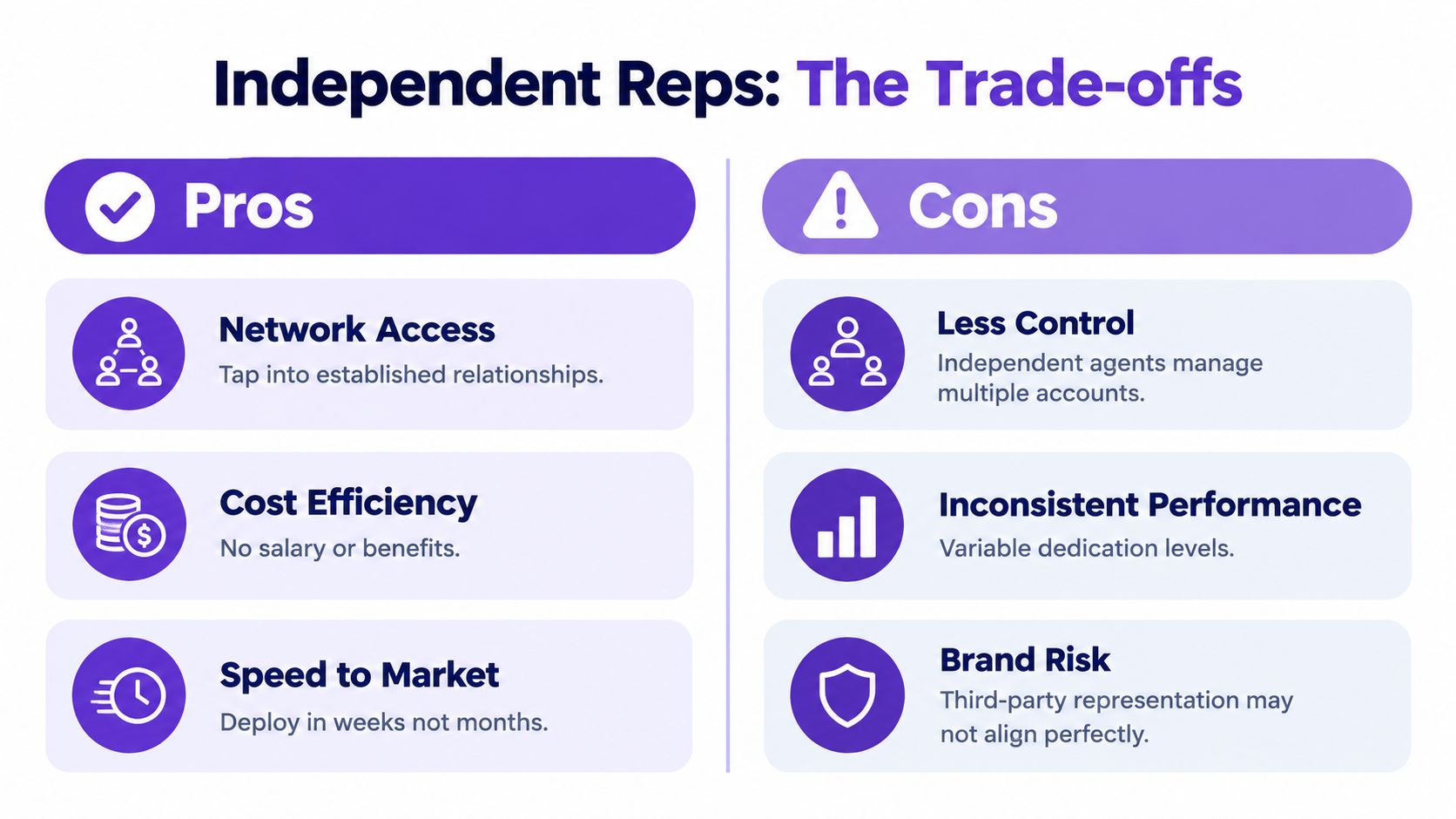
Independent representatives offer reach without a permanent payroll commitment, but they also introduce distance between your company and the customer. A rep may know the local market better than your internal team and still put another principal first because that product is easier to sell or pays faster.
Where the model earns its keep
Network access is the obvious advantage. A credible rep can shorten the path to distributors, procurement teams, plant managers, or specialist buyers who ignore generic outbound.
Cost flexibility is another. You don't carry a guaranteed salary and benefits package while testing whether the territory deserves dedicated headcount. That flexibility is especially valuable for physical products and established categories where relationships still drive access.
Market learning often matters more than the first order. A good rep tells you why buyers reject the offer, which competitors dominate, and what channel partners expect.
Where it bites
Control drops. Independent sellers manage their own calendars and portfolios, so your launch won't receive the same attention as an internal priority.
Complex products ramp slowly. A technical SaaS platform or specialized service may require training, demos, security answers, and commercial judgment that a representative can't absorb from a one-page PDF.
Brand risk increases. The customer experiences the rep as part of your company, even when the contract says otherwise. Inconsistent claims, unauthorized discounts, or weak follow-up land on your brand.
My recommendation is to use independent reps where relationship access is scarce and the offer is already understandable. If the product needs constant internal coaching, a W2 team or specialist partner will usually provide tighter execution.
Navigating Legal Risks and Contract Essentials
Writing “1099” at the top of an agreement doesn't create contractor status. The working relationship has to behave independently. If you set daily hours, dictate scripts, require attendance, provide all tools, supervise every activity, or restrict outside work like an employer, the label becomes weak evidence.
The risk is not theoretical. Independent sales representative laws have been enacted in 35 U.S. states and Puerto Rico, according to this legal summary of representative protections. Those laws commonly address written contracts, commission calculations, timely payment, accounting with payments, and commissions earned after termination.
Clauses that prevent expensive arguments
Your agreement should define:
Territory and account ownership: Identify geography, customer groups, named accounts, and what happens when two reps claim the same opportunity.
Authority: State whether the rep may negotiate, bind the company, approve discounts, or only solicit orders.
Commission basis: Specify gross sales, net sales, gross margin, collected cash, returns, taxes, freight, cancellations, and chargebacks.
Payment records: Provide a commission statement that lets the rep reconcile every amount.
Post-termination rights: Define commissions on accepted orders, renewals, expansions, and deals already in the pipeline.
Conflicts and confidentiality: Address competing principals without pretending that every form of exclusivity is harmless.
Independent operation: Preserve control over schedule, methods, expenses, and business organization.
European arrangements need a separate review. Under the directive, an agent can be entitled to commission when a transaction results from their work, but also when it is concluded with a customer they previously acquired for similar transactions. An agent with an exclusive territory or customer group may also receive commission on transactions concluded with customers inside that protected area or group, as described in the European Commission document on commission rights.
Don't copy a U.S. template into an international channel program and hope the heading does the legal work. Have counsel review classification, termination, commission, exclusivity, and dispute terms in every relevant jurisdiction.
When to Hire Reps Versus Using AI SDRs
Your pipeline is growing, but the economics are tightening. An independent rep may open a regional door that automation cannot, while an AI SDR can cover routine prospecting at a lower variable cost. Choose the motion that fits the bottleneck, then confirm the rep's role stays within the contractor boundaries set in the agreement and applicable law.
Situation | Best first motion | Reason |
|---|---|---|
Local relationships drive access | Independent representative | The rep's network is the asset |
Physical product requires site credibility | Independent representative | Buyers may need demonstrations, visits, and channel trust |
High-volume prospecting across a defined ICP | AI SDR or internal SDR | Research and first-touch work can be systematized |
Complex enterprise negotiation | Internal AE or specialist rep | Senior judgment matters late in the funnel |
Unproven offer and unclear messaging | Internal discovery first | Contractors will not repair a weak proposition for free |
Hire a rep when trust, local knowledge, technical credibility, or channel access determines whether a buyer engages. Use an AI SDR when the constraint is account research, buying-signal detection, or consistent follow-up. The financial crossover comes when the rep's incremental gross profit and access exceed commission, management time, travel expectations, and compliance oversight.
Use the guide to how to use AI in sales to define the automation workflow before assigning it to a rep. Automation should identify prospects and prepare context. The representative should judge account fit, personalize the exchange, and handle commercial discussions. Do not direct every hour, script every action, or treat the contractor like a W2 employee.

RoverLead AI is one option for LinkedIn prospecting. Its Signal Agents track comments, content interactions, and pricing or demo discussions, then provide contextual openers and drafts for approval. A rep or internal seller can start with a cleaner list while retaining qualification and closing responsibility.
Keep human judgment in relationship-heavy sales. Automate list building and repetitive follow-up when those tasks consume selling time. Scale the network only after the unit economics and operating model both hold.
Frequently Asked Questions About Independent Reps
What is an independent sales representative?
A self-employed intermediary who solicits or negotiates sales for a principal and is paid wholly or partly by commission.
Are they employees?
Usually not, but the relationship must operate independently. A contractor label alone isn't decisive.
How are representatives paid?
Common arrangements use commission on net sales, gross sales, or gross margin. The correct base should be written plainly.
Can a rep represent competing companies?
Often yes, unless the agreement restricts conflicts. Define competing products, protected accounts, and disclosure duties precisely.
Who pays expenses?
The agreement should say so. Independent reps commonly control and pay their own business expenses.
Should commission be based on revenue or margin?
Use revenue when margins are stable and the sale is straightforward. Use margin when discounting or delivery costs can materially change profitability.
What happens when two reps claim the same account?
Set account-registration, territory, and attribution rules before the first dispute. Don't improvise after a contract is signed.
Can commission remain payable after termination?
It can, and the contract should define the eligible opportunity, transaction, renewal, or customer relationship.
What does EU law change?
The EU framework can protect commission rights tied to customers previously acquired by the agent and to exclusive territories or customer groups. Local legal review remains essential.
When should I hire an internal seller instead?
Choose an employee when you need daily control, intensive product training, coordinated account management, or consistent ownership of the full sales process.
RoverLead AI helps B2B teams find high-intent LinkedIn activity, prepare personalized outreach, and keep follow-up organized while independent reps focus on qualified conversations and closing. Visit RoverLead AI to evaluate whether an intent-led prospecting layer belongs alongside your representative network.