What Is an SDR and How This Role Drives Pipeline

An SDR is a top-of-funnel specialist who identifies, contacts, and qualifies prospects to book sales-ready meetings for account executives, not a closer. Recent benchmarks report that SDRs generate 46% to 73% of total pipeline conversion, while only about 56% to 60% reach quota, so the role is both highly influential and demanding.
You might be looking at a healthy website, a capable product, and a sales team that works hard, yet the calendar still looks strangely empty. Your account executives are researching prospects between demos, founders are writing outbound emails after dinner, and everyone insists that pipeline is a priority. Somehow, nobody owns the first conversation.
That's where the sales development representative, or SDR, fits. The role gives prospecting, qualification, and meeting creation a dedicated owner instead of treating them as chores squeezed between closing calls. This guide explains what an SDR does, how the role differs from a BDR and an account executive, which metrics matter, and how modern teams use buyer signals and AI-assisted personalization without turning outreach into a robot parade.
Table of Contents
Why Pipeline Feels Stuck Without an SDR
A founder at a growing B2B company often starts as the entire go-to-market team. They find a prospect, send the message, run the demo, answer product questions, negotiate terms, and update the CRM with the emotional energy of someone filing taxes during a fire drill.
That arrangement can work while the customer list is small. It becomes fragile when the company needs a repeatable flow of conversations. Account executives naturally prioritize active opportunities because those deals are closest to revenue. Founders prioritize product, hiring, fundraising, and the next urgent customer request. Prospecting gets postponed, then restarted, then postponed again.
The result isn't always a lack of effort. It's a lack of ownership. Pipeline creation requires consistent research, timely outreach, qualification, follow-up, and handoff. When nobody specializes in that work, the company measures activity inconsistently and loses useful context between the first touch and the sales call.
A dedicated SDR changes the operating model. Instead of asking closers to perform every sales task, the team separates the early funnel from the closing motion. The SDR finds plausible opportunities, starts relevant conversations, checks whether a real business problem exists, and passes qualified prospects to the AE.
That doesn't mean adding someone to make random calls all day. Good sales process optimization makes ownership, stages, qualification standards, and handoffs visible so every person knows what happens next.
Practical rule: If prospecting only happens when everyone has spare time, prospecting isn't a process. It's a wish.
The rest of the role makes more sense once you see the SDR as a pipeline specialist rather than a junior AE. The title, however, has a history that explains why companies still define it differently.
What an SDR Actually Does Today
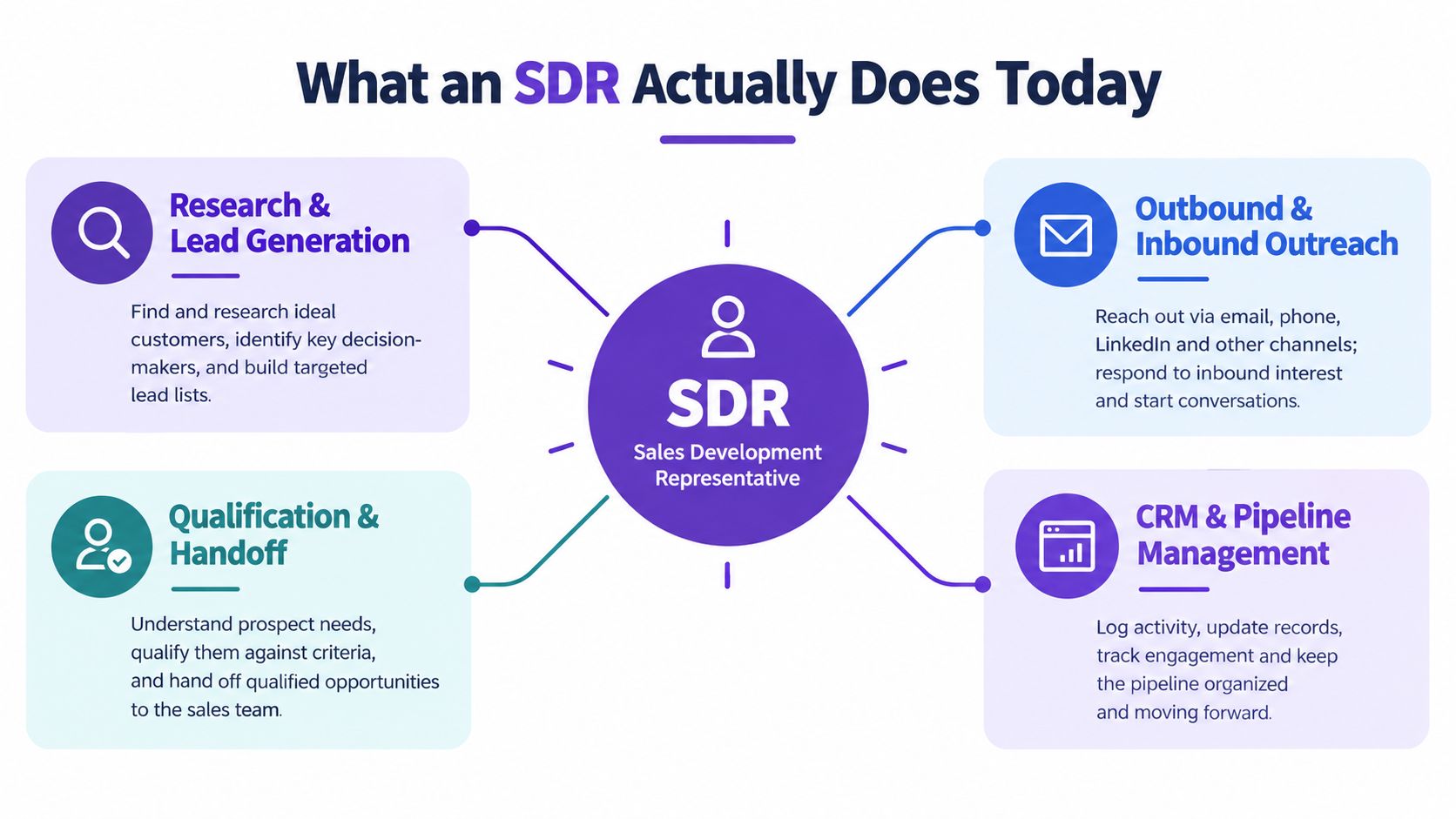
SDR stands for Sales Development Representative. In practical terms, an SDR researches potential buyers, contacts them through appropriate channels, qualifies their situation, and books a useful meeting for an AE or another closing role.
The specialization emerged in B2B IT during the 1980s, with Oracle often cited as an early pioneer. Historical accounts also place similar sales development work at Computer Associates in the late 1990s. The SDR title became more widely adopted in the early 2000s and was later popularized by Aaron Ross's Predictable Revenue framework, as described in this history of the sales development representative role.
Before specialization, a generalist rep often handled everything from list building to closing. The segmented model assigns the top of the funnel to the SDR and the later commercial conversation to the AE. Think of the SDR as air traffic control for early pipeline. They identify which aircraft are approaching, check whether each one is ready to land, and direct qualified opportunities to the runway managed by the AE. They don't fly the plane, and they shouldn't pretend to.
The four core responsibilities
Research and lead generation
The SDR identifies accounts and people who fit the ideal customer profile. Research might include company structure, role relevance, business changes, existing tools, public comments, or content activity.Inbound and outbound outreach
An inbound SDR responds to people who have already shown interest. An outbound SDR creates the first contact. A hybrid SDR handles both, often with different response times and messaging rules.Qualification and appointment setting
Qualification checks whether the prospect has a relevant problem, a plausible use case, and enough interest for a productive sales conversation. The objective isn't to interrogate someone with a checklist. It's to prevent the AE's calendar from filling with meetings that should have been emails.CRM and pipeline management
The SDR records contact attempts, responses, qualification notes, next steps, and handoff context. Clean records help the AE continue the conversation instead of asking the prospect to repeat everything.
The definition varies because companies organize the funnel differently. LinkedIn's explanation of SDR responsibilities reflects the broader ambiguity: some teams emphasize prospecting and appointment setting, while others use SDRs mainly for inbound qualification. The job title alone doesn't tell you the channel, lead source, or handoff standard.
An SDR creates qualified access to potential buyers. An AE turns qualified access into commercial outcomes.
That distinction also explains why activity volume is a weak substitute for pipeline ownership. One hundred irrelevant touches don't equal one well-timed conversation with a buyer who has a clear reason to explore change.
SDR vs BDR vs Account Executive Compared
The most common hiring mistake is treating SDR, BDR, and AE as universal titles. They aren't. Different companies use them differently, which is why a candidate can apply for an SDR role at one business and find an inbound qualification job, then apply for the same title elsewhere and discover a pure outbound position.
The functional difference matters more than the label. Before hiring, define the lead source, funnel stage, daily work, and handoff.
Role | Funnel Focus | Primary Job | Success Metric |
|---|---|---|---|
SDR | Top of funnel, often inbound, outbound, or hybrid | Research, contact, qualify, and book meetings | Qualified meetings, SQLs, and pipeline created |
BDR | Top of funnel, often outbound prospecting | Create conversations with net-new accounts and qualify interest | Positive replies, meetings, and sourced opportunities |
AE | Middle and bottom of funnel | Run discovery, present the solution, negotiate, and close | Revenue, closed-won business, and forecast accuracy |
Some organizations use SDR for inbound and BDR for outbound. Others use SDR and BDR interchangeably, particularly when both roles perform prospecting and qualification. Industry explanations differ on this point, with one comparison of SDR and BDR roles describing distinctions based on lead source and inside-sales emphasis.
How to choose the structure
Use an inbound SDR when the company receives enough relevant interest to require fast qualification. Use an outbound BDR or SDR when the business must create demand among accounts that haven't raised their hands. Use a hybrid role when the team is small, but document how the rep should prioritize competing work.
The AE owns the opportunity after the handoff, but that doesn't mean the SDR disappears. A clean handoff includes the prospect's problem, why the conversation is timely, what was discussed, who will attend, and what outcome the prospect expects.
Role confusion hurts hiring because candidates prepare for the wrong job. It also damages forecasting. If one team counts booked meetings and another counts qualified opportunities under the same title, leadership can't compare performance without first translating the definitions.
The safer job description says exactly what the person will do. “Outbound SDR responsible for researching target accounts and qualifying conversations” is far more useful than “rockstar sales development professional.” The latter sounds exciting, but it doesn't tell anyone whether the job involves inbound leads, cold calls, LinkedIn outreach, or all three before lunch.
Inside the SDR Day and Modern Workflow
A modern SDR day starts with prioritization, not a giant spreadsheet and a heroic commitment to pressing “send.” The rep first looks for evidence that an account, person, or market conversation may be relevant now.
A useful signal could be a prospect discussing a problem publicly, engaging with a topic tied to the product, comparing vendors, mentioning pricing, or responding to a competitor's content. The signal doesn't prove buying intent. It gives the SDR a reason to investigate rather than treating every contact as equally likely.
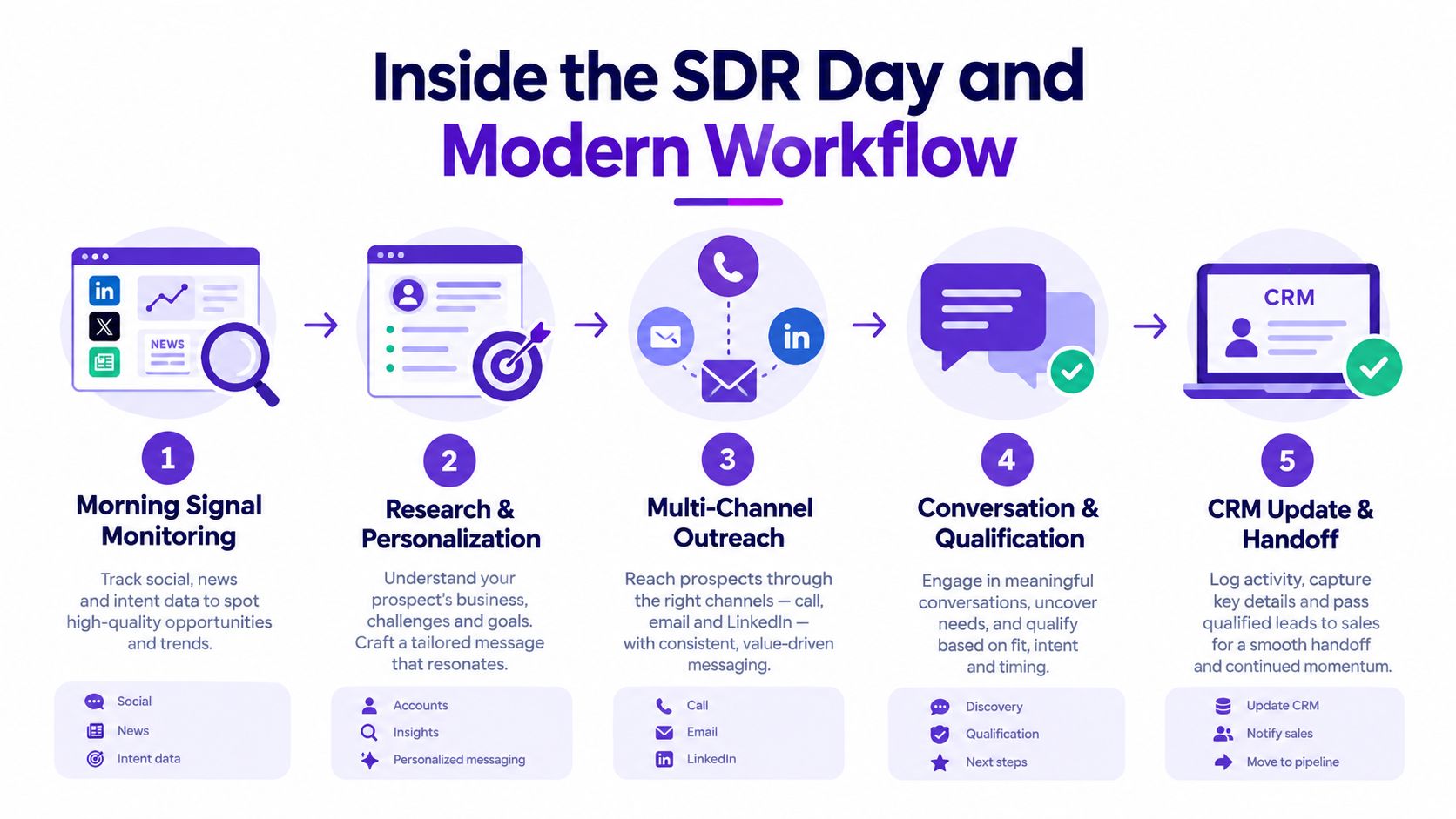
A signal-led sequence
Morning signal monitoring comes first. The SDR reviews social activity, relevant news, account changes, intent data, and conversations connected to the ICP. This creates a working queue based on context rather than sorting names alphabetically.
Research and personalization follow. The rep checks whether the person owns a relevant problem and writes an opener connected to the observed signal. “Saw your post about onboarding friction” is a starting point. The rest of the message must explain why the issue may matter and offer a low-pressure next step.
Multichannel outreach can include a call, email, and LinkedIn touch, but the channels should support the same hypothesis. Sending three disconnected messages across three platforms creates noise, not persistence.
Conversation and qualification turn a response into useful information. The SDR listens for the current process, the cost of leaving it unchanged, the people involved, timing, and whether the proposed conversation deserves AE attention.
CRM update and handoff preserve the thread. The AE should receive a concise narrative, not a pile of activity logs.
This approach differs from a volume-led workflow, where a rep works through a static list and hopes enough contacts eventually respond. Automation can accelerate research and drafting, but it shouldn't decide what a company means, whether a person is a fit, or whether an outreach claim is appropriate.
RoverLead AI is one example of a signal-led LinkedIn workflow. Its Signal Agents monitor creators, competitors, and niche topics for buying behavior, then surface prospects with context and a personalized opener. The SDR reviews and approves outreach, while the lead inbox supports follow-up, tagging, nurturing, auto-drafts, and auto-replies.
The operating principle is simple: use automation to reduce searching and drafting, not to remove judgment.
A lightweight CRM inbox can hold the queue, qualification notes, approvals, and next actions. Each response should feed the next decision. If a message earns replies but poor meetings, improve qualification. If the opener earns no response, revisit the signal, audience, or relevance before increasing volume.
See this practical guide to building an SDR outbound strategy for the operating details behind that motion.
How to Measure SDR Success Without Vanity Metrics
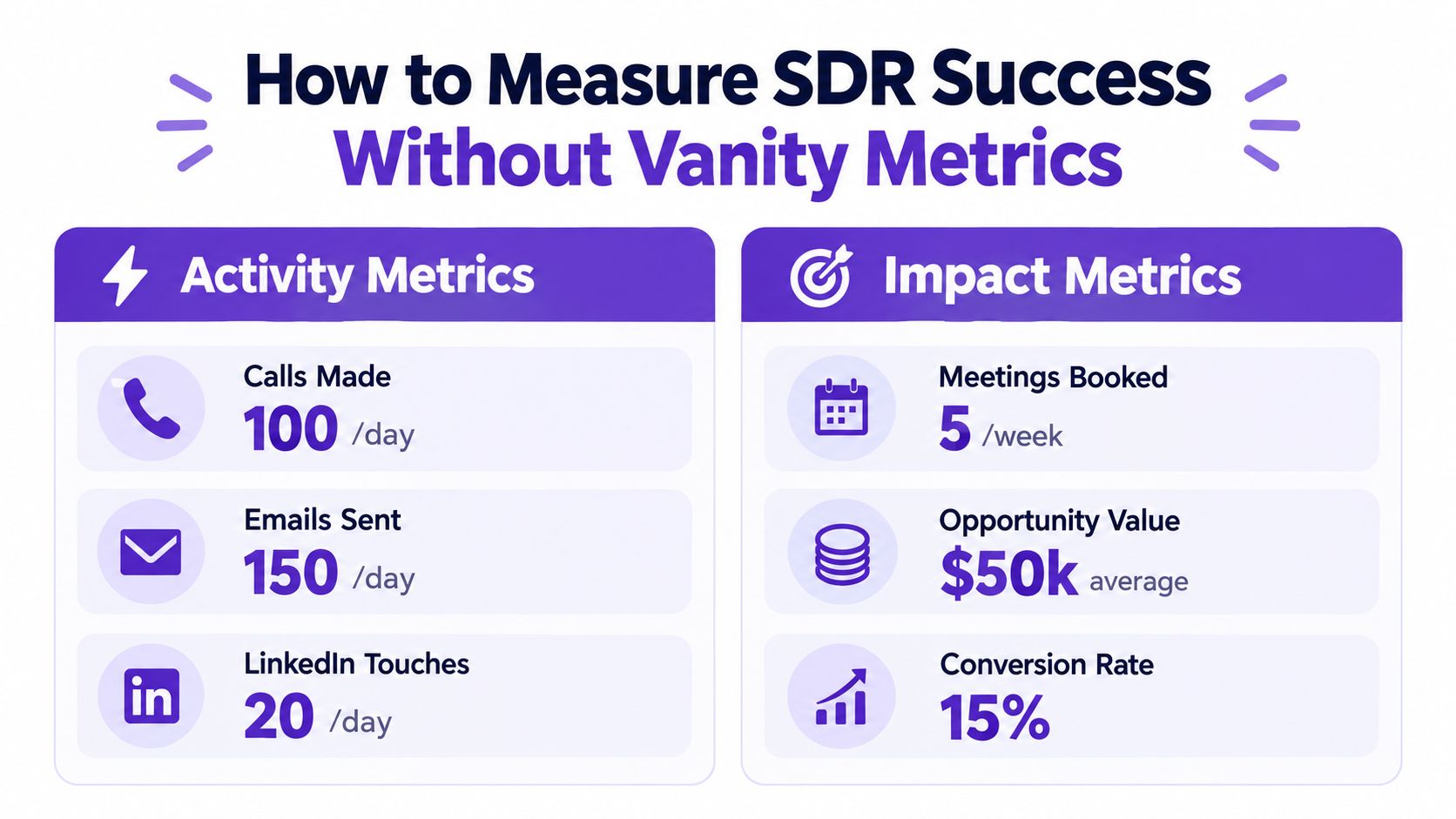
SDR measurement works best when leaders separate what a rep does from what the work produces. Calls made, emails sent, and LinkedIn touches describe effort. Replies, meetings, SQLs, and pipeline show whether that effort created access to potential revenue. A 2026 SDR metrics guide separates these same activity and outcome categories.
Activity metrics still have a purpose. They reveal whether the rep has enough opportunities to work, whether the territory is covered, and where a workflow is breaking. They become vanity metrics when managers use them as proof of effectiveness without checking message quality or downstream conversion.
The metrics that deserve attention
Activity metrics: Calls made, emails sent, and LinkedIn touches show the volume of work entering the system.
Engagement metrics: Positive replies and meaningful conversations reveal whether the message reached the right person with a relevant reason.
Meeting metrics: Meetings booked matter, but attendance and qualification determine whether the calendar is useful.
Pipeline metrics: SQLs created and pipeline generated connect SDR work to the commercial process.
Quality metrics: AE acceptance, opportunity progression, and feedback on handoffs expose whether the SDR is creating real opportunities or merely calendar events.
Reply quality is more informative than raw activity. Gong's engagement benchmarks report cold email reply rates of 1.8% at baseline and 3.9% for top-performing reps. The same source reports 1.1% for automated emails compared with 2.1% for manual outreach. Those figures don't mean every team should chase a particular rate. They show why targeting and personalization deserve coaching attention.
Quota data adds another layer of realism. A 2026 benchmark places SDR quota attainment at roughly 56% to 60%, meaning a large portion of reps don't reach quota in a given period, as reported in Apollo's SDR overview. Leaders should diagnose whether the issue comes from territory quality, messaging, enablement, management, qualification, or execution before blaming motivation.
The same Apollo source reports that SDRs needed about one year of experience to land the role, down from 2.5 years a decade earlier. It also reports average onboarding and coaching time of 3.2 months and average tenure of 1.4 years. These figures make ramp design important. A short-tenure role can't rely on informal shadowing and a folder of old email templates.
Coach the conversion between stages, not just the count at the top.
Managers should review calls, messages, signal selection, qualification notes, and handoffs. A rep who creates fewer conversations but produces accepted opportunities may be building a healthier pipeline than a rep who fills the calendar with poor-fit meetings.
For qualification detail, use this guide to qualify sales leads, then define the handoff standard in writing.
Hiring Training Tools and Templates That Work
A strong SDR operation combines the right person, a teachable process, and tools that reduce low-value work. Hiring for confidence alone is a trap. The best candidates show curiosity, clear writing, comfort with research, resilience after rejection, and the judgment to stop when a message isn't relevant.
Build the ramp before the hire
A practical onboarding plan can unfold across three months:
First month: Learn the ICP, product, customer language, qualification rules, CRM, and compliance boundaries. Listen to sales calls and practice research.
Second month: Run supervised outreach, review message quality, role-play objections, and make handoffs with manager approval.
Third month: Own a defined segment, review outcome metrics, test messaging carefully, and improve based on AE feedback.
The exact calendar can vary, but the sequence matters. Reps need product context before personalization, and they need qualification practice before their meetings become someone else's problem.
Give the workflow a sensible toolkit
LinkedIn and Sales Navigator support account and person research. Sequencing tools help organize follow-up. Enrichment tools fill gaps in account data. Signal agents can reduce the time spent searching for relevant activity. RoverLead AI, for example, uses a five-minute ICP setup based on keywords, competitors, and experts, monitors 10+ buying signals, and keeps outreach approval-based rather than sending automatically.
Templates should provide structure without turning every prospect into the same paragraph.
LinkedIn connection request
I noticed your comments on [specific topic]. I work with teams dealing with [relevant problem], so I thought it made sense to connect.
Follow-up after acceptance
Thanks for connecting. You mentioned [specific signal]. How are you handling that today?
Email opener
Subject: A question about [specific workflow]
I saw [observable signal] and wondered whether [relevant challenge] is on your roadmap. If it is, I can share how similar teams think about the first step.
The bracketed text isn't decoration. Replace it with a real observation, and remove the sentence if you can't explain why it matters to that person. Personalization should demonstrate relevance, not prove that the SDR found someone's profile.
Review every automated draft before it sends. Maintain clear approval rules for claims, sensitive topics, contact frequency, and opt-outs. LinkedIn outreach also needs to respect platform policies and user expectations. A pipeline engine that creates compliance problems is just an expensive way to manufacture future headaches.
For supporting content that helps reps handle objections and explain value, organize a useful sales enablement content system.
Your Next Move to Build Predictable Pipeline
An SDR is a pipeline engine built around qualified conversations, not an activity machine with a headset. The role works when responsibilities are clear, signals guide prioritization, outreach earns attention, qualification protects AE time, and measurement follows outcomes through the funnel.
Before hiring or adding automation, answer four questions:
Lead source: Will the rep handle inbound demand, outbound accounts, or both?
Handoff: What must be true before an AE accepts a meeting?
Measurement: Which outcome shows progress, such as qualified meetings, SQLs, or sourced pipeline?
Workflow support: Which research, drafting, CRM, and approval tasks should software assist?
Start with a clear ICP and one measurable pilot. Give the SDR a defined account segment, a small set of observable buying signals, approved messaging, a qualification rubric, and a review cadence. If the team spends too much time searching for prospects or drafting repetitive LinkedIn messages, test AI assistance with human approval rather than handing the entire motion to a black box.
Frequently asked questions
What does SDR stand for?
SDR stands for Sales Development Representative. The role generally owns early-funnel research, outreach, qualification, and appointment setting.
Is an SDR a salesperson?
Yes, but an SDR usually doesn't own the final close. The SDR creates and qualifies sales conversations, while the AE typically manages discovery, negotiation, and closing.
Do SDRs handle inbound leads?
Some do. Companies may assign inbound qualification to SDRs, outbound prospecting to BDRs, or combine both motions under one SDR team.
What's the difference between an SDR and a BDR?
There isn't one universal definition. Some companies use SDR for inbound and BDR for outbound, while others use both titles for top-of-funnel prospecting roles.
What does an SDR hand off to an AE?
The handoff should include the prospect's problem, relevant context, qualification notes, timing, participants, and agreed next step. The AE shouldn't have to reconstruct the conversation from scattered CRM entries.
Is cold calling part of SDR work?
It can be. The channel depends on the team's motion and buyer preferences. Effective calling supports a relevant hypothesis rather than adding noise to an activity report.
What should an SDR measure first?
Start with outcome metrics, including positive replies, qualified meetings, SQLs, accepted opportunities, and pipeline generated. Use activity data to diagnose execution, not to replace outcome analysis.
Is SDR work a good entry point into sales?
It can be a practical entry into B2B sales because the role develops research, messaging, qualification, objection handling, and CRM discipline. Career progression often depends on performance, coaching, and the company's path into closing or account management.
How does an SDR get paid?
Compensation varies by company, market, seniority, territory, and quota structure. Review the base salary, variable plan, quota definition, payout rules, and treatment of canceled or unqualified meetings before accepting an offer.
Will AI replace SDRs?
AI can assist with research, prioritization, drafting, and follow-up. Human SDRs still provide judgment, context, conversation skills, qualification, and accountability. The role is more likely to change than disappear, particularly as teams move from static lists toward signal-based workflows.
RoverLead AI helps B2B teams monitor LinkedIn buying signals, surface ICP prospects with context, draft personalized outreach, and manage follow-up through approval-based workflows. If you want to test a signal-led SDR motion without spray-and-pray prospecting, visit RoverLead AI.