10 Lemlist Alternatives for Smarter Outreach

The popular advice is to find a cheaper sequence builder and recreate your Lemlist campaigns. That's often the wrong first move. A polished sequence can still produce weak conversations if the team is reaching people who aren't researching, commenting, comparing, or otherwise showing a reason to talk.
The better question is what job your replacement must perform. Do you need high-volume email, genuine multichannel sequencing, contact data plus outreach, agency controls, or LinkedIn intent-based prospecting? This guide compares ten Lemlist alternatives by that actual job, then maps each option to founders, SDRs, sales leaders, agencies, and LinkedIn-led sellers. Capabilities, packaging, and pricing can change, so verify current plan details before moving production campaigns.
Cold outreach is already a low-yield channel in many B2B markets. One 2026 benchmark reported a 3.43% average reply rate, while a separate 2025 dataset found 0.45% across high-volume B2B emails, with targeting and list hygiene helping explain the gap. Email Chaser's cold email benchmark also frames 5% to 10% as good and 10% or higher as excellent. More sending volume isn't automatically the answer.
Table of Contents
What counts as a strong Lemlist alternative
A useful alternative should match the way your team creates pipeline, not merely imitate Lemlist's interface. Email-first platforms such as Instantly and Smartlead are excellent when the operating problem is mailbox rotation and deliverability at scale. They're a poor substitute if your reps need native LinkedIn actions or buying-signal discovery.
The category itself has expanded beyond basic sequence builders. One 2026 estimate places the sales engagement market at about $9.2 billion, with a projection of $26.6 billion by 2033 at a 16.4% CAGR. Prospeo's sales engagement market overview connects that growth with software for sequencing, enrichment, multichannel outreach, and pipeline automation.
That creates five practical buying paths:
Email scale: More mailboxes, warmup, rotation, and inbox diagnostics.
Multichannel execution: Email, LinkedIn, calls, SMS, or WhatsApp in coordinated cadences.
Data plus outreach: Prospect discovery, enrichment, sequencing, and CRM sync in one place.
Agency operations: Client separation, team controls, unified inboxes, and infrastructure flexibility.
Intent-led prospecting: Finding people who are already showing relevant behavior before outreach starts.
The best-rated products aren't necessarily interchangeable. A comparison from Clay's outbound sales tools guide lists lemlist at 4.6/5 on G2, alongside Apollo at 4.7/5, Reply.io at 4.6/5, and Smartlead at 4.6/5. Satisfaction is strong across the category, but the workflow fit is what determines whether your team gets value or another expensive tab in the browser.
1. RoverLead AI
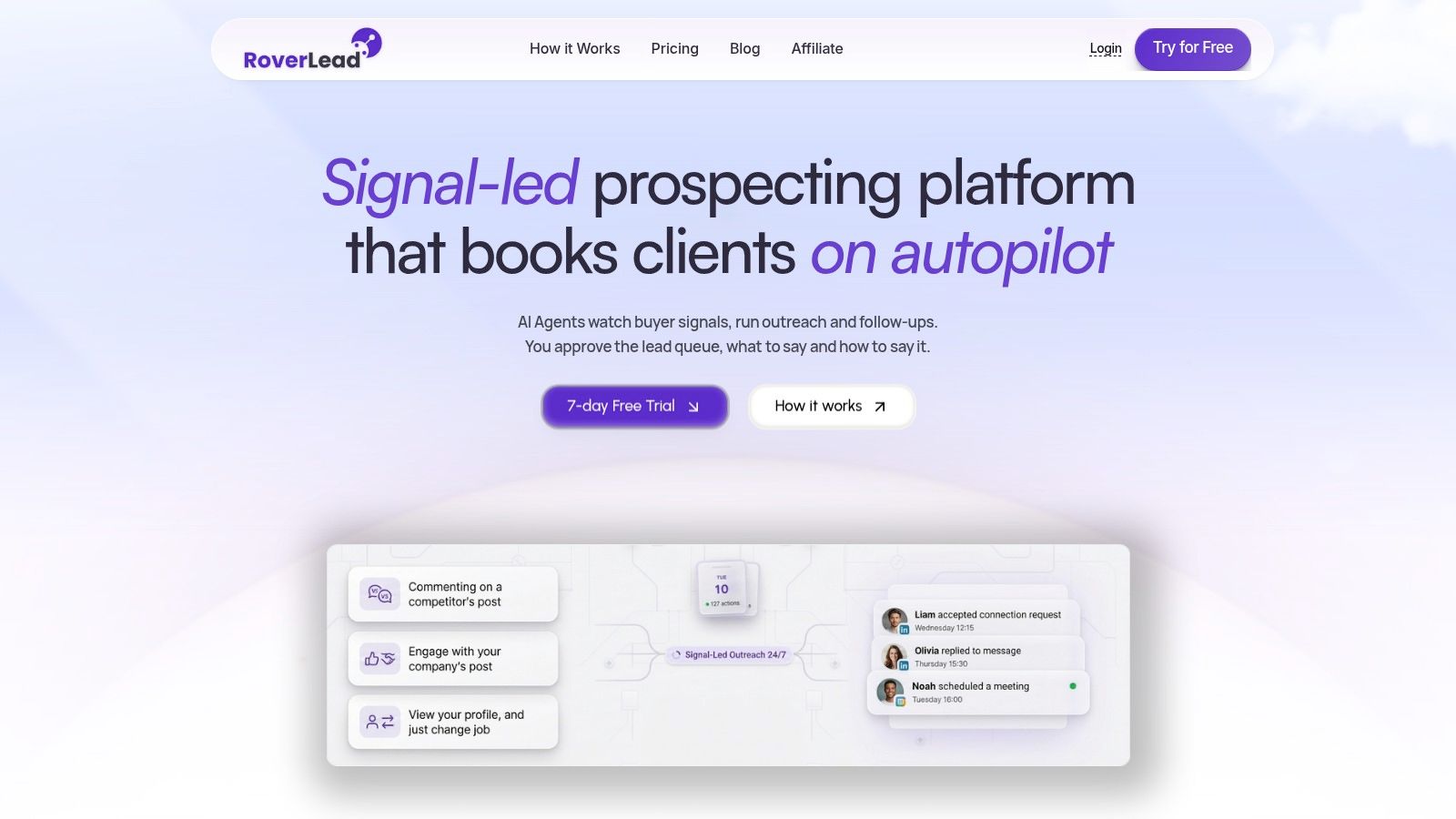
RoverLead AI targets a job that standard email sequencers handle poorly, finding prospects who are already showing buying intent on LinkedIn. Its core offer is LinkedIn AI SDRs that book meetings 24/7, with less manual list research for the sales team.
You define the ICP using keywords, competitors, and niche experts. After setup, Signal Agents monitor creators, competitors, and relevant activity, then present a curated feed showing the post or interaction behind each lead. The platform drafts personalized openers and follow-ups, while requiring your approval before anything is sent.
That review gate is useful for teams that want automation without handing over their voice. Reps can check the target, timing, and message before approval, while auto-drafts and auto-replies reduce the chance that promising conversations sit unanswered. The lead inbox supports pinning, tagging, nurturing, and follow-up, giving it some lightweight CRM functionality alongside prospect discovery.
Best fit and real trade-offs
RoverLead fits B2B sales leaders, SDR and BDR teams, founders, and GTM marketers whose buyers actively use LinkedIn. Its strongest use case is intent-based prospecting, where the challenge is identifying who has a timely reason to respond rather than collecting another large contact list.
The company reports higher reply rates and faster research in its own product materials. Treat those statements as vendor-reported outcomes, not a forecast for your team. Results depend on whether your buyers post or engage publicly on LinkedIn. LinkedIn policy and data-access changes can also affect coverage.
Pricing: Starter begins at $149/month per user with two Signal Agents. Growth is $449/month per user with up to ten Signal Agents, while Enterprise pricing is custom.
Control: Nothing sends without approval, and the system learns from those approvals.
Commercial test: A 7-day free trial lets teams assess signal quality before moving a workflow.
Limitation: Per-user pricing can become expensive for larger teams, and LinkedIn-visible intent will not cover every market.
For SDRs, RoverLead is a fit when LinkedIn activity should guide daily prospecting. Sales leaders should test signal quality and approval workload before expanding seats. Founders may prefer it when they handle outreach themselves and need context faster. Teams migrating from lemlist should move intent-led LinkedIn work first, while keeping email volume in a dedicated sequencer.
Practical rule: If your buyers rarely create public LinkedIn signals, an intent platform cannot manufacture them. Use RoverLead where LinkedIn reflects how your market researches, evaluates, and discusses vendors.
2. Instantly.ai
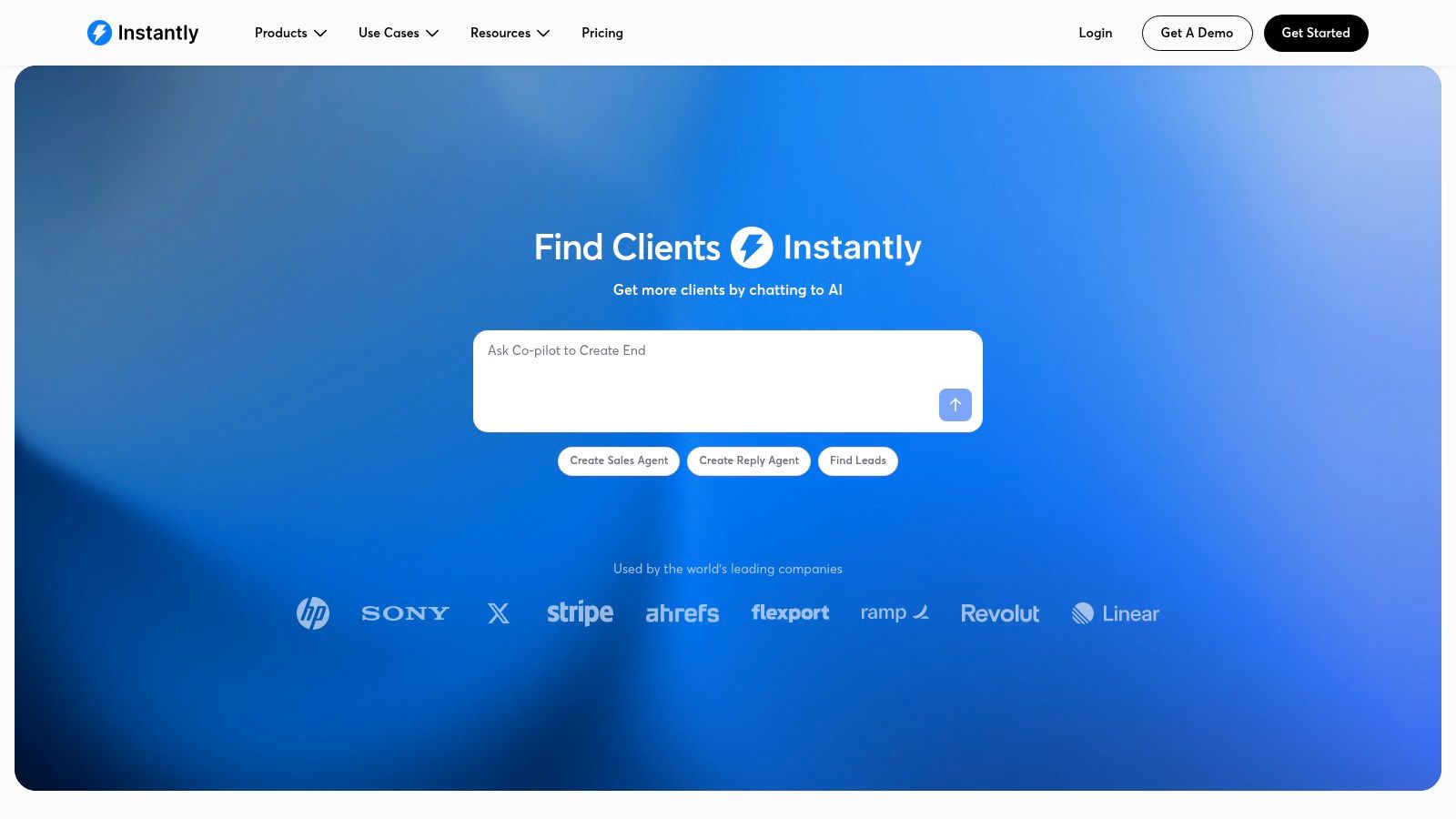
Instantly.ai is built for high-volume cold email, not for coordinating every outbound channel in one place. Teams can connect unlimited sending accounts, automate warmup and inbox rotation, and run placement checks through its deliverability tools. The flat-fee model makes sense when you need more mailboxes rather than more rep seats.
The platform also includes a B2B leads database, enrichment, CRM exports, an AI email writer, and a reply agent. Those additions reduce tool switching, though email remains the core motion. LinkedIn steps require another system, and teams wanting detailed sales-engagement reporting may find Instantly's interface and analytics lighter than a full suite.
That fit matters during migration. Move email-heavy campaigns first, map domains and inbox ownership, and keep LinkedIn activity in its existing workflow until you have a clear handoff.
Instantly earns its place with agencies, cold-email specialists, and operators comfortable managing mailbox infrastructure. It suits teams that value sending capacity over per-inbox charges, but extra accounts cannot rescue weak targeting or poor list hygiene.
Before launch, review how to avoid spam filters and include deliverability checks in the migration plan. Waiting until a campaign falters makes diagnosis harder.
Best job: Email volume, account rotation, warmup, and diagnostics.
Useful advantage: Flat-fee packaging can support multi-account operations.
Main compromise: LinkedIn is not a native part of the sequence.
Best fit: Agencies and SDR teams running repeatable email motions.
3. Smartlead.ai
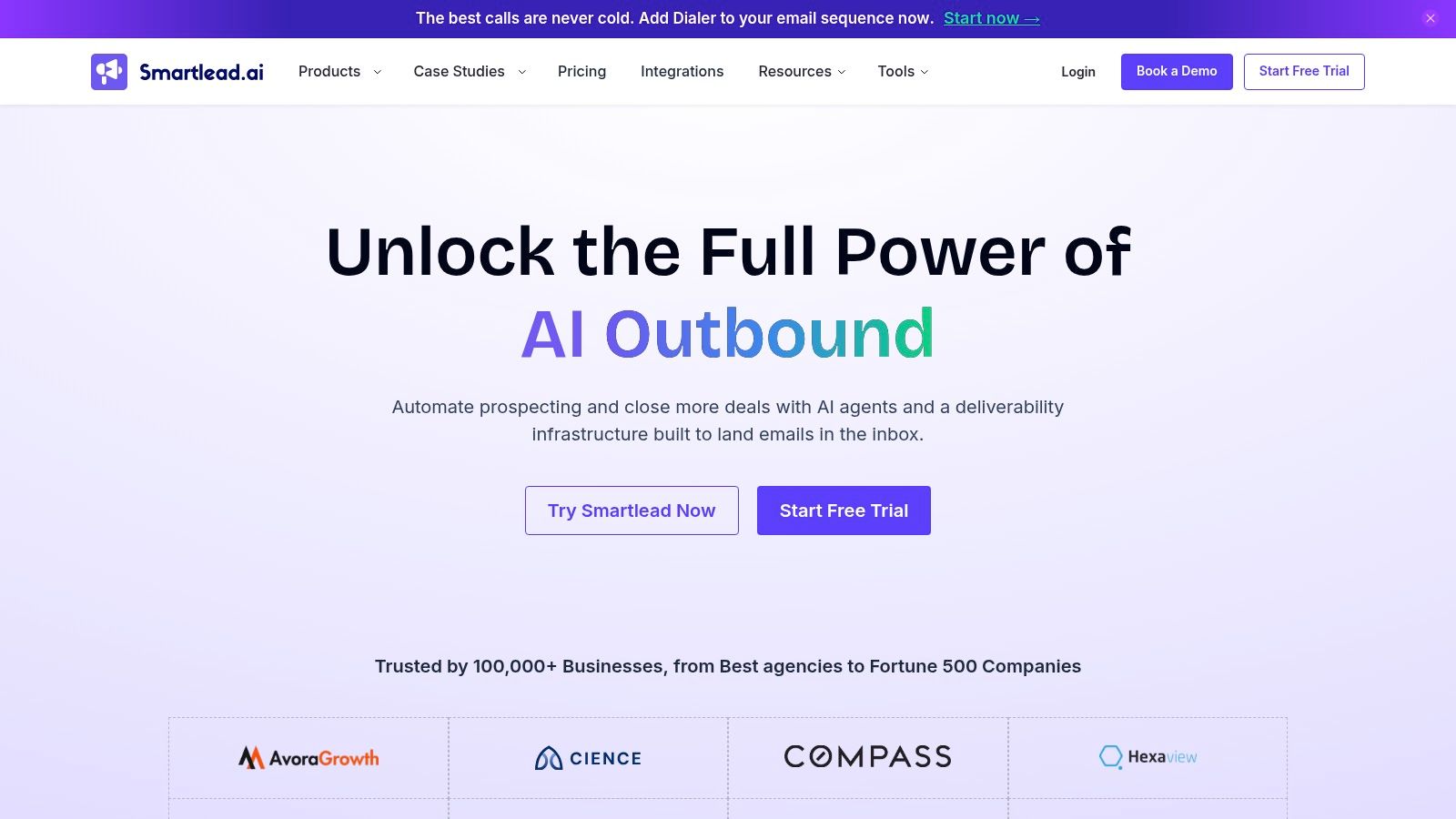
Smartlead.ai fits agencies managing many inboxes, client campaigns, and deliverability controls. Unlimited email accounts across plans, automatic rotation, SmartDelivery, placement testing, and optional dedicated infrastructure give operators control over sending operations.
Its unified inbox keeps replies from several client domains together. Warmup, optional servers, a power dialer, and lead-finding tools broaden the platform, while adding more setup choices. Smartlead suits operators willing to build and maintain a sending stack. A founder who wants to define an audience and start conversations quickly may find that configuration heavier than expected.
The practical question is channel fit. Smartlead is built around email, so LinkedIn automation is not a native sequence step. LinkedIn-led prospecting therefore requires another platform or manual coordination. For agencies, SDR leaders, and founders replacing Lemlist, it makes the strongest case when scale, infrastructure, and client separation matter more than social context.
Before connecting accounts, assign each client's domains, suppression lists, reply ownership, and reporting rules. Follow this outbound sales automation guidance, then document who handles every reply before launch.
Best job: Agency email operations and inbox management.
Strength: Deliverability controls and first-party infrastructure options.
Trade-off: Add-ons increase setup complexity and may raise total cost.
Not ideal for: Teams expecting LinkedIn intent discovery in the same workflow.
4. Mailshake
Mailshake fits small teams that want email outreach with manual LinkedIn tasks and calling, without taking on a heavyweight revenue platform. Setup is straightforward, sequences support A/B testing, and the unified inbox keeps replies together. Higher tiers add an integrated dialer. LinkedIn messages, connection requests, and profile views can appear in a sequence as rep-managed tasks.
That distinction shapes the workflow. Mailshake organizes the next action, while the rep still chooses the message, timing, and follow-up logic. It supports multichannel execution, but LinkedIn remains human-led rather than an automated intent engine.
Founders, small SDR teams, and service businesses can get campaigns running quickly. Lead Catcher adds a lightweight CRM layer, while integrations with common CRM systems help teams keep pipeline records in their existing tools. The platform's practical advantage is low setup effort, not advanced prospect intelligence.
Cost and scale deserve a close check. Multi-mailbox management is tied to user count, which can make a larger sending operation more expensive. Data enrichment and behavioral intent features are also limited beside platforms built around those jobs.
Use sales engagement platform guidance to design the surrounding workflow, especially when reps will coordinate email, calls, and LinkedIn tasks.
For a Lemlist migration, move only sequences that match how reps work. Mailshake suits founders and SDR managers prioritizing quick adoption. Teams seeking data-plus-outreach or automated LinkedIn prospecting will need another platform, or a second tool beside it.
Best job: Simple email plus rep-led multichannel execution.
Why teams like it: Fast setup and low operational friction.
Where it falls short: Limited intent data and advanced prospect intelligence.
Migration note: Rebuild the workflows reps will use. Unused branching logic adds cost without adding conversations.
5. Woodpecker
Woodpecker fits SMB teams that need deliverability controls and predictable cost management, rather than another complex channel stack. It supports condition-based email campaigns, manual LinkedIn steps, free warmup, inbox rotation, email verification, A/B testing, and a Lead Finder database. Pricing is tied to contacted prospects, so campaign reach remains visible in the budget.
Its integrations include HubSpot, Pipedrive, Clay, APIs, and webhooks. Technical teams can keep lead ownership and lifecycle data in their existing systems without rebuilding the surrounding workflow.
Email control with human LinkedIn steps
LinkedIn actions are manual and tied to Woodpecker's classic editor. A rep gets a clear task inside an email sequence, while the platform avoids pretending it can replace human judgment on LinkedIn. Teams looking for automatic LinkedIn sequencing or intent-based prospecting will find that boundary quickly. Workarounds may be possible, but the motion stays email-led.
Unlimited email accounts and team members can suit a growing SMB operation. Still, test the contacted-prospect calculation against the actual campaign design before migrating. The headline price may change as audiences and sequence volume expand.
For Lemlist users, Woodpecker is a sensible move when the goal is simpler email operations, stronger deliverability controls, and manual social follow-up. SDRs can adopt it quickly, while sales leaders should confirm that LinkedIn discovery is not part of the platform's required job.
Best job: Controlled email outreach with manual LinkedIn tasks.
Strength: Warmup, verification, and contact-based budgeting.
Weakness: LinkedIn remains a manual campaign extension.
Good migration candidate: Teams leaving Lemlist for simpler operations, not broader automation.
6. Reply.io
Reply.io fits teams that run multichannel outreach. A cadence can combine email, LinkedIn, calls, SMS, and WhatsApp, with website visitor identification and live data credits adding more entry points. Reporting on team performance and channel efficiency helps managers assess how reps work, not only how many messages they send.
The trade-off is operational overhead. Someone must set channel order, ownership, compliance rules, reply handling, and escalation paths. Without those decisions, a wider channel mix creates more tasks without creating a clearer sales process. Phone and text follow-up are useful advantages only when the team already has a reason and process for using them.
Built for coordinated sales teams
Reply.io is a fit for SDR organizations and sales leaders that need structured cadences across several channels. Its optional AI SDR can support semi-automated or fully automated outreach, though human review still matters for nuanced replies and sensitive accounts.
LinkedIn automation may require an add-on, increasing total cost. The platform also demands more setup than an email-only tool. Before committing to a full multichannel stack, review these sales automation tools to confirm the workflow fits your team. Migrate through a sandbox workflow, then train reps, rather than switching in one day.
Founders should choose Reply.io only when they will actively manage the added complexity.
Best job: Full multichannel sequencing with calls and messaging.
Strong point: Channel-efficiency reporting and broad cadence design.
Trade-off: Add-ons and setup can expand the bill and workload.
Best buyer: Sales leaders with a real process across several channels.
7. Apollo.io
Apollo.io is built for teams that want prospecting data, enrichment, sequences, and pipeline tools in one workspace. Its main advantage is operational: reps can find contacts, enrich records, launch email sequences, add manual LinkedIn or call steps, and connect activity to a CRM without moving data between separate systems.
The workflow suits broad account coverage. Search company and contact records, filter by job title, technology, or firmographic details, then move qualified prospects into outreach. AI research and personalization features can reduce research time, while the Chrome extension supports browser-based prospecting.
Apollo's cost and setup require closer attention than the interface suggests. Credits can apply differently to enrichment and contact actions, so teams should model expected usage before migrating. Start with one representative workflow, track credit consumption, and confirm which features each plan includes before expanding access.
LinkedIn is generally task-based rather than native auto-send. Apollo therefore fits data-led prospecting better than autonomous LinkedIn engagement. It can help reps identify accounts and coordinate follow-up, but it will not replace a platform designed around LinkedIn intent signals or automated social activity.
For SDRs, Apollo is useful when list building and sequencing belong in the same workflow. Sales leaders get broader account visibility, while founders can start with one general-purpose system instead of assembling several tools. The trade-off is that a large database does not equal buying intent. Filters describe a target market, not necessarily who is researching a solution now.
Best job: Data plus outreach in one platform.
Strength: Prospecting, enrichment, sequencing, and CRM connectivity.
Limitation: Credit logic can be difficult, and LinkedIn actions are usually manual.
Best fit: SDRs and revenue teams that need broad account coverage.
8. Snov.io
Snov.io fits teams that want to find, verify, enrich, and contact prospects in one workspace. Its drip campaigns handle email, and LinkedIn Automation adds another channel for teams willing to configure it. Warmup, verification, integrations, and unlimited campaigns keep the initial setup manageable for founders and small SDR teams.
The main trade-off appears in the billing model. Credits can cover research and enrichment, while searches, verification, recipients, and LinkedIn activity may draw from different counters. Before migrating, run one representative campaign and record how quickly each action uses credits. The model can cost less than fixed seat pricing, but only if someone owns usage tracking.
Snov.io is a generalist by design. It works best when the team needs a complete prospecting-to-outreach workflow, rather than a specialist tool for high-volume email, advanced multichannel sequencing, or LinkedIn intent signals. Building a list, validating contacts, launching email, and adding social tasks can happen without connecting several vendors.
LinkedIn-heavy operations should calculate the full cost first, since automation is an add-on priced per slot. Email-led teams that use social touches occasionally will usually find the economics easier to manage. Solo sellers and founders get a practical starting point, while SDR managers should confirm the credit rules before giving the platform to a larger team.
Best job: Budget-conscious prospecting and email outreach.
Strength: Research, verification, and campaign execution in one platform.
Watch out for: Credit and recipient counters make scaling costs harder to forecast.
Ideal user: Solo sellers, founders, and small SDR teams.
9. Klenty
Klenty earns its place when the job is running a repeatable multichannel motion across an SDR team. Email, calls, SMS, and LinkedIn tasks sit in the same cadence, while playbooks, goals, and account views give managers a shared operating model. That makes it more useful for sales leaders standardizing rep behavior than for founders sending a small number of highly personal notes.
The practical advantage is process control. Reps can follow defined steps, managers can review outcomes, and CRM records stay connected to the activity. Setup takes more thought than a lightweight email tool, but that effort pays off when several reps need the same workflow.
Klenty's dialer adds call transcription and AI coaching on higher tiers. Those features help managers review conversations, not just count calls. A/B testing, deliverability controls, and CRM integrations support the rest of the cadence.
Budget for upper-tier account-based selling and analytics features. Klenty also has a smaller native data supply than Apollo-style platforms, so teams may need a separate prospecting source. Founders should consider a simpler tool unless they already have a defined sales process. SDR managers and sales leaders get more value when playbooks, reporting, and CRM discipline are part of the migration plan.
Best job: Structured multichannel cadences and manager oversight.
Strength: Consistent rep workflows across email, calls, SMS, and LinkedIn tasks.
Trade-off: Advanced analytics and ABM features can raise the budget.
Best buyer: Sales leaders building repeatable SDR operations.
10. QuickMail
QuickMail fits agencies and services teams running email-led outreach for multiple clients. Its workspace controls separate campaigns and stakeholders, while inbox rotation, deliverability guardrails, and centralized replies keep account management manageable. Paid plans include unlimited users and inboxes, which can simplify access when several people work across client accounts.
LinkedIn actions extend the channel mix without turning QuickMail into a full prospecting database. Higher tiers add connections, messages, and voice messages, and AI-assisted reply drafting helps reps handle routine responses.
The trade-off is scale at the entry level. Starter limits on uploaded contacts and monthly sends need checking against each client's smallest package. Advanced integrations sit on Growth and higher plans, so a connected setup costs more and may require tighter account planning.
QuickMail works best when an agency already has reliable lead sources and wants repeatable delivery controls. It is a weaker fit for teams whose main job is finding in-market prospects through live LinkedIn behavior. Founders sending a small number of highly personal notes may find the workspace model heavier than necessary, while agency operators gain clearer separation between client workspaces.
Best job: Agency outreach operations and client management.
Useful feature: LinkedIn voice messages on higher tiers.
Limitation: Entry-level caps and higher-tier integrations can complicate standardization.
Best fit: Consultancies and agencies with repeatable, email-led delivery.
Top 10 Lemlist Alternatives, Feature & Pricing Comparison
Product | Core capability | UX & results | Pricing & value | Target audience & USP |
|---|---|---|---|---|
RoverLead AI 🏆 | ✨ LinkedIn AI SDRs + Signal Agents that surface high-intent prospects from real LinkedIn activity; auto-draft personalized openers (approve before send) | ★★★★☆ 2–5x replies; +30–50% meetings; research −60% time | 💰 Starter $149/mo/user (2 Agents); Growth $449/mo/user (up to 10); Enterprise custom; 7‑day trial | 👥 B2B sales leaders, SDR/BDR teams, founders, ✨ intent-based prospecting, LinkedIn-compliant, approval workflow |
Instantly.ai | ✨ High-volume cold email + deliverability, inbox rotation, large lead DB | ★★★☆☆ Strong deliverability at scale; inbox diagnostics | 💰 Flat-fee model with unlimited sending accounts, cost-effective for multi-account teams | 👥 Teams needing scale & deliverability, ✨ inbox rotation & deliverability AI |
Smartlead.ai | ✨ Unlimited mailboxes, deliverability suite, optional dedicated infra | ★★★☆☆ Cost-effective for many inboxes; agency-friendly controls | 💰 Unlimited accounts on plans; infra add-ons available | 👥 Agencies / high-volume senders, ✨ SmartServers & deep deliverability controls |
Mailshake | ✨ Email sequences + manual LinkedIn tasks + integrated dialer | ★★★★☆ Easy UX, fast onboarding; scales to multichannel | 💰 Mid-tier pricing; multi-mailbox costs grow with seats | 👥 Small teams / SMBs, ✨ simple multichannel setup and dialer |
Woodpecker | ✨ Deliverability-focused cold email with manual LinkedIn steps | ★★★☆☆ Strong deliverability toolkit; precise cost control | 💰 Contacted-prospect pricing slider; unlimited accounts & free warmup | 👥 SMB teams wanting cost predictability, ✨ free warmup & verification |
Reply.io | ✨ True multichannel cadences (email, LinkedIn, SMS, calls, WhatsApp) + visitor ID | ★★★★☆ Advanced reporting & channel efficiency analytics | 💰 Active-contacts pricing; LinkedIn add-ons may increase cost | 👥 Mid-to-large SDR teams, ✨ full multichannel stack + optional AI SDR |
Apollo.io | ✨ Large contact/company DB + sequences, enrichment & AI research | ★★★☆☆ Consolidates data + outreach; strong free tier | 💰 Credit/tier-based pricing; complexity vs. generous free options | 👥 Teams wanting integrated data + outreach, ✨ big contact database |
Snov.io | ✨ Prospecting, email drip + LinkedIn add-on, verification & warmup | ★★★☆☆ All-in-one research & outreach; token/credit model | 💰 Pay-by-credits/tokens; LinkedIn slots priced separately | 👥 Teams needing list building & verification, ✨ verification + warmup tools |
Klenty | ✨ Multichannel cadences, dialer & analytics with ABM playbooks | ★★★★☆ Balanced feature set for scaling SDRs | 💰 Clear tiered pricing; advanced features on higher plans | 👥 Scaling SDR teams, ✨ dialer, call coaching & playbooks |
QuickMail | ✨ Campaign sequencing, multi-inbox rotation, agency workspaces | ★★★☆☆ Agency-oriented UX; stealth sending & client portals | 💰 Unlimited users/inboxes on paid plans; starter caps apply | 👥 Agencies & service teams, ✨ agency workspaces, voice messages |
Choose the Outreach Motion You Can Actually Run
The best Lemlist alternative is the one your team can operate consistently without pretending that every channel deserves equal attention. Founders and solo sellers usually need fast setup, clear costs, and enough automation to protect selling time. Snov.io is a practical all-in-one, Mailshake keeps execution simple, and RoverLead AI is the stronger choice when LinkedIn activity is where your buyers reveal intent.
SDRs and BDRs should start with the daily motion. If reps need structured email, calls, SMS, and LinkedIn tasks, Reply.io or Klenty can provide the cadence discipline. If they mostly need clean data and a sequence in the same workspace, Apollo is more direct. If the team spends hours researching LinkedIn activity before writing each message, RoverLead can remove that manual layer while keeping approval in human hands.
Sales leaders should compare qualified conversations, not raw sends. Cold-email benchmarks already show how widely results can vary, from 0.45% to 3.43% average reply rates across cited datasets, as documented by Email Chaser. The lesson isn't that one tool guarantees a result. It's that targeting, data quality, sender health, message relevance, and channel fit matter more than a larger activity dashboard.
Agencies have a clearer split. Instantly and Smartlead are built around email scale, inbox rotation, and multi-client sending operations. QuickMail adds useful workspace and client controls. If your agency sells through LinkedIn conversations and intent signals, an email-first platform may force your team to bolt the most valuable part of the process onto the side.
A migration plan that won't create chaos
Move in this order:
Export contacts and suppression lists: Preserve unsubscribes, bounced addresses, disqualified accounts, and existing exclusions.
Document sequence logic: Record delays, branches, stop conditions, owner rules, and the exact event that moves a lead to the next step.
Verify integrations: Check CRM field mapping, calendar links, webhooks, enrichment connections, and reply ownership before importing live records.
Prepare sending infrastructure: For email-first tools, confirm domains, authentication, mailbox health, warmup, rotation, and inbox monitoring.
Recreate only proven plays: Don't migrate every abandoned sequence. Keep the messages and branches that produced qualified conversations.
Test a small cohort: Run a controlled group first, review replies manually, and check that suppression and stop rules work.
Measure business outcomes: Compare qualified replies, meetings held, opportunities created, and sales-cycle movement. Raw volume is the easiest metric to inflate and the least useful one to worship.
For supporting workflows, build a content cluster around cold-email deliverability, LinkedIn prospecting, sales engagement workflows, and CRM migration. Keep compliance in the operating plan as well. A GDPR-focused LinkedIn outreach guide recommends maintaining an Article 30 record covering collected data, purpose, retention, and legitimate interest, with a suggested record-retention window of 12–24 months. Read the GDPR LinkedIn outreach guidance before scaling a signal-led process.
Frequently asked questions
What pricing models do Lemlist alternatives use?
You'll find per-user pricing, flat-fee plans, contacted-prospect pricing, credit systems, per-slot LinkedIn pricing, and custom enterprise contracts. RoverLead AI uses per-user plans, Instantly and Smartlead emphasize sending-account scale, Woodpecker ties cost to contacted prospects, and Apollo or Snov.io use credits in parts of their workflows. Compare the cost of your actual motion, including add-ons, inboxes, data, and integrations.
Can these tools automate LinkedIn outreach?
Some support native LinkedIn actions, some create manual tasks, and some are email-only. Reply.io, Mailshake, Snov.io, Klenty, and QuickMail include LinkedIn-related workflows in different forms, while Apollo is generally task-based and Instantly is email-first. RoverLead AI takes a different approach by using LinkedIn activity to identify prospects and requiring approval before outreach sends.
Which alternative is strongest for email deliverability?
Instantly, Smartlead, Woodpecker, Reply.io, and Snov.io all provide deliverability-related features, but no platform can rescue poor targeting, unhealthy domains, or badly configured mailboxes. Review warmup, rotation, verification, placement testing, suppression handling, and infrastructure ownership together. A deliverability feature list is not the same thing as inbox performance for your specific market.
Who owns the prospect data after migration?
Ownership depends on the vendor agreement, connected data providers, CRM configuration, and the records your team imports. Before switching, review export rights, deletion procedures, enrichment terms, retention settings, and whether generated activity can be exported. Keep your CRM and suppression data authoritative rather than allowing one sequencer to become the only copy of your pipeline history.
Which alternatives integrate with CRMs?
Apollo, Mailshake, Woodpecker, Reply.io, Klenty, Snov.io, Smartlead, and QuickMail offer CRM or automation integrations in different configurations. Check whether the integration supports two-way sync, custom fields, activity logging, lead ownership, and stop conditions. “Integrates with Salesforce” can mean anything from a useful sync to a thin export button, so test the exact workflow.
How much effort does migration require?
A small email campaign can move quickly, but a mature multichannel operation needs sequence documentation, field mapping, mailbox checks, suppression imports, and testing. The work grows when you change the underlying motion, such as moving from title-based email lists to LinkedIn intent signals. Budget time for validation, not just tool configuration.
Which alternative works best for agencies?
Smartlead and Instantly are strong for high-volume email operations, while QuickMail adds agency workspaces and client-oriented controls. Snov.io can suit smaller service teams that want data and outreach together. Agencies selling through LinkedIn should also evaluate whether their platform helps discover relevant activity, not merely send more messages.
What are intent signals in outreach?
Intent signals are observable behaviors that suggest a prospect may be researching, comparing, or discussing a problem connected to your offer. On LinkedIn, those can include relevant comments, content interactions, competitor engagement, or public discussion of pricing and demos. The value comes from using the context to write a relevant message, not from treating every interaction as a buying decision.
Which tool fits a sales team with several SDRs?
Klenty and Reply.io are suited to structured team cadences, reporting, and multichannel execution. Apollo fits teams that want data and outreach in one system. RoverLead AI fits teams whose advantage depends on finding high-intent LinkedIn activity and keeping human approval in the loop. Choose based on how reps spend their day, not on the longest feature list.
How should you evaluate a free trial?
Use a real but controlled cohort. Test data quality, signal relevance, deliverability controls, CRM sync, reply handling, approval workflows, reporting, and the time required to produce a qualified conversation. Compare against your current process using qualified replies and meetings, not send volume. Also verify current pricing and plan limits before treating trial performance as a forecast.
RoverLead AI gives B2B teams LinkedIn AI SDRs that book meetings 24/7, using Signal Agents to find high-intent activity, draft personalized outreach, and keep conversations moving only after you approve. If your next Lemlist alternative should prioritize warmer buying signals over more cold-email volume, visit RoverLead AI and test the workflow with the 7-day trial.