10 Lead Scoring Best Practices for Better Sales

Most lead scores go stale before sales uses them. A tidy number can still fail to distinguish a perfect-fit account researching your category from a poor-fit contact clicking everything in sight. Lead scoring is a system for ranking prospects by combining who they are, what they do, and how current their buying interest appears.
Those signals aren't interchangeable. Fit measures alignment with your ideal customer profile, such as industry, role, company characteristics, and technology environment. Engagement records actions, including content views, comments, page visits, and form submissions. Intent adds context about active research, while account scoring looks across a buying committee instead of treating one contact as the whole opportunity. Predictive scoring uses historical outcomes to estimate conversion likelihood, but it needs trustworthy data and proper validation.
The practical sequence is straightforward: define fit, add behavior and intent, use account context, apply freshness and negative signals, set handoff rules, and close the loop with sales outcomes. These lead scoring best practices turn a static point model into a living prioritization system.
For a useful foundation, connect this work with your ICP definition and intent-driven prospecting strategy, so the score reflects the market you want to win.
Table of Contents
1. Behavioral Engagement Scoring
Behavioral scoring should reflect what a prospect does, not merely what a database says about them. A pricing-page interaction, product comparison view, relevant LinkedIn comment, or demo-page visit can reveal a more timely signal than a static job title. That doesn't mean every click deserves a reward. A single casual visit is weak evidence, while repeated, relevant actions deserve more attention.
Start with your strongest customers and examine the behaviors that appeared before meaningful sales conversations. Then separate signal type from signal frequency. Someone who comments thoughtfully on several competitor or industry posts may be more useful to a rep than someone who visited one page and disappeared.
Practical rule: Score relevance and repetition together, then give recent activity more influence than old activity.
Build a small set of tiers rather than a mathematical jungle. A hot lead might show several related actions in a short period, a warm lead may show consistent but less direct engagement, and a cool lead may match your ICP without showing active interest. The exact weights should come from your outcomes, not from a universal template.
Machine-generated activity deserves caution, particularly email opens. Adobe's lead-scoring guidance highlights why simple engagement signals can mislead modern teams. Use stronger actions, such as meaningful content interaction or a pricing discussion, to anchor the model. For a clearer view of the underlying signals, see behavioral data in lead generation.

2. Intent Data Integration
Intent data becomes useful when it answers a specific sales question, not when it adds another mysterious field to the CRM. External signals can indicate that a company is researching a category, competitor, or problem. First-party activity shows how that prospect interacts with your own content and people. Combining both can create a stronger context than either source alone.
A practical example is a prospect researching sales automation while commenting on a relevant LinkedIn post from your company. The research suggests category interest. The comment gives your rep a timely, human opening. Neither signal guarantees a deal, but together they can justify a focused conversation.
Start with a controlled test
Don't buy every intent feed available and pour it into your score. Choose a provider whose coverage matches your ICP, then run a limited pilot against an outcome your sales team understands. Compare whether accounts with the signal produce better meetings, opportunities, or sales acceptance than comparable accounts without it.
Your model should also explain the signal in plain English. “Intent increased” isn't an outreach message. “The account is researching CRM migration and three employees engaged with your category content” gives a rep something usable.
Teams should review the meaning of third-party signals as markets and products change. The intent data guide from RoverLead offers useful context for connecting external research with first-party engagement. Keep the handoff specific, and never treat vendor intent as proof that a prospect is ready to buy.
3. Account-Based Scoring
In B2B sales, the contact in your CRM is rarely the entire buying process. Account-based scoring evaluates the company's fit, activity, and buying stage, then helps the team identify the people who can influence or approve a decision. That prevents a common mistake, giving one highly active contact too much importance while ignoring the rest of the account.
Begin with account-level ICP criteria. Group target companies into clear tiers based on strategic value and fit, then map relevant personas within each account. A high-fit account with activity from sales, marketing, and finance deserves a different motion from a single individual at a low-fit company.
A lead can be interesting while the account is wrong. The account score keeps enthusiasm from outrunning strategy.
Use individual scores to guide sequencing, not to replace account context. One director may be an excellent entry point, while a finance leader or operations executive may hold the commercial or technical veto. Track each person's engagement, but let the account view determine whether the team should multi-thread.
Identity resolution matters here. If contacts aren't connected to the correct company, collective engagement becomes fiction with a dashboard. Define ownership before launching an account-based campaign, including who qualifies the account, who contacts each persona, and when sales accepts responsibility. Account-based prospecting guidance can help teams structure that motion without reducing it to a list of names.
4. Predictive Lead Scoring
Predictive scoring uses machine learning to identify patterns in historical customer and prospect data. It can surface combinations that a manual ruleset might overlook, but it isn't a shortcut around weak data. A model trained on inconsistent lifecycle stages, duplicate records, or incomplete opportunity outcomes will produce confident-looking nonsense.
Before deployment, establish whether your data can support the model. Microsoft's predictive lead-scoring documentation says predictive scoring requires at least 40 qualified and 40 disqualified leads from the past two years. That threshold is a practical warning for smaller teams. If your history is thinner or identity resolution is unreliable, begin with transparent fit, behavior, and intent rules.
Validate the model like a classifier
Don't judge predictive scoring by whether the top names look plausible. Check discrimination with AUC and ROC, inspect calibration, and monitor stability over time. Validation guidance from Reform also discusses recalibration methods such as Platt Scaling and Isotonic Regression, along with retraining after major changes or on a quarterly cadence.
Backtest historical cohorts with one primary outcome and a fixed time window. A practical validation workflow from The Pedowitz Group recommends checking whether higher score bands show monotonic lift against outcomes such as a qualified meeting, opportunity creation, or Closed-Won. Sales should see the evidence, not just the score.

5. LinkedIn Engagement Signals and Native Intent Tracking
LinkedIn can provide valuable professional context, but only when your team separates relevant activity from social noise. Profile views, creator follows, job changes, comments, and interactions with competitor or industry content can indicate an active problem or evaluation. A prospect who engages with several related posts from the same company is more interesting than an anonymous impression.
The signal becomes stronger when it matches your ICP. A comment about sales automation from a target-account sales leader deserves attention. The same comment from a student or unrelated industry may be useful for awareness, but it shouldn't consume an SDR's prime follow-up time.
Use Sales Navigator filters to narrow the audience before scoring engagement. Maintain a consistent content presence so prospects have something relevant to interact with, and capture the exact post or topic that prompted the signal. Reps can then write a contextual message instead of pretending a cold list is warm.
Turn activity into a conversation
Set a clear response window that your team can meet. Fresh intent loses value when a rep waits until the conversation has moved on. The outreach should reference the prospect's professional context without implying surveillance. “Your team is exploring this problem” is safer and more natural than listing every action they took.
RoverLead's LinkedIn lead-generation approach focuses on turning relevant engagement into prospecting context. Whether you use that platform or another workflow, keep a human review step before outreach. Automation should surface the moment, not manufacture familiarity.

6. Fit-Based Scoring with ICP Alignment
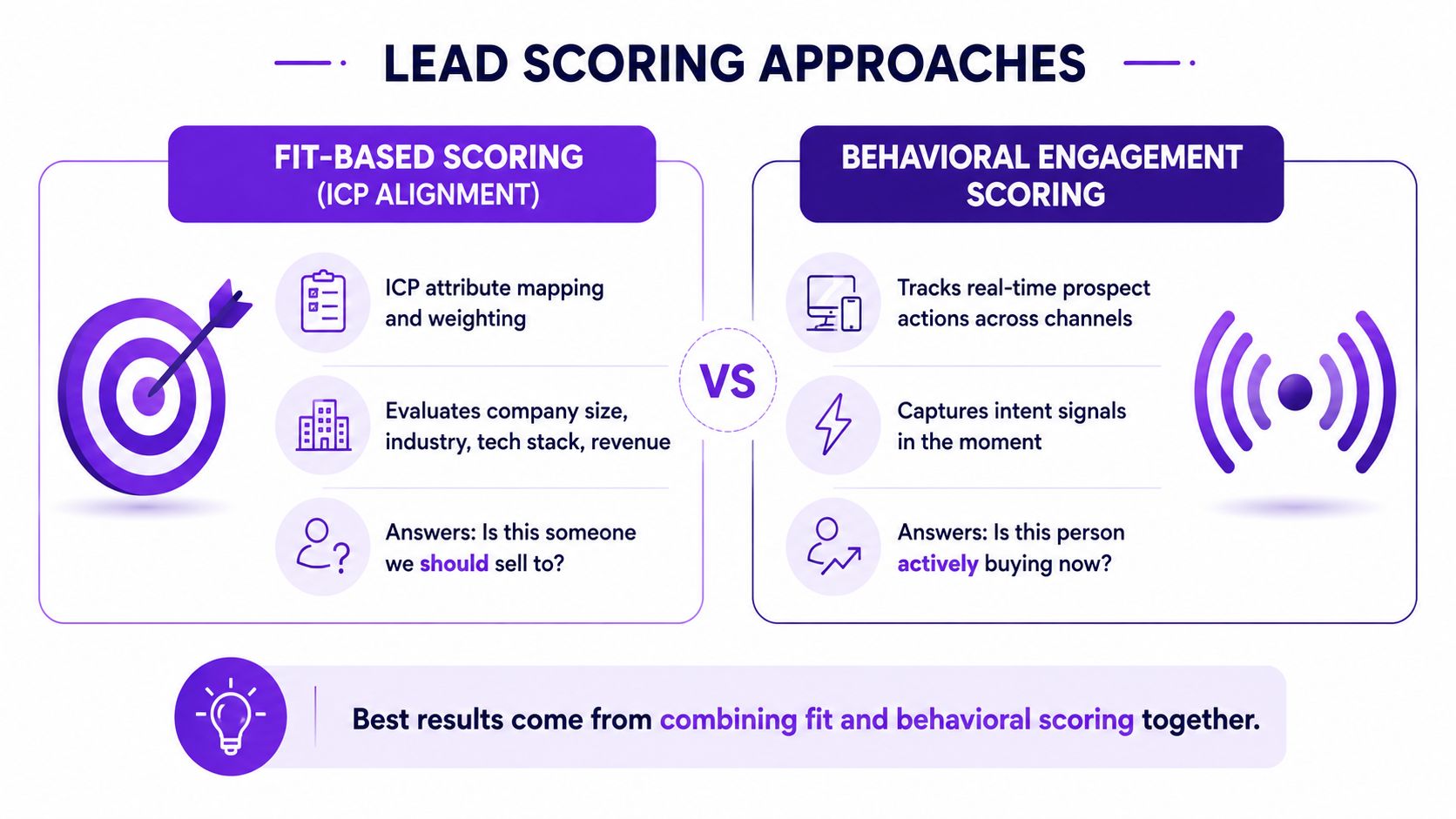
Fit scoring answers the question behavioral scoring can't: should this team be selling to this prospect at all? It uses company and person attributes, such as industry, company profile, role, location, technology environment, and organizational structure. A strong fit score protects sales capacity from attractive but unsuitable activity.
Build the ICP with sales, customer success, and revenue leadership. Start with the characteristics of customers who receive value and remain commercially attractive. Keep the criteria focused. Too many fields create a brittle model that rejects promising accounts because one data point is missing.
A useful fit model distinguishes between must-haves and preferences. A required technology or regulated industry may disqualify an account, while company size or role seniority may alter priority. Treat the score as a prioritization aid, not an automatic delete button.
Combine fit with intent
Two prospects can display identical behavior while representing very different opportunities. The ICP-aligned prospect should usually receive more sales attention, while the poor-fit contact may enter education or a lower-touch path. Conversely, a high-fit account with no activity shouldn't leapfrog a relevant prospect who is actively researching your category.
Audit fit against closed deals and sales feedback. If reps repeatedly override the same criterion, investigate whether the ICP is wrong, the data is stale, or the field is being interpreted poorly. A living model changes when your best customers and market focus change.
7. Multi-Touch Attribution and Influence Scoring
Last-touch attribution is tidy because it gives one interaction all the credit. It's also often too tidy for B2B buying. A prospect may see leadership content, read a comparison page, engage with a sales message, attend an event, and then book a meeting. The final touch matters, but it may not explain why the prospect was ready to respond.
Multi-touch attribution distributes influence across the journey. Influence scoring goes a step further by examining which people, campaigns, topics, and content types repeatedly appear in successful paths. Use the analysis to improve sequencing, not to award marketing a trophy nobody can spend.
Start with a modest model. Track a small number of meaningful touchpoints and compare them with meeting quality, opportunity creation, pipeline, and revenue. A complex attribution framework built on incomplete identity data creates an impressive report with very little operational value.
Connect attribution to scoring
Influence insights can improve weights. If relevant comparison content consistently precedes accepted meetings, that behavior may deserve more attention than a generic page view. If a channel produces engagement but no qualified conversations, reduce its scoring influence rather than celebrating volume.
Review attribution with both sales and marketing. Sales can explain whether a touchpoint changed the conversation, while marketing can adjust content and distribution. The accompanying fit and behavioral scoring comparison graphic reinforces the key distinction, fit says who belongs in the market, while behavior says who is active.
A visual walkthrough can also help stakeholders understand how multiple signals work together.
8. Engagement Recency Weighting and Lead Decay
A score that only rises is a historical scrapbook, not a buying-priority system. Recency weighting gives current activity more influence, while decay reduces the value of old signals when no new behavior appears. This keeps a prospect who was active recently ahead of someone whose score was built months ago.
The right decay rate depends on your sales cycle and signal type. Digital engagement often becomes stale faster than a durable company signal, such as a role change or a major organizational event. The model should make that distinction explicit rather than applying one blunt timer to everything.
Use decay to create useful next actions. A falling score can trigger a nurture path, a research task, or a re-engagement message. It shouldn't bury a high-fit account that sales already has a live conversation with.
Freshness rule: A score should explain both why a lead is prioritized and when the evidence may stop being relevant.
Tell sales why priorities move. Without that explanation, reps may assume the model is broken when it is correctly responding to inactivity. Monitor score bands against downstream outcomes and adjust the decay logic when it systematically moves promising leads too quickly or leaves inactive prospects at the top.
Negative scoring can complement decay. Unsubscribes, invalid data, poor fit, and explicit disinterest should reduce priority, while an open opportunity or active sales conversation should protect the record from an automatic downgrade.
9. Competitor and Industry Keywords Signal Tracking
Prospects often reveal buying intent before they fill out a form. They may discuss sales productivity, compare vendors, ask peers about workflow automation, or engage with content about a problem your product solves. Tracking those keywords extends your view beyond people who already know your brand.
Build a keyword library around three groups: category terms, competitor names, and pain-point language. Include the phrases buyers use in conversation, not only the polished terms your marketing team prefers. Revisit the library with sales because reps hear emerging language first.
Use keywords as context, not proof
A keyword match alone is weak. A relevant job role, target account, repeated engagement, or current intent signal should raise confidence. A random mention in a broad industry discussion shouldn't trigger an aggressive sequence.
When a prospect engages with competitor content, lead with relevance rather than attack. Ask about the problem they're exploring or share a useful comparison point. Don't claim to know their buying stage. The best outreach gives them a reason to reply without forcing them to defend a decision they may not have made.
Set alerts and review the resulting feed regularly. Remove terms that generate noise, add language from real sales calls, and distinguish between research by an individual and activity spread across an account. This signal works best as one layer in a hybrid model, not as a shortcut around fit.
10. Job Change and Organizational Change Detection
A new role can create a natural reason to revisit tools, processes, and priorities. Promotions, moves between companies, new leadership, hiring activity, restructuring, and mergers can all change who owns a problem. These events deserve attention, but they don't automatically prove buying intent.
Score the transition alongside account fit and current behavior. A newly appointed sales leader at a target account who also engages with your category content is more compelling than someone who changed jobs but shows no connection to the problem. Existing vendor relationships may continue after a promotion, so don't treat the event as permission for a hard pitch.
Use a simple, human opening. Congratulate the person, acknowledge the transition, and offer a resource that helps with a plausible challenge in the new role. Avoid pretending the job change reveals their budget or plans.
Put ownership around the signal
Create a workflow for alerts, review, routing, and follow-up. Decide who checks the event, how quickly a rep should act, and what happens if the account isn't a fit. Track which types of transitions lead to useful conversations, then refine the model from those outcomes.
Organizational change detection also needs careful verification. Public announcements can be incomplete, job data can lag, and a company's restructuring may not affect your category. Treat the signal as a prompt for research and relevance, not a marching order.
10-Point Lead Scoring Best Practices Comparison
Item | 🔄 Implementation Complexity | ⚡ Resource Requirements | ⭐ Expected Outcomes / 📊 Impact | 💡 Ideal Use Cases | 📊 Key Advantages |
|---|---|---|---|---|---|
Behavioral Engagement Scoring | Medium, requires tracking rules & CRM integration 🔄 | Moderate, tracking pixels, event mapping, CRM sync ⚡ | High relevance & reply rates; better timing for outreach ⭐📊 | Real-time outreach, SDR prioritization, content-driven campaigns 💡 | Captures in‑the‑moment intent; enables personalized outreach 📊 |
Intent Data Integration | High, multi-source integration, privacy compliance 🔄 | High, third‑party feeds, enrichment, integration costs ⚡ | Leads earlier in buyer journey; improved predictability ⭐📊 | Market trends, account prioritization, cross‑channel scoring 💡 | Combines macro & internal signals for stronger lead signals 📊 |
Account-Based Scoring (ABS) | High, account models, multi-stakeholder mapping 🔄 | High, account enrichment, cross‑team processes ⚡ | Better enterprise close rates; improved sales/marketing alignment ⭐📊 | Enterprise deals, ABM programs, multi‑stakeholder opportunities 💡 | Focuses resources on accounts and buying committees 📊 |
Predictive Lead Scoring (PLS) | High, ML models, data pipelines, validation 🔄 | High, historical CRM data, data science or vendor support ⚡ | More accurate, adaptive scores; uncovers non‑obvious patterns ⭐📊 | Organizations with 12–24+ months of data; scaling scoring automation 💡 | Continuously learns from outcomes; reduces manual maintenance 📊 |
LinkedIn Engagement Signals & Native Intent | Low–Medium, depends on API access and monitoring setup 🔄 | Low–Moderate, content creation, Sales Navigator or tooling ⚡ | Very timely, highly actionable signals; strong personalization ⭐📊 | Social selling, creator-led outreach, LinkedIn-first strategies 💡 | Native B2B signals, cost‑effective, immediate intent detection 📊 |
Fit-Based Scoring (ICP Alignment) | Medium, ICP definition and enrichment rules 🔄 | Moderate, firmographic/technographic data sources ⚡ | Improves qualification; reduces wasted effort ⭐📊 | Early qualification, territory planning, campaign targeting 💡 | Ensures focus on prospects who can actually buy; scalable 📊 |
Multi‑Touch Attribution & Influence Scoring | High, cross‑channel tracking & attribution models 🔄 | High, analytics, tracking pixels, unified data layer ⚡ | Holistic ROI insights; optimizes content and channel mix ⭐📊 | Budget allocation, campaign optimization, content strategy 💡 | Reveals which touches and creators drive conversions 📊 |
Engagement Recency Weighting & Lead Decay | Medium, decay functions per signal type 🔄 | Low–Moderate, scoring rules, automation for re‑engage ⚡ | Prioritizes fresh intent; reduces time on stale leads ⭐📊 | Short buying cycles, daily SDR queues, freshness-driven outreach 💡 | Keeps prioritization current; forces periodic re‑engagement 📊 |
Competitor & Industry Keyword Signal Tracking | Medium, keyword taxonomy and monitoring rules 🔄 | Moderate, keyword monitoring tools, tuning effort ⚡ | Identifies active evaluators; enables contextual outreach ⭐📊 | Competitive displacement, problem-aware prospecting, content plays 💡 | Flags prospects engaging with competitors or problem topics 📊 |
Job Change & Organizational Change Detection | Low–Medium, job feed and alert setup 🔄 | Low, LinkedIn alerts, automation sequences ⚡ | High receptivity windows; timely outreach opportunities ⭐📊 | New hires, promotions, account expansion plays, relationship building 💡 | Targets prospects at natural decision moments; easy conversation starter 📊 |
Turn Scores Into Conversations, Not Just Spreadsheets
A lead score earns trust only when it helps a salesperson choose the next conversation. Start with fit, then layer on behavioral engagement, intent, account context, and negative signals. Apply recency so current activity matters more than an old accumulation of clicks. Finally, define clear MQL and SQL thresholds, route accepted leads to the right owner, and give sales a practical reason to act.
The 2023 systematic review in PubMed Central identified 14 separate metrics used to evaluate lead-scoring impact on sales performance. The lesson is important. Conversion, revenue, sales efficiency, and other downstream outcomes matter more than a score that merely predicts engagement.
Adoption still isn't universal. An independent industry summary reported that 44% of organizations use lead scoring systems and associated adoption with 138% ROI on lead generation in its reporting, as documented in this industry summary. A separate 2026 benchmark reported 67% adoption, with MQL-to-SQL performance averaging 23.4% and the top quartile at 31.7%. The same benchmark discusses predictive model checks including AUC-ROC of at least 0.80, precision above 70%, and conversion lift of at least 25%. Treat these as benchmark reference points, not promises for your business, and review the B2B automation benchmark methodology before comparing your model.
A practical pilot sequence
Define one outcome. Choose qualified meetings, sales acceptance, opportunity creation, or Closed-Won.
Document the ICP. Separate must-have fit criteria from preferences and disqualifiers.
Start with transparent rules. Combine fit, relevant behavior, intent, negative scoring, and recency.
Set handoff rules. Specify thresholds, routing, response expectations, and rejection reasons.
Backtest and launch. Compare score bands against the chosen outcome over a fixed time window.
Review with sales. Examine replies, meetings, opportunities, pipeline, revenue, overrides, and stale records.
The common failure modes are fixable. Score inflation means too many weak actions carry too much weight. Double-counting happens when several fields describe the same event. Stale data keeps old interest alive. Platform dependence leaves gaps when one channel misses behavior. Unclear ownership lets qualified leads sit untouched. Audit the rules, consolidate duplicate signals, enforce decay, reconcile multiple sources, and assign a named owner for calibration.
AI-assisted scoring is spreading, but maturity varies. One 2026 benchmark reported AI scoring adoption among B2B teams at 61%, up from 23% in 2024, while total lead-scoring usage rose from 44% to 54% over that period, according to ModernLeads' lead-scoring trends. The sensible response isn't to automate everything. Use a hybrid architecture, keep fit and intent visible, and make sales feedback part of the operating rhythm.
For related operating systems, connect the model to your sales automation workflow, LinkedIn prospecting process, ICP strategy, and revenue attribution framework. Review the model with sales regularly, and change weights only when evidence or clearly documented market shifts justify it.
Lead scoring FAQ
What is lead scoring?
Lead scoring ranks prospects using signals about their fit, activity, intent, and account context. It gives marketing, sales, and RevOps a shared way to decide who needs attention first.
What's the difference between fit and behavior?
Fit asks whether a prospect belongs in your target market. Behavior asks whether that prospect is engaging now. Strong systems use both, because a perfect-fit account may be inactive while an active prospect may be a poor commercial match.
How should teams choose scoring weights?
Use customer and opportunity history, then test the weights against a defined downstream outcome. Keep the first model transparent enough that a salesperson can understand why a score changed.
How do we set MQL and SQL thresholds?
Start with a threshold that sales can work consistently, then compare acceptance and conversion by score band. Adjust the threshold when the quality of routed leads, sales capacity, or ICP changes.
Which LinkedIn signals matter most?
Relevant comments, repeated engagement with category or competitor content, creator follows, and activity from multiple people at one target account can be useful. Always filter for ICP fit and review the context before outreach.
Should we use third-party intent data?
Use it when the provider's coverage matches your ICP and the signal correlates with your own sales outcomes. Treat it as supporting evidence, not a substitute for first-party behavior or account research.
What is account scoring?
Account scoring evaluates a company's fit, activity, and buying stage across multiple contacts. It helps sales prioritize buying committees instead of overvaluing one active individual.
Are predictive models worth deploying?
They can be useful when your CRM contains enough qualified and disqualified historical records, clean identities, and consistent outcomes. Otherwise, a transparent hybrid model is usually easier to validate and improve.
Why should scores decay?
Buying interest changes. Decay prevents old activity from permanently outranking fresh signals and gives sales a more realistic view of current buying temperature.
How do we measure ROI?
Tie scoring to outcomes such as sales acceptance, qualified meetings, opportunities, pipeline, revenue, and sales efficiency. Compare performance by score band and review whether the system improves prioritization without creating extra operational work.
RoverLead AI turns LinkedIn engagement into daily, ICP-matched prospecting signals, including interactions with creators, competitors, and relevant topics. If you want a living lead-scoring workflow that helps your team find timely context instead of relying on static lists, visit RoverLead AI and explore how it can support your next scoring pilot.