Investors Email List: How to Build One That Actually Replies

Most advice about an investors email list starts in the wrong place. It treats contact volume like the asset, when the asset is investor intent. I've burned a domain on stale files, watched bounces drag inbox placement into the mud, and learned the expensive lesson the hard way, a big list can be a tax on attention.
The better question is simpler, who is reachable, relevant, and likely to respond right now? That's where static lists, clean lists, and signal-based outreach diverge. If you're choosing between buying, building, or working from live behavior, don't shop for more names first, choose the strategy that matches your reply goal.
Table of Contents
Deliverability and Compliance Mechanics That Decide If You Land in the Inbox
Why Signal-Based Prospecting Beats a Static Investors Email List
Why Most Investors Email Lists Quietly Lose Money
The average purchased investors email list is usually a cost center wearing a fake mustache. The reason is boring and brutal, records decay at about 2–3% per month, which means roughly 7–9% of contacts can become stale each quarter if nobody re-verifies them, and that stale data drives bounces, then reputation damage, then worse deliverability for the good addresses still on the file, as summarized in the investor list guide from Campaign Lake's resources page.
That's why list size is often the wrong bragging right. A thousand names that still work beats ten thousand that were current six months ago. Once your sending reputation drops, even valid emails can stop behaving like valid emails, which is how teams end up blaming copy when the problem was contact decay.
The hidden cost is not the price tag
A list feels cheap until you account for the downstream mess. The outreach team wastes time sending to dead inboxes, the domain absorbs avoidable risk, and the whole program starts looking “inefficient” when it was really just under-maintained.
Practical rule: if a list hasn't been re-verified recently, assume part of it is already dead and send to it like it's radioactive.
The smarter question isn't “how many investor contacts can we buy?” It's “which investors are still reachable and in market?” That shift matters because investor theses, check sizes, and attention move fast, and static files do not move with them. If you're still collecting names like baseball cards, you're buying yesterday's mood, not today's response.
For a blunt take on list-building hygiene, the prospecting side of the house has already learned this lesson the hard way in prospect list building.
What an Investors Email List Actually Contains
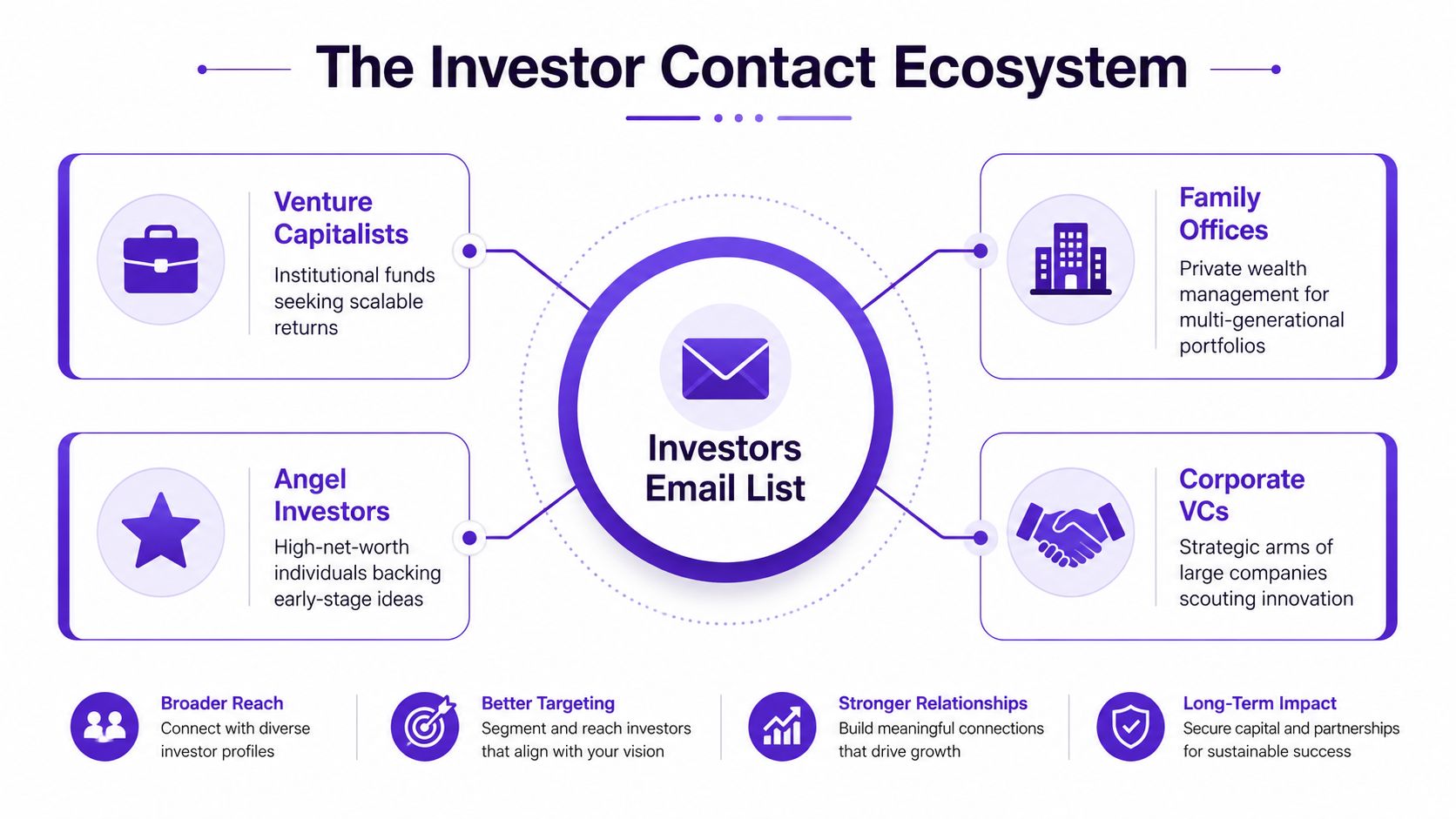
A usable investors email list is more than a pile of addresses. Provider descriptions usually cluster around specific professional segments, venture capitalists, angel investors, private equity professionals, and institutional investors, with fields such as names, email addresses, company affiliations, investment focus, and phone numbers, according to the investor mailing list description from AverickMedia. That definition matters because it tells you the list is built for professional targeting, not casual mass marketing.
The field that changes the game is recency
The most useful records aren't just names and emails. They include investment focus, stage, geography, and activity signals that tell you whether the contact fits your pitch today. A US-focused provider defines its active investor audience as people who have either recently invested in or inquired about at least one conservative or speculative investment within the last 12 months, with a minimum investment threshold of $10,000, which is a clean way to separate actual financial decision-makers from generic business contacts.
That definition is useful because it reframes the list from “can I reach someone?” to “am I reaching someone who can act?” Those are very different questions. The second one is the only one that pays.
An investor file also has to match how you'll use it. If you're raising capital, you care about stage and thesis fit. If you're selling into funds, you care about company affiliation and role. If you're doing account-based outbound, geography and recency matter more than raw count.
Bottom line: an investors email list is a tool, not a strategy. The strategy is whether the list matches a live buying moment.
For a deeper lookup workflow, the contact discovery angle is covered in reverse lookup for email address.
Buying Versus Building Versus Intent-Driven Outreach
You're not choosing between good and bad, you're choosing between speed, control, and reply quality. If your goal is to blast volume, buying can look attractive for about five minutes. If your goal is response from investors who care, that math changes fast.
Investors Email List Strategies Compared
Approach | Time to first send | Compliance risk | Reply quality | Best for |
|---|---|---|---|---|
Buying | Fast | Higher | Usually weak unless heavily cleaned | Teams that need immediate volume |
Building | Slower | Lower if sourced carefully | Better because fit is tighter | Teams that want control and governance |
Intent-driven outreach | Fast once set up | Lower when sourced from live behavior | Strongest because timing is current | Teams optimizing for reply rate |
Buying gives you immediate inventory, but inventory is not intent. Building gives you cleaner ownership, but it takes time and discipline. Intent-driven outreach starts from live behavior, so the contact is no longer just a line in a spreadsheet, it's a person doing something relevant now.
That's why the best choice depends on the KPI. If you're measured on “how many names did you export,” buying will always tempt you. If you're measured on replies and meetings, behavior beats vanity. The most effective teams I've seen stop asking for larger files and start asking what the investor just did, who they engaged with, what topic they touched, what signal proves they're active.
If you want a more modern sourcing philosophy, the logic behind live buyer signals is laid out in what is intent data.
How to Ethically Build and Verify an Investor Contact List
If you are building an investors email list instead of buying one, the standard is simple, use contacts you can justify and verify. Start with legitimate source categories, curated databases, event and demo-day attendee lists, LinkedIn profile and post engagement, and public company disclosures such as cap tables and fund announcements. Source quality matters because an email address that is visible is not the same thing as an email address you can use freely.
Build from sources, not scraps
Scraped contacts are cheap until they start hurting reply quality and sender reputation. A contact pulled from a conference list with clear sharing terms is a different case from an address buried in a deck or copied from a random profile. If you work under GDPR, UK GDPR, or similar regimes, you need lawful basis, not just technical deliverability.
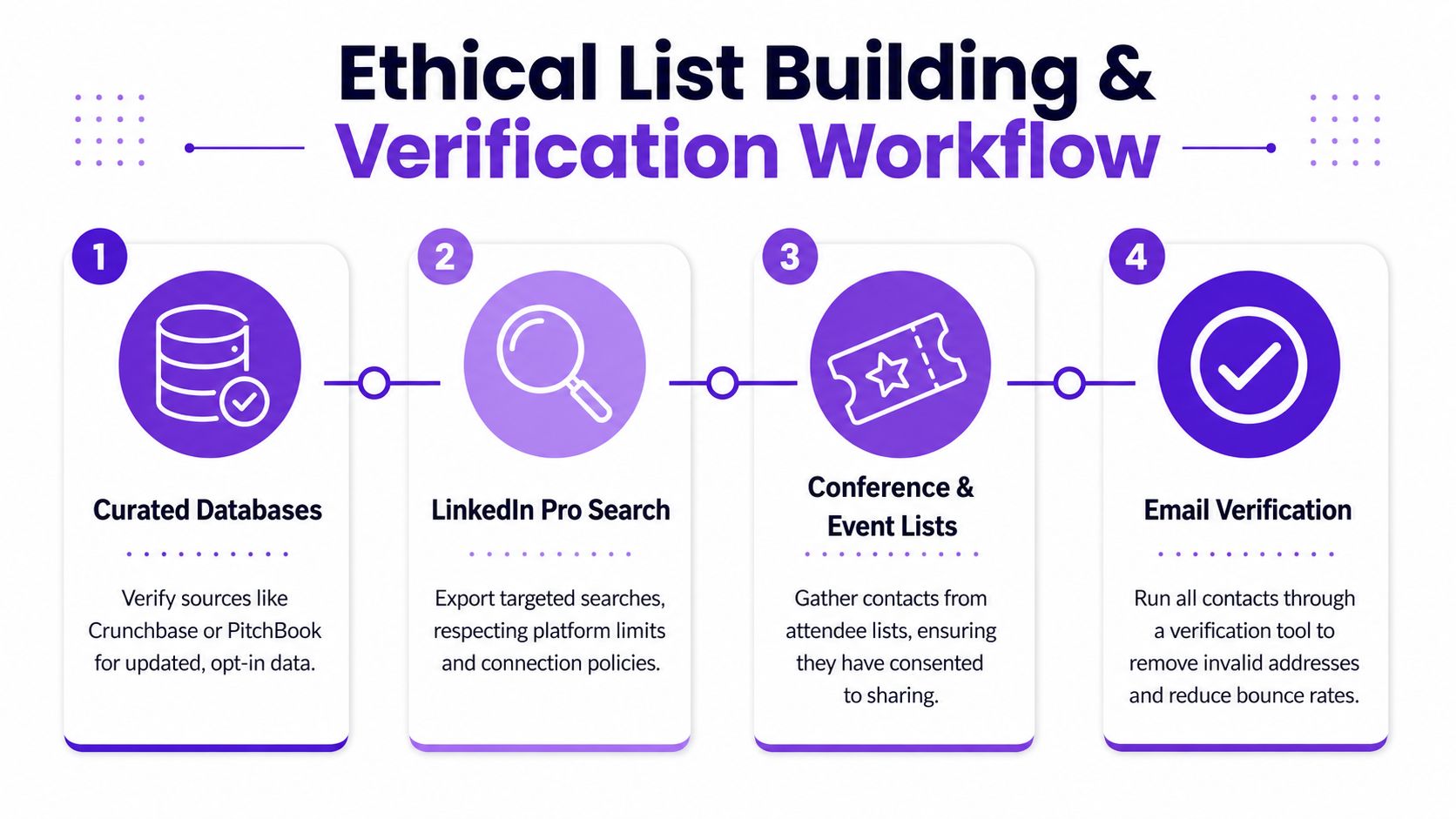
Verification is where weak lists fall apart. Check syntax, filter role addresses, detect catch-all domains, and run the file through a validation tool before you send. Campaign Lake's guidance says list records decay quickly, so the practical control is a quarterly re-verification pass plus validation before sending. The deliverability tools referenced in that guidance, such as ZeroBounce and NeverBounce, exist for a reason.
Useful habit: if a record has not been touched in a quarter, treat it like it needs a second opinion before it goes near your sending domain.
The best teams also do a deeper lookup on suspicious or high-value contacts instead of trusting the first match they find. For a deeper lookup workflow, the contact discovery angle is covered in reverse lookup for email address.
The last step is restraint. Do not hoard names just because they are available. Keep only the contacts that match your actual segment, then verify them again before launch. That is how you build a list that behaves like an asset instead of a liability.
Deliverability and Compliance Mechanics That Decide If You Land in the Inbox
Inbox placement is a technical game with legal consequences, and most investor outreach gets neither part right. Cold-email guidance for investors recommends sending from a real domain you control, configuring SPF, DKIM, and DMARC, keeping messages plain-text or very light HTML, avoiding heavy tracking pixels, avoiding attachments on the first touch, and keeping daily volume reasonable. Those aren't stylistic preferences, they're survival rules.
Make the email look like a person wrote it
A subject line should be short and useful. One email-marketing guide recommends 40–50 characters and action-oriented language, while investor outreach guidance says VC subject lines should be short, avoid bland phrases like “investment opportunity,” and ideally combine thesis fit, a positive signal, stage, and company name. That's a lot of discipline for one tiny line, but the inbox is ruthless.
The body should be even tighter. Investor-email template guidance says the pitch should be under 80 words, with one specific personalization signal and one ask. The best investor emails don't meander. They state relevance, ask for the next step, and get out of the way.
Compliance is not the same thing as verification
This is the gap most list articles skip. A verified email isn't automatically a usable email under GDPR, UK GDPR, or similar privacy regimes. Scraped, bought, or outdated contacts can still create reputational and legal risk even if they technically deliver.
Follow-up timing matters too. Investor cold-email guidance recommends waiting 2 to 3 weeks before trying a second person at the same firm if there's no reply. That cadence feels slow to overeager SDRs, but it's cleaner than machine-gunning a partner group because one contact ignored you.
For a deliverability-focused playbook, the spam-control side is covered in how to avoid spam filters.
Why Signal-Based Prospecting Beats a Static Investors Email List
A static investors email list is a tax on attention. You pay for names, then spend more time proving relevance than creating it. Signal-based prospecting flips the logic. Start with investor intent, then work backward to the contact.
Live behavior beats stale matching
Behavior-based prospecting watches what investors are doing now, not just what title they hold or which firm they sit in. That is the edge in investor outreach. An investor who just engaged with a relevant discussion is a better target than a “perfect fit” contact who has gone quiet for months. Analysts on behavior-based lead generation report 2–3x positive reply rates, 30–50% more meetings, and up to 60% less research time when teams use LinkedIn signals, which is exactly what happens when timing and relevance do the heavy lifting.
The workflow is straightforward. Define your ICP, keywords, competitors, and experts once, then watch for live engagement and turn that activity into an opener that feels current instead of recycled. That matters because outbound falls apart when the first line sounds like it came from a committee.
If you want a more modern sourcing philosophy, the logic behind live buyer signals is laid out in what is intent data.
Sell into your network, don't interrupt strangers
The strongest version of this approach is simple. Track comments on creator posts, competitor engagement, pricing discussions, demo conversations, and niche keywords, then contact the people already showing interest in the topic. That is not spray-and-pray. That is a response to a live signal.
Signal-based outreach also gives you a clean reason to write a relevant first line without sounding creepy. It shifts the message from “we found you in a database” to “you just showed interest in this problem.” That difference is where reply rates start to improve, because the timing and context are already doing part of the selling.
KPIs and a 30-60-90 Day Plan to Make the List Pay
If the program can't be measured, it's just expensive optimism. The four KPIs that matter are bounce rate, primary-inbox placement, positive reply rate, and meetings booked per 1,000 contacts. Those tell you whether the list is alive, whether the mailbox trusts you, whether the message resonates, and whether the whole thing produces meetings instead of noise.
What good looks like in practice
You don't need mystical benchmarks to know if the program is healthy. If bounce behavior is ugly, your data is bad. If inbox placement falls off, your domain setup or sending pattern is suspect. If replies are weak but deliverability is fine, the list or signal quality is off. If meetings never convert, the offer doesn't fit the audience.
Here's the operating plan I'd use:
Days 1 to 30: clean the file, authenticate the sending domain, verify the contacts, and send to a small high-fit segment first.
Days 31 to 60: segment by stage, geography, and recency of activity, then tighten copy around the strongest subgroup.
Days 61 to 90: add intent signals and decide whether to keep buying, keep building, or switch to a behavior-led workflow.
A clean, compliant, segmented send should tell you something quickly. If reply rate stays flat after that, the list is probably not the bottleneck. The source of truth needs to shift from contacts to behavior.
That's the recommendation I'd give any sales leader, founder, or solo seller: stop chasing bigger investor files unless you've already exhausted the current one. If you want a system that turns live LinkedIn behavior into qualified investor leads, A CTA for RoverLead AI.
FAQ
What is an investors email list used for
It's used to reach professional investors, usually VCs, angels, private equity professionals, and institutional investors, with targeted outreach instead of broad consumer marketing.
Is buying an investors email list a good idea
Only if speed matters more than quality and you're willing to clean and verify it aggressively. For many teams, it's the fastest way to inherit stale data.
Why do investor lists go stale so fast
Contacts change firms, inboxes, priorities, and activity. The source guidance says records decay at about 2–3% per month, which adds up fast.
What fields should a useful investor record include
At minimum, name, email, company affiliation, and investment focus. Better records also include geography, stage, and recency of activity.
How do I know if an investor is active
Look for recent investing behavior, recent inquiry behavior, or current engagement with relevant topics and events. Recency matters more than just title.
What's the safest way to verify a list
Run syntax checks, filter risky role addresses, detect catch-all domains, and validate before sending. Then re-verify on a quarterly cadence.
Do I need SPF, DKIM, and DMARC
Yes, if you care about inbox placement. Cold-email guidance for investors explicitly recommends all three.
Should I use attachments in the first email
No. First-touch investor outreach guidance says to avoid attachments and keep the message light.
How long should the first investor email be
Keep it under 80 words and make it personal, relevant, and direct. Brevity wins because the inbox is crowded.
When should I follow up with another person at the same firm
Wait 2 to 3 weeks before trying a second contact if there's no reply. That keeps the sequence credible instead of annoying.
If you're tired of paying attention tax on stale investor files, stop optimizing the spreadsheet and start optimizing the signal. Use a cleaner list if you need one, but move fast toward behavior-based outreach if you want replies that turn into meetings.