
Lemlist Pricing: Transparent Breakdown for 2026 Buyers

Email plans begin at $69 per month for 50,000 emails, or about $1.38 per 1,000, and fall to roughly $0.66 per 1,000 at the 1,000,000-email tier. Multichannel Expert is $109 per user monthly, or $87 per user on annual billing.
That sounds simple until a sales team adds seats, changes volume halfway through a billing period, pays VAT, or discovers that unused enrichment credits don't wait politely for next month. The headline price gets you into the checkout flow. The effective cost curve tells you whether the purchase still makes sense after real campaigns, real sender limits, and real pipeline volatility.
Table of Contents
How Lemlist Pricing Works
A team can choose the cheaper headline plan and still overspend once volume changes, seats increase, or a downgrade lands outside the renewal window. Lemlist uses two pricing axes, so the first decision is how your outreach runs.
Email is priced around monthly sending capacity. Current bands run from $69 for 50,000 emails to $659 for 1,000,000 emails per month. Multichannel Expert is priced per user at $109 per month, or $87 on annual billing. Enterprise is custom-priced and requires at least five seats, according to Lemlist's plan overview.
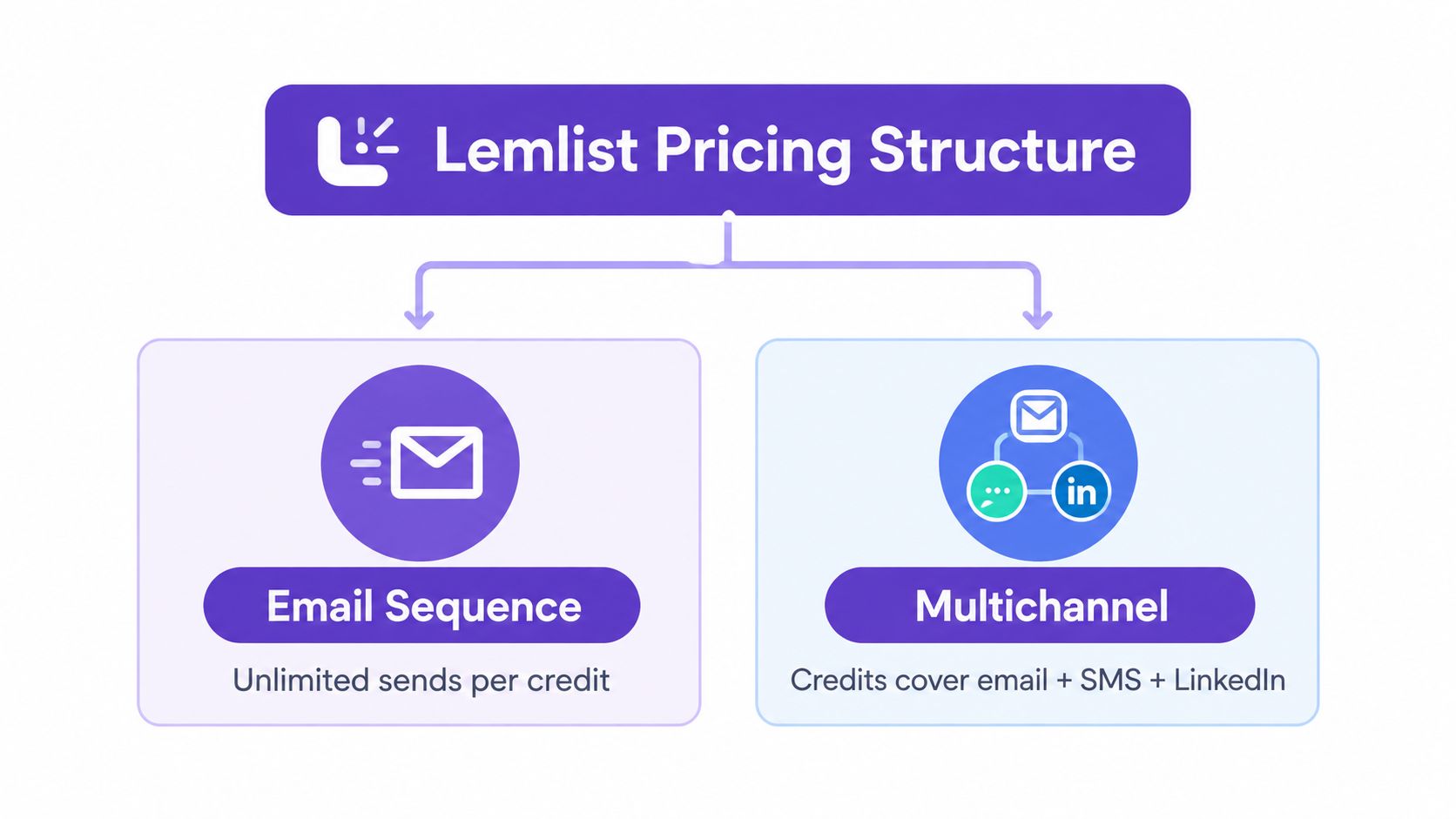
The headline rate hides the cost curve. Email capacity can rise far faster than subscription cost, while annual billing offers roughly 20% savings. That discount becomes less attractive if campaign volume drops, because the unused capacity and remaining term still affect the effective price.
Plan changes create another budget risk. Before upgrading, downgrading, or adding a seat mid-cycle, check proration rules and when the change takes effect. A lower tier may not reduce the current invoice immediately.
Earlier comparisons listed Email Pro at $69 per month and Multichannel Expert at $99 to $109 per user, so dated articles can point buyers to rates that no longer match the displayed plan. Choose email-first or multichannel based on workflow, then compare billing terms.
Email Volume Tiers and the Hidden Cost Curve
A team can move from a modest campaign to a large sending tier before its list quality, mailbox capacity, or reply handling is ready. The Email plan therefore has a nonlinear cost curve: capacity grows much faster than the monthly fee, but the extra allowance only helps if the team can use it safely.
Monthly emails | Monthly price | Annual price | Approx cost per 1,000 emails (monthly) |
|---|---|---|---|
50,000 | $69 | $55 | $1.38 |
100,000 | $89 | $71 | $0.89 |
200,000 | $159 | $127 | $0.80 |
500,000 | $359 | $287 | $0.72 |
1,000,000 | $659 | $527 | $0.66 |
The Lemlist pricing guidance lists these five monthly bands and their annual-equivalent prices. Annual billing represents roughly 20% savings against monthly billing, yet that discount can become a trap when campaigns slow down. You commit to the term and capacity even when the team no longer needs the higher allowance. A lower unit price does not automatically produce a lower total cost.
The headline math looks attractive because the monthly price rises about 9.6 times from the lowest to highest tier, while capacity rises 20 times. That is useful only when delivered volume supports the upgrade. Bounce rates, mailbox health, sending policies, reply quality, and domain reputation limit responsible usage. A large cap can become an expensive ceiling rather than usable capacity.
Track delivered messages and qualified replies beside subscription cost. Before changing tiers, confirm how proration works and whether a downgrade affects the current invoice or only a later cycle. Review this guide to avoiding spam filters alongside the pricing table, because list quality and inbox placement determine whether the purchased capacity creates pipeline or waste.
Who Should Pick the Email Plan versus Multichannel Expert
The right choice depends on how outreach scales inside your team, not on which plan has the more impressive feature list.
For a solo seller or a small SDR group that mainly runs cold email, the Email track is usually easier to defend. You pay against sending capacity instead of immediately multiplying the bill by every person who needs access. That structure fits a team with a clear email motion, stable list production, and little need for coordinated LinkedIn or call steps.
Multichannel Expert makes more sense when the workflow actually depends on multiple channels. A sales manager coordinating email, LinkedIn activity, and other touchpoints needs to model the cost per active user, then check whether each seat has enough work to justify its recurring charge. A seat that logs in once a month is not a bargain. It's office furniture with a password.
A simple buying decision
Choose Email when most prospecting happens through sequenced email and the team can share a disciplined volume plan.
Choose Multichannel Expert when each active user needs multichannel execution rather than occasional access.
Consider Enterprise when the organization needs a custom commercial arrangement and can meet the minimum five-seat requirement described in Lemlist's plan documentation.
Don't compare a single Email subscription with a multichannel team quote as though they solve the same operating problem. If you're weighing broader workflows, use this practical guide to Lemlist alternatives as a prompt to compare channel coverage, seat economics, and the amount of unused functionality each option creates.
Discounts, Billing Terms, and the Effective Price You Actually Pay
A discounted annual contract can look efficient until the campaign slows, a seat goes unused, or the sending plan changes. Lemlist's historical billing structure offered 10% off quarterly billing and 20% off yearly billing. The current annual-equivalent Email prices reflect roughly the same broad annual saving. Under the earlier plan structure documented by Lemlist, Email Pro could cost $62.10 monthly with quarterly billing or $55.20 with annual billing. Multichannel Expert could cost $89.10 or $79.20.
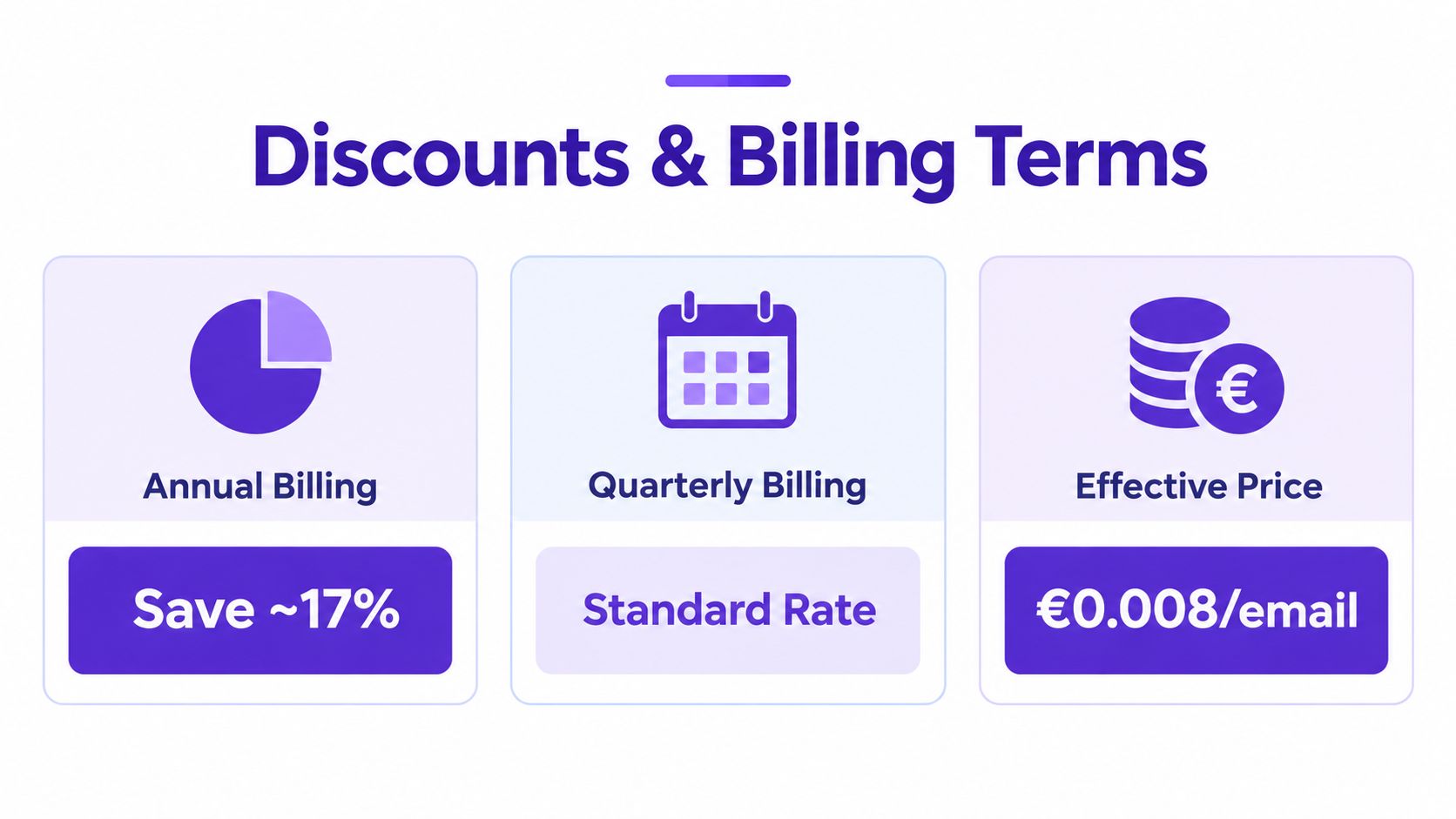
The lower monthly equivalent does not guarantee a lower total cost. Annual billing exchanges flexibility for a better nominal rate. That works when seat count, campaign timing, and sending demand remain dependable. A seasonal sales organization can save on paper while paying for unused capacity during a quiet period.
The billing documentation allows monthly, quarterly, or yearly payment in USD, EUR, or GBP, with prices excluding VAT. Email-tier upgrades are prorated immediately, while downgrades take effect at the end of the billing period. A mid-cycle change can therefore create a short-term charge, while reducing the plan may require carrying the higher tier until renewal.
Before signing, model the committed subscription cost, usable sending volume, and cost of changing direction. Email caps can make the cost curve nonlinear when a small capacity increase forces a higher tier. Compare that exposure with adjacent tools such as Clay pricing if enrichment or data operations will sit outside Lemlist.
Credits, Enrichment, and What Does Not Roll Over
Multichannel pricing is a seat-based model with a usage component. Lemlist's documentation identifies 400 non-rolling enrichment credits per user per month for the Multichannel plan. If a user underuses those credits, the team shouldn't assume the unused balance becomes a reserve for a larger campaign later.
That changes how managers should size seats. Buying extra users to create theoretical enrichment capacity is risky when those users don't have a consistent multichannel workload. The credit allowance isn't a savings account. It's a monthly operating limit attached to the people you pay for.
The monthly habit that prevents waste
At the end of every billing cycle, record:
Credits consumed: Compare actual enrichment use with each active user's allowance.
Seats with a job to do: Identify users who aren't running campaigns or managing replies.
Next-cycle demand: Separate committed campaign work from hopeful pipeline plans.
Email capacity: Check whether the team needs more sending room or better targeting.
Small teams often fare better with volume-based Email pricing when their work is email-centric. Multichannel becomes easier to justify when the team uses the extra channels as part of a repeatable process, not as decorative buttons in a product tour.
Billing Scenarios That Reveal Mid-Cycle Costs
The awkward costs appear when plans change after the invoice is already in motion. Lemlist's billing guidance confirms that customers can pay monthly, quarterly, or yearly in USD, EUR, or GBP, with VAT excluded from listed prices. It also says Email upgrades are prorated immediately and downgrades wait until the billing period ends, as described in the billing and pricing overview.
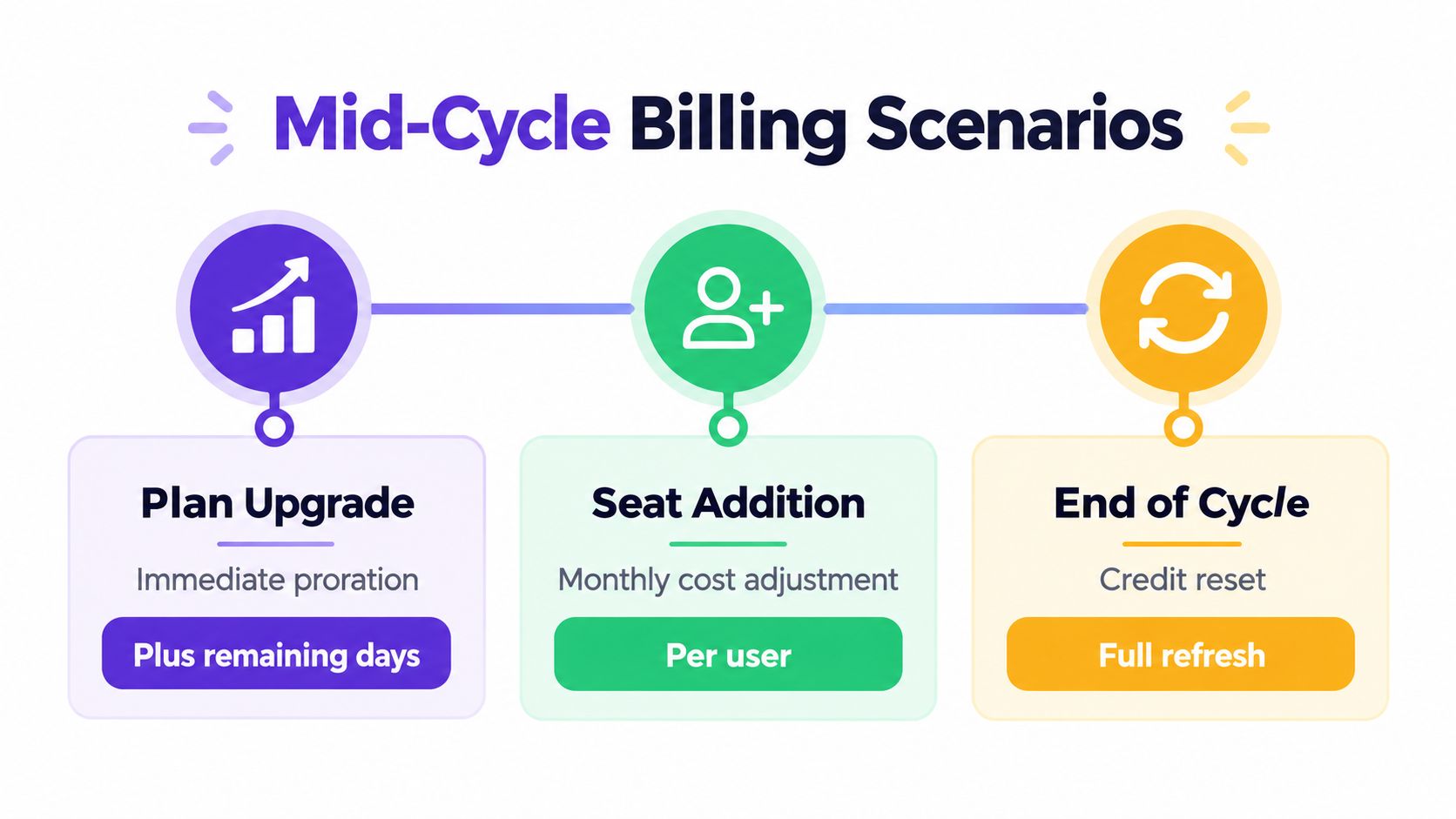
Consider a seasonal team that starts a quarter with modest demand, then wins a campaign requiring more email capacity. An upgrade can create an immediate prorated charge for the remaining part of the term. The commercial benefit arrives quickly, but so does the billing adjustment.
A different team may discover that its planned volume was optimistic. Downgrading doesn't necessarily reduce the current invoice immediately, because the lower tier takes effect at the end of the existing billing period. Finance should record the effective date, not just the date someone clicked the downgrade button.
International teams have another layer to forecast. A displayed price excluding VAT isn't the final invoice for every buyer, and currency conversion can affect what the local budget absorbs. Check the invoicing currency, tax treatment, renewal date, and seat count before approving a quarterly or annual commitment.
Calendar discipline beats pricing optimism. Put upgrades near the start of a term when possible, and schedule downgrade reviews well before renewal.
What Cancel Anytime Means in Practice
A team can cancel after an outbound strategy changes and still owe money on the commitment it made. “Cancel anytime” does not automatically mean a refund for unused time.
Lemlist's terms describe paid plans as commonly involving a fixed-term commitment and a Minimum Annual Fee that is non-cancelable and non-refundable unless an exception applies. They also state that customers may terminate a paid plan, while fees for a month or year already started remain non-refundable, including on a prorated basis.
Cancellation can prevent a future renewal or end future service obligations. It does not necessarily recover prepaid time. An annual plan with a 20% discount can therefore create a costly trade-off: the effective rate is lower, but unused commitment remains exposed if campaigns stop early.
Treat commitment as a forecast decision
Before choosing a longer billing term, document:
Expected active seats: Count campaign operators, not everyone who may need visibility.
Expected campaign duration: Separate a durable outbound motion from a short experiment.
Exit exposure: Assume unused prepaid time will not return unless the contract says otherwise.
Change control: Assign one owner to approve plan changes and cancellations.
The monthly equivalent matters only when the forecast is dependable. If demand is uncertain, the flexibility of monthly billing may justify paying more to avoid stranded spend. Record the renewal date and cancellation terms where finance can review them before committing.
Lemlist Pricing FAQ
Is Lemlist pricing based on users or email volume?
It depends on the track. Email pricing is organized around monthly sending bands, while Multichannel Expert is priced per user.
What is the entry point for the Email plan?
The lowest published Email band is $69 per month for 50,000 emails, as shown in Lemlist's official pricing guidance.
Does Multichannel Expert use the same pricing model?
No. Multichannel Expert primarily scales with seats, so your cost changes as active users change.
Are annual prices lower than monthly prices?
Yes, the published annual-equivalent prices are lower than the corresponding monthly Email rates. The saving needs to be weighed against reduced flexibility.
Can a team upgrade during a billing period?
Email-tier upgrades are prorated immediately, so a mid-cycle change can create an additional charge for the remaining term.
Can a downgrade reduce the current invoice immediately?
Not necessarily. Email downgrades take effect at the end of the billing period.
Are listed prices inclusive of VAT?
No. The public billing guidance says prices exclude VAT, so the final invoice can differ by buyer location.
Which currencies are supported for billing?
The documentation lists USD, EUR, and GBP as billing currencies.
Do Multichannel enrichment credits roll over?
The documented Multichannel allowance is described as non-rolling. Underused credits shouldn't be treated as a future campaign bank.
Does cancellation refund unused prepaid time?
The terms say unused fees for a month or year already started aren't refunded on a prorated basis. Review the agreement before committing funds.
How to Choose and Optimize Your Lemlist Plan
Start with the volume you can use responsibly, not the largest cap that looks efficient in a spreadsheet. Then choose Email for an email-first motion, or Multichannel Expert when active users need coordinated channels.
Use monthly billing while your pipeline is experimental or seasonal. Consider annual billing only after seat demand and campaign volume have proved stable, and review credit usage before renewal. Keep a monthly dashboard with sending capacity, delivered volume, replies, bounces, active seats, and unused credits.
For message quality, pair the plan decision with a tested cold email template, then review whether the problem is capacity or targeting before upgrading. A larger allowance won't repair weak lists or poor deliverability.
RoverLead AI helps B2B teams find high-intent LinkedIn activity, approve personalized outreach, and manage follow-ups without spray-and-pray sending. If you're comparing multichannel spend with an intent-led workflow, visit RoverLead AI and evaluate whether its LinkedIn AI SDR approach fits your pipeline.